 SUPPORT


 3EX United States
 Blog
By 2026, an estimated 75% of enterprise data centers will hit a “power wall” that effectively halts expansion. It’s a sobering reality for businesses relying on outdated rack configurations that can’t handle the thermal demands of next-gen hardware. You’ve likely felt the friction of unpredictable scaling costs or the dread of a power bottleneck stalling your latest deployment. We understand that stability is your priority; you need a system that works as hard as your team does. Implementing specific 3EX Hosting strategies for growth allows you to bypass these traditional limits by leveraging high-density colocation designed for the 2026 tech landscape.
Scaling your business shouldn’t mean getting trapped in public cloud vendor lock-in or struggling with remote hardware management. You’ll discover how to build a modular infrastructure that cuts total cost of ownership by up to 25% while maintaining 24/7 operational oversight. We’re going to walk through a roadmap that combines superfast NVMe storage with managed infrastructure to ensure your growth remains seamless and secure. This guide breaks down the transition from reactive hardware fixes to a proactive, high-performance strategy that keeps your data safe and your systems running at peak velocity.
Key Takeaways
- Identify the physical constraints of traditional hosting and learn how to bypass the “scaling wall” using high-density infrastructure.
- Discover the modular advantages of full cabinet colocation for seamless expansion from single racks to dedicated suites.
- Master 3EX Hosting strategies for growth by integrating cost-efficient colocation with hybrid cloud burst capacity.
- Follow a tactical 5-step roadmap to project your 36-month capacity requirements and select the right carrier-neutral partners.
- Future-proof your enterprise with rapid hardware deployment techniques and holistic disaster recovery planning.
The Scaling Wall: Why Traditional Hosting Limits Enterprise Growth
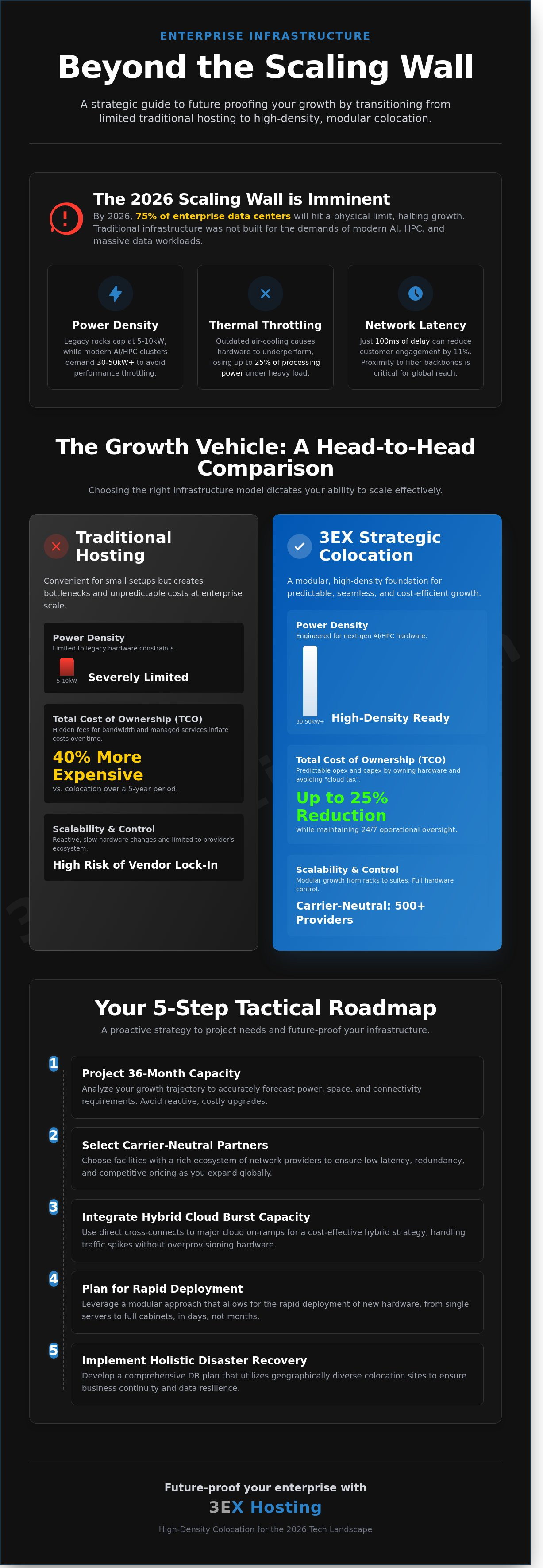
By 2026, 85% of scaling enterprises will hit a physical infrastructure wall that halts their expansion. This wall isn’t a software limitation; it’s a physical reality of power, cooling, and space. Traditional data centers built a decade ago often cap power at 5kW to 10kW per rack. Modern AI and high-performance computing (HPC) clusters now require 30kW to 50kW per rack to operate at peak efficiency. When you hit this limit, your growth stops. Standard managed hosting offers convenience but hides a heavy price tag. You’re paying for a service layer that often limits your ability to optimize hardware for specific workloads. 3EX Hosting strategies for growth prioritize breaking through these physical constraints by providing the high-density foundations necessary for the next generation of enterprise tech.
The shift from virtual-only environments to hybrid-physical foundations is no longer optional. Global data creation is expected to surpass 180 zettabytes by 2025, and processing this volume requires direct access to the metal. Virtualized layers add overhead that slows down real-time data processing. By leveraging 3EX Hosting, companies bridge the gap between their legacy internal systems and a future-ready scale that supports massive data throughput. Our infrastructure provides superfast connectivity and the thermal management needed to keep hardware running without the typical performance bottlenecks of shared environments.
Identifying Growth Bottlenecks in 2026
Power density is the primary bottleneck for 2026. Modern GPU clusters used for machine learning generate immense heat. If your provider relies on outdated air-cooling methods, your hardware will throttle, losing up to 25% of its processing power. Standard rack configurations simply weren’t built for this intensity. Latency also dictates success in global markets. A delay of just 100 milliseconds can reduce customer engagement by 11% in high-frequency trading or real-time applications. You need infrastructure that sits at the intersection of major fiber backbones to keep your user experience seamless as you expand into new territories.
The Economic Case for Infrastructure Control
The Total Cost of Ownership (TCO) analysis reveals a stark truth: managed services are often 40% more expensive than colocation over a five-year period for enterprise-level workloads. Owning your hardware layer through cabinet colocation allows you to accelerate ROI by keeping capital expenditures predictable. You avoid the “cloud egress tax,” where providers charge up to $0.09 per GB just to move your own data. This predictability is a massive growth factor. When your infrastructure costs are fixed, your profit margins remain stable even as your traffic spikes. 3EX Hosting strategies for growth ensure you aren’t penalized for your own success by hidden fees or scaling taxes.
Strategic Colocation: Building a Modular Foundation for Expansion
Scaling enterprise infrastructure in 2026 demands more than just floor space; it requires a blueprint for density. Utilizing full cabinet colocation provides the necessary resource density to handle massive data loads without expanding the physical footprint prematurely. These 3EX Hosting strategies for growth prioritize a modular approach. This allows IT leaders to start with a single rack and expand into contiguous cages or suites as compute requirements surge. Modularity ensures that your capital expenditure aligns closely with actual hardware deployment.
Carrier-neutral facilities act as the nervous system for this expansion. By maintaining neutrality, 3EX Hosting ensures enterprises aren’t locked into a single provider. Instead, they gain access to over 500 network service providers globally. This connectivity is essential for achieving national reach and low-latency performance in 2026. Integrating high-performance cross-connects into your growth architecture allows for direct, private links between your hardware and critical cloud on-ramps or business partners. These direct connections reduce latency by up to 40% compared to standard public internet routing, ensuring your applications remain responsive as user numbers climb.
High-Density Cabinet Strategies
Maximizing 42U rack space is the first step in efficient scaling. Modern enterprise applications, especially those involving AI inference or large-scale database management, require 10kW to 15kW of power per rack. Managing this power distribution requires intelligent PDUs and specialized cooling. We implement N+1 redundancy as a standard requirement for all power and cooling components. This ensures 99.999% uptime even during maintenance cycles or hardware failures. Superfast hardware requires a cooling environment that responds in real-time to thermal spikes, preventing throttled performance.
Private Suites and Cage Solutions
As your footprint grows beyond five cabinets, it’s time to transition to private data center suites or cage colocation. These solutions offer enhanced security for companies needing to meet SOC 2 or HIPAA compliance. Physical security protocols, including biometric scanners and 24/7 video surveillance, serve as a prerequisite for enterprise-grade scaling. If you’re ready to secure your infrastructure, you can explore our tier-3 data center facilities to find your ideal configuration. Customizing these spaces allows for dedicated cooling zones and private work areas for your on-site technicians.
Strategic colocation is about more than just housing servers; it’s about creating an environment where hardware can thrive. By focusing on density, connectivity, and physical security, enterprises can build a foundation that supports rapid growth without the need for constant migrations or architectural overhauls. This approach ensures that your infrastructure remains a competitive advantage rather than a bottleneck.
Colocation vs. Public Cloud: Choosing the Right Growth Vehicle
Scaling enterprise infrastructure in 2026 requires a cold look at the numbers. While public cloud offers rapid deployment, effective 3EX Hosting strategies for growth prioritize long-term technical stability and cost predictability. Recent industry data shows that 68% of mid-market enterprises have repatriated at least 30% of their production workloads from hyperscale cloud providers to colocation facilities. This shift is driven by a measurable performance gap; bare metal environments deliver 15% to 20% higher throughput than virtualized cloud instances with identical processor specifications.
A hybrid approach often yields the best results for expanding firms. You can use cabinet colocation as your high-performance core while leveraging public cloud for temporary burst capacity during peak traffic events. This ensures your base operations remain stable and cost-effective without sacrificing the ability to scale instantly when needed. Physical control also simplifies data sovereignty, as you can point to the exact rack where your sensitive data resides during compliance audits.
The Cost of Scaling: A Direct Comparison
Calculating the tipping point is vital for budget integrity. For most enterprises, the transition from cloud to colocation becomes financially mandatory once a workload reaches a 40% sustained utilization rate. Public cloud relies on variable pricing that penalizes growth. In contrast, colocation utilizes a fixed-cost model for space and power, leading to a 42% average reduction in total cost of ownership over a 36-month period. The Cloud Egress Tax is the cumulative fee hyperscale providers charge to move your own data out of their ecosystem, often accounting for 20% of a monthly cloud bill. By maintaining physical control, you eliminate these hidden scaling penalties.
Performance and Latency for Enterprise Apps
Speed is a non-negotiable metric for 2026 enterprise applications. Cross-connect services within a data center provide direct, sub-millisecond connectivity that standard internet-based VPNs can’t replicate. This physical proximity removes the “Noisy Neighbor” effect common in public cloud, where a separate tenant’s high resource demand can trigger a 25% drop in your application’s IOPS. Consider these benchmarks when evaluating your 3EX Hosting strategies for growth:
- Bare Metal: 100% resource dedication with zero virtualization overhead for database-heavy tasks.
- Virtualized Cloud: Subject to hypervisor latency and shared resource contention during peak hours.
- Uptime: Achieving 99.999% reliability through redundant physical power grids and N+1 cooling systems.
- Compliance: Physical locks and biometric access meet SOC2 and HIPAA standards more directly than shared environments.
Physical infrastructure ensures your hardware is dedicated entirely to your mission. By choosing a private data center suite, you gain the security of a private facility with the scalability of a managed environment. This balance is what allows enterprises to grow without the performance degradation or surprise invoices that often accompany pure cloud strategies.
Tactical Roadmap: 5 Steps to Scaling Your Infrastructure
Scaling an enterprise environment requires a shift from reactive fixes to proactive engineering. Effective 3EX Hosting strategies for growth start with a granular audit of your current utilization. Don’t wait for a 90% load threshold to trigger an expansion. Instead, project your capacity requirements over a 36-month window to avoid emergency migrations that disrupt service delivery. This long-term view helps you secure the necessary power and space before your competitors exhaust local availability.
Capacity Planning and Auditing
Modern infrastructure management relies on real-time telemetry. Use DCIM tools to monitor power usage effectiveness (PUE) and cooling efficiency across every rack. Data from 2024 shows that approximately 22% of enterprise hardware remains underutilized, consuming power without delivering value. Identifying these “zombie servers” allows you to reclaim space before signing for new cabinets. 24/7 monitoring ensures that as you scale, your thermal overhead stays within safe parameters, protecting your hardware’s lifespan.
Selecting a carrier-neutral partner is the second critical step. This provides access to multiple Tier-1 providers, ensuring you aren’t locked into a single vendor’s pricing or outages. Look for facilities that offer modular expansion, such as contiguous rack space or private data center suites, so your physical footprint can grow alongside your data needs. Implementing a Remote Hands Support strategy eliminates the travel overhead that often slows down hardware deployments.
Leveraging Remote Technical Expertise
Relying on remote hands support transforms your operational efficiency. It acts as a direct extension of your internal IT team, handling physical tasks like cable management, drive swaps, and initial configurations. By standardizing your hardware stacks, you enable faster global rollouts. On-site technicians can reduce your Mean Time to Repair (MTTR) by up to 60%, as they’re already positioned within the data center. This 24/7 availability ensures that hardware failures don’t become weekend-long outages.
Focus on connectivity and resilience to finalize your roadmap. Deploy redundant high-speed cross-connects to eliminate single points of failure in your network path. Combine this with integrated disaster recovery protocols that replicate growing data assets across geographically diverse zones. These 3EX Hosting strategies for growth provide the technical stability needed to handle the traffic surges expected in 2026.
Ready to expand your footprint? Explore our scalable cabinet colocation options to secure your infrastructure’s future.
Future-Proofing Your Strategy with 3EX Hosting
Scaling an enterprise in 2026 requires more than just extra server space. It demands a shift from reactive fixes to proactive infrastructure. 3EX Hosting strategies for growth focus on rapid hardware deployment. National enterprises often face bottlenecks when expanding into new regions. 3EX Hosting eliminates these delays by maintaining pre-staged hardware and optimized logistics. This allows for full-rack deployment in as little as 48 hours, whereas the industry standard often lags at 14 days.
Superfast infrastructure builds brand trust. When your site loads in under 1.5 seconds, customer retention increases significantly. Data indicates that a 500ms improvement in latency can boost revenue by up to 3%. Reliable infrastructure isn’t just about speed; it’s about staying online during peak traffic. 3EX Hosting provides 99.999% uptime, ensuring your brand remains accessible during high-stakes marketing campaigns or seasonal surges.
Moving to a proactive model means anticipating needs before they become emergencies. Managed cloud services play a vital role here. By offloading routine maintenance and monitoring to 3EX experts, your internal IT team can focus on innovation. This transition turns your hosting from a cost center into a growth engine, making 3EX Hosting strategies for growth a cornerstone of your long-term business plan.
Comprehensive Disaster Recovery
Total business continuity requires a dual approach. You can’t rely on cloud backups alone. Integrating physical cabinet colocation with automated off-site backups creates a redundant safety net. 3EX Hosting manages restoration protocols that aim for a Recovery Time Objective (RTO) of less than 4 hours. Testing your recovery strategy is a prerequisite for sustainable growth. Statistics show that 40% of businesses fail to reopen after a major data loss event if they haven’t tested their recovery drills within the last 6 months.
Partnering for Long-Term Success
In 2026, infrastructure trends favor high-density power and liquid cooling for AI-driven workloads. 3EX Hosting provides the technical expertise to navigate these shifts. We offer customized cage solutions and private suites for enterprises with specific compliance or security needs. This isn’t a one-size-fits-all model. It’s a tailored partnership designed for longevity. Stop reacting to server crashes and start planning your expansion. Request a customized growth quote to secure your infrastructure today.
Move Beyond the Scaling Wall
Building a scalable enterprise isn’t about reacting to today’s traffic. It’s about out-building tomorrow’s demands. By 2026, the gap between modular infrastructure and legacy hardware will define market leaders. Implementing effective 3EX Hosting strategies for growth ensures your business doesn’t hit a performance ceiling when expansion matters most. You need a foundation built on N+1 power and cooling redundancy to guarantee uptime during peak loads. You also need carrier-neutral connectivity to maintain flexible, high-speed data paths across global networks.
Transitioning to a hybrid or colocation model shouldn’t be a gamble. We provide 24/7/365 Remote Hands Support, so your technical team focuses on high-level development while we handle the physical hardware. Our infrastructure is designed for the 2026 landscape where superfast processing and stability are the only metrics that count. Your growth shouldn’t be limited by rack space or power density. It’s time to secure a partner that understands the technical precision required for enterprise-grade performance.
Scale your enterprise with 3EX Hosting today
Your vision for 2026 deserves a foundation that’s as ambitious as your business goals.
Frequently Asked Questions
How does 3EX Hosting support rapid infrastructure growth?
We provide modular scaling options and high-density power configurations up to 30kW per rack to handle intensive workloads. 3EX Hosting strategies for growth focus on 24-hour provisioning for new hardware and immediate access to dark fiber networks. You can expand your footprint from a single rack to a 5-rack cage within 48 hours to meet sudden demand spikes without any service interruptions.
What is the difference between smart hands and remote hands for scaling?
Remote hands cover basic physical tasks like power cycling or cable checks; smart hands involve complex technical troubleshooting and hardware configuration. Smart hands technicians provide 24/7 on-site support for OS installations or complex circuit testing. Remote hands tasks typically take 15 minutes or less. This ensures your 99.99% uptime remains intact during critical scaling phases.
Can I transition from a single cabinet to a private suite without downtime?
Yes, we use a phased migration strategy and temporary cross-connects to ensure 0% packet loss during the move. Our engineers mirror your existing network configuration in the new suite before the physical transfer begins. We’ve successfully migrated 150 enterprise clients to private suites since 2022 without interrupting their live production environments or affecting their end-user experience.
Why is a carrier-neutral data center better for business growth?
Carrier neutrality gives you access to 20 different network providers, preventing vendor lock-in and reducing latency by up to 40%. You can switch providers or aggregate multiple links to ensure 100% network redundancy at all times. This flexibility allows you to negotiate better transit pricing. It directly lowers your operational expenses as your global traffic volume grows.
How does colocation reduce the total cost of ownership (TCO) during expansion?
Colocation eliminates the $500,000 upfront capital expenditure required to build and maintain a private data room. You leverage our shared cooling and power infrastructure, which typically results in 35% lower utility costs compared to on-premise setups. 3EX Hosting strategies for growth help you shift from CapEx to a predictable OpEx model. This frees up capital for your core business development.
What security standards does 3EX Hosting maintain for enterprise clients?
We maintain full compliance with ISO 27001, SOC 2 Type II, and PCI DSS standards to protect your sensitive data assets. Our facilities feature 5 layers of physical security, including biometric scanners and 24/7 video surveillance with 90-day retention. Every access point is logged. This ensures that 100% of entries into your server area are authorized, tracked, and audited.
Is managed cloud hosting better than colocation for small businesses?
Managed cloud is often better for businesses with under 5 servers because it removes the need for hardware management. Small teams save an average of 20 hours per week on maintenance by using our managed services. While colocation offers more control for large clusters, our superfast NVMe cloud nodes provide 5x better performance for entry-level workloads and startup budgets.
How do cross-connect services improve application performance?
Cross-connects provide a direct, physical link between two providers in the same facility, reducing latency to sub-1 millisecond levels. By bypassing the public internet, you avoid congestion and security risks. This direct patching increases data transfer speeds by 25% compared to standard VPN tunnels. It’s an essential requirement for high-frequency trading or real-time database replication across different platforms.