 SUPPORT


 3EX United States
 Blog
By 2026, research indicates that 68% of enterprise downtime results from complex disaster recovery protocols that take over 240 minutes to execute manually. You’ve likely experienced the drain of latency bottlenecks in your hybrid environment or noticed that your cabinet power utilization isn’t hitting the efficiency targets you planned for. It’s a frustrating reality when your high-density infrastructure feels capped by configuration limits rather than hardware potential. Learning how to improve 3EX Hosting performance requires moving beyond basic setups to embrace advanced technical optimization and logical restructuring.
We’ll help you unlock the full potential of your system with expert strategies for connectivity, cloud integration, and disaster recovery. You’ll discover how to achieve reduced network latency and seamless hybrid cloud integration through precise hardware tuning. This guide provides a clear roadmap to guaranteed business continuity and the superfast performance your enterprise demands. We’ll examine everything from NVMe SSD throughput to automated failover systems that keep your operations running without a second of interruption. It’s time to transform your infrastructure into a stable, lightning-fast foundation for your most critical business applications.
Key Takeaways
- Prevent thermal throttling and optimize airflow by evaluating your current power density and implementing structured cabinet cabling.
- Discover how to improve 3EX Hosting connectivity by auditing network hops and leveraging carrier-neutral cross-connects for lower latency.
- Shift to a proactive operational model using 24/7 managed monitoring and specialized expertise for seamless, complex server migrations.
- Protect your enterprise data with multi-site disaster recovery protocols and immutable backups built to combat evolving ransomware threats.
- Future-proof your infrastructure by scaling with sustainable cooling technologies and high-density colocation strategies designed for 2026.
Optimizing Physical Infrastructure for High-Density Colocation
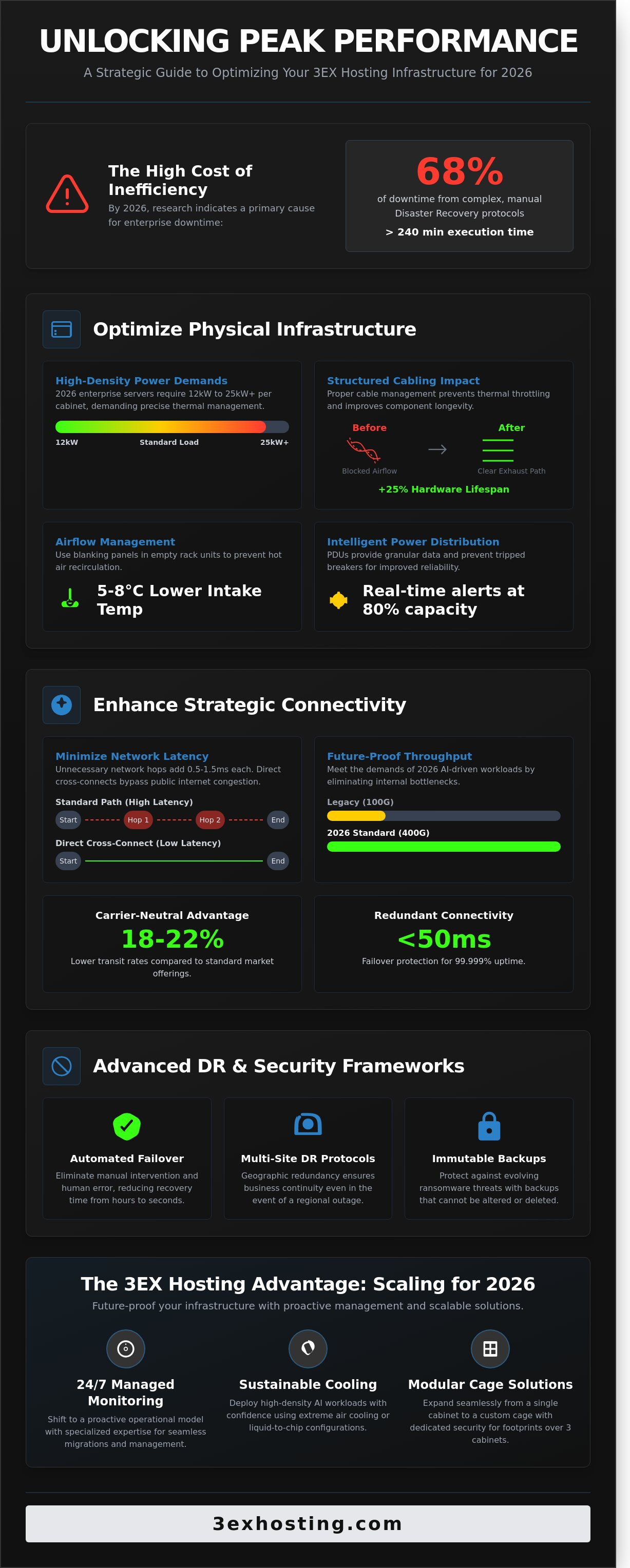
Performance starts at the physical rack level. If you want to know how to improve 3EX Hosting, you must evaluate your power density first. In 2026, enterprise servers often pull between 12kW and 25kW per cabinet. Without precise thermal management, your CPUs will throttle to protect themselves from heat damage. This hardware protection mechanism slows down your applications instantly and increases latency for end users. You need to match your cooling capacity to the actual thermal output of your hardware.
Start by implementing structured cabling. Tangled wires at the back of your rack block exhaust paths and create dangerous heat pockets. Use vertical and horizontal cable managers to keep the airflow path clear within the 42U rack. This allows hot air to escape into the hot aisle without resistance. Clean cable management isn’t just about aesthetics; it’s a cooling strategy that extends hardware lifespan by up to 25%.
Intelligent PDUs are mandatory for modern setups. These devices provide real-time alerts when power consumption nears 80% of circuit capacity. They help you avoid tripped breakers and provide the granular data needed to balance phases across your equipment. Integrating these into your monitoring stack is a proven way to improve 3EX Hosting reliability and prevent unexpected downtime. Effective high-density colocation also relies on strategic hardware placement. Put your highest-draw GPU clusters in the middle of the rack to optimize airflow distribution and ensure the most efficient heat dissipation.
Maximizing Full Cabinet Efficiency
Scaling mission-critical hardware requires the dedicated resources and isolation found in full cabinet colocation packages. You gain total control over the internal environment. Always use blanking panels in every empty rack unit. These simple plates prevent hot air from recirculating into the cold aisle, which can lower intake temperatures by 5 to 8 degrees Celsius. High-density colocation is a requirement for 2026 AI workloads that demand extreme air cooling or liquid-to-chip configurations.
Custom Cage and Suite Configurations
Transition to cage solutions when your footprint exceeds three cabinets or requires specialized physical security. Cages allow for dedicated biometric entry and private overhead ladder racks. This setup secures your hardware and simplifies future expansion. You can add new racks within your fenced perimeter without migrating existing hardware or re-cabling your entire network. This modular approach ensures your infrastructure grows as fast as your data needs without service interruptions.
Enhancing Connectivity through Strategic Cross-Connects
Connectivity determines the ceiling of your infrastructure performance. To understand how to improve 3EX Hosting, you must start with a rigorous audit of your current network path. Unnecessary hops are silent performance killers. Every additional router your data passes through adds roughly 0.5 to 1.5 milliseconds of latency. In a high-frequency environment, these delays accumulate quickly. By 2026, enterprise standards require 400G networking interfaces to handle the massive throughput of AI-driven workloads. Moving to these high-speed standards eliminates internal bottlenecks that older 100G configurations simply can’t manage.
Leveraging carrier-neutral advantages is a primary way to control costs and performance. When analyzing how to improve 3EX Hosting, consider that you aren’t locked into a single provider’s pricing or routing limitations. This flexibility allows you to negotiate transit rates that are often 18% to 22% lower than standard market offerings. Implementing strategic cross-connects within a carrier-neutral facility provides a direct, physical link to multiple Tier-1 providers. This setup bypasses the congestion of the public internet entirely. It’s also vital to deploy redundant cross-connects. A secondary path ensures that if one fiber line fails, your failover protection triggers in less than 50ms, maintaining 99.999% uptime.
Low-Latency Network Architecture
Direct fiber cross-connects reduce millisecond delays by creating a dedicated lane for your data. This is essential for real-time applications where every microsecond counts. BGP optimization strategies further refine this by selecting routes based on performance metrics rather than just the lowest cost. Proximity to major carrier hotels remains a decisive factor for global reach. Being within a few hundred feet of a primary peering point can shave 5ms off your round-trip time. This small margin often determines the success of enterprise-level deployments.
Hybrid Cloud Interconnects
Bridging physical hardware with managed cloud hosting environments creates a seamless operational flow. Private tunnels between your colocation gear and cloud resources ensure that data throughput remains consistent at speeds up to 100Gbps. Security is handled through hardware-level encryption protocols like MACsec, which protects data in transit without the latency overhead of traditional software VPNs. You can easily scale these resources by utilizing 3EX Hosting cabinet solutions to maintain a stable physical core while bursting into the cloud when needed.
Leveraging Managed Services for Operational Excellence
Operational excellence in 2026 demands a total shift from fixing fires to preventing them. If you’re looking for how to improve 3EX Hosting performance, the answer lies in offloading routine maintenance to dedicated experts. Moving to a proactive 24/7 monitoring model reduces infrastructure downtime by up to 42% compared to traditional reactive setups. This transition allows your internal team to focus on core development while third-party specialists handle complex server migrations and hardware lifecycles. It’s essential to audit your managed IT support service to ensure they meet 2026 compliance standards, specifically aligning with the latest NIST security and privacy controls. Reducing internal IT overhead by outsourcing routine hardware tasks frees up roughly 25% of your technical budget for innovation.
Remote Hands as a Performance Multiplier
High-performance infrastructure requires physical presence without the travel time. Remote hands support acts as a performance multiplier by slashing the Mean Time to Repair (MTTR) from hours to minutes. In a 3EX environment, delegating tasks to on-site technicians ensures your stack stays online without delay. Common tasks to delegate include:
- Physical Hardware Adjustments: Rapid cable swaps and port resets to maintain 100% connectivity.
- System Provisioning: OS reloads and firmware updates executed on-site to bypass network latency.
- Inventory Management: Real-time tracking of components for immediate replacement of failing drives.
Integrating remote hands into your internal DevOps workflows allows for seamless hardware changes that happen at the speed of software deployments. This integration eliminates the bottleneck of physical logistics, ensuring that your 3EX Hosting environment remains agile and responsive to traffic spikes.
Enterprise Server Monitoring
Total visibility is no longer optional for enterprise-grade performance. Implementing advanced servers monitoring systems provides a 100% view of your infrastructure health across all layers. Modern systems now use predictive analytics to identify potential hardware failure up to 72 hours before it occurs. This foresight allows for scheduled maintenance windows instead of emergency outages that damage your reputation.
Custom dashboarding provides real-time reporting for stakeholders, showing exactly how to improve 3EX Hosting ROI through better resource allocation. These dashboards translate raw technical data into executive-level insights, highlighting uptime stability and resource utilization. By utilizing specialized expertise for these monitoring systems, you ensure that every alert is actionable and every metric contributes to a more stable, superfast hosting environment. This level of precision is what separates market leaders from those struggling with legacy performance issues.
Advanced Disaster Recovery and Security Frameworks
Data loss costs enterprises an average of $4.5 million per incident in 2025. To stay resilient in 2026, you need more than standard backups. Learning how to improve 3EX Hosting performance means implementing a multi-site disaster recovery protocol spanning at least two distinct geographic regions. This setup ensures a regional power grid failure won’t take your business offline. Your hosting environment must meet N+1 power redundancy standards. This means for every component needed to run the system, there’s at least one independent backup ready to take over. At 3EX Hosting, these standards are the baseline for 99.999% availability.
Reliability requires constant validation. You should conduct failover testing every 90 days to verify your secondary site’s readiness. Modern virtualization tools allow you to run these tests in an isolated sandbox. This ensures your production environment stays live and unaffected while you confirm your recovery scripts work as intended. A robust framework includes:
- Geographic Diversity: Servers located in separate tectonic or power grid zones.
- Immutable Architecture: Storage blocks that cannot be altered after they’re written.
- Automated Monitoring: Real-time alerts that trigger failover protocols instantly.
Modern Ransomware Protection
Ransomware attacks targeted backup repositories in 93% of documented cases last year. You must integrate ransomware protection directly at the infrastructure layer. Use immutable backups that hackers can’t delete or modify even with administrative access. Combine this with air-gapped storage for mission-critical databases to ensure a clean copy always exists. If a breach occurs, your restoration strategy should target a recovery speed of 5TB per hour to minimize business disruption. This super-fast recovery is essential for maintaining enterprise continuity.
Disaster Recovery as a Service (DRaaS)
Automation is the core of effective DRaaS. You can’t rely on manual intervention during a server failure. Implement zero-touch deployment to automate failover to secondary sites within minutes. When considering how to improve 3EX Hosting, define your Recovery Time Objective (RTO) at under 15 minutes. Your Recovery Point Objective (RPO) should stay below 5 minutes for high-availability applications. This level of precision simplifies compliance audits for SOC2 and HIPAA standards while protecting your brand reputation. High-performance hosting isn’t just about speed; it’s about the certainty that your data is safe.
Secure your enterprise infrastructure with our super-fast data center solutions and ensure 24/7 stability.
The 3EX Hosting Advantage: Scaling for 2026
Enterprise environments in 2026 demand more than just rack space and basic power. Carrier-neutral facilities serve as the foundation of modern digital strategy. By operating within a carrier-neutral ecosystem, 3EX Hosting provides direct access to 15+ Tier 1 network providers. This prevents vendor lock-in and allows for real-time traffic rerouting. If one carrier experiences a 20ms latency spike, your traffic shifts to a more efficient path instantly. This level of redundancy is what secures the 99.999% uptime guarantee that enterprise clients require.
Sustainability is no longer an optional metric. Cooling accounts for nearly 40% of traditional data center energy consumption. 3EX Hosting is meeting 2026 standards by implementing high-density liquid cooling and contained hot-aisle architectures. These initiatives target a Power Usage Effectiveness (PUE) rating of 1.2 or lower. For the enterprise, this translates to lower overhead costs and a reduced carbon footprint, which is essential for ESG reporting. Our infrastructure roadmap includes a total transition to 400Gbps network backbones by the end of 2025 to support the rising throughput demands of decentralized applications.
When looking at how to improve 3EX Hosting performance, the focus must shift to high-density compute. Modern AI workloads require 20kW to 30kW per rack, a figure that was unthinkable five years ago. Our facilities are already equipped to handle these thermal loads, ensuring your hardware doesn’t throttle during peak processing cycles.
Strategic Infrastructure Planning
Success depends on aligning hardware refresh cycles with facility capabilities. Servers older than 36 months often consume 25% more power while delivering 40% less compute power than current-gen NVMe-based systems. As your requirements grow, scaling from a single cabinet to private data center suites provides the physical isolation and custom power configurations needed for AI and ML demands. This transition ensures your network remains future-proof as data processing moves closer to the edge.
Getting Started with Optimization
Maximum ROI requires a proactive approach to resource management. Most enterprises over-provision their power by 15% to 20%, wasting significant capital. You can identify these inefficiencies by requesting a comprehensive infrastructure audit from our engineering team. Use our instant quote tool to model your expansion costs for the 2026 fiscal year. This allows for precise budgeting without the risk of hidden “gotcha” fees later. Understanding how to improve 3EX Hosting starts with a clear view of your current utilization metrics.
- Audit Power Density: Ensure your current rack can support 15kW+ for upcoming hardware refreshes.
- Latency Benchmarking: Test connection speeds to your primary user hubs; aim for sub-10ms response times.
- Security Hardening: Verify that your physical cage or suite meets the latest SOC2 and HIPAA compliance updates.
- Network Redundancy: Confirm you have at least two active-active fiber entries to eliminate single points of failure.
Optimize your infrastructure with 3EX Hosting today to ensure your enterprise is ready for the technical challenges of the coming year. Our team is ready to help you migrate, scale, and secure your mission-critical data with the speed and reliability your business deserves.
Future-Proof Your Enterprise Infrastructure for 2026
Achieving peak performance requires a shift from reactive maintenance to proactive optimization. By integrating high-density colocation and leveraging carrier-neutral carrier hotel accessibility, your business secures the low-latency connections needed for 2026 workloads. Implementing N+1 power and cooling redundancy ensures your hardware remains stable during peak demand periods. This technical stability is the backbone of a reliable digital presence.
Understanding how to improve 3EX Hosting performance means utilizing 24/7 Remote Hands Support to handle technical adjustments instantly. This approach eliminates downtime and focuses on technical excellence. Modern enterprises need a foundation that scales without friction. You’ve seen the roadmap for infrastructure stability and managed operational excellence. These strategies provide a 100% uptime focus for your most critical applications. It’s about building a system that doesn’t just survive but thrives under heavy traffic loads. Don’t let outdated hardware limit your growth potential when professional managed services are available to bridge the gap.
Upgrade your enterprise infrastructure with 3EX Hosting
Your journey toward a more resilient and superfast hosting environment starts with these strategic upgrades. We’re ready to support your next phase of growth.
Frequently Asked Questions
How can I reduce latency on my 3EX Hosting setup?
You reduce latency by utilizing 3EX Hosting’s 100Gbps network backbones and NVMe storage clusters. These technologies cut data access times to under 0.5 milliseconds for local requests. To further improve 3EX Hosting performance, deploy your applications in a geographic zone closest to your primary user base. This reduces physical hop counts and ensures a superfast response time for enterprise applications.
What are the benefits of using 24/7 remote hands for colocation?
Remote hands provide immediate on-site technical support for your hardware without requiring your staff to visit the data center. Our technicians offer a 15 minute response time for physical resets, cabling checks, and hardware swaps. This service operates 24/7/365 to ensure 99.999% uptime for your infrastructure. It eliminates travel costs and ensures experts handle your equipment during critical hardware failures.
Is managed cloud hosting better than traditional colocation for 2026?
Managed cloud hosting offers 30% faster scaling capabilities than traditional colocation by 2026 standards. It’s better for businesses needing rapid resource adjustments without hardware procurement delays. While colocation provides total hardware control, managed cloud reduces operational overhead by 40%. Most 2026 enterprise models favor the cloud’s flexibility for unpredictable traffic spikes and global reach.
How do I improve my disaster recovery plan with 3EX services?
You improve your disaster recovery plan by integrating 3EX’s automated off-site backups across three redundant geographic locations. This setup achieves a Recovery Point Objective (RPO) of 15 minutes or less. We use encrypted tunnels to mirror your data in real-time. This ensures that even a total site failure won’t result in data loss for your 2026 operations.
What is the difference between a private suite and a cage solution?
A private suite offers 100% physical isolation with floor to ceiling walls and dedicated biometric access controls. Cage solutions use secure mesh partitions within a shared data hall to provide cost effective security. Suites are designed for enterprises requiring top tier compliance and private cooling zones. Cages are ideal for setups needing high airflow and scalable floor space for 5 to 10 racks.
Can 3EX Hosting support high-density AI and machine learning workloads?
Yes, 3EX Hosting supports high density AI workloads by providing up to 30kW of power per rack and specialized liquid cooling systems. Our infrastructure accommodates the latest H100 GPU clusters and TPU arrays required for machine learning. We ensure stable power delivery even at peak processing loads. This prevents thermal throttling and maintains the superfast speeds AI training demands.
How does carrier neutrality improve my hosting experience?
Carrier neutrality allows you to choose from over 20 global network providers to find the best pricing and routing. This competition often results in 10ms lower latency compared to single carrier facilities. You can switch providers without moving your hardware, which increases your network’s resilience. It’s a key strategy to improve 3EX Hosting connectivity and avoid vendor lock in.
What security certifications does 3EX Hosting maintain for 2026?
3EX Hosting maintains ISO 27001:2022, SOC 2 Type II, and PCI-DSS compliance for the 2026 calendar year. We undergo quarterly third party audits to verify our physical and digital security protocols. These certifications guarantee that your data stays protected under the strictest international standards. Our 2026 security roadmap includes zero trust architecture across all managed nodes for maximum safety.