 SUPPORT


 3EX United States
 Blog
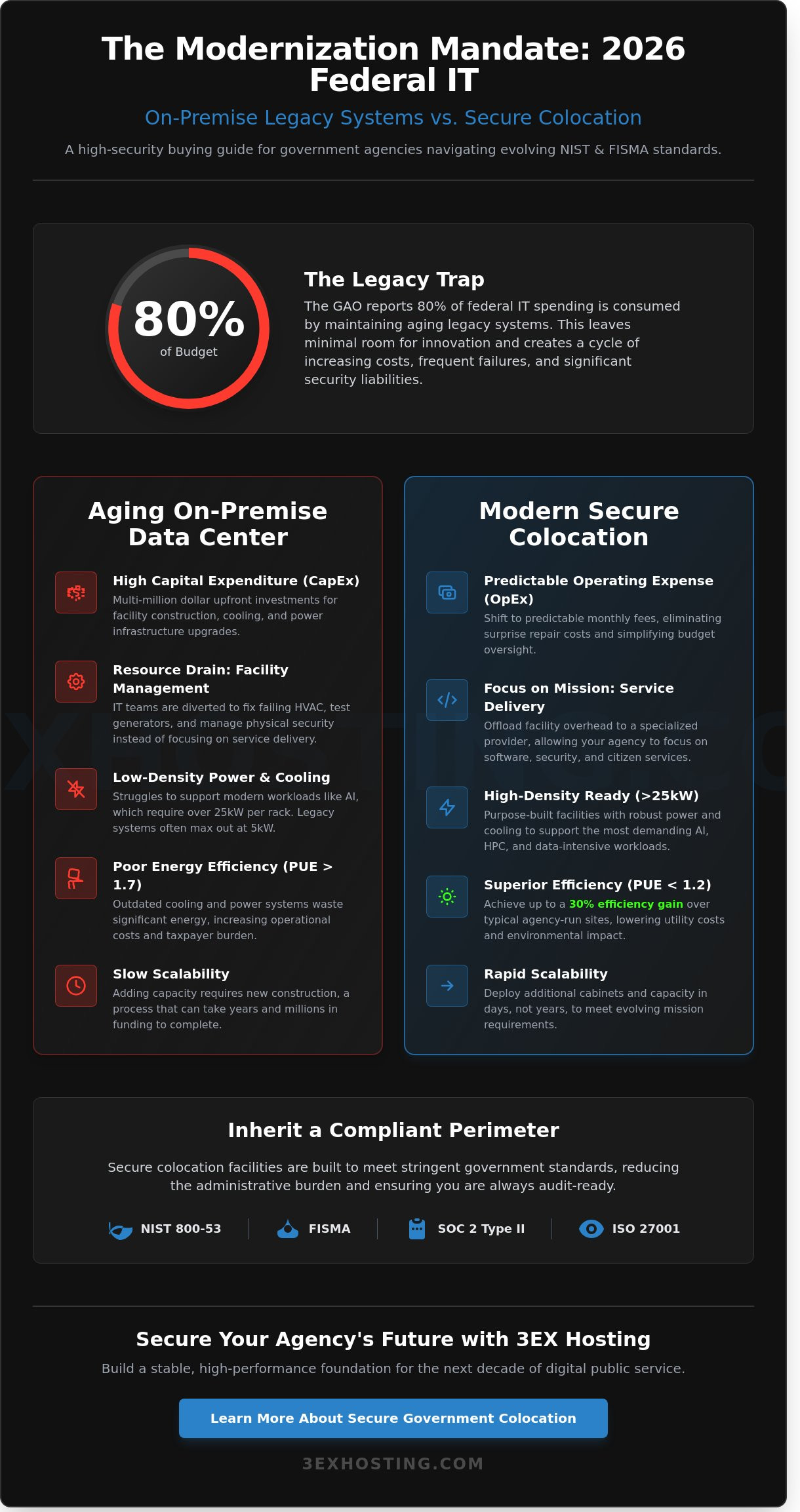
The GAO reports that 80% of federal IT spending goes toward maintaining legacy systems, leaving little room for innovation. It’s a frustrating cycle. You’re under pressure to meet evolving NIST 800-53 standards while managing aging on-premise servers that fail more frequently each year. You know that maintaining these outdated data centers isn’t just expensive; it’s a liability. Secure colocation for government agencies offers a stable, high-performance path forward that respects your budget while hardening your security posture.
This 2026 buying guide shows you how to leverage high-security facilities to meet FISMA standards and modernize critical IT infrastructure. You’ll learn how to achieve zero-downtime migration and maintain full compliance audit readiness while lowering operational costs. We’ll break down the essential technical specifications, physical security layers, and connectivity requirements needed to ensure your agency remains fast, secure, and fully operational.
Key Takeaways
- Learn how to align your IT modernization strategy with 2026 mandates while maintaining strict compliance with NIST and FISMA standards.
- Identify the optimal physical configuration for your agency, including the benefits of secure colocation for government agencies that utilize private suites for maximum isolation.
- Explore best practices for seamless hardware migration and how to integrate robust disaster recovery solutions to ensure zero service interruption.
- Discover the critical role of 24/7 remote hands support and carrier-neutral connectivity in maintaining high-performance, off-site agency infrastructure.
- Understand why shifting away from on-premise data center management reduces operational overhead and enhances long-term technical stability.
The Strategic Shift to Secure Government Colocation
By 2026, government IT mandates require a complete overhaul of how data is stored and processed. Secure colocation for government agencies has evolved from a simple real estate play into a strategic necessity. A data center used for public sector workloads must now meet stringent physical and cybersecurity standards that most aging on-premise facilities can’t match. Agencies are facing a landscape where the 2024 Federal Data Center Strategy updates demand higher efficiency and tighter security protocols.
Managing an on-site facility in 2026 is a massive drain on resources. It requires constant updates to cooling systems, 24/7 armed security, and multi-layered power redundancy. Most agency buildings weren’t designed for these requirements. By moving to secure cabinet colocation, departments offload the high overhead of facility management. This allows IT teams to focus on software and service delivery rather than fixing broken HVAC units or testing backup generators.
Connectivity is the other half of the equation. Carrier hotels have become essential for mission-critical government networks. These facilities offer direct, low-latency access to multiple telecommunications providers and cloud on-ramps. For an agency, this means reducing latency to under 2 milliseconds for regional traffic. It ensures that data flows between departments and to the public without bottlenecks. Balancing these modernization goals with strict budgetary oversight is easier when costs are predictable and facilities are purpose-built for high-performance computing.
Modernizing Public Services Through Infrastructure
Colocation provides the high-density power needed for 2026 AI-driven citizen services. Modern AI workloads often require over 25kW per rack, a demand that legacy on-premise cooling systems can’t handle. Moving to a professional facility eliminates the technical debt of maintaining 15-year-old power grids. It ensures 24/7 availability for essential digital platforms, keeping public services online even during regional power outages or hardware stress tests.
The Economic Case for Agency Colocation
The financial shift from CapEx to OpEx is the primary driver for many department heads. Instead of multi-million dollar upfront investments in building upgrades, agencies pay predictable monthly fees. This model eliminates the need for specialized on-site facility maintenance staff, which are increasingly difficult to recruit. Energy efficiency is another major win. Industrial-scale facilities often operate with a Power Usage Effectiveness (PUE) of 1.2 or lower. This represents a 30% efficiency gain over typical agency-run sites, directly reducing the taxpayer burden for utility costs.
- Reduced Overhead: No more emergency repairs on aging facility hardware.
- Scalability: Add capacity in days rather than the years required for new construction.
- Compliance: Facilities often come with pre-certified physical security and environmental controls.
Choosing secure colocation for government agencies isn’t just about saving money; it’s about building a stable foundation for the next decade of digital growth. It’s a move toward technical excellence and operational reliability.
Compliance Frameworks: Navigating NIST, FISMA, and FedRAMP
Government data protection hinges on the Physical and Environmental (P&E) control family within NIST 800-53. Secure colocation for government agencies isn’t just about renting rack space; it’s about inheriting a compliant perimeter. Providers must demonstrate 100% alignment with these standards to satisfy FISMA requirements. SOC 2 Type II and ISO 27001 certifications provide the necessary third-party validation that security controls remain consistently applied over 6 to 12-month observation periods. Maintaining audit readiness requires a provider that delivers real-time access logs and environmental telemetry on demand.
The transition to NIST 800-53 Revision 5 has introduced stricter requirements for supply chain risk management and hardware provenance. Agencies now look for facilities that offer transparent documentation regarding their equipment vendors and maintenance schedules. This level of detail ensures that the underlying infrastructure doesn’t become a weak link in the agency’s broader security posture. By choosing a partner with a proven compliance track record, agencies reduce their administrative burden during the Authorization to Operate (ATO) process.
FISMA and FedRAMP Physical Control Alignment
Verification is the primary duty of any agency auditor. You must confirm the presence of dual-authentication mantraps and biometric access points at every entry. High-security facilities implement 24/7 surveillance with 90-day minimum video retention. Perimeter security often includes K-rated vehicle barriers and anti-climb fencing to prevent unauthorized approach. These layers ensure data sovereignty by restricting physical contact to vetted, US-based personnel. Achieving a FedRAMP security authorization means every physical touchpoint is documented and defensible during a yearly assessment. It’s not enough to have the locks in place; the provider must prove they’ve never been bypassed.
Data Center Redundancy and Mission Continuity
Power and cooling failures are the leading causes of unplanned downtime in the public sector. Agencies should prioritize 2N redundancy, where every system has a mirrored, independent backup. This exceeds the basic N+1 standard by ensuring that even a total failure of one entire power train won’t impact the server load. Diverse carrier paths are mandatory for government resilience to ensure that a single fiber cut cannot isolate an entire agency’s infrastructure. 3EX Hosting builds its high-density infrastructure solutions to support these mission-critical requirements with 100% uptime guarantees. For agencies needing complete physical separation for their secure colocation for government agencies, private data center suites offer a tailored environment that meets the highest security tiers.
Physical Security Architectures: Private Suites vs. Custom Cages
Physical security isn’t a one-size-fits-all model for the public sector. Agencies must align their hardware footprint with specific data classification levels and compliance mandates. Choosing the right architecture ensures that secure colocation for government agencies remains both compliant and cost-effective. In 2026, the focus has shifted toward granular access control and verified physical isolation. Whether you’re managing a small departmental database or a massive enterprise cloud, the physical boundary is your first line of defense.
Private Suites for High-Sensitivity Data
For agencies handling Level 5 or 6 impact data, private colocation suites offer the highest tier of physical isolation. These environments feature floor-to-ceiling hard walls, effectively creating a data center within a data center. This setup eliminates the risk of “shoulder surfing” and ensures that no other facility tenants can even view your hardware. By following CISA cybersecurity best practices regarding physical site security, suites allow for dedicated cooling zones and private power distribution.
Security layers in a private suite are fully customizable. Agencies often deploy multi-factor authentication, including biometric palm scanners and iris readers, at the suite entrance. You can also install private CCTV feeds that integrate directly with your agency’s Security Operations Center (SOC). It’s the ideal solution for classified workloads or highly regulated citizen data where zero-trust physical access is mandatory. The stability of a dedicated room ensures that your mission-critical systems operate in a pristine, controlled environment.
Scalable Cages for Enterprise Agency Needs
When you need to balance high security with rapid scalability, custom cage solutions provide a professional middle ground. Cages use heavy-duty steel mesh to create a secure perimeter within a shared data center hall. This configuration optimizes airflow and power distribution while maintaining a clear physical barrier. It’s a cost-effective way to secure large-scale server deployments without the higher overhead of a full suite.
Cages offer the flexibility to expand your footprint as digital transformation initiatives grow. If a department adds 50 new nodes for a data analytics project, the cage perimeter can often be extended quickly. This agility is vital for 2026 government operations that require superfast deployment cycles. You get the benefit of the facility’s redundant power and cooling infrastructure while keeping your hardware behind locked, monitored gates.
For smaller, departmental workloads, managing a full cabinet colocation setup is often the most efficient choice. This approach works well for non-classified data or edge computing tasks. Each cabinet is individually locked and monitored, providing a secure, professional home for your gear. It ensures that secure colocation for government agencies remains accessible even for projects with limited physical footprints but high performance requirements.
Implementation: Migration and Disaster Recovery Strategy
Transitioning to a new facility requires more than just moving hardware. It demands a zero-trust migration framework that aligns with NIST SP 800-34 Rev. 1 standards for contingency planning. Secure colocation for government agencies succeeds when the physical move is treated as a tactical operation, ensuring data remains encrypted and accessible throughout the entire relocation process. Agencies must prioritize “swing space” or temporary environments to maintain 99.999% uptime during the transition.
Modern disaster recovery depends on high-performance cross-connects. These dedicated physical cables provide sub-1ms latency for real-time data replication between your primary rack and backup nodes. Unlike public internet routes, these direct connections bypass external congestion and provide a private path for sensitive government data. Integrating remote hands support into your framework ensures that on-site technicians can perform physical resets or hardware swaps in minutes, not hours.
Protecting against 2026-era cyber threats requires proactive ransomware protection strategies. This involves creating “air-gapped” immutable backups where data cannot be modified or deleted by unauthorized scripts. By combining physical security with logical isolation, agencies prevent lateral movement of malware during a breach.
The Government Migration Roadmap
Hybrid cloud strategies are now the standard for secure colocation for government agencies. By combining physical colocation with managed cloud hosting, agencies create a redundant architecture that survives localized disasters. Automated failover protocols must be tested quarterly to ensure mission-critical applications can switch to backup sites without manual intervention.
Geographic diversity is a non-negotiable requirement. Your secondary backup site should be located on a separate power grid and a different tectonic plate or flood zone. This 3-2-1-1 strategy, three copies of data, two different media types, one off-site, and one immutable, ensures that even regional outages don’t compromise national or local security operations.
Ready to modernize your infrastructure with a partner who understands federal-grade security? Explore our high-density data center solutions to start your secure migration today.
The 3EX Hosting Advantage: Secure Enterprise Infrastructure
3EX Hosting functions as a premier carrier hotel, offering the robust connectivity required for secure colocation for government agencies. Our infrastructure centers on ultra-low latency and high-speed throughput, which are essential for modern public sector operations. By 2026, data demands have scaled significantly; our facility handles these requirements with redundant power paths and carrier-neutral fiber entries. We provide direct access to global Tier 1 providers, ensuring that sensitive data moves across the most efficient routes possible. This technical foundation supports high-density workloads while maintaining 99.999% uptime standards.
Expert Remote Hands and On-Site Support
Agency IT teams often manage distributed networks across multiple jurisdictions. Sending a senior engineer to a data center for a simple drive swap or cable reset is a poor use of taxpayer resources. 3EX Hosting solves this with 24/7 remote hands support. Our on-site technicians act as an extension of your team, performing rapid hardware swaps and complex troubleshooting within 15 to 30 minutes of a request. This rapid response eliminates the need for agency staff to travel, allowing them to focus on high-level strategy instead of physical maintenance.
- Hardware Management: Professional installation of servers, switches, and storage arrays with precise cable labeling.
- Troubleshooting: Immediate visual verification of status lights and physical power cycling to resolve connectivity issues.
- Inventory Audits: Regular physical checks to ensure all government assets are accounted for and secure.
24/7 monitoring ensures government mission continuity by preventing downtime through proactive oversight.
Customizable Government Solutions
Government workloads aren’t one-size-fits-all. Some projects require full cabinet colocation, while larger departments need private enterprise suites for total physical isolation. 3EX Hosting provides carrier-neutral connectivity, meaning you aren’t locked into a single provider. You gain access to over 200 network providers, which allows for redundant routing and competitive bandwidth costs. This flexibility is essential for agencies modernizing legacy systems that require specific network configurations or dedicated fiber loops.
The infrastructure at 3EX Hosting is built for the high-density demands of 2026. We support power configurations exceeding 20kW per rack, accommodating the latest AI-driven government analytics tools. This technical stability, combined with superfast connectivity, ensures that critical public services remain online and responsive. Secure colocation for government agencies isn’t just about floor space; it’s about a resilient ecosystem that scales with the mission. Request a managed IT support quote to begin your modernization journey.
Modernize Your Agency’s Infrastructure for 2026
The transition toward modernized data centers is a strategic necessity for federal entities facing 2026 security mandates. You’ve seen how strict adherence to NIST and FedRAMP frameworks prevents data breaches. Physical isolation through private suites provides the essential barrier against unauthorized access. Selecting a partner that offers N+1 power and cooling redundancy guarantees that mission-critical systems stay online during emergencies. 24/7 on-site remote hands support means technical issues get resolved in minutes. Choosing the right secure colocation for government agencies is the most effective way to balance high-speed connectivity with rigid compliance standards. Our carrier-neutral facilities provide high-speed cross-connects that keep your agency agile. You don’t have to manage these complexities alone. Expert infrastructure management allows your team to focus on serving the public while we handle the hardware. Your path to a more resilient and compliant future starts with a stable foundation.
Secure your agency’s future with 3EX Hosting’s enterprise colocation solutions.
Frequently Asked Questions
Is colocation more secure than an on-premise government data center?
Secure colocation for government agencies often exceeds on-premise security because dedicated providers invest millions in physical hardening. Modern facilities utilize 5 layers of security, including biometric scanners and 24/7/365 armed guards. While 60% of on-premise sites struggle with aging infrastructure, colocation centers maintain N+1 or 2N redundancy. You gain access to infrastructure that meets the highest federal standards without the massive capital expenditure of building your own.
How does NIST 800-53 impact my choice of colocation provider?
NIST 800-53 dictates the mandatory security and privacy controls for federal information systems. You must choose a provider that supports these controls, specifically within the physical and environmental protection (PE) family. A compliant partner provides the necessary documentation for your Authorization to Operate (ATO). Ensure the facility undergoes annual SOC 2 Type II audits to verify these 20 families of controls are consistently met.
Can we maintain physical access to our servers in a colocation facility?
Your authorized IT staff maintains 24/7/365 physical access to your hardware through secure authentication protocols. Most facilities require a pre-approved access list and multi-factor authentication, such as a badge and iris scan, at every entry point. You keep full control over your server racks while the provider manages the surrounding environment. This ensures your team can perform manual hardware swaps or upgrades whenever necessary.
What happens during a power outage or natural disaster?
Redundant power systems ensure 99.999% uptime even during total grid failure. Facilities utilize onsite diesel generators with 72 hours of fuel and immediate failover to Uninterruptible Power Supply (UPS) systems. In 2023, Tier III data centers maintained operations through major weather events by using N+1 cooling and power architectures. Your data remains accessible because the facility doesn’t rely on a single point of failure.
How do we manage compliance audits for hardware located off-site?
You manage compliance by leveraging the provider’s existing certifications and third-party audit reports. Most secure colocation for government agencies includes access to annual SOC 1, SOC 2, and FedRAMP readiness assessments. These documents prove the facility meets federal standards for physical security and environmental monitoring. Instead of auditing the entire building yourself, you simply incorporate the provider’s compliance package into your agency’s broader audit framework.
What is the difference between a cage and a private suite for government use?
A cage is a secure area enclosed by steel mesh, while a private suite is a fully enclosed room with solid walls. Cages provide excellent airflow and visibility for 10 to 20 racks at a lower cost. Private suites offer the highest level of privacy and noise reduction, which is ideal for agencies handling highly sensitive data. Both options include dedicated biometric access and individual CCTV monitoring for your specific footprint.
How does Remote Hands support help government IT teams?
Remote Hands provides 24/7 on-site technical support to perform physical tasks like cable management, server reboots, or hardware replacements. This service eliminates the need for your team to travel 50 miles for simple manual fixes. Our superfast response times ensure that a technician is at your rack within 15 minutes of a request. It’s a cost-effective way to maintain high availability without staffing the data center yourself.
Are there specific connectivity requirements for government agencies in colocation?
Government agencies require carrier-neutral connectivity with at least two diverse fiber entry points to prevent outages. You’ll often need dedicated connections to the Government Cloud or specific low-latency links to regional offices. Many agencies mandate 10Gbps or 100Gbps ports to handle large datasets efficiently. Using a provider with multiple Tier 1 backbone carriers ensures your applications remain superfast and resilient against network congestion.