 SUPPORT


 3EX United States
 Blog
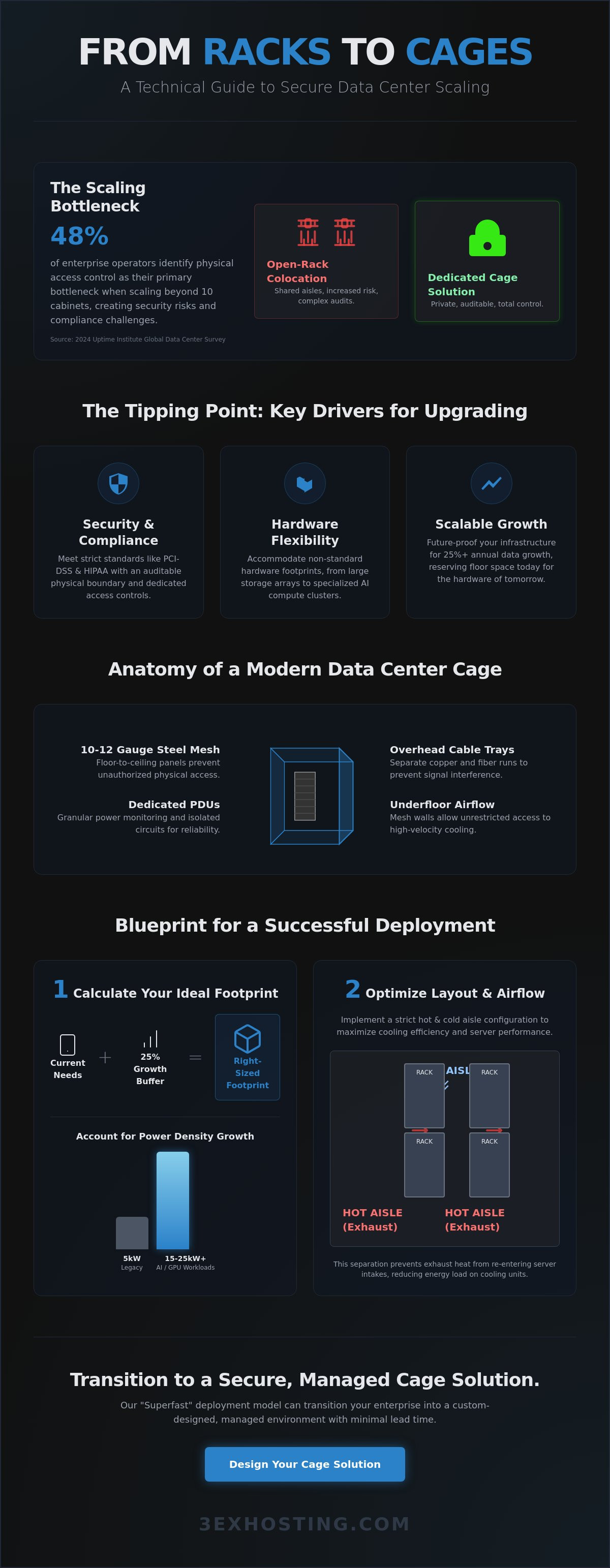
According to the 2024 Uptime Institute Global Data Center Survey, 48% of enterprise operators identify physical access control as their primary bottleneck when scaling beyond 10 cabinets. You’ve likely realized that relying on standard open-rack colocation creates unnecessary security risks and complicates your annual compliance audits. As your hardware density increases toward 2026 standards, the need for dedicated cage solutions datacenter environments becomes a non-negotiable requirement for technical stability. It’s difficult to maintain peak performance when you’re restricted by the physical boundaries of a shared floor and lack total control over your environment.
We’ll show you exactly how to design, secure, and scale your infrastructure using custom enclosures tailored for enterprise-grade reliability. This guide provides a clear roadmap for deployment, helping you understand the cost-to-security ratio while future-proofing your layout for high-density hardware. You’ll get a detailed look at floor planning, airflow optimization, and advanced biometric access systems. By the end, you’ll have the technical foundation needed to move from a few cabinets to a secure, private suite without the typical growing pains.
Key Takeaways
- Learn how to calculate square footage and rack density for a 3-year growth plan to ensure your infrastructure scales without disruption.
- Discover the “defense-in-depth” approach to physical security required to meet strict compliance standards like PCI-DSS and HIPAA.
- Optimize high-density AI and GPU workloads by integrating advanced cooling and redundant N+1 power within your cage solutions datacenter deployment.
- Master the technical design of hot and cold aisle alignments to maximize airflow efficiency and maintain peak server performance.
- Explore how a “Superfast” deployment model can transition your enterprise into a custom-designed, managed environment with minimal lead time.
What are Data Center Cage Solutions?
A cage solution is a dedicated, secure area within a colocation facility partitioned by physical barriers. Unlike standard rack-level hosting, cage solutions datacenter deployments provide an exclusive footprint for an enterprise’s entire infrastructure stack. This includes servers, networking switches, and storage arrays. It’s a private enclave that ensures physical isolation from other tenants while leveraging the shared power and cooling of a world-class data center environment.
Enterprises often view cages as the ideal middle ground. They offer more privacy than cabinet colocation, where hardware sits in shared aisles, but they don’t carry the high overhead of a private suite. You get the security of a locked room without the cost of building a dedicated four-wall enclosure. It’s a pragmatic choice for companies that need to manage 10 to 50 racks without the capital expenditure of a stand-alone facility. By 2026, this model has become the standard for firms balancing strict compliance with budget efficiency.
Key Components of a Modern Data Center Cage
The physical structure typically consists of floor-to-ceiling steel mesh or solid panels. Most high-spec facilities use 10-gauge or 12-gauge steel to prevent unauthorized access. Inside, the cage features dedicated Power Distribution Units (PDUs). These allow for granular monitoring of energy consumption and ensure your power draw doesn’t affect neighbors. Effective cage solutions datacenter setups also include overhead cable trays to separate copper and fiber runs. This prevents signal interference and simplifies maintenance. Access to underfloor cooling remains critical, as the mesh walls allow for high-velocity airflow to reach high-density server clusters efficiently.
Why Enterprises Move from Racks to Cages
Security drives the shift. Many compliance frameworks, such as PCI-DSS or HIPAA, require strict physical access controls. A cage provides an auditable boundary where only authorized personnel can enter. Hardware flexibility is another factor. Standard racks often limit you to specific dimensions. Cages allow for non-standard hardware footprints, such as large-scale storage arrays or specialized AI compute clusters that don’t fit in a 19-inch cabinet. Growth is the final catalyst. Enterprises seeing a 25% annual increase in data volume need room to scale. A cage allows you to reserve floor space today for the hardware you’ll install tomorrow. It eliminates the logistical nightmare of moving equipment between different aisles as your footprint expands.
How to Plan Your Data Center Cage Deployment
Successful implementation of cage solutions datacenter projects depends on precise spatial and power forecasting. You must begin by auditing your current hardware and projecting your growth through 2028. A common mistake is planning only for immediate needs; this leads to costly migrations or cage expansions within two years. Your planning phase should establish a technical baseline for power density, cooling efficiency, and physical security layers.
Step 1: Calculating the Ideal Footprint
Determining the required square footage involves more than measuring rack dimensions. You must account for the “working space” required for technicians to safely service equipment. Industry standards typically require a 36 inch clearance in the front and rear of every rack to allow for door swings and hot-swap component replacements. When calculating your area, distinguish between usable square footage, which is the space occupied by hardware, and the total cage area, which includes these mandatory access paths.
Right-sizing is the balance between current needs and 25% growth capacity. This buffer prevents overpaying for empty space while ensuring you can scale without moving to a new enclosure. Verify your power density requirements with the provider early. While 5kW per rack was standard in 2022, many enterprise AI workloads in 2026 require 15kW to 25kW per rack. Ensure the facility’s cooling infrastructure can support these high-density clusters within your specific footprint.
Step 2: Mapping Internal Connectivity and Airflow
Efficient internal layouts prioritize thermal management and cable organization. Position your network switches to minimize cable lengths and ensure optimal cross-connect access. For cooling, align your racks in a strict hot and cold aisle configuration. This separation prevents the mixing of exhaust and intake air, which significantly reduces the energy load on the facility’s cooling units. You should follow the foundational standards found in the enterprise guide to data center colocation in 2026 to ensure your setup meets modern efficiency benchmarks.
- Install blanking panels in every empty “U” space to maintain static pressure.
- Use overhead cable trays to keep the under-floor airflow unobstructed.
- Place high-heat equipment near the center of the row for more uniform cooling.
Security protocols must be integrated into the physical layout. Beyond the perimeter fence, your cage solutions datacenter strategy should include dedicated biometric scanners at the cage entrance and internal cameras that provide 360 degree coverage of the rack faces. Finally, coordinate with the facility’s remote hands team to plan the physical hardware migration. Their expertise in rack-and-stack services ensures that your equipment is installed according to the planned layout while you focus on logical configuration. If you are ready to define your technical requirements, requesting a custom quote can help you finalize your budget and spatial needs.
Enhancing Physical Security and Compliance in a Caged Environment
Securing enterprise hardware requires a multi-layered defense-in-depth strategy. It’s not enough to rely on the data center’s perimeter security. You need a dedicated physical barrier that separates your infrastructure from other tenants. Implementing cage solutions datacenter environments creates a controlled zone where every interaction is monitored and restricted. This isolation acts as a critical fail-safe against human error or malicious intent on the shared colocation floor.
Visual privacy provides a psychological and practical shield. High-density mesh or solid panels prevent unauthorized observers from mapping your network topology by looking at cabling patterns or server blink rates. It stops “shoulder surfing” during sensitive maintenance tasks. This privacy ensures your hardware configurations remain confidential even in a high-traffic facility.
Advanced Access Control Systems
Traditional keycards are no longer sufficient for 2026 security benchmarks. They’re easily lost or cloned. Professional cage solutions datacenter deployments now favor dual-factor biometric scanners. These systems require both a physical credential and a fingerprint or iris scan to grant entry. This ensures that the person entering the cage is exactly who they claim to be.
- Tailgating Prevention: Floor-to-ceiling cage walls prevent unauthorized individuals from climbing over the partition.
- Rack-Level Locks: Smart locks on individual cabinets inside the cage add a second layer of protection.
- Real-Time Alerts: Modern systems trigger instant notifications if a cage door remains open for more than 30 seconds.
Meeting Regulatory Compliance Requirements
Strict compliance standards like PCI-DSS 4.0 and HIPAA demand rigorous physical safeguards. Physical isolation is a core requirement for passing SOC 2 Type II audits. It provides a documented perimeter that simplifies the audit process. You don’t have to guess who had access to your servers; the audit logs provide the proof.
Maintaining a clean chain of custody is easier in a caged environment. Every technician’s entry is timestamped and recorded. This creates a permanent paper trail for hardware swaps or drive disposals. If your organization handles highly sensitive government or financial data, you might require even more isolation. In those cases, private colocation suites offer a fully walled environment with dedicated cooling and power distribution.
Security isn’t just about locks; it’s about visibility. Integrating 24/7 IP-based CCTV coverage inside the cage allows your team to monitor remote hands activities in real-time. This level of oversight ensures that your internal security protocols are followed to the letter, even when your staff isn’t on-site. It’s a professional approach to risk management that protects your brand’s reputation and technical stability.
Technical Optimization: Power, Cooling, and High-Density Loads
Technical optimization transforms a simple enclosure into a high-performance engine for your business. In a 2026 enterprise environment, power, cooling, and connectivity must work in perfect unison. Standard setups often fail under the weight of modern workloads. A well-designed cage solutions datacenter environment ensures your hardware runs at peak efficiency without the risk of thermal throttling or power outages.
Managing High-Density GPU and AI Infrastructure
AI clusters and GPU-heavy workloads have changed the rules of data center management. It’s now common to see deployments requiring 30kW to 45kW per rack. Standard open-floor cooling can’t dissipate this level of heat effectively. Enterprises choose cage solutions because they allow for localized containment. By installing hot or cold aisle containment systems within the cage perimeter, you can isolate airflows. This physical barrier increases the efficiency of Computer Room Air Conditioning (CRAC) units by up to 28%.
Power reliability is the second half of the high-density equation. We utilize N+1 redundant power feeds to ensure that a single circuit failure doesn’t take your entire cluster offline. Metered Power Distribution Units (PDUs) give you real-time visibility into consumption. You’ll track every watt used by your hardware, which is essential for accurate capacity planning and cost management. This transparency prevents over-provisioning and reduces waste in your infrastructure budget.
Network Interconnectivity and Cross-Connects
A messy cage isn’t just an eyesore; it’s a technical liability. Structured cabling is a core component of optimization. By using overhead cable trays and dedicated patch panels, you avoid the “spaghetti” wiring that blocks airflow and complicates maintenance. This organization speeds up troubleshooting and reduces the chance of accidental disconnects during hardware swaps. Clear cable paths ensure that your cage solutions datacenter remains scalable as your network grows.
Connectivity flexibility is a major advantage for cage tenants. Carrier-neutral environments allow you to connect with multiple telecommunications providers. You aren’t locked into a single vendor’s pricing or performance limits. Direct cross-connects to major cloud on-ramps provide sub-millisecond latency for hybrid cloud architectures. Strategic rack placement within the cage further minimizes cable lengths, ensuring your data moves at the highest possible speeds across your internal fabric.
Build a stable, high-performance environment for your most demanding hardware with a custom cage quote tailored to your power and cooling needs.
Transitioning to a Managed Cage Solution with 3EX Hosting
Transitioning to a dedicated environment shouldn’t be a source of friction for your IT team. 3EX Hosting approaches cage solutions datacenter deployments with a focus on technical stability and rapid execution. We recognize that for an enterprise in 2026, every day of delay represents lost opportunity. Our process eliminates the guesswork by providing a structured, engineer-led path from initial design to live operations. We don’t just lease floor space; we build high-performance environments tailored to your specific power densities and cooling requirements.
The 3EX Onboarding Experience
The process begins with a collaborative design phase where 3EX engineers work directly with your architects. We map out the footprint to maximize airflow and rack density. Our team manages the entire physical installation, including the deployment of PDUs, server racks, and structured cabling. For enterprises migrating from legacy facilities, our move-in assistance ensures a seamless transition. We’ve helped clients reduce their migration timelines by up to 30% through meticulous pre-configuration. Our ‘Superfast’ deployment model ensures your cage is ready for hardware installation within days, not months.
Operational Excellence and Support
Operating within a 3EX facility provides several strategic advantages that go beyond physical security. We maintain a carrier-neutral environment, giving you direct access to multiple Tier 1 providers to optimize latency and prevent vendor lock-in. Our infrastructure is built for 100% uptime, supported by N+1 or 2N redundant power and cooling systems. Technical stability is our baseline, not a goal.
Managing a cage solutions datacenter footprint requires constant vigilance. 3EX provides 24/7 technical support and remote hands services to act as your local eyes and ears. Whether it’s a routine cable swap or an emergency drive replacement at 3:00 AM, our on-site technicians handle it immediately. This level of professional colocation provides the peace of mind your stakeholders demand.
Modern enterprise infrastructure requires a partner that values speed as much as security. Don’t settle for generic space when you can have a custom-engineered environment. Contact a 3EX engineer today to right-size your next deployment and request a customized quote for your cage requirements.
Future-Proofing Your Enterprise Infrastructure
Implementing high-performance cage solutions datacenter infrastructure requires balancing physical security with technical scalability. By 2026, enterprise standards demand more than just a locked gate. Success relies on meticulous airflow management to handle high-density loads and strict adherence to SOC2 or ISO 27001 compliance frameworks. These elements ensure your hardware remains cool, powered, and protected against unauthorized access.
At 3EX Hosting, we bridge the gap between complex hardware requirements and operational simplicity. Our facilities provide N+1 power redundancy to ensure your systems never go dark. We maintain carrier-neutral connectivity, giving you access to over 10 global Tier 1 providers for maximum network flexibility. If an issue arises at midnight, our experts provide 24/7 remote hands support to resolve hardware tasks within a 15 minute response window. You shouldn’t leave your critical assets to chance. Partner with a provider that treats your uptime as the only priority. Our team is ready to help you design a space that grows with your data demands.
Get a Custom Quote for Your Enterprise Cage Solution
Frequently Asked Questions
What is the difference between a data center cage and a private suite?
A data center cage uses floor-to-ceiling steel mesh to isolate your racks, while a private suite is a solid-walled room. Cages share the facility’s ambient cooling and lighting systems. Suites provide complete visual privacy and often include dedicated environmental controls. Choosing a cage saves approximately 25% on construction costs compared to a full suite build-out. It’s the professional choice for 2026 enterprise deployments.
How much does a data center cage cost compared to individual cabinets?
Cage solutions datacenter deployments involve higher upfront setup fees but offer lower long-term costs for scaling. You trade the per-rack pricing model for a per-square-foot lease. Industry data from 2024 shows that companies with more than six racks reduce their total cost of ownership by 15% over a three-year term. It’s a strategic move for predictable budgeting as your hardware footprint grows.
Can I customize the security hardware on my specific cage door?
You can install custom biometric readers, cameras, and magnetic locks on your specific cage door. Most providers support integration with enterprise platforms like Genetec or Avigilon. This allows your security team to manage access logs remotely. 80% of our enterprise clients implement dual-factor authentication to meet internal risk management protocols. It’s your space, so you control the entry points and the logs.
What are the typical power limits for an enterprise data center cage?
Enterprise cages typically support power densities ranging from 10kW to 25kW per rack. By 2026, most Tier III facilities expect a minimum of 150 Watts per square foot across the footprint. If you’re running AI workloads, you’ll need specialized power circuits. We ensure the infrastructure handles these loads without tripping breakers or overheating your hardware. High-density zones can exceed these limits with specialized cooling.
Is it possible to expand my cage footprint after the initial installation?
Expanding your footprint is possible if the contiguous floor space isn’t already leased to another tenant. You should negotiate a “Right of First Refusal” for the adjacent 500 square feet during your initial contract phase. 40% of growing firms find themselves landlocked because they didn’t reserve expansion rights early. It’s better to plan for growth before the concrete is poured and the mesh is installed.
Do I need my own insurance for hardware stored in a colocation cage?
You need your own insurance policy because the data center’s coverage only protects the building and shared infrastructure. Most providers include a “Waiver of Subrogation” in their contracts. This means their insurance won’t pay for your server failures or data loss. Standard enterprise agreements require you to carry at least $2 million in professional liability coverage for your hosted assets to stay protected.
How does cage colocation help with SOC2 or HIPAA compliance?
Cage colocation directly addresses the physical security requirements of SOC2 Type II and HIPAA by creating a restricted access zone. These cage solutions datacenter options create a documented audit trail of exactly who entered your server area. Since 2023, auditors have increasingly required this physical separation for organizations handling sensitive Level 3 data. It’s an easy way to pass your annual compliance checks and ensure data integrity.