 SUPPORT


 3EX United States
 Blog
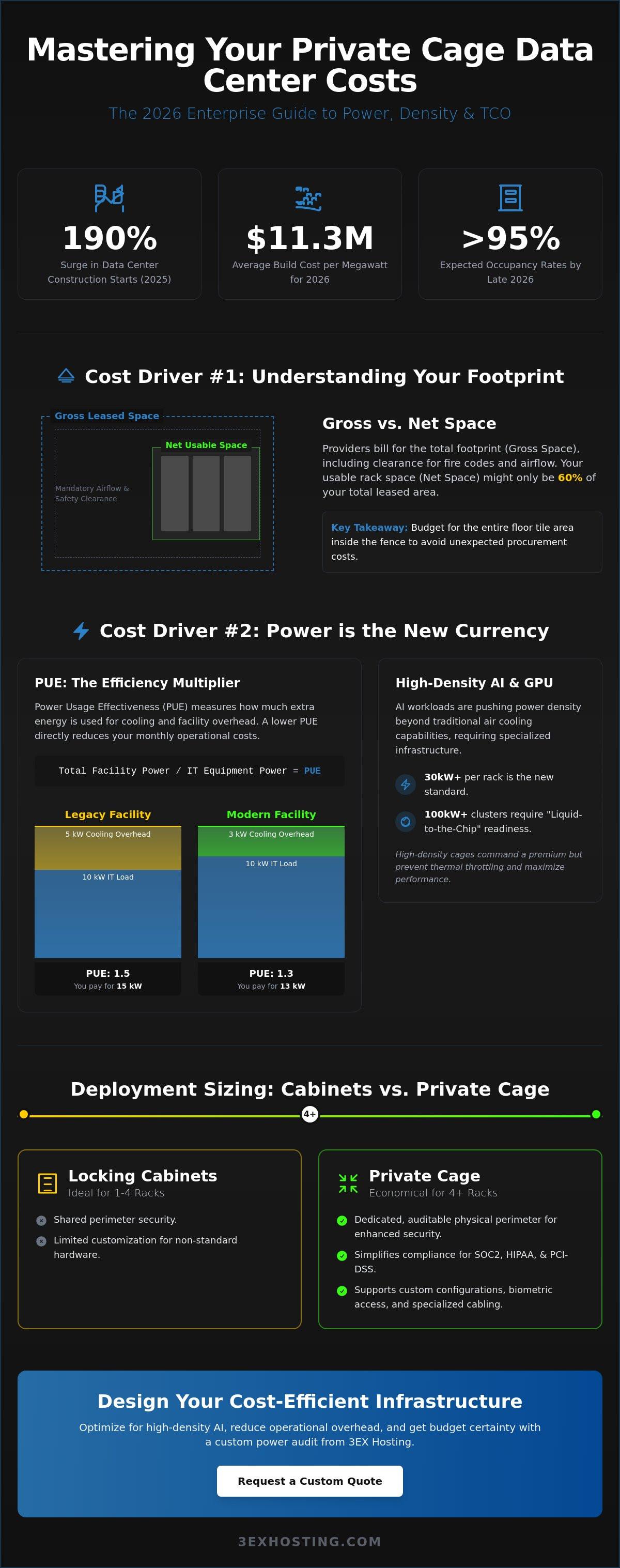
Did you know that data center construction starts surged by 190% in 2025, pushing the average global build cost to a staggering $11.3 million per megawatt for 2026? This massive capital influx is fundamentally shifting how enterprises calculate their private cage data center cost. It’s no longer just about the price per square foot. In a market where occupancy rates are expected to climb past 95% by late 2026, the real budget drivers are power density and cooling efficiency for high-performance workloads.
You’ve likely felt the frustration of unpredictable monthly power bills and those hidden cross-connect fees that seem to appear out of nowhere. We know that maintaining security compliance for sensitive workloads is a constant pressure. This guide will help you master these complex variables to optimize your infrastructure TCO and scaling strategy. We’ll provide a clear line-item budget for your deployment, analyze the ROI of custom power density, and offer a framework to compare providers across the country.
Key Takeaways
- Differentiate between gross and net space to ensure your budget accurately covers the entire physical footprint required for secure operations.
- Master the variables of modern power density and PUE to forecast your total private cage data center cost for the 2026 fiscal year.
- Identify hidden monthly recurring charges for cross-connects and learn how carrier hotel locations provide a significant bandwidth pricing advantage.
- Use our step-by-step TCO framework to determine when a custom cage build-out becomes more cost-effective than managing individual locking cabinets.
- Optimize your infrastructure for high-density AI workloads while reducing operational overhead through professional 24/7/365 remote hands support.
Understanding Private Cage Architecture and Space Allocation
A private cage provides a physical security barrier within a shared colocation data center environment. It’s a dedicated, fenced-off area that separates your infrastructure from other tenants. While a standard locking cabinet offers basic protection, a cage creates a comprehensive perimeter that only your authorized personnel or 3EX Hosting technicians can access. This architecture is the preferred choice for enterprises that have outgrown individual racks but aren’t yet ready for a full private suite.
Calculating your private cage data center cost requires an understanding of “Gross vs. Net” space. Many operators bill based on the total footprint, or gross square footage, rather than just the area your cabinets occupy. Gross space includes the perimeter fencing and the mandatory clearance required for fire codes and airflow. You’ll typically pay for the entire floor tile area inside the fence. It’s a critical distinction because your usable rack space might only represent 60% of the total square footage you’re leased. Accurate budgeting must account for this overhead to avoid surprises during the procurement phase.
Most facilities set a minimum entry point for cage deployments. This usually starts at 2 to 4 cabinets depending on the specific floor layout and power distribution design. If your requirement is smaller, a high-density locking cabinet is often more efficient. However, once you cross the four-cabinet threshold, the cage becomes the more economical and secure option. It allows for physical sovereignty features like custom digital locks, dedicated biometric access scanners, and specialized overhead cable management that keeps your connectivity separate from the house mesh.
Standard vs. Custom Cage Configurations
Standard cages use pre-built dimensions designed for rapid deployment. These are ideal for businesses that need to scale quickly using standard 42U or 48U racks. Custom cages are tailored for non-standard footprints, such as liquid-cooled GPU clusters or oversized storage arrays. If you’re planning a high-density AI deployment, custom aisle containment is often integrated into the cage design. This improves cooling efficiency but will increase your initial setup fees due to the specialized engineering required.
The 2026 Compliance Advantage
In 2026, physical security audits for SOC2, HIPAA, and PCI-DSS have become significantly more rigorous. A private cage simplifies these requirements by providing a clear, auditable physical perimeter. It reduces compliance friction because you aren’t sharing a cabinet door or side panels with another organization. For enterprises with extreme sovereignty needs, Private Colocation Suites offer a completely walled-off environment. However, for most sensitive workloads, a well-configured cage provides the perfect balance of security and cost-efficiency.
Decoding the Core Cost Drivers: Power, Cooling, and Density
In 2026, the primary variable in your private cage data center cost isn’t the physical floor space; it’s the power profile. Leading carrier hotels have moved away from legacy fixed-fee models toward metered kW consumption. This change reflects the reality of high-density computing where a single rack might draw 30kW or more. You’re no longer just renting a room; you’re securing a portion of the facility’s electrical and thermal capacity. This shift ensures you only pay for what you use, but it requires more diligent monitoring of your hardware’s actual draw.
Power Usage Effectiveness (PUE) is the multiplier that determines your “all-in” power rate. If your IT equipment draws 10kW and the facility has a PUE of 1.5, you’re actually paying for 15kW of power to cover the cooling and lighting overhead. Modern facilities aim for a PUE below 1.3. When evaluating providers, a lower PUE directly reduces your operational expenses over the life of the contract. Power Density is the kilowatts per rack supported by the facility cooling.
AI and GPU hosting are pushing the limits of traditional air cooling. By mid-2026, many enterprise cages require “Liquid-to-the-Chip” readiness. These cages command a premium because they involve specialized plumbing and heat exchange infrastructure. You’ll likely see a surcharge for these high-density environments, but the trade-off is the ability to run 100kW+ clusters without thermal throttling. If you need help sizing your environment, you can request a custom power audit to ensure your budget is accurate.
Fixed Capacity vs. Metered Power Billing
Fixed billing provides budget certainty by charging a flat fee per circuit. It’s simple but often results in paying for “stranded” power you don’t use. Metered billing is more transparent, charging for actual consumption plus a base fee for space and cooling. For a typical 4-cabinet cage, you should estimate your average draw at 60-70% of the circuit capacity to build an accurate OpEx forecast. This prevents overpaying for capacity that sits idle during low-traffic periods.
Cooling Overhead and High-Density Surcharges
As density increases, so does the “Density Tax.” Cooling 20kW in a single rack is complex. It requires more than basic airflow, often necessitating specialized containment or rear-door heat exchangers. Facilities often apply surcharges for high-density configurations to offset the cost of these advanced systems. Additionally, your choice of redundancy, such as N+1 vs. 2N, will significantly impact your private cage data center cost. A 2N configuration effectively doubles your power distribution costs because every component has a fully independent backup. For more on this, see our insights on high-density AI infrastructure.
The Hidden Economics of Connectivity and Security
Connectivity and security are the most underestimated components of an infrastructure budget. While floor space is a visible line item, the networking fabric and specialized security protocols represent the hidden side of your private cage data center cost. Enterprises often focus on the physical fence while overlooking the recurring fees associated with the data flowing through it. In 2026, managing these variables is the difference between a scalable deployment and an expensive bottleneck.
Every fiber or copper link that leaves your cage to reach a carrier or another tenant incurs a Monthly Recurring Charge (MRC). Some competitors suggest these are one-time setup fees, but in reality, they’re permanent fixtures on your bill. However, being situated in a major carrier hotel provides a massive economic advantage. Access to a dense ecosystem of providers creates a competitive marketplace. This competition often drives down bandwidth pricing by 25% or more compared to isolated facilities. For high-security environments, you may also need dedicated fiber entry points, which involve specialized conduit and additional engineering fees.
On-site support is another critical budget variable. For organizations managing national deployments, the travel costs for senior engineers are substantial. A single emergency trip can cost upwards of $1,800 in 2026 when you account for last-minute airfare and logistics. Shifting these tasks to expert on-site staff eliminates this volatility. It allows your team to focus on high-level architecture while local technicians handle physical maintenance.
Cross-Connects and Network Fabric Fees
Cross-connects are frequently the silent budget killer in complex cage deployments. If your architecture requires 15 separate links to different cloud providers and carriers, the monthly fees can rival your space rental. A carrier-neutral strategy offers the best ROI here. It allows you to switch bandwidth providers without moving your hardware. Using Remote Hands Support ensures these interconnections are labeled, tested, and managed professionally, preventing costly downtime due to cabling errors.
Physical Security and Surveillance Premiums
Standard data center CCTV monitors the aisles, but many compliance frameworks now require dedicated cameras inside the cage. These customer-accessible feeds allow your security team to monitor the environment 24/7. Biometric access control is another common requirement for 2026 audits. While the setup is a one-time CapEx, the integration with your internal identity management system may carry a monthly maintenance fee. In high-security facilities, you might also pay a premium for “Man-Trap” access protocols, ensuring only one person enters the secure zone at a time.
TCO Analysis: Private Cages vs. Multi-Cabinet Deployments
Moving from individual locking cabinets to a fenced environment is a major milestone in infrastructure maturity. To determine if the transition is right for your budget, you must look beyond the monthly lease rate. Managing 10 individual locking cabinets creates fragmented OpEx. You’re tracking 10 separate access logs and managing physical security across multiple points on a shared floor. A private cage consolidates these into a single secure perimeter, streamlining your daily operations. This consolidation often reduces the time your technicians spend on-site by 15% to 20% during routine maintenance.
The upfront investment, or CapEx, for custom cage build-outs is higher than standard rack leases. You’re paying for the physical fencing, specialized grounding, and dedicated overhead trays. However, the private cage data center cost becomes more attractive as you factor in the “Expansion Buffer.” Holding empty space within a cage ensures your future racks are adjacent to your current ones. On a shared floor, your 11th cabinet might end up in a different row. This forces you to deal with increased latency and complex cable runs that drive up long-term costs. When you account for the 190% surge in data center construction starts seen in 2025, securing your footprint now protects you from future capacity shortages.
Compliance audit costs also shift significantly. Auditing a shared floor is a logistical challenge. A private cage provides a “box-in-a-box” security model that auditors can verify quickly. This reduces the billable hours for third-party compliance officers during SOC2 or HIPAA reviews. By localizing your security controls, you simplify the audit trail and reduce the risk of physical security findings. Get a detailed TCO comparison for your cabinet-to-cage transition from our experts.
The Breakeven Point for Cage Transitions
At what cabinet count does a private cage become financially superior? For most enterprises, the breakeven point occurs between 5 and 8 cabinets. Beyond this range, the per-rack overhead of a cage footprint is lower than the retail price of individual locking cabinets. There’s also the value of “Operational Sovereignty.” Having a private workspace where your team can stage equipment without being watched by other tenants is a massive productivity boost. If your requirements demand even more isolation, explore our Enterprise Private Suites for total sovereignty.
Non-Recurring Charges (NRC) and Setup Logistics
Deployment begins with Non-Recurring Charges. NRC is the upfront investment required before the first server is racked. With data center construction costs reaching $1,033 per square foot in 2025, these setup fees reflect the high-quality materials and labor needed for a secure build. This includes the installation of the cage mesh, biometric access points, and dedicated cooling baffles. To streamline this phase, 3EX Hosting offers Move-In Assistance to minimize your deployment downtime and ensure a professional setup from day one.
Designing a Cost-Efficient Infrastructure with 3EX Hosting
Optimizing your private cage data center cost requires more than just a low price per kilowatt. It demands a partner that understands the technical nuances of 2026 infrastructure. At 3EX Hosting, we design cage footprints specifically for high-density AI and enterprise workloads. With data center occupancy rates projected to exceed 95% by late 2026, securing an efficient, scalable footprint is a strategic necessity. We help you avoid the common pitfalls of over-provisioning while ensuring your hardware has the thermal headroom it needs to perform at peak capacity.
Our 24/7/365 remote hands support is a primary driver of long-term cost reduction. By utilizing our on-site experts, you eliminate the need for expensive national travel. When an emergency arises, our team acts as your local eyes and ears, handling everything from drive swaps to complex cabling. This service alone can save thousands in annual travel logistics and minimizes the risk of extended downtime. Our position as a premier carrier hotel provider means you get direct access to global network fabrics. You don’t have to worry about backhaul costs or the latency penalties associated with remote facilities.
We offer full customization to match your specific sovereignty requirements. Whether you need a compact half-cage for a specialized cluster or a series of full private suites for a regional hub, our team provides the engineering support to build it correctly. We focus on technical stability and speed, ensuring your infrastructure is a foundation for growth rather than a financial burden. Our systems are built to handle the most demanding workloads without compromising on security or reliability.
Scalable Cage Solutions for Growing Enterprises
Our modular cage designs are built to grow alongside your business. You can start with a footprint that matches your current rack count and expand seamlessly as your requirements evolve. This approach prevents the “stranded capacity” that often inflates a private cage data center cost. For organizations that aren’t yet ready for a full cage, our Cabinet Colocation services provide a high-performance entry point with the same level of technical excellence and support.
Next Steps: Requesting a Custom Quote
Ready to optimize your deployment? To provide the most accurate assessment, please have your rack count, projected kW per rack, and specific carrier requirements ready. Our team will analyze your needs to build a transparent, line-item budget that reflects the actual demands of your workload. We’re committed to 100% uptime and technical excellence, providing the stability your enterprise deserves. Get a custom private cage quote today and secure your infrastructure’s future.
Secure Your 2026 Infrastructure Strategy
Budgeting for high-performance workloads in 2026 requires a shift from square footage metrics to power-density analysis. You’ve seen how metered billing models and cooling efficiencies directly influence your total private cage data center cost. By consolidating cabinets into a secure, fenced perimeter, you streamline compliance audits and protect your expansion buffer in a market where occupancy rates are nearing 95% as of January 2026.
The right infrastructure partner ensures these technical variables work in your favor. 3EX Hosting provides the stability of N+1 redundant power and cooling infrastructure combined with the agility of carrier-neutral interconnectivity. Our 24/7/365 on-site remote hands support eliminates the volatility of travel expenses, keeping your senior engineers focused on high-level architecture rather than physical maintenance.
Ready to build a predictable, scalable budget? Request a custom private cage quote from the 3EX Hosting experts today. Let’s ensure your high-density AI or enterprise environment is built on a foundation of technical excellence and long-term reliability.
Frequently Asked Questions
What is the average monthly cost of a private cage in 2026?
Based on H2 2025 data, wholesale colocation rates in primary North American markets average $195.94 per kW for 250-500 kW deployments. In other high-demand US markets, these rates can range between $310 and $470 per kW due to localized supply-demand dynamics. Your specific private cage data center cost will fluctuate based on local power utility rates and the specific density requirements of your hardware.
How many cabinets do I need to justify a private cage?
You typically need a minimum of 2 to 4 cabinets to justify the transition from individual racks to a private cage. At this scale, the benefits of physical sovereignty and dedicated growth space outweigh the initial setup fees. Securing a cage now is a strategic move, especially as data center occupancy rates are projected to climb past 95% by late 2026.
What are the common hidden fees in a cage colocation contract?
Monthly recurring charges for cross-connects and remote hands support are the most frequent hidden expenses. You should also watch for “Density Taxes” on high-power racks and one-time setup fees for fencing, grounding, and overhead cable trays. These non-recurring charges reflect 2025 construction costs, which reached an average of $1,033 per square foot.
Is power usually included in the private cage footprint price?
No, power is almost never included in the base footprint price for a private cage. Modern facilities use metered billing where you pay for actual kW consumption plus a cooling overhead multiplier based on the facility’s PUE. This model is more transparent for high-density AI workloads that require significantly more power than standard enterprise hardware.
How long does it take to build out a custom data center cage?
A standard cage deployment usually takes 4 to 8 weeks from the signed contract to the first racked server. Custom configurations involving liquid cooling or specialized security protocols can extend this timeline to 12 weeks. Planning ahead is vital because data center construction starts surged by 190% in 2025, occasionally impacting the lead times for specialized fencing materials.
Can I install my own security cameras inside a private cage?
Yes, most professional providers allow you to install dedicated, customer-accessible cameras inside your fenced area. This is a standard requirement for SOC2 and HIPAA compliance audits in 2026. While the facility maintains general perimeter surveillance, having your own internal cameras provides your security team with 24/7 visibility into your specific hardware environment.
What is the difference between a private cage and a private suite?
A private cage is a fenced-off area on a shared data center floor, while a private suite is a fully walled room with its own cooling and fire suppression. Suites offer the highest level of physical sovereignty but carry a higher private cage data center cost multiplier. Most enterprises find that cages provide the perfect balance of security and cost-efficiency.
How do remote hands services impact the overall cost of a cage?
Remote hands services significantly reduce your total cost of ownership by eliminating the need for national travel. A single emergency flight and hotel stay for an internal engineer can cost $1,800 or more in 2026. Leveraging on-site technicians for physical tasks like drive swaps or cabling ensures faster response times and a more predictable operational budget.