 SUPPORT


 3EX United States
 Blog
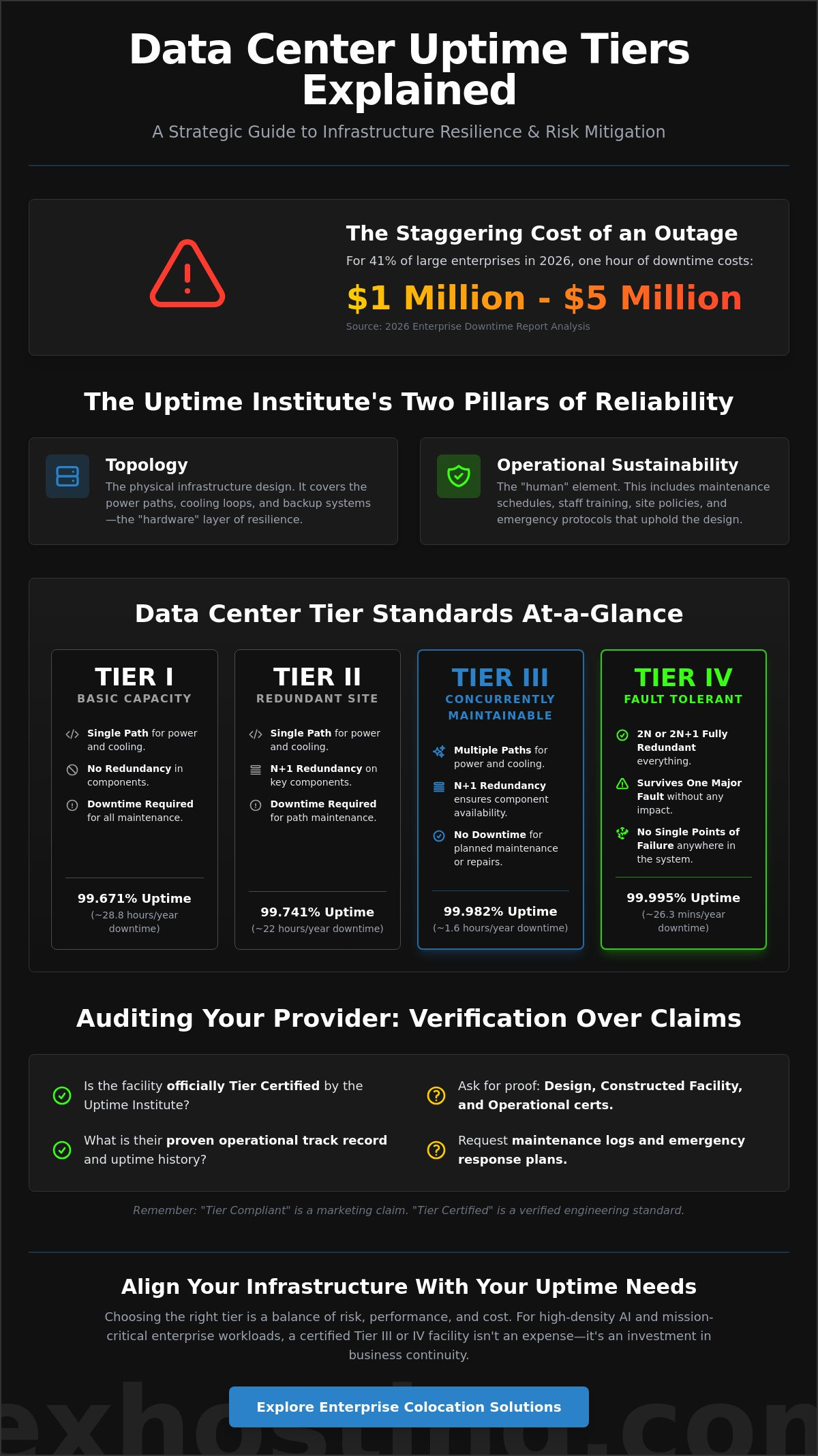
In 2026, 41% of large enterprises report that one hour of downtime costs between $1 million and $5 million. It’s a staggering figure that makes “good enough” infrastructure a massive business risk. You’ve likely felt the pressure to justify high-redundancy costs to stakeholders who only see the bottom line. You might also worry about overpaying for Tier IV fault tolerance when your specific workload doesn’t actually demand it.
Choosing the right facility shouldn’t feel like a guessing game. This guide provides a clear data center uptime tiers explained (Tier I-IV) framework to help you match your infrastructure to your specific risk profile. You’ll gain the technical clarity needed to distinguish between N+1 and 2N+1 systems while learning how to audit providers against the latest 2026 energy and AI density standards. We’ll explore how to ensure your mission-critical availability without wasting budget on unnecessary redundancy. This overview gives you the roadmap needed for a stable, high-performance deployment that meets modern regulatory and technical requirements.
Key Takeaways
- Understand the Uptime Institute’s dual pillars of Topology and Operational Sustainability to evaluate true facility resilience beyond just power and cooling.
- Use this data center uptime tiers explained (Tier I-iv) guide to distinguish between basic single-path capacity and fully fault-tolerant, concurrently maintainable architectures.
- Learn the engineering differences between N+1 and 2N+1 redundancy models to determine which level of fault tolerance matches your business risk.
- Master the specific auditing questions to ask providers, focusing on official certifications and proven operational track records over marketing claims.
- Align your full cabinet colocation strategy with the right tier level to balance cost-efficiency with high-density AI and enterprise availability.
Understanding the Uptime Institute Tier Classification System
The Uptime Institute (UI) introduced the Tier Classification System in the 1990s to create a common language for data center performance. It moved the industry away from vague marketing terms toward measurable engineering standards. Having Data center tiers allows stakeholders to compare facilities based on objective criteria rather than superficial promises. This foundation ensures that when we discuss data center uptime tiers explained (Tier I-IV), we’re looking at both the physical infrastructure and the management protocols that keep it running.
Official Tier Certification involves three separate stages. First, the Design Documents are audited to ensure the plans meet the standard. Second, the Constructed Facility is inspected to verify it was built according to those plans. Finally, Operational Sustainability assesses the management behaviors. Many providers claim to be “Tier III compliant,” but this is often a self-assessment. Without third-party verification, you’re essentially trusting a provider’s homework. This distinction is vital for your Service Level Agreement (SLA). A certified facility provides a level of certainty that a “compliant” site simply can’t match.
Topology vs. Operational Sustainability
Reliability stands on two distinct pillars. Topology refers to the physical design, including the arrangement of power paths, cooling loops, and backup generators. It’s the hardware layer. Operational Sustainability is the human element. It covers maintenance schedules, staff training, and emergency response protocols. A facility can have a world-class Tier IV topology, but if the operators fail to perform preventative maintenance, the system will eventually fail. High-density environments, especially those supporting AI workloads, demand that these two pillars work in perfect synchronization. If the management protocols don’t match the design quality, the technical redundancy becomes irrelevant.
Aligning Infrastructure to Business Goals
Higher tiers aren’t always better; they are simply more robust. A Tier IV facility offers the highest availability but comes with a significant price tag. For many enterprises, Tier III has become the standard baseline. It balances concurrent maintainability with cost efficiency. You must assess your specific Recovery Time Objective (RTO) and Recovery Point Objective (RPO). In 2026, the average cost of data center downtime ranges between $300,000 and $540,000 per hour. Understanding data center uptime tiers explained (Tier I-IV) helps you avoid over-provisioning while ensuring your most critical applications stay online. If your business can’t sustain even a few minutes of interruption, the investment in a higher tier is a logical insurance policy against catastrophic financial loss.
Technical Breakdown: Tier I through Tier IV Standards
Understanding the technical specifics behind each level is essential for infrastructure planning. The Uptime Institute’s Tier Standards provide the definitive blueprint for these classifications. While Tier I and II focus on basic capacity, Tiers III and IV introduce the sophisticated redundancy required for modern enterprise operations. When evaluating your infrastructure, having data center uptime tiers explained (Tier I-IV) allows you to map your technical needs to these specific hardware configurations.
Tier I and II: When Basic Redundancy Suffices
Tier I represents basic capacity with a single distribution path for power and cooling. There are no redundant components. If a pump or generator fails, the system goes dark. Tier II adds redundant components (N+1). This means there’s an extra generator or UPS on standby. However, it still relies on a single distribution path. If a pipe bursts or a circuit breaker trips in the main line, the entire facility is affected. For most professional deployments, Tier II is the bare minimum for non-critical workloads, small business backups, or development environments where a brief outage isn’t catastrophic.
Tier III and IV: The Enterprise Gold Standards
Tier III and Tier IV are where mission-critical reliability begins. Tier III introduces concurrent maintainability. This means every component and distribution path can be removed or replaced without impacting the IT load. It requires multiple power and cooling paths, though only one is active at a time. This configuration limits annual downtime to approximately 1.6 hours. It’s a robust choice for businesses that need 24/7 availability but can’t justify the extreme costs of a fault-tolerant setup.
Tier IV reaches the pinnacle of fault tolerance. It utilizes a 2N+1 architecture, where two completely independent systems are active simultaneously. If any single piece of equipment fails or a distribution path is interrupted, the workload continues without a millisecond of disruption. Tier IV also requires continuous cooling to handle the heat loads of high-density AI servers even during a power transition. The annual downtime allowance drops to just 26 minutes. This level of compartmentalization prevents a failure in one area from cascading through the system. If you’re building a resilient disaster recovery strategy, evaluating highly available data center infrastructure is the first step in protecting your mission-critical assets.
The choice between these standards depends on your risk tolerance. While Tier III protects against planned maintenance, Tier IV protects against unplanned events and human error. In a digital economy where downtime costs can exceed $5,600 per minute, the technical nuances of data center uptime tiers explained (Tier I-IV) become the foundation of your business continuity plan.
Redundancy Models: N+1 vs. 2N+1 and Their Impact on Business Continuity
Redundancy is the technical core of any uptime strategy. It’s the difference between a system that survives a component failure and one that crashes during routine maintenance. While the previous sections established the baseline for data center uptime tiers explained (Tier I-IV), the real world performance of a facility depends on its specific redundancy model. At the component level, N+1 provides a basic safety net. If your facility requires four UPS units to handle the full load (N), an N+1 design includes a fifth unit as a spare. This allows for the failure or maintenance of one unit without dropping the load. However, N+1 usually relies on a single distribution path, leaving the system vulnerable to failures in the wiring or switchgear.
True resilience for mission-critical applications requires 2N or 2N+1 architectures. A 2N system provides two completely independent distribution paths. Each path is capable of carrying the entire load on its own. If one side of the power grid or a main transformer fails, the second path takes over instantly. When you add a spare component to both of these paths, you reach 2N+1 redundancy. This setup is the gold standard for disaster recovery solutions because it virtually eliminates the need to fail over to a secondary site due to local hardware issues. It ensures that your infrastructure remains stable even during catastrophic equipment failures.
The Engineering of 2N+1 Redundancy
Implementing 2N+1 redundancy involves more than just doubling the hardware. It requires diverse power feeds from separate utility substations and connections through multiple carrier hotels to ensure network diversity. This level of compartmentalization is vital for high density GPU colocation. AI and machine learning workloads generate intense heat and draw massive amounts of power. A sudden power fluctuation in these environments doesn’t just cause downtime; it can lead to thermal shock and hardware damage. Active-active distribution paths ensure that power delivery remains smooth, even when the facility transitions between utility and generator power.
Cost vs. Benefit Analysis of Fault Tolerance
Selecting a redundancy level is a balance of risk and capital. Google Cloud’s perspective on Tier Standards highlights that while hardware redundancy is critical, modern cloud-native applications often build resilience at the software layer. For traditional enterprise workloads, however, the physical layer remains the primary defense. Tier III is often the sweet spot for many businesses. It provides concurrent maintainability without the extreme costs of Tier IV.
You must consider the hidden costs of over-engineering. 2N systems are inherently less efficient because equipment often runs at 40-50% capacity to ensure the other side can pick up the load. This can increase your Power Usage Effectiveness (PUE) and operational overhead. For financial services or healthcare providers, where a single significant outage can cost over $1 million, the ROI of Tier IV fault tolerance is clear. For others, a well-managed Tier III facility offers the most efficient path to reliable data center uptime tiers explained (Tier I-IV) performance.
Auditing Your Provider: Key Questions for Mission-Critical Reliability
Auditing a provider requires looking past sales brochures to verify technical reality. While having data center uptime tiers explained (Tier I-IV) provides the necessary vocabulary, a physical audit provides the proof. Start by requesting documentation for official Uptime Institute certifications. Many sites claim to be “built to Tier III standards” without ever undergoing a formal third-party audit. This creates a hidden risk for your SLA. You should also examine the operational track record over a multi-year period. A facility might have a Tier IV design, but its actual performance during utility grid stress tells the real story. Reliability is a result of consistent execution, not just expensive hardware.
Support excellence is the silent partner of infrastructure. Even a fault-tolerant system needs immediate attention when a component fails to restore redundancy. Professional remote hands support ensures that on-site technicians can swap hardware or troubleshoot connectivity without your team needing to travel. This responsiveness is a core part of maintaining the operational sustainability required for high-tier ratings. If a provider can’t guarantee 24/7 on-site technical expertise, their ability to maintain a Tier III or IV environment is compromised.
The 2026 High-Density Audit
AI and machine learning workloads have changed the audit checklist. Traditional air-cooled Tier III facilities often struggle with racks exceeding 20kW. In 2026, you must verify if a facility can handle 30kW to 50kW densities through liquid cooling or advanced thermoregulation. Ask for metered power transparency. You need to see how much of the redundant capacity is actually being utilized. Overloaded redundancy paths are a common cause of cascading failures during a utility outage. Ensure the provider can demonstrate how they maintain cooling tiers during peak AI processing loads without hitting thermal limits.
Physical Security and Compliance
Security is inseparable from uptime. Unauthorized access remains a primary cause of human-error downtime. Utilizing private suites or cages provides a physical barrier that enhances the “Operational Sustainability” pillar. These solutions ensure that only your authorized personnel interact with your hardware, preventing accidental cable pulls or power-cycle errors from other tenants. Ensure the facility maps its tier level to critical compliance standards like SSAE 18, SOC 2, and HIPAA. A Tier IV facility isn’t truly fault-tolerant if its security protocols allow for preventable breaches.
If you’re ready to move beyond generic claims, request a technical audit of our Miami facility to see how we maintain mission-critical standards for enterprise workloads.
Enterprise Colocation: Aligning Infrastructure with Uptime Requirements
Transitioning from a theoretical understanding of data center uptime tiers explained (Tier I-IV) to a live, production-ready environment requires a partner that understands the high stakes of enterprise availability. Your infrastructure foundation isn’t just about floor space. It’s about the engineering logic behind every power circuit and cooling vent. Selecting the right full cabinet colocation environment ensures that your mission-critical hardware sits on a bedrock of concurrent maintainability and high-speed connectivity. It’s the difference between reactive troubleshooting and proactive stability.
At 3EX Hosting, we integrate the rigorous principles of Tier III and Tier IV standards into every deployment. We don’t just provide space; we provide a managed ecosystem designed for technical stability. Our facilities are built to handle the most demanding mission-critical requirements. This ensures your systems remain online through both planned maintenance and unforeseen external events. We understand that every enterprise has a unique risk profile. That’s why we offer scalable options that range from shared environments to highly secure private suites. This flexibility allows you to align your physical layer with your specific business continuity goals without overpaying for unnecessary overhead.
Tailored Infrastructure Solutions
Customization is the key to operational efficiency. Our cage solutions allow you to define your own physical security and redundancy parameters within our high-tier environment. By leveraging our cross-connect services, you can build multi-homed network resilience that eliminates single points of failure at the carrier level. This commitment to technical excellence is backed by our expert on-site support team. We act as a magisterial extension of your IT department. We provide the eyes and hands needed to maintain your uptime 24/7, ensuring that every component of your data center uptime tiers explained (Tier I-IV) strategy is executed flawlessly.
Request a Technical Consultation
Auditing a facility for your specific mission-critical requirements is a vital step in the procurement process. We invite you to examine our infrastructure and discuss how we can customize power and cooling for your high-performance AI clusters. Our team specializes in high-density environments that require sophisticated thermoregulation and 2N+1 power paths to sustain massive GPU workloads. AI-driven power demands require a level of precision that standard facilities often lack. We provide the transparency and technical depth needed to ensure your deployment is future-proof.
Don’t leave your availability to chance. Get a custom quote for your enterprise colocation needs today and secure a resilient foundation for your digital future. Our experts are ready to help you navigate the technical nuances of modern infrastructure and select the redundancy model that best fits your business risk profile.
Securing a Resilient Foundation for Your Digital Infrastructure
Matching your business risk to the right redundancy level is no longer optional in an era where downtime costs can exceed $540,000 per hour. You now have the technical framework from this data center uptime tiers explained (Tier I-IV) guide to audit providers and distinguish between basic N+1 capacity and fault-tolerant 2N architectures. True reliability requires a balance between physical topology and operational sustainability to ensure your infrastructure scales alongside modern AI and high-density GPU demands.
We provide the technical stability and expert support required for mission-critical deployments. Our facilities feature enterprise-grade N+1 and 2N redundancy, designed specifically to handle the thermal and power requirements of high-density AI and GPU hosting. With 24/7/365 Remote Hands Support, our team ensures your systems remain stable and responsive around the clock. Our commitment to technical excellence means your data is always in expert hands.
Secure your mission-critical infrastructure with a custom 3EX Hosting quote and build your deployment on a foundation of proven reliability. Your enterprise deserves a partner that treats uptime as a technical certainty rather than a marketing promise. We are ready to help you future-proof your infrastructure today.
Frequently Asked Questions
What is the difference between Tier III and Tier IV data centers?
Tier III facilities provide concurrent maintainability, meaning any component can be removed for service without impacting the IT load. Tier IV adds full fault tolerance, where the system survives any single equipment failure or distribution path interruption without a service break. Tier IV also requires 2N+1 redundancy and continuous cooling to protect high-density hardware during power transitions.
Is a Tier IV data center always better than a Tier III?
Not necessarily, as the choice depends on your specific uptime requirements and budget. While Tier IV provides the highest level of resilience, its complexity and cost are often unnecessary for non-mission-critical applications. Tier III remains the enterprise standard for balancing cost with high availability. You should select the tier that matches your business risk profile rather than simply choosing the highest number.
What does N+1 redundancy mean in a data center?
N represents the base capacity needed to support the full IT load, while the +1 indicates a single redundant component. This could be an extra generator, UPS unit, or cooling pump. This configuration ensures that if one unit fails or needs maintenance, the extra component picks up the load immediately. It’s the baseline for professional reliability in Tier II and Tier III facilities.
How does Uptime Institute certify a data center?
Certification involves a rigorous audit of three distinct pillars. The Uptime Institute reviews the initial design documents, inspects the physical constructed facility, and evaluates operational sustainability protocols. This comprehensive process verifies that the site matches the engineering plans and management behaviors required for its assigned level. Many sites claim compliance, but only those with an official audit are truly certified.
Can a Tier III data center achieve 100% uptime?
Yes, many Tier III facilities deliver 100% availability through superior management and operational excellence. The tier rating describes the infrastructure’s capability to handle maintenance without shutdown, not a guarantee of failure. While the standard allows for 1.6 hours of annual downtime, a well-run facility can go years without a single second of interruption.
What are the power requirements for a Tier IV facility?
A Tier IV facility must have two completely independent, active distribution paths for power. This 2N or 2N+1 architecture ensures that each path can carry the entire load on its own. It also requires autonomous response systems to handle power transitions without human intervention. This prevents a failure in one distribution path from affecting the second path or the connected IT equipment.
Does colocation tiering affect network latency?
Tiering focuses exclusively on power and cooling infrastructure rather than network performance. However, higher-tier facilities are often located in carrier hotels with high fiber density. This proximity can reduce latency by providing direct access to major internet exchanges. While the tier level itself doesn’t define connection speed, the infrastructure quality often reflects the overall quality of the network environment.
How do high-density AI workloads impact data center tiering?
AI workloads generate intense heat and require massive power density per rack, often exceeding 30kW. In the context of data center uptime tiers explained (Tier I-IV), a facility must support these densities without losing its redundant cooling paths. High-density AI demands that the cooling infrastructure remains fault-tolerant even at maximum processing loads. This prevents thermal runaway if a single cooling component fails during peak AI processing cycles.