 SUPPORT


 3EX United States
 Blog
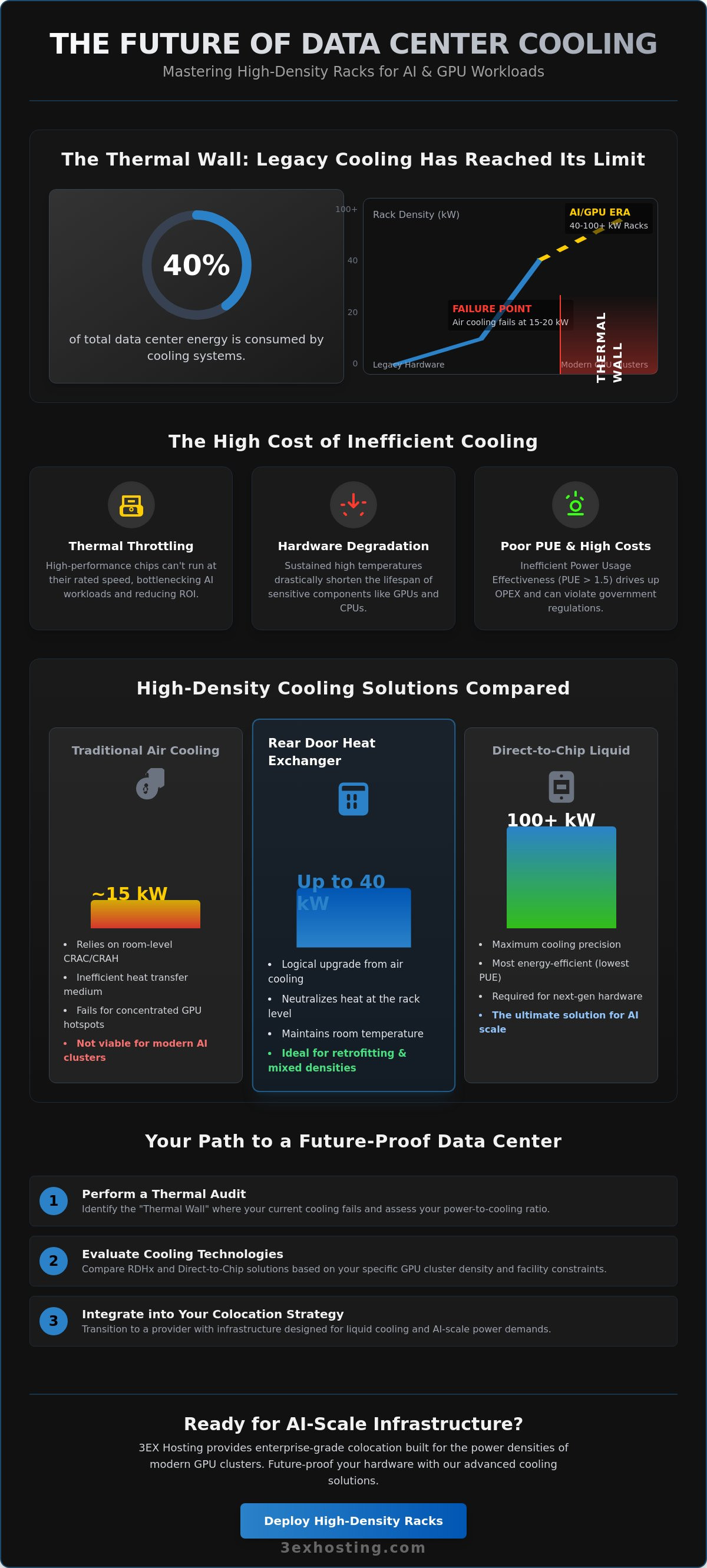
Cooling now consumes up to 40% of total data center energy. With 2026 rack densities commonly reaching 40 to 100 kW, traditional air-cooling has reached its physical breaking point. Relying on legacy fans for high-density server rack cooling solutions often leads to thermal throttling on GPU clusters and inefficient Power Usage Effectiveness (PUE) that drives up operational costs. You need a system that handles the heat without sacrificing uptime or physical space.
You’re likely feeling the pressure of government regulations mandating PUE ratios below 1.5 while trying to scale for massive AI workloads. We understand that transitioning from air to liquid cooling feels like a massive shift in infrastructure. This guide provides the technical frameworks you need to master AI-scale power densities exceeding 20kW per rack. We’ll explore how Direct-to-Chip (DLC), immersion cooling, and Rear-Door Heat Exchangers (RDHx) can lower your PUE, improve hardware reliability, and future-proof your colocation strategy for the next generation of high-performance hardware.
Key Takeaways
- Identify the “Thermal Wall” where traditional perimeter cooling fails and learn how to manage rack densities ranging from 15kW to over 100kW.
- Compare the technical advantages of Direct-to-Chip (DTC) and Rear Door Heat Exchangers (RDHx) as high-density server rack cooling solutions for GPU clusters.
- Evaluate the structural differences between row-based and rack-based cooling strategies to optimize your data center footprint and airflow.
- Follow a step-by-step roadmap for transitioning to liquid cooling, starting with comprehensive thermal audits and power-to-cooling ratio assessments.
- Discover how specialized Full Cabinet and Private Suite colocation can provide the stable, high-density infrastructure required for AI-scale power demands.
The Evolution of Data Center Cooling: Why High-Density Solutions are Essential in 2026
The 2026 data center cooling market has reached a projected $22.81 billion, reflecting an urgent shift in enterprise infrastructure. High-density server rack cooling solutions have transitioned from a niche requirement to a structural prerequisite. We define high-density cooling as systems capable of managing thermal loads between 15kW and 100kW+ per rack. This evolution is driven by the “Thermal Wall,” the point where traditional Perimeter Cooling, such as CRAC or CRAH units, becomes physically ineffective. You can’t simply blow more air at a rack when the power density exceeds the heat-carrying capacity of that air.
Inefficient cooling doesn’t just raise your power bill. It actively degrades hardware. Constant high temperatures shorten the lifespan of sensitive components and force chips to throttle performance. This creates a hidden spike in Total Cost of Ownership (TCO). You end up paying for high-performance silicon that can’t run at its rated speed because the environment is too hot. At 3EX Hosting, we focus on the technical stability required to prevent these failures through advanced infrastructure design.
The Threshold of Traditional Air Cooling
Air is an inefficient heat transfer medium. Compared to liquid, it requires massive volumes and high velocity to move the same amount of thermal energy. Standard hot and cold aisle containment strategies typically hit a hard ceiling between 15kW and 20kW. Beyond this, the Delta T, the temperature difference between the supply air and the exhaust, becomes too extreme to manage. Overcoming these limits often requires close-coupled cooling systems that bring the heat exchanger closer to the heat source, reducing the distance air must travel.
Impact of AI and GPU Clusters on Thermal Profiles
Standard CPU servers distribute heat relatively evenly across the chassis. In contrast, NVIDIA-class GPU clusters concentrate massive amounts of energy into small physical footprints. These clusters create intense localized hot spots that traditional room-level cooling cannot reach. Precision is now the priority. You need localized management to ensure every chip stays within its operational window. In 2026 hardware, Thermal Design Power (TDP) represents the maximum amount of heat a component generates under a specific workload that the cooling system must dissipate to maintain operational stability.
Sustained workloads like AI training and Large Language Model (LLM) inference have fundamentally altered the data center landscape. These operations aren’t bursty; they keep GPUs at peak power for weeks at a time. If your infrastructure isn’t designed for this, you’ll see a rapid decline in hardware reliability. Implementing robust high-density server rack cooling solutions ensures that your AI infrastructure remains fast, stable, and cost-effective over its entire lifecycle.
Primary High-Density Cooling Technologies: Air, Liquid, and Hybrid Approaches
Managing 100kW per rack requires a departure from traditional methodology. By 2026, high-density server rack cooling solutions have branched into three distinct categories: refined air-hybrid systems, direct-to-chip loops, and full immersion tanks. Choosing the right path depends on your hardware’s Thermal Design Power (TDP) and your existing facility constraints. We focus on providing the stability and speed required to deploy these technologies without the risks of trial-and-error implementation.
Rear Door Heat Exchangers (RDHx)
Rear Door Heat Exchangers (RDHx) offer a logical first step for enterprises transitioning from air-cooled environments. These units replace the standard back door of a server rack with a liquid-filled coil. Passive RDHx systems rely on the server’s internal fans to push hot air through the coil; active systems include dedicated fans for higher-density loads. This technology effectively neutralizes the heat before it enters the room, maintaining a neutral ambient temperature. It makes Full Cabinet Colocation viable for densities up to 40kW without requiring a complete room overhaul.
Direct-to-Chip (DTC) and Liquid Loop Integration
Direct-to-Chip (DTC) cooling takes precision a step further by bringing liquid directly to the cold plate on the GPU or CPU. A Coolant Distribution Unit (CDU) manages the pressure and flow, ensuring the hardware remains within safe thermal limits. In this comparative study of cooling technologies, data shows that liquid-to-chip methods significantly reduce energy overhead compared to air. Modern systems use quick-disconnect fittings to allow for hot-swapping hardware without fluid leaks. Using warm-water cooling in these loops can also eliminate the need for energy-hungry chillers, which drastically improves your PUE.
Immersion cooling represents the peak of thermal management for 100kW+ densities. Single-phase systems circulate a dielectric fluid that stays liquid, while two-phase systems utilize the latent heat of evaporation as the fluid boils and condenses. While these systems provide the highest reliability for AI GPU hosting, they require specialized tanks rather than standard racks. This is often the best choice for dedicated AI infrastructure hosting where maximum density is the primary goal.
Most enterprises face a hybrid reality. You don’t need to convert your entire facility to support a single AI pod. We often help clients integrate high-density islands within traditional halls, allowing for a phased transition. This approach balances the need for high-performance GPU hosting with your existing legacy hardware. If you’re planning an AI deployment, you can request a quote for a tailored infrastructure assessment to see which technology fits your specific load profile.
Evaluating Infrastructure: Row-Based vs. Rack-Based Cooling Strategies
Choosing between row-based and rack-based architectures is a critical decision for any enterprise scaling its infrastructure. While both fall under the umbrella of high-density server rack cooling solutions, they solve different spatial and thermal challenges. Close-coupled cooling serves as the foundational principle here. By placing the cooling source as close to the heat load as possible, you eliminate the bypass air and mixing issues that plague traditional raised-floor designs. This proximity ensures that the cooling capacity is used exactly where it’s needed, preventing the “Thermal Wall” we discussed previously.
The trade-off often comes down to floor space versus granular control. In-row units occupy the same footprint as a standard server cabinet, which can reduce your total rack count in a given row. However, they’re capable of cooling multiple high-density racks simultaneously. In-rack solutions preserve floor space by keeping the cooling hardware within the cabinet frame, but they require more complex plumbing or refrigerant lines for every individual unit. We help our clients analyze their power-to-cooling ratios to determine which path offers the best hardware reliability and long-term efficiency.
In-Row Cooling Mechanics and Scalability
In-row cooling units sit directly within the server row. They pull hot exhaust air from the rear aisle, chill it, and discharge it into the cold aisle. This horizontal airflow pattern is much more efficient than vertical delivery because it eliminates long air paths and reduces the fan power needed to maintain pressure. For mission-critical GPU workloads, in-row systems allow for N+1 redundancy at the row level. If one cooling unit fails, the others in the row ramp up to compensate. This architecture is particularly effective for Cage Colocation where private enterprise clusters require dedicated, scalable thermal management.
In-Rack Cooling for Sovereign High-Density Clusters
In-rack cooling provides a self-contained thermal environment. These units use integrated DX or chilled water coils within a fully enclosed cabinet. It’s an ideal solution for deploying high-density hardware in legacy data centers that weren’t originally built for AI-scale loads. You don’t have to worry about the room’s ambient temperature because the rack is thermally isolated. Localized cooling is essential for AI sovereignty because it allows organizations to maintain strict environmental control over their proprietary GPU clusters without impacting adjacent infrastructure. This level of isolation ensures that your high-density server rack cooling solutions remain stable even if the surrounding facility environment fluctuates.
Implementation Roadmap: Integrating High-Density Cooling into Your Colocation Strategy
Transitioning to high-density server rack cooling solutions requires a shift from general facility management to precision engineering. You can’t simply deploy 40kW racks into a space designed for 5kW loads without a structured plan. We recommend a five-step roadmap to ensure your infrastructure remains stable, fast, and cost-effective during this transition. This process moves beyond basic power availability to focus on the technical mechanics of heat rejection and structural integrity.
- Step 1: Thermal Audit. Conduct a comprehensive audit of your current hardware and projected AI growth. You need to know the specific Thermal Design Power (TDP) of every GPU and CPU in your cluster to size your cooling loops correctly.
- Step 2: Power-to-Cooling Ratios. Assess the facility’s ability to support heat rejection. It’s not enough to have the power to run the servers; the data center must have the mechanical capacity to remove the resulting thermal energy.
- Step 3: Floor Loading Assessment. High-density cabinets and liquid-cooled tanks are significantly heavier than standard racks. Verify that the floor can support the concentrated weight of these systems.
- Step 4: Provider Selection. Choose a partner with carrier-hotel connectivity and documented expertise in high-density environments. Proximity to fiber backbones is just as critical as the cooling itself.
- Step 5: SLA Definition. Define clear Service Level Agreements for thermal management. These should include specific temperature thresholds and uptime guarantees for the cooling distribution units (CDUs).
Assessing Power Density and Floor Loading
Weight is a frequently overlooked constraint in high-density deployments. Modern racks filled with GPU clusters or immersion tanks often exceed 3,000 lbs. This weight density requires reinforced flooring or slab-on-grade environments to prevent structural failure. Calculating your cooling load is equally vital. A general rule is that 1 kW of power translates to approximately 3,412 BTU/h of heat that must be removed. Our Full Cabinet Colocation solutions are designed to handle these specific structural and thermal demands while maintaining high availability.
The Role of Carrier Neutrality in High-Density Deployments
Proximity to fiber backbones matters because high-density AI clusters generate and process massive datasets. There’s a direct synergy between high-density cooling and low-latency cross-connects. If your cooling keeps the chips running at peak speed, but your network introduces latency, the efficiency of the cluster is lost. Utilizing a 3EX Hosting Data Center ensures you have the carrier-neutral connectivity required to feed your high-performance hardware. This combination of thermal stability and network speed is the foundation of a successful AI strategy.
If you’re ready to evaluate your current infrastructure against these requirements, you can request a quote for a technical consultation to secure your high-density footprint.
Future-Proofing with 3EX Hosting: Enterprise High-Density Colocation Solutions
3EX Hosting serves as a technical anchor for enterprises deploying AI-scale hardware. We provide the stability and precision required to manage power densities exceeding 20kW per rack without the risks of thermal throttling. Our facilities are engineered specifically to support advanced high-density server rack cooling solutions, offering the mechanical capacity that legacy data centers cannot provide. We focus on technical excellence so your team can focus on scaling AI models and high-performance clusters with total confidence.
Security and sovereignty are fundamental to our cage and suite solutions. We understand that AI workloads often involve proprietary data and sensitive intellectual property. By providing isolated, high-density environments, we ensure that your hardware is protected both physically and thermally. Our infrastructure is built to handle the intense heat profiles of modern GPU clusters while maintaining the strict environmental controls required for enterprise-grade reliability. We don’t just provide space; we provide a stable foundation for your most critical computing assets.
Scalable Infrastructure and Private Suites
Our Private Data Center Suites offer a controlled environment for custom cooling configurations. These suites are designed to accommodate the specialized needs of enterprise clients, including the integration of Rear-Door Heat Exchangers (RDHx) and Direct-to-Chip (DTC) loops. We work closely with your engineering team to ensure that the facility’s chilled water or DX systems interface perfectly with your rack-level hardware. This level of customization allows you to deploy sovereign AI clusters that meet your specific performance and security requirements.
Operational Excellence with 24/7 Remote Hands
High-density, liquid-cooled hardware demands a higher level of on-site technical expertise than traditional air-cooled servers. Our Remote Hands Support provides the specialized assistance necessary to maintain complex thermal systems. Our technicians understand the mechanics of liquid loops, from monitoring Coolant Distribution Units (CDUs) to managing leak-detection protocols. This proactive support is essential for maintaining the uptime of high-performance clusters that run 24/7.
The complexity of high-density deployment begins the moment your hardware arrives. Our Move-In Assistance is specifically designed to handle the logistical challenges of heavy, liquid-cooled racks. We manage the structural and power-up requirements to ensure a fast, safe transition into your new environment. If you’re ready to secure a footprint that can handle the thermal demands of 2026 and beyond, you can Get a Quote for your high-density deployment today. We provide the speed and reliability your enterprise requires to stay competitive in the AI era.
Secure Your Competitive Edge in the AI Infrastructure Era
Mastering the transition from traditional air cooling to liquid-based architectures is no longer optional for enterprises running AI workloads. We’ve seen how the thermal wall of 20kW per rack requires a move toward precision, close-coupled systems. By adopting high-density server rack cooling solutions, you ensure that your GPU clusters operate at peak performance without the risk of thermal throttling or premature hardware failure. This shift lowers your PUE and provides the physical scalability needed for 2026 and beyond.
Success depends on a foundation of technical stability and expert support. 3EX Hosting offers high-density optimized cabinets and carrier hotel connectivity to keep your data flowing at maximum speed. Our 24/7 expert remote hands are always available to manage your complex liquid-cooled hardware, giving you the peace of mind that your systems are in professional hands. Don’t let legacy cooling constraints hold back your innovation. Request a High-Density Infrastructure Consultation today and build a future-proof colocation strategy that scales with your ambition.
Frequently Asked Questions
What is considered a high-density server rack in 2026?
In 2026, high-density racks are those supporting power loads between 15kW and 100kW+. While 5kW was once the enterprise standard, modern AI GPU clusters have pushed the baseline significantly higher. High-density server rack cooling solutions become a technical requirement once you exceed the 20kW threshold, as traditional air-cooling can’t dissipate the heat fast enough to prevent hardware throttling.
Can I use liquid cooling in a standard colocation cabinet?
You generally can’t use advanced liquid cooling in a standard air-cooled cabinet without significant modifications. Most high-density setups require specific manifolds, plumbing, or rear-door heat exchangers that standard racks don’t include. It’s better to use specialized cabinets pre-engineered for fluid distribution. This ensures technical stability and prevents the risks associated with retrofitting hardware not designed for liquid loops.
How does high-density cooling affect my data center PUE?
High-density cooling significantly improves Power Usage Effectiveness (PUE) by reducing the energy spent on massive fan arrays and room-level chillers. Liquid is much more effective at carrying heat than air. By moving to liquid-to-chip or immersion methods, many enterprises achieve PUE ratios below 1.2. This efficiency helps facilities meet the latest government regulations mandating PUE ratios below 1.5.
What is the difference between active and passive rear door heat exchangers?
Passive rear door heat exchangers rely on the server’s internal fans to push hot air through the cooling coil. Active systems include their own dedicated fan arrays to pull air through the coil more aggressively. Active RDHx units are better for densities exceeding 30kW. They’re essential when server fans alone aren’t strong enough to overcome the coil’s airflow resistance and maintain proper Delta T.
Is liquid cooling safe for mission-critical enterprise hardware?
Liquid cooling is safe and highly reliable when you use industrial-grade components and professional installation. Modern high-density server rack cooling solutions use dielectric fluids or leak-resistant quick-disconnect fittings to protect sensitive electronics. These systems actually increase hardware reliability by maintaining a consistent, lower operating temperature. This stability prevents the thermal stress often caused by air-cooling fluctuations.
How much power do I need for a high-density cooling system?
The power required for the cooling system itself is usually about 5% to 10% of the total rack load. This includes the pumps in the Coolant Distribution Unit (CDU) and any fans on an active rear door. While this adds a small overhead, it’s significantly less than the energy required to run traditional room-level air conditioning for the same heat load. It’s a more efficient use of your power budget.
What are the floor loading requirements for high-density racks?
High-density racks often exceed 3,000 lbs once you include GPU clusters and liquid cooling manifolds. This weight requires reinforced flooring or slab-on-grade data center halls. Standard raised floors in legacy facilities may not support these concentrated loads. You should always verify the structural capacity of your colocation space before deploying cabinets that exceed 2,500 lbs to ensure the physical safety of your infrastructure.
Does 3EX Hosting support custom liquid cooling integrations?
3EX Hosting supports custom liquid cooling integrations within our private suites and high-density optimized cabinets. We work with enterprise clients to facilitate Direct-to-Chip (DTC) and Rear-Door Heat Exchanger (RDHx) setups. Our technical teams provide the stability and expertise needed to manage the facility-side plumbing and power-to-cooling ratios. We ensure your specific AI hardware deployment has the precise thermal environment it needs to stay fast and reliable.