 SUPPORT


 3EX United States
 Blog
With the Thermal Design Power of leading-edge GPUs projected to exceed 4,000 W by 2029, the era of relying solely on air is over. You’ve likely watched your PUE climb as rack densities hit 40 kW, feeling the pressure to balance performance with rising energy costs. It’s a common concern; managing fluid in a server environment feels complex and carries inherent risks. We understand that technical stability is your primary priority when scaling high-density infrastructure.
This guide helps you master liquid cooling in data centers to support intensive AI and GPU workloads with maximum efficiency and zero downtime. You’ll learn how to navigate the 2026 regulatory landscape, including California’s updated Title 24 standards and the EPA’s 85% HFC phase-down, while selecting the right architecture for your deployment. We’ll explore the transition from traditional air systems to advanced solutions like 2.5 MW coolant distribution units and direct-to-chip configurations. By the end of this article, you’ll have a clear roadmap for integrating liquid-cooled infrastructure that ensures your hardware stays fast, cool, and reliable.
Key Takeaways
- Understand why the “Thermal Wall” makes transition to liquid-cooled infrastructure a physical necessity for 2026 AI and GPU workloads.
- Evaluate the technical differences between Direct-to-Chip (DLC) and immersion liquid cooling in data centers to select the most reliable architecture for your density requirements.
- Learn how to maximize your compute ROI by capturing the “performance dividend” and eliminating the energy costs of thermal throttling.
- Follow a practical roadmap for auditing hardware readiness and selecting colocation facilities equipped with the necessary plumbing and CDU capacity.
- Discover how integrating custom liquid cooling manifolds can future-proof your high-density infrastructure against the rising TDP of next-generation processors.
The AI Thermal Wall: Why Liquid Cooling is Mandatory in 2026
Liquid cooling in data centers is the process of using high-thermal-conductivity fluids to remove heat directly from high-performance components. Unlike traditional systems that rely on ambient air, these fluids circulate through cold plates or around submerged hardware to absorb thermal energy at the source. This method is no longer a luxury for experimental labs; it’s a fundamental requirement for 2026 enterprise infrastructure. As AI workloads dominate the landscape, the industry has hit a physical limit known as the “Thermal Wall.”
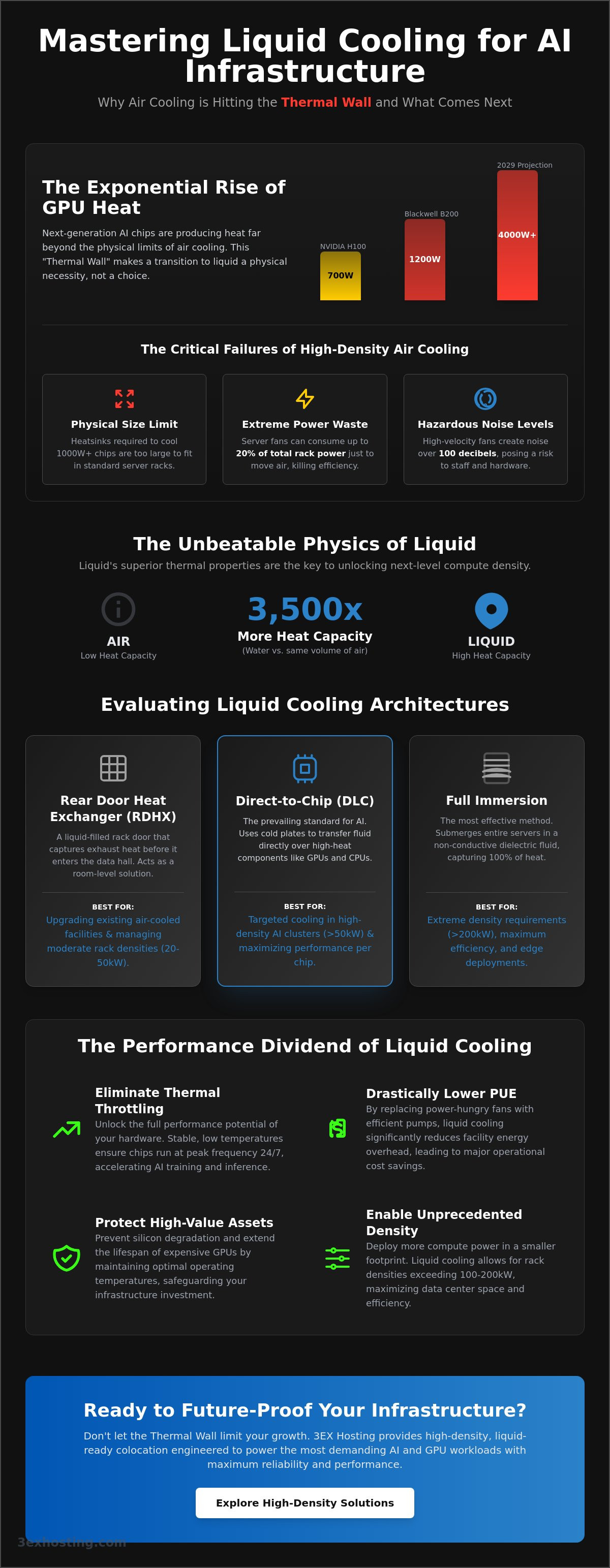
This wall exists because air-cooled heatsinks have reached their maximum effective size. To cool a modern NVIDIA H100 or a Blackwell B200 class GPU, which can pull between 700W and 1,200W respectively, an air-based heatsink would need to be so large it wouldn’t fit inside a standard server chassis. With the Thermal Design Power (TDP) of next-generation chips projected to exceed 4,000 W by 2029, the physical space required for air transfer simply isn’t available in a high-density rack. Beyond space, fan power consumption is cannibalizing energy budgets. In high-density air-cooled setups, server fans can consume up to 20% of the total rack power just to move enough air to prevent a shutdown. This inefficiency drives up costs and lowers the overall compute output per watt.
Physical Limits of Air Heat Transfer
The core of the problem lies in the basic computer cooling principles regarding specific heat capacity. Water can carry approximately 3,500 times more heat than the same volume of air. Dielectric fluids also offer significantly higher thermal transfer rates than air, allowing for more compact and efficient designs. When rack densities exceed 50kW, high-velocity fans become a liability rather than a solution. They require massive amounts of electricity and create a “Noise Floor” issue, where acoustic levels in the data center exceed 100 decibels. This creates a dangerous environment for technicians and can even cause hardware failures due to vibration. Liquid cooling in data centers solves this by replacing noisy, power-hungry fans with silent, efficient fluid pumps.
The Shift to High-Density GPU Hosting
Modern enterprises realize that high density GPU colocation requires integrated thermal management to maintain peak performance. There’s a direct relationship between chip temperature and AI model training stability; even minor fluctuations can cause “jitter” or hardware throttling that extends training times by days. Thermal management is now a performance metric, not just a facility concern. The AI Thermal Wall is the point where air cannot move heat fast enough to prevent silicon degradation. Transitioning to fluid-based systems is the only way to protect these expensive assets while maintaining the speeds required for competitive AI development.
Evaluating Liquid Cooling Architectures: DLC vs. Immersion
Selecting the appropriate architecture for liquid cooling in data centers requires an objective look at both performance and operational complexity. As enterprises move beyond the limits of air, they typically choose between Direct-to-Chip (DLC) systems, immersion tanks, or Rear Door Heat Exchangers (RDHX). RDHX often serves as a bridge technology; it replaces the standard rack door with a liquid-filled radiator that captures heat before it enters the room. While RDHX helps manage ambient temperatures, it doesn’t solve the problem of high-TDP chips requiring localized cooling at the silicon level.
For most 2026 deployments, the choice comes down to how much you’re willing to modify your hardware and infrastructure. Research from the Lawrence Berkeley National Laboratory indicates that while liquid systems are significantly more efficient than air, the implementation strategy must align with your specific maintenance capabilities. If you need to scale quickly without redesigning every server, a hybrid approach is often the most stable path forward. This involves using liquid for high-heat components like GPUs while relying on traditional air for lower-power secondary components.
Direct-to-Chip (DLC) and Cold Plates
Direct-to-Chip cooling, or cold-plate cooling, is currently the prevailing architecture for AI clusters. This method uses a metal plate with internal fluid channels mounted directly onto the CPU or GPU. It targets the highest heat producers where they sit, allowing the rest of the server to remain air-cooled. This architecture is particularly effective for full cabinet colocation because it fits within standard rack footprints. Maintenance is straightforward, provided you use high-quality, leak-proof couplings and manage your manifolds with precision. It’s a reliable way to support 700W+ chips without a total facility overhaul.
Immersion Cooling: Single-Phase vs. Two-Phase
Immersion cooling takes a more radical approach by submerging the entire server in a non-conductive dielectric fluid. In single-phase immersion, the fluid stays in a liquid state as it circulates through a heat exchanger. Two-phase immersion is more complex; the fluid boils when it touches hot components, turns into a gas, and then condenses back into a liquid. While immersion offers the ultimate solution for extreme densities, it requires specialized server modifications, such as removing fans and sealing certain components. It’s a high-performance choice but carries a higher CAPEX premium, often estimated between $2,500 and $4,500 per kW. If you’re planning a high-density deployment, exploring Miami colocation options that support these advanced thermal loads is a critical first step.
While immersion provides the highest efficiency, liquid cooling in data centers is most frequently deployed via DLC due to its balance of performance and ease of service. Both architectures significantly outperform air, but your decision should rest on your long-term hardware roadmap and the specific density requirements of your AI workloads.
The ROI of Liquid Cooling: Beyond Power Usage Effectiveness (PUE)
Maximizing the return on investment for high-density compute requires looking past the raw hardware cost. While Power Usage Effectiveness (PUE) remains a standard industry metric, it doesn’t tell the full story of operational efficiency. Traditional cooling can account for up to 40% of a data center’s total energy consumption. By transitioning to fluid-based thermal management, enterprises can capture what we call the “Performance Dividend.” This is the tangible gain in compute output achieved by eliminating thermal throttling. When your GPUs operate at a stable, lower temperature, they maintain peak clock speeds consistently, ensuring you get the full processing power you’ve paid for.
Stable operating environments also extend the physical lifespan of your silicon. Thermal cycling, the constant expansion and contraction of components as they heat up and cool down, is a primary cause of hardware failure. Liquid cooling in data centers provides a more consistent thermal envelope, reducing mechanical stress on chips and solder joints. Industry experts often describe this shift as the hottest innovation in the sector because it addresses both energy efficiency and hardware reliability simultaneously. While the capital expenditure (CAPEX) premium for direct-to-chip systems is estimated at $2,500 to $4,500 per kW, the long-term operational savings and performance gains often justify the initial investment in high-density environments.
Calculating the Total Cost of Cooling (TCC)
A true ROI analysis must factor in the Total Cost of Cooling (TCC). This includes the price of dielectric fluids, specialized maintenance, and the power required for pumps rather than massive CRAC fans. Liquid cooling can reduce cooling energy consumption by up to 90% compared to traditional air-based units. For enterprises using metered power structures, this efficiency translates directly into lower monthly OPEX. By spending less on moving air, you can allocate more of your power budget to actual compute tasks.
Space Efficiency and Rack Density
Physical footprint is the final piece of the ROI puzzle. Liquid cooling in data centers allows for rack densities exceeding 100kW, which is nearly impossible to achieve with air without massive aisle spacing. This density allows you to consolidate infrastructure, which has several benefits:
- Reduced Floor Space: You can fit more compute power into a smaller square footage, delaying the need for expensive facility expansions.
- Simplified Networking: Shorter cable runs between nodes reduce cross-connect complexity and can even lower latency in high-performance clusters.
- Optimized Utility Distribution: Concentrating power and cooling in fewer racks simplifies the physical layout and reduces the weight loading issues associated with sprawling, air-cooled server farms.
Consolidating your infrastructure into high-density, liquid-cooled rows doesn’t just save energy; it streamlines your entire operational workflow, making your technical foundation more agile and secure.
Implementation Roadmap: Preparing for Liquid-Cooled Colocation
Implementing liquid cooling in data centers requires moving beyond standard rack-and-stack procedures. It’s a shift from managing airflows to managing fluid dynamics. The first step involves a rigorous audit of your hardware. You need to determine if your GPUs are factory-ready for cold plates or if they require third-party conversion kits. Removing fans and installing manifolds changes the physical profile of your servers, so verify that your chassis can still fit within standard rail systems. This transition is a technical evolution that demands precision at every stage of the deployment.
Once hardware is verified, facility selection becomes the primary constraint. You must partner with a provider that offers the necessary plumbing and Coolant Distribution Unit (CDU) capacity to handle high-density thermal loads. Designing the secondary cooling loop, which is the connection between the facility manifold and your specific rack, is where most technical challenges occur. This loop must be pressurized correctly to ensure consistent flow without stressing the couplings. It’s not just about the fluid; it’s about the stability of the entire delivery system.
Plumbing and Infrastructure Requirements
The Coolant Distribution Unit (CDU) is the heart of the system. It acts as the interface between the data center’s primary chilled water loop and the rack’s secondary loop. By managing pressure, flow rates, and temperatures, the CDU prevents thermal shock to sensitive silicon. Water quality is another critical factor. Both loops require treated water with low mineral content to prevent scale buildup and galvanic corrosion. For enterprises requiring maximum control over these variables, integrating liquid cooling into private suites allows for dedicated infrastructure that isn’t shared with other tenants. This setup ensures that your specific thermal requirements are met without compromise.
Operational Safety and Risk Management
Safety protocols must evolve when you introduce liquids into a server environment. Reliable leak detection sensors are essential. These should be placed at the lowest points of the rack and near all manifold connections. Automatic shut-off valves can stop the flow of coolant the moment moisture is detected, protecting your hardware from short circuits. Managing “wet” infrastructure also requires a different skill set for on-site staff. Establishing clear remote hands support protocols is vital for 24/7 thermal monitoring and fluid maintenance. Technicians must be trained to check fluid levels, inspect quick-disconnect couplings, and monitor for particulates in the secondary loop. If you’re ready to transition your AI workloads to a high-density facility, request a technical consultation to review your specific thermal requirements.
Future-Proofing with 3EX Hosting High-Density Infrastructure
3EX Hosting positions your enterprise at the forefront of the AI revolution by providing the specialized infrastructure required for high-TDP clusters. While many providers struggle with the power draw of modern GPUs, our facility is engineered to support the specific demands of liquid cooling in data centers. We don’t just provide space; we provide a technical foundation where custom liquid cooling manifolds and Coolant Distribution Units (CDUs) are standard considerations, not afterthoughts. Our team understands that technical stability is the only metric that matters when running multi-million dollar AI training models.
Deploying these systems is complex, but it shouldn’t be high-friction. We’ve developed a specialized move-in assistance program specifically for liquid-cooled hardware. This service ensures that your cold-plate equipped servers are integrated into our data center environment with precision. We handle the logistical heavy lifting, allowing your engineers to focus on software performance rather than plumbing connections. Our infrastructure is built to handle the weight and utility requirements of 2026’s most demanding hardware.
Customized High-Density Solutions
Our approach focuses on tailoring cage and suite configurations to match your exact power and thermal requirements. Whether you’re deploying a single high-density rack or a multi-megawatt private suite, we provide the carrier-neutral connectivity and high-speed fiber access essential for distributed AI workloads. This low-latency environment ensures that data moves as fast as your hardware processes it. By consolidating your compute into a smaller, liquid-cooled footprint, you reduce cross-connect complexity and optimize your utility distribution. We ensure your systems have the breathing room to scale without hitting a power or thermal ceiling.
Expert Support for Complex Deployments
The reliability of liquid cooling in data centers depends on consistent monitoring and expert intervention. Our on-site technicians provide 24/7 oversight of your thermal environment and power delivery systems. We act as your eyes and ears on the ground, managing the physical logistics of fluid maintenance and manifold pressure checks. This proactive support model minimizes the risk of thermal events and ensures your high-density infrastructure remains operational under the most intensive workloads. Our team is trained to handle the specific needs of “wet” infrastructure, providing the peace of mind that your assets are in expert hands.
If you’re ready to secure a stable, high-performance environment for your next GPU cluster, we’re here to help. Request a custom quote for your high-density liquid cooling project and see how our infrastructure supports your long-term growth.
Securing Your High-Density Compute Roadmap
It’s clear that the transition to liquid cooling in data centers is a technical necessity for those deploying next-generation GPU clusters. You’ve seen how air cooling hits a physical wall at 50kW per rack and why direct-to-chip architectures offer the most reliable path for 2026 enterprises. By focusing on ROI through the “performance dividend” and stable hardware lifespans, you can turn thermal management into a competitive advantage. Technical stability is the foundation of every successful AI deployment.
3EX Hosting provides the professional infrastructure needed to manage these complex environments. We support rack densities exceeding 50kW and offer enterprise-grade leak detection and mitigation protocols to protect your high-value hardware. Our specialized remote hands team is trained for precision thermal management, ensuring your fluid-based systems remain operational around the clock. Your high-density project deserves a facility that is as fast and reliable as your compute power. We’re ready to help you bridge the gap to next-generation cooling.
Scale your AI infrastructure with a liquid-ready custom quote
Frequently Asked Questions
Is liquid cooling safe for enterprise servers?
Liquid cooling is safe when implemented with enterprise-grade components and dielectric fluids. Cold plates isolate the liquid from electronics; immersion uses non-conductive fluid that won’t cause short circuits even if it touches a live PCB. Modern systems include multi-point leak detection and automatic shut-off valves to mitigate risks. These layers of protection ensure technical stability for mission-critical AI hardware.
What is the difference between single-phase and two-phase immersion cooling?
Single-phase immersion keeps the dielectric fluid in a liquid state as it circulates through a heat exchanger. Two-phase immersion is more advanced; the fluid boils when it touches hot components, turns into vapor, and then condenses back into liquid. While two-phase offers higher heat rejection, it’s more complex to manage due to pressure changes. Most enterprise deployments favor single-phase for its operational simplicity and reliability.
Can I retrofit my existing air-cooled servers for liquid cooling?
You can retrofit many air-cooled servers for liquid cooling in data centers using direct-to-chip conversion kits. This process involves removing existing heatsinks and fans, then installing cold plates and manifold connectors. It’s essential to check with your hardware vendor first, as these modifications can void standard warranties. Many enterprises choose this path to extend the life of high-TDP legacy systems without a full hardware refresh.
How does liquid cooling impact Data Center PUE?
Liquid cooling significantly improves Power Usage Effectiveness (PUE) by eliminating the energy-intensive fans and large-scale chillers required for air. By moving heat more efficiently, facilities can achieve PUE ratings below 1.1. This reduction in overhead power allows you to allocate a larger portion of your utility budget directly to compute performance. It’s a key strategy for meeting the strict efficiency requirements of modern energy standards.
What happens if there is a leak in a direct-to-chip cooling system?
If a leak occurs in a direct-to-chip system, sensors at the manifold and rack base trigger an immediate shut-off of the secondary cooling loop. High-quality systems use dripless quick-disconnect couplings to minimize fluid loss during maintenance or failure. Since many systems now use non-conductive fluids, the risk of catastrophic hardware damage is much lower than with traditional water-based loops. Proactive monitoring remains the best defense against downtime.
Do I need specialized racks for liquid-cooled deployments?
Specialized racks are typically required to support the weight and plumbing of liquid-cooled systems. These racks include integrated manifolds and vertical space for Coolant Distribution Units (CDUs). They also feature reinforced frames to handle the increased weight loading of fluid-filled servers. Standard air-cooled cabinets often lack the necessary clearance for the secondary loop hoses and high-pressure couplings required for liquid cooling in data centers.
How much more expensive is liquid cooling compared to air cooling?
The capital expenditure for liquid systems is higher than air cooling, with direct-to-chip setups often requiring a premium of $2,500 to $4,500 per kW. However, the total cost of ownership often breaks even within three to five years due to lower energy bills and avoided hardware throttling. As rack densities exceed 50kW, the cost of scaling air cooling infrastructure actually surpasses the cost of liquid-based alternatives.
What kind of maintenance does a liquid cooling system require?
Maintenance involves monitoring fluid chemistry, inspecting couplings for wear, and cleaning particulate filters. You should check the pH levels and conductivity of your coolant regularly to prevent corrosion or biological growth. Many enterprises rely on remote hands support to perform these physical checks and manage fluid top-offs. Consistent maintenance ensures the long-term reliability of your thermal infrastructure and prevents unexpected performance drops.