 SUPPORT


 3EX United States
 Blog
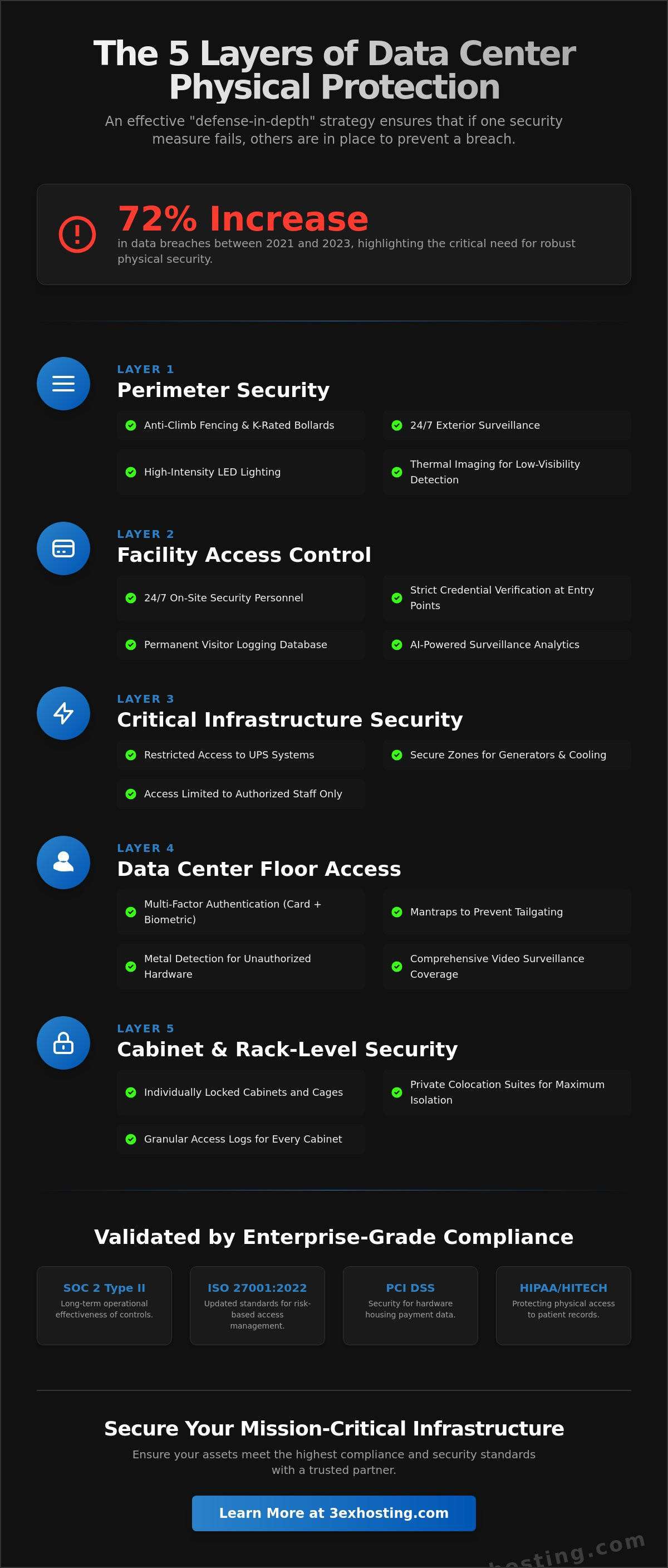
Data breaches saw a 72% increase between 2021 and 2023, and for many enterprises, the vulnerability didn’t start with a line of code, but with a physical security gap. You’ve likely felt the pressure of distinguishing between “marketing security” and genuine data center physical security standards. It’s a common frustration to worry that a provider’s negligence might lead to a catastrophic audit failure or a costly breach that compromises your hardware. You need technical stability and a documented audit trail, not just a locked door.
This guide will help you master the complex landscape of infrastructure protection to ensure your mission-critical assets meet the highest compliance requirements for 2026. You’ll gain a clear framework for evaluating facilities, from the mandatory transition to ISO 27001:2022 to the enforcement of the NIS 2 Directive. We’ll examine specific audit requirements for SOC 2 and the physical layers necessary for high-density AI GPU hosting, giving you total confidence in your infrastructure choice.
Key Takeaways
- Understand the mandatory shift to ISO 27001:2022 and how SOC 2 Type II audits validate the effectiveness of your provider’s internal controls.
- Learn to evaluate the five essential layers of data center physical security standards, ranging from perimeter fencing to granular access controls at the rack level.
- Discover how combining AI-powered surveillance analytics with on-site security personnel creates a proactive defense system that stops threats before they reach your hardware.
- Use our comprehensive audit checklist to verify critical safety measures like tailgating prevention and visitor logging during your next facility walkthrough.
- Explore how specialized infrastructure like private colocation suites and secure cage solutions provide the highest level of isolation for mission-critical enterprise workloads.
The Evolution of Data Center Physical Security Standards
Physical security is the bedrock of any holistic cybersecurity strategy. If an unauthorized individual gains physical access to a server, digital encryption and firewalls become secondary concerns. In 2026, data center physical security standards have moved beyond simple fences and badge readers. They now represent a sophisticated, multi-layered ecosystem designed to prevent, detect, and respond to threats in real time. Modern infrastructure protection treats the physical environment as an integrated component of the technical stack. This evolution reflects a shift from “perimeter-only” security to granular, rack-level protocols where every touchpoint is logged. Comprehensive Data center security now requires a documented audit trail that satisfies both internal risk management and external regulators.
Regulatory Frameworks and Compliance
Passing an enterprise-level audit today depends on adhering to specific regulatory frameworks. The SOC 2 Type II distinction is the gold standard for physical security. Unlike Type I, which only looks at a point in time, Type II measures the operational effectiveness of security controls over a period of months. This ensures that security isn’t just a policy on paper but a daily operational reality. As of 2026, all organizations must also comply with ISO/IEC 27001:2022. The 2013 version is officially retired, and the updated standard places a heavier emphasis on risk-based physical access management. Industry-specific requirements add another layer of complexity. Financial entities must meet PCI DSS standards for hardware housing payment data, while healthcare providers rely on HIPAA/HITECH compliance to protect physical access to patient records. These frameworks provide the technical stability enterprises need to operate without fear of compliance failure.
The Business Impact of Physical Breaches
The cost of a physical breach extends far beyond the immediate loss of hardware. It includes massive operational downtime, legal fines, and long-term reputational damage. Data breaches saw a 72% increase between 2021 and 2023, making physical resilience a top priority for stakeholders. Implementing robust data center physical security standards directly impacts your bottom line by lowering cybersecurity insurance premiums. Insurers now view physical access controls as a primary risk mitigator. There is also a critical link between physical security and disaster recovery solutions. A facility that cannot guarantee physical integrity cannot guarantee business continuity. When physical access is strictly controlled and monitored, the recovery process becomes more predictable. Security professionals know that a stable physical environment is the only way to ensure that mission-critical infrastructure remains available during a crisis.
The Five Layers of Data Center Physical Protection
Effective infrastructure protection relies on a defense-in-depth model. This “onion” approach ensures that if one security measure fails, others remain in place to stop a breach. Adhering to modern data center physical security standards requires a rigorous application of five distinct layers. Each layer serves a specific purpose in the overall security posture of the facility.
- Layer 1: Perimeter Security. This is the first line of defense. It includes physical barriers like K-rated bollards to prevent vehicle ramming, anti-climb fencing, and high-intensity LED lighting. 24/7 exterior surveillance with thermal imaging detects movement even in low-visibility conditions.
- Layer 2: Facility Access. Security starts at the gate. Professional facilities utilize staffed entry points where security personnel verify credentials before any vehicle or individual enters the property. All visitors must be logged into a permanent database.
- Layer 3: Support Areas. Critical infrastructure like UPS systems, generators, and cooling units require their own restricted access. Compromising these rooms can lead to a total system shutdown. These areas are strictly off-limits to everyone except authorized maintenance staff.
- Layer 4: The Data Center Floor. This is the inner sanctum. Entry requires multi-factor authentication, often combining a physical key card with biometric verification. Metal detection and mantraps ensure that no unauthorized hardware enters or leaves the floor.
- Layer 5: The Cabinet. The final layer of data center physical security standards involves locking handles and rack-level sensors. Individual cabinets should have electronic locks that provide a digital audit trail of every time the door is opened.
Advanced Access Control Technologies
Biometric authentication has moved beyond simple fingerprints. Modern facilities now use iris scanning and facial recognition to provide a higher level of certainty. These systems are integrated with interlocking doors, known as “mantraps.” A mantrap prevents “tailgating” by ensuring the first door must close and lock before the second door opens. This setup creates an immutable electronic access log. Every entry and exit is timestamped and tied to a specific individual, which is vital for passing SOC 2 Type II audits.
Granular Security for High-Density AI Infrastructure
High-density AI GPU clusters present unique security challenges due to their extreme power requirements and high asset value. These systems often require specialized monitoring that integrates physical security with cooling management. For enterprises running sensitive AI workloads, a cage solutions datacenter provides a dedicated, fenced-off area within the data center floor. This adds a physical barrier between your hardware and other tenants. If your enterprise requires maximum isolation, private colocation suites offer a completely dedicated environment with custom access protocols tailored to your specific compliance needs.
Human Intelligence vs. Automated Monitoring Systems
The most resilient facilities understand that technology alone isn’t enough. A robust implementation of data center physical security standards requires a fusion of high-speed automation and expert human judgment. While sensors can detect a breach, only on-site personnel can provide the immediate incident response needed to mitigate a physical threat. This hybrid approach ensures that mission-critical infrastructure remains stable even during complex security events. It’s about creating a layer of human oversight that complements digital triggers.
Visitor management protocols form a vital part of this human-centric defense. Every non-staff entry requires escorted access and temporary credentialing that expires automatically. This minimizes the risk of insider threats and unauthorized loitering. For enterprises that want to limit physical visits entirely, remote hands support serves as a secure alternative. By utilizing trusted on-site technicians for hardware maintenance, you eliminate the need for external contractors to enter sensitive areas. This maintains a tighter security perimeter while ensuring that technical tasks are handled by professionals who already understand the facility’s specific protocols.
The Role of On-Site Security Personnel
On-site guards aren’t just observers; they follow strict Standard Operating Procedures (SOPs) for hourly patrols and alarm verification. Every technician and security officer undergoes rigorous background checks and continuous training to handle evolving threats. This human element is especially critical during emergency response scenarios. During natural disasters or power outages, personnel ensure that physical access points remain locked and that only essential staff can enter the facility. They provide the technical stability and oversight that automated systems might lose during a network disruption.
Next-Gen Surveillance and Monitoring
Automated monitoring has evolved significantly for 2026. Modern CCTV systems now leverage AI-powered analytics to identify proactive threats like loitering or abandoned objects in real time. These systems provide automated alerts to a centralized Security Operations Center (SOC), allowing for multi-site visibility from a single pane of glass. This allows for a proactive rather than reactive security posture.
Enterprise benchmarks for data center physical security standards now mandate at least 90 days of high-definition video retention. This storage duration is essential for forensic audits following a potential incident. Beyond standard visual feeds, facilities use thermal imaging and environmental sensors to detect heat anomalies or unauthorized door openings. These tools act as a force multiplier for the security team, ensuring that every square inch of the facility is under constant, intelligent observation. This combination of human expertise and advanced hardware creates the secure environment that modern enterprises demand for their data.
Enterprise Audit Checklist: Evaluating Your Provider
A facility tour is not a security audit. While marketing materials might highlight “state-of-the-art” features, your technical team must verify that the facility adheres to rigorous data center physical security standards. An effective audit requires a point-by-point verification of operational reality. You need to see the logs, test the hardware, and challenge the personnel. This process ensures your mission-critical infrastructure remains protected against both external intruders and internal negligence.
- Compliance Verification: Request the latest SOC 2 Type II report and ISO 27001:2022 certification. Check for any “exceptions” noted by the auditor regarding physical access controls.
- Access Control Testing: Observe the mantrap in action. Verify that the system prevents a second person from entering before the first door is fully secured.
- Credential Management: Review the badge deprovisioning process. Ask for documentation showing how quickly access is revoked when an employee or contractor is terminated.
- Logistics Security: Evaluate the loading dock. Equipment staging areas should be monitored 24/7 and hardware should never be left unattended during the intake process.
The Physical Redundancy Audit
Security is inseparable from environmental stability. During your audit, verify that the facility maintains N+1 or 2N redundancy for all power and cooling infrastructure. This prevents a single hardware failure from compromising the entire site. Check the fuel supply security for backup generators. These should be protected by bollards and constant surveillance to prevent tampering. Finally, inspect the “Carrier Hotel” cross-connect points. These network intersections must be housed in restricted, locking cabinets to prevent unauthorized physical tapping of your data streams.
Operational Security Benchmarks
Technical stability depends on regular maintenance and testing. Ask the provider how often they test their biometric scanners, cameras, and silent alarms. A standard data center physical security standards protocol includes monthly testing of all physical triggers. You should also review the provider’s policy for Move-In Assistance. A secure chain of custody for your hardware is essential from the moment it arrives at the dock. For those utilizing full cabinet colocation, ensure that each rack features individual locking handles with unique credentials.
If you’re ready to move your infrastructure to a facility that treats security as a technical requirement rather than a marketing bullet point, request a custom quote today to see how our Miami facility meets these enterprise benchmarks.
Securing Your Mission-Critical Infrastructure with 3EX Hosting
3EX Hosting operates a carrier-neutral facility designed for enterprises that cannot afford even a second of downtime. We implement data center physical security standards that go beyond the basic requirements of SOC 2 and ISO 27001. Our approach ensures that your hardware is protected by a multi-layered defense system, starting at the perimeter and ending at the rack handle. National enterprises trust our infrastructure because we provide a stable, high-performance environment where security and connectivity work in parallel. Every component of our facility is optimized for technical reliability.
The synergy between our physical security and 24/7 technical support provides a foundation for growth. We understand that security isn’t just about keeping people out; it’s about ensuring your systems are always accessible to you. Our facility serves as a secure hub for high-density colocation, offering the power and cooling needed for modern AI workloads while maintaining a strict security perimeter. Your hardware remains isolated, monitored, and supported by a team that understands the technical demands of enterprise-grade hosting.
Sovereignty and Privacy in Colocation
For clients with strict regulatory requirements, private colocation suites offer the ultimate level of isolation. These suites provide a dedicated room where you have total control over access protocols and internal monitoring. If a full suite exceeds your current needs, our cage solutions datacenter allows you to design a custom environment that meets specific internal audit standards. This ensures physical sovereignty over your sensitive data. You aren’t just renting space; you’re securing a dedicated piece of infrastructure that is fenced off from other tenants. This level of privacy is essential for maintaining compliance in highly regulated industries.
Get Started with a Secure Infrastructure Audit
We encourage technical teams to verify our security layers firsthand. You can schedule a facility walkthrough to inspect our mantraps, biometric scanners, and redundant power systems. During your visit, you can consult with our technical team about your high-density AI and GPU hosting needs. We’ll help you design a deployment that meets both your performance targets and your data center physical security standards. We provide the technical stability you need to host mission-critical assets with confidence. Get a quote for secure colocation and start your infrastructure audit today.
Building a Resilient Foundation for 2026 Infrastructure
Maintaining modern data center physical security standards is a continuous commitment to technical excellence. As we move through 2026, the distinction between marketing claims and operational reality has never been more critical. You’ve seen how a multi-layered defense model, from biometric mantraps to granular rack-level monitoring, creates the documented audit trail your stakeholders demand. By prioritizing facilities that integrate AI-driven analytics with on-site human intelligence, you ensure your infrastructure remains stable against evolving threats.
Success in the next audit cycle depends on choosing a partner that treats security as a technical prerequisite. 3EX Hosting provides a SOC 2 Type II compliant facility equipped with 24/7/365 on-site security and remote hands. Our high-density GPU ready infrastructure is designed to handle the most demanding enterprise workloads while maintaining total physical sovereignty. It’s about more than just a locked door; it’s about a comprehensive environment built for reliability and performance.
Secure your mission-critical infrastructure with 3EX Hosting today. Your hardware belongs in a facility that works as hard as you do to protect it.
Frequently Asked Questions
What are the most common physical security standards for data centers?
The most common data center physical security standards include ISO/IEC 27001:2022 and SOC 2 Type II. These frameworks provide a technical baseline for access control, surveillance, and risk management. Industry-specific standards like PCI DSS for financial data and HIPAA for healthcare also mandate strict physical protocols. Compliance with these standards ensures that a facility has undergone rigorous third-party testing of its multi-layered security infrastructure.
How does a “mantrap” improve data center security?
A mantrap improves security by using a system of two interlocking doors to prevent unauthorized entry or “tailgating.” Only one door can be open at a time; the first door must close and lock before the second door can be opened. This mechanism ensures that every individual is verified by biometric or card-based systems in a controlled environment. It creates a physical bottleneck that stops intruders from following authorized staff into sensitive areas.
Why is SOC 2 Type II compliance important for physical security?
SOC 2 Type II compliance is critical because it validates the operational effectiveness of security controls over an extended period. While a Type I audit only checks if a system exists at a single moment, Type II requires a history of successful performance. For physical security, this means auditors verify that access logs, camera feeds, and visitor protocols were followed consistently for months. It provides much higher assurance of technical stability.
What is the difference between shared space and a private colocation suite in terms of security?
Shared colocation space places your hardware on a common floor with other tenants, though still secured within locking cabinets. A private colocation suite offers total physical isolation in a dedicated room with its own walls and entrance. Private suites allow for custom biometric readers and dedicated surveillance that only your team can access. This provides a higher level of sovereignty for enterprises with the most stringent regulatory requirements.
How does physical security impact business continuity and disaster recovery?
Physical security is a primary driver of business continuity because it protects the infrastructure from unauthorized tampering and environmental threats. A breach of a mechanical or electrical room can lead to immediate system failure and downtime. By strictly controlling who can access support areas, facilities ensure that disaster recovery solutions remain viable. Robust data center physical security standards prevent the human errors and malicious acts that often trigger recovery events.
What should I look for in a data center visitor access policy?
A strong visitor policy requires government-issued ID verification, pre-authorization by the client, and mandatory escorted access at all times. You should also look for automated badge deprovisioning and real-time logging of all movements. The policy must include a clear chain of custody for any hardware brought into or removed from the facility. Every visit should be documented in an immutable audit trail for future compliance reviews.
How often should a data center undergo a physical security audit?
Enterprises should expect an external third-party audit, such as SOC 2 or ISO 27001, at least once every year. However, high-quality providers perform internal audits and testing of security hardware on a monthly or quarterly basis. Regular testing of biometric scanners, camera retention, and alarm triggers ensures that the system remains reliable. Frequent audits help identify potential vulnerabilities before they can be exploited by an intruder.
Can I customize the physical security of my colocation cage?
Yes, you can customize the security within a dedicated cage solution. Many clients add their own biometric locks, individual rack sensors, or dedicated CCTV cameras that feed directly into their own Security Operations Center. This allows you to tailor the environment to meet specific internal audit standards or specialized compliance needs. Customization ensures that your most sensitive mission-critical infrastructure has an extra layer of protection beyond the facility’s standard protocols.