 SUPPORT


 3EX United States
 Blog
Did you know that by early 2026, the average rack density for AI training clusters has surged toward 100 kW per rack? Most traditional data centers were built for a 5 kW world. This leaves enterprise AI teams stranded with expensive hardware they can’t actually power. Finding GPU server colocation providers that can handle these extreme loads is no longer just about floor space. It’s about specialized power engineering and sophisticated thermal management.
It’s frustrating to watch your H100 or B200 clusters sit idle because of cooling limitations or to see your budget drained by unpredictable cloud egress fees. Moving to colocation can offer total cost of ownership savings of up to 60%, but only if the facility’s infrastructure can scale with your specific needs. You need a partner that treats high-density power as a primary requirement rather than a challenge. This guide will show you how to evaluate providers based on their ability to support next-generation AI infrastructure while maintaining absolute uptime.
We’ll examine the technical benchmarks for liquid cooling, explain how to secure predictable monthly costs, and explore the remote hands support needed to manage your hardware without being physically present.
Key Takeaways
- Identify the critical infrastructure benchmarks for 30kW+ power density and advanced liquid cooling required for modern AI clusters.
- Learn how to evaluate GPU server colocation providers based on carrier neutrality and the availability of high-speed cross-connects.
- Discover the economic benefits of shifting to private infrastructure to eliminate unpredictable cloud egress fees and reduce total cost of ownership.
- Understand how professional remote hands and deployment assistance ensure operational stability and guaranteed uptime for intense training cycles.
The Rise of High-Density GPU Colocation in 2026
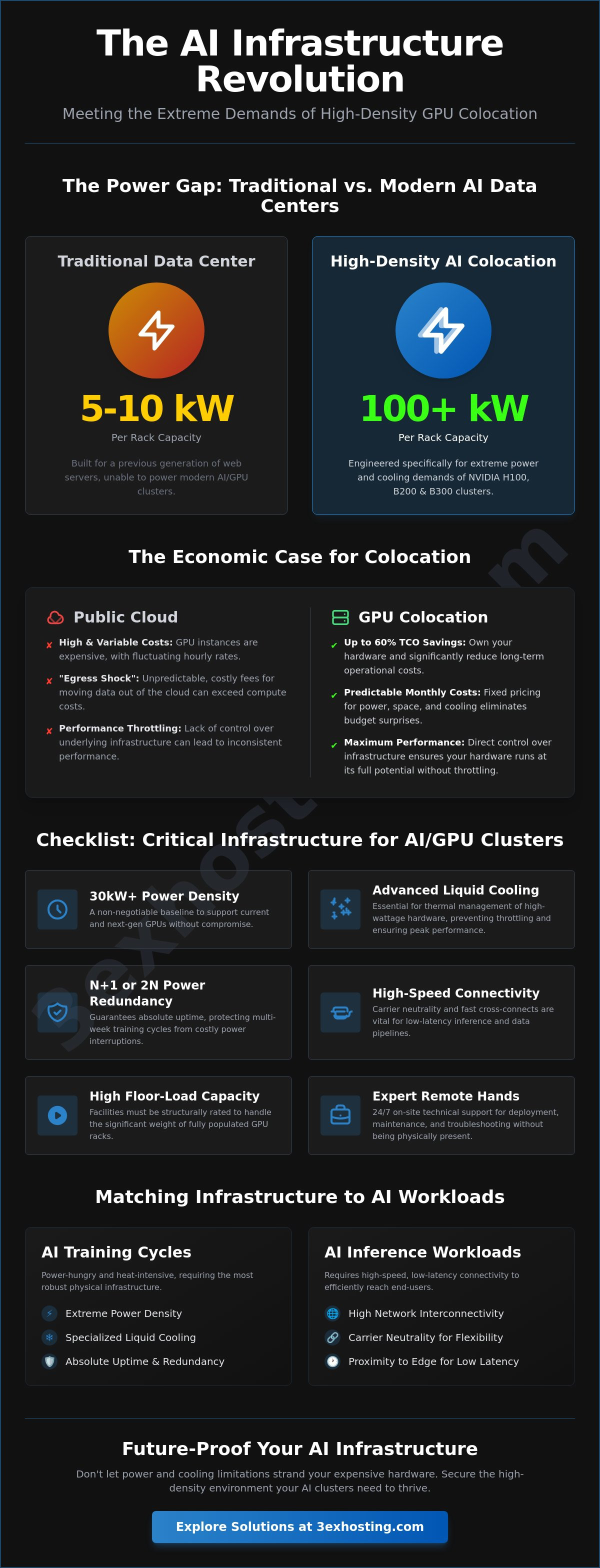
Modern AI workloads have fundamentally changed the requirements for data center hosting. GPU colocation is a specialized service designed for the extreme thermal and electrical demands of accelerated computing. It isn’t just a colocation centre with extra power; it’s an environment built for high-wattage hardware. Enterprise teams are increasingly vetting GPU server colocation providers that can guarantee the infrastructure required for these massive loads. Leading providers now engineer facilities to handle 30 kW, 50 kW, or even 100 kW per cabinet. This evolution is necessary. By early 2026, the average rack density for AI training clusters reached 27 kW, largely due to the power demands of NVIDIA B200 and B300 SXM6 architectures.
The shift away from public clouds is driven by practical economics. Many enterprises face “egress shock,” where the cost of moving data out of a hyperscale environment exceeds the compute costs. By moving to private infrastructure, organizations gain control over their data and their operational budgets. Standard enterprise colocation, which often caps out at 10 kW or 15 kW per rack, simply cannot support the 50 kW densities required by 2026 AI models.
The Economic Case for Colocating GPU Servers
Choosing to own hardware and colocate it offers significant long-term ROI compared to the hourly rates of cloud rentals. While renting an NVIDIA B300 SXM6 might cost $6.80 per hour on-demand, owning the asset and placing it in full cabinet colocation can lead to TCO savings of 40-60%. Beyond the hardware, predictable power pricing stabilizes monthly operational expenses. You aren’t subject to the fluctuating instance costs of public providers. Moving infrastructure closer to the edge also reduces latency, which is vital for real-time inference applications that require sub-millisecond responses. You don’t have to worry about the hidden costs of scaling when your base infrastructure is fixed and predictable.
Training vs. Inference: Different Infrastructure Needs
Your infrastructure strategy must account for the distinct phases of the AI lifecycle. Training cycles are power-hungry and generate immense heat. In these scenarios, high-density power and specialized cooling, such as liquid-to-chip systems, are the primary constraints. Inference workloads have different priorities. They require high network interconnectivity and carrier neutrality to reach end-users efficiently. A robust hybrid strategy often involves private colocation suites for core training, linked via enterprise data center connectivity to various cloud on-ramps. This setup ensures you have the power for heavy lifting and the connectivity for global delivery. Balancing these needs is what separates top-tier GPU server colocation providers from standard hosting companies.
Critical Infrastructure Requirements for AI and Machine Learning
AI workloads aren’t just software; they’re heavy-duty physical engineering. Standard facilities often fail when faced with the thermal output of modern clusters. Top-tier GPU server colocation providers must offer infrastructure that goes beyond basic space. They need to support 30kW+ per cabinet as a baseline. This isn’t a luxury. It’s a technical necessity for the high-wattage accelerated computing environments of 2026.
Power redundancy is non-negotiable. An AI training cycle can run for weeks. A single power dip can corrupt a checkpoint, wasting thousands of dollars in compute time. This is why N+1 or 2N configurations are mandatory for operational stability. You also need to consider floor loading. A fully populated rack of B200 or H100 servers is significantly heavier than standard web servers. Your provider’s facility must be rated for these high-density loads to prevent structural issues and ensure safety.
The Engineering of High-Density Power Delivery
Metered power is the most transparent way to manage GPU operational costs. You only pay for what your clusters consume during intense training runs. High-voltage PDUs (Power Distribution Units) are essential within the rack to manage these loads safely. Without precision airflow management, even the best servers will suffer from thermal throttling. This reduces performance and extends training times. If you’re planning a large-scale deployment, our private colocation suites provide the dedicated environment needed for such complex power engineering.
Cooling Innovations for 2026 GPU Clusters
Traditional air cooling reaches its limit around 20-25kW. For 2026 GPU clusters pushing 30-40kW, liquid cooling is becoming the standard. Rear Door Heat Exchangers (RDHx) and Direct-to-Chip systems are much more efficient at removing heat. This efficiency is reflected in a lower PUE (Power Usage Effectiveness). A lower PUE directly reduces your total cost of ownership over the hardware lifecycle. During the RFP process, always ask for a provider’s specific cooling capacity per rack. Don’t settle for “average” facility cooling. You need guaranteed thermal headroom for your specific hardware. Experienced GPU server colocation providers will be able to provide detailed thermal maps and cooling capacity proof for your specific rack configuration.
Evaluating GPU Server Colocation Providers: A Decision Framework
Selecting the right facility requires a framework that balances connectivity with rigorous security standards. While power density is the physical foundation, network architecture determines how effectively your models interact with the world. Top GPU server colocation providers distinguish themselves through carrier neutrality. This allows you to choose from multiple Tier-1 providers, ensuring data sovereignty and avoiding vendor lock-in. It also provides the redundancy needed to maintain uptime during critical training or inference windows. High-speed cross-connects are the glue that links your GPU clusters to external storage arrays or cloud on-ramps, creating a seamless hybrid environment.
Compliance is equally vital. If your AI models process sensitive health or financial data, your provider must maintain SOC 2 Type II, HIPAA, or PCI-DSS certifications. These aren’t just checkboxes; they’re verified proof that the facility’s operational controls meet enterprise-grade standards. Scalability should also be part of your initial evaluation. You might start with full cabinet colocation, but your infrastructure needs to be able to expand into private colocation suites as your model complexity grows. Planning for this growth now prevents the need for a costly migration later.
Network Connectivity and Low Latency
In the world of AI, speed is often measured by “time to token.” This metric depends heavily on optimized network paths and low-latency interconnects. Proximity to a carrier hotel is a major advantage. It allows for high-speed cross-connect services that link your hardware directly to the backbone of the internet. Evaluating a provider’s peering fabric and existing ecosystem helps you understand how quickly your data can move between training nodes and inference endpoints. Efficient routing reduces overhead and ensures your hardware isn’t waiting on the network to deliver data.
Physical Security for Mission-Critical Hardware
Your hardware represents a massive capital investment. Protecting it requires more than just a locked door. Multi-factor authentication and biometric access controls should be standard at every entry point. For organizations requiring an extra layer of isolation, cage solutions offer a dedicated physical perimeter within the data center. This ensures your racks are separated from other tenants. Combined with 24/7/365 on-site security presence and comprehensive surveillance, these measures create a fortress for your mission-critical AI assets. Peace of mind comes from knowing your physical infrastructure is as secure as your digital data.
Operational Excellence: Managing High-Density Racks Remotely
Managing specialized AI hardware shouldn’t require your internal team to be physically present at the data center every time a component needs attention. The most effective GPU server colocation providers offer a layer of operational support that goes beyond providing power and cooling. This operational excellence includes managing the entire hardware lifecycle, from initial installation to complex component replacements. Real-time monitoring and reporting provide essential visibility into power draw and environmental metrics. This ensures your clusters operate within optimal thermal parameters, preventing the performance degradation often caused by thermal throttling.
Hardware lifecycle management in a high-density environment is particularly demanding. Swapping a failed GPU or upgrading system memory in a rack drawing 30kW requires precision and an understanding of the specific thermal dynamics involved. Cable complexity also increases significantly with high-density networking. Professional management of these interconnects is vital to maintain airflow and prevent accidental disconnections. By offloading these tasks to on-site experts, you maintain focus on model development rather than hardware maintenance. The ROI of this approach is clear: you reduce travel costs and eliminate the risk of extended downtime during critical training windows.
Leveraging 24/7 Remote Hands for GPU Maintenance
Troubleshooting power or connectivity issues in real-time is critical for maintaining intense training schedules. Technical tasks like GPU card swaps, RAM upgrades, and firmware updates can be handled by on-site experts without your team ever boarding a plane. Remote Hands support is the physical extension of your IT team. By utilizing Remote Hands Support, you significantly decrease the time between hardware failure and resolution. This 24/7/365 availability ensures that even if a system fails at midnight, a qualified technician is already on-site to begin the recovery process.
Seamless Deployment and Move-In Assistance
Scaling AI infrastructure requires meticulous planning and execution. Deployment logistics involve coordinating hardware delivery, secure storage, and the physical rack-and-stack of heavy GPU servers. Professional cable management is essential for high-density networking. Poor organization can lead to airflow blockages and dangerous thermal pockets. Learn more about our move-in assistance to see how we streamline the transition of your mission-critical hardware into our facility. From the moment your gear arrives at the loading dock, our team ensures it’s handled with the care that multi-million dollar assets deserve.
To ensure your next high-density cluster is deployed with professional precision, request a custom colocation quote for your specific hardware requirements.
Future-Proofing Your AI Infrastructure with 3EX Hosting
Building for the future of AI requires more than just square footage. It demands a facility engineered for the thermal and power realities of next-generation hardware. 3EX Hosting stands out among GPU server colocation providers by offering infrastructure specifically designed for enterprise-grade clusters. Our facilities are positioned within strategic carrier hotels, providing superior cross-connect services that link your training nodes to the global network with minimal latency. Whether you’re deploying a single rack or an entire row, our environment scales with your computational needs. We’ve built our reputation on technical stability and the speed of our infrastructure.
Our strategic location as a premier data center in Miami provides a gateway to international markets while ensuring your hardware is housed in a facility built for resilience. We understand that AI training cycles are massive investments. Any interruption is costly. That’s why we focus on power redundancy and high-density cooling as core features, not optional add-ons. You get a partner that understands the specific demands of high-wattage accelerated computing. We don’t just provide space; we provide a foundation for your AI roadmap.
Full Cabinet Colocation for Rapid Scaling
Deploying AI workloads shouldn’t be delayed by infrastructure bottlenecks. Explore our full cabinet colocation options to see how we optimize power and space for immediate deployment. We help organizations move beyond experimental test-beds to full-scale AI factories. Our high-density cabinets support the 30kW+ requirements required for modern GPU clusters. This ensures your hardware runs at peak performance from day one without thermal throttling. You get the stability of a Tier-1 facility with the flexibility of a provider that can move as fast as your business requires.
Private Suites and Custom Cages for Enterprise Sovereignty
Data sovereignty is a primary concern for enterprises conducting sensitive AI research. Our cage solutions and bespoke suites provide the physical isolation required for high-stakes projects. Secure your private data center suite to create a dedicated environment that mirrors your internal security protocols. We combine this physical isolation with a commitment to technical stability and 24/7 support. Your systems are managed by experts who understand the nuances of high-density cooling and power distribution. It’s about providing a foundation where innovation isn’t limited by your data center’s capabilities. Our team works in the background to ensure your environment remains stable, secure, and ready for the next generation of AI development.
Secure Your Competitive Edge in the AI Era
High-density AI infrastructure is no longer a niche requirement. It’s the baseline for enterprise competitiveness. Success depends on selecting GPU server colocation providers that offer more than just floor space. You need a partner capable of delivering 30kW+ per rack while maintaining the carrier-neutral interconnectivity required for global data distribution. Transitioning to a private environment provides the thermal headroom and cost predictability your business needs to scale without the burden of cloud egress fees.
By prioritizing technical stability and operational excellence, you ensure your training cycles remain uninterrupted and efficient. Enterprise-grade security and compliance protocols provide the necessary safeguards for your most sensitive data and proprietary models. With 24/7/365 Remote Hands Support, your physical infrastructure remains in expert hands regardless of where your team is located. This level of support allows you to focus on developing models instead of managing hardware logistics.
It’s time to build a foundation that won’t limit your innovation. Request a custom quote for your high-density GPU colocation needs today. Our team is ready to help you design a scalable, secure environment that supports your long-term AI roadmap.
Frequently Asked Questions
What is the minimum power density required for modern GPU colocation?
Modern AI clusters typically require a minimum of 20 kW to 30 kW per rack to operate effectively. While standard enterprise data centers are built for 5 kW to 10 kW, next-generation hardware like the NVIDIA B200 pushes these limits much higher. Leading GPU server colocation providers now engineer their facilities to support densities reaching 50 kW or even 100 kW per cabinet to prevent thermal throttling.
How does carrier neutrality affect the performance of AI inference?
Carrier neutrality allows you to select from multiple Tier-1 network providers to find the lowest latency paths for your specific user base. This diversity is critical for minimizing “time to token” in real-time inference applications. By avoiding vendor lock-in, you can optimize your network routing based on performance and cost while maintaining complete data sovereignty over your model’s outputs.
Can I use liquid cooling in a standard colocation cabinet?
Standard cabinets aren’t typically equipped to handle the plumbing and manifolds required for liquid cooling. High-density GPU server colocation providers offer specialized infrastructure like Rear Door Heat Exchangers (RDHx) or Direct-to-Chip cooling systems. These specialized setups are necessary for any deployment exceeding 30 kW per rack where traditional air cooling reaches its physical limits.
What are the benefits of remote hands support for GPU clusters?
Remote hands support provides a physical extension of your IT team, allowing for hardware maintenance and troubleshooting without requiring your staff to travel. On-site technicians can perform technical tasks like GPU card swaps, RAM upgrades, and firmware updates 24/7/365. This immediate response capability is vital for maintaining the uptime of intense AI training cycles that can’t afford unexpected interruptions.
How do GPU colocation costs compare to public cloud instances in 2026?
Colocation often delivers 40% to 60% savings in total cost of ownership compared to public cloud rentals for long-term training projects. While cloud instances provide rapid elasticity, they often include high egress fees and fluctuating hourly rates. Colocation offers predictable monthly power and space costs, allowing enterprises to capitalize their hardware investments more efficiently over a three to five-year lifecycle.
What security certifications should I look for in a GPU colocation provider?
You should prioritize providers that maintain SOC 2 Type II, HIPAA, and PCI-DSS certifications to ensure enterprise-grade protection. These certifications verify that the facility follows strict operational and physical security protocols. If your AI models process sensitive health or financial data, these audited standards are essential for meeting your organization’s regulatory and compliance requirements.
What is a carrier hotel and why does it matter for AI?
A carrier hotel is a specialized data center where hundreds of network providers interconnect their backbones in a single location. For AI workloads, proximity to a carrier hotel ensures your GPU clusters have the fastest possible access to storage arrays and cloud on-ramps. It simplifies the process of securing high-speed cross-connects, which are necessary for moving the massive datasets required for model training.
How fast can a new GPU cluster be deployed in a colocation facility?
A new cluster can typically be deployed within 10 to 15 business days if the provider has the necessary power and cooling headroom available. This timeline includes coordinating the delivery of hardware, secure on-site storage, and professional rack-and-stack services. Experienced providers use streamlined move-in assistance to ensure your systems are powered on and networked as quickly as possible.