 SUPPORT


 3EX United States
 Blog
Relying on the public internet for international data transit is no longer a viable strategy for enterprises targeting global scalability. When your traffic jumps through multiple uncontrolled hops to reach Latin America or Europe, performance isn’t just a variable; it’s a liability. You likely recognize the frustration of high latency and the soaring costs of traditional bandwidth that eat into your margins. Managing hardware in a distant facility adds another layer of complexity that can feel like a constant drain on your internal resources. Strategic Miami interconnection services offer a direct path to stability and speed.
This guide explains how interconnection services and carrier-neutral hubs provide the sub-millisecond latency foundation your infrastructure requires. By moving beyond simple storage and into direct peering, you can significantly reduce transit costs while improving reliability. We’ll explore how to leverage carrier hotels and 24/7 remote support to ensure your physical infrastructure remains stable and accessible without requiring a local team on the ground. Discover how to turn your data center presence into a high-speed gateway for national growth.
Key Takeaways
- Understand how transitioning from public internet transit to private network-to-network interfaces (NNI) eliminates latency bottlenecks for international traffic.
- Learn why carrier-neutral hubs are essential for avoiding vendor lock-in and maintaining the flexibility to choose providers based on performance and cost.
- Discover how to optimize network speed and reduce long-term expenses by utilizing Miami interconnection services for direct cross-connects.
- Explore how 24/7 remote hands support functions as your local technical team, allowing you to manage complex physical infrastructure from any distance.
- Identify the specific infrastructure requirements for high-density AI and GPU hosting to ensure your national enterprise remains scalable and competitive.
What Are Miami Interconnection Services and Why Do They Matter?
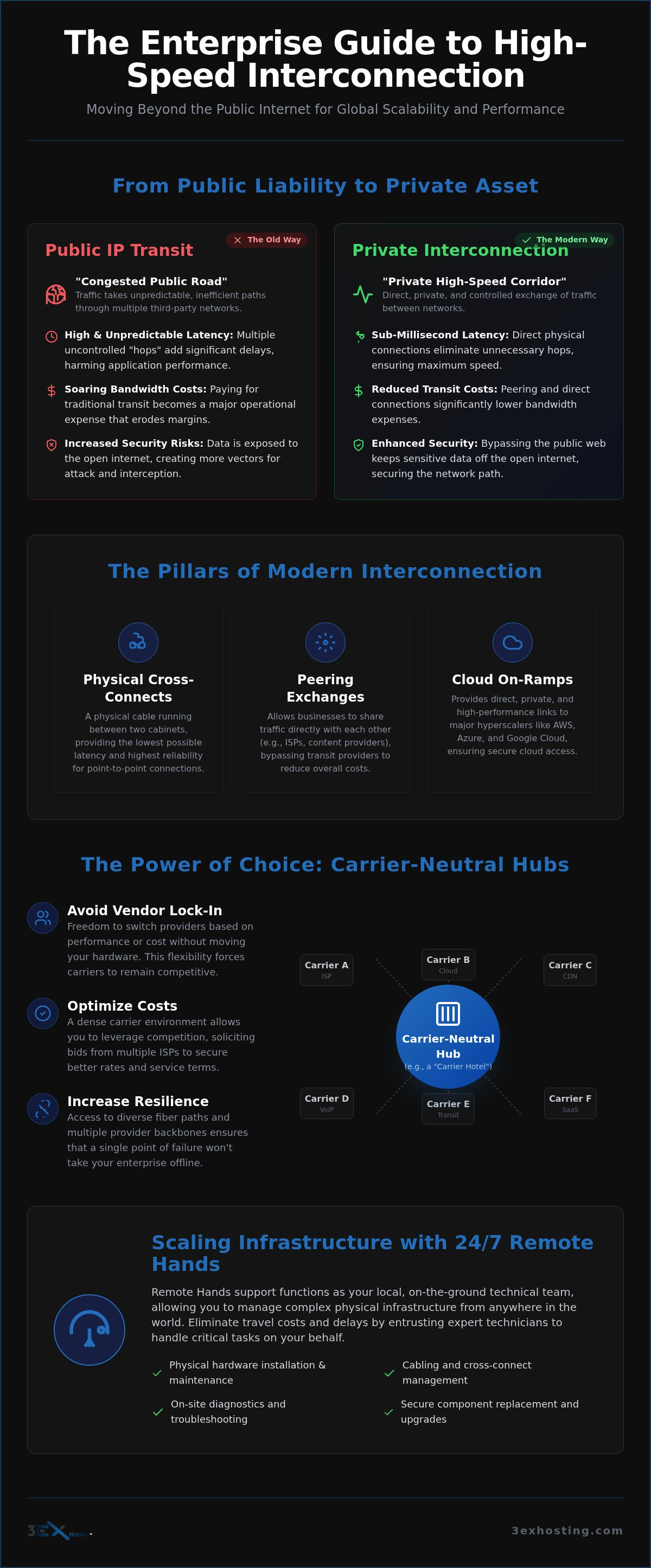
Interconnection is the private, direct exchange of traffic between two or more networks. It happens within specialized facilities where service providers and enterprises physically connect their infrastructure. Unlike the public internet, which relies on unpredictable “best-effort” routing, Miami interconnection services provide a dedicated environment for data transfer. It’s the difference between a congested public road and a private high-speed corridor.
Enterprises are increasingly moving away from traditional transit toward private network-to-network interfaces (NNI). Public routing often sends data on inefficient paths through multiple third-party networks. This adds latency and increases security risks. By using a private NNI, you control the path. You ensure your data moves directly from point A to point B without unnecessary hops. This level of control isn’t just a luxury; it’s essential for modern business applications.
The “Carrier Hotel” serves as the physical foundation for this ecosystem. These buildings act as the central nervous system for national data flow. By housing a high density of carriers, ISPs, and cloud providers, they enable instant connectivity. Being in a data center that serves as a carrier hotel means you can connect to almost any network partner with a simple physical cable. This proximity eliminates the need for expensive long-haul circuits.
The Core Components of Modern Interconnection
Modern connectivity relies on three main pillars. Physical cross-connects are the most basic. They consist of a physical cable running between two cabinets. This setup provides the lowest possible latency and the highest reliability. Peering exchanges are another critical piece. They allow businesses to share traffic directly, which significantly reduces overall transit costs. Finally, cloud on-ramps provide direct, private links to major hyperscalers like AWS, Azure, and Google Cloud, bypassing the public internet entirely.
Strategic Advantages for National Enterprises
Location is a primary driver for performance. By utilizing carrier-neutral hubs, you physically reduce the distance between your infrastructure and your end-users. This proximity is the only way to achieve sub-millisecond latency for mission-critical applications. Security is another major factor. Bypassing the public web means your sensitive data is never exposed to the open internet. You gain a more predictable, secure, and cost-effective network environment. Miami interconnection services turn your regional presence into a powerful global gateway to Latin America and Europe.
The Strategic Value of Carrier-Neutral Hubs
Carrier neutrality is more than just a technical specification. It’s a financial strategy. In a carrier-neutral environment, the facility operator doesn’t provide the bandwidth itself. Instead, they provide the space and power, allowing multiple telecommunications providers to compete for your business. This setup directly impacts your bottom line. When you utilize Miami interconnection services within a neutral hub, you aren’t tied to a single provider’s pricing or performance limitations. You have the leverage to negotiate based on real-time market rates.
Avoiding vendor lock-in is a primary benefit. If a specific carrier experiences frequent outages or raises their rates, you have the freedom to switch. You don’t have to move your hardware to a different building. You simply request a new cross-connect to a different provider in the same room. This flexibility forces carriers to keep their pricing competitive and their service levels high. True resilience also depends on redundant entry points. A high-quality facility provides diverse fiber paths, ensuring that a single accidental cut at the street level doesn’t take your entire enterprise offline.
The Economics of Carrier Neutrality
Operating in a dense carrier environment allows your IT team to leverage competition. You can solicit bids from multiple ISPs simultaneously. This often results in lower bandwidth costs and better service terms. High carrier density also improves network resilience. If one provider’s backbone fails, you have immediate access to alternatives. Interconnection agreements between these providers within the facility ensure that traffic flows efficiently, reducing the operational risk of a total network blackout. Diversifying your providers within a single hub is the most cost-effective way to guarantee 100% uptime.
Miami as the Global Gateway
Miami’s geography makes it a critical hub for international data. It serves as a major landing point for subsea fiber optic cables connecting North America to Central America, South America, and Europe. This connectivity makes Miami interconnection services indispensable for enterprises with global footprints. You can serve international markets with significantly lower latency than from an inland data center. Many national firms also use Miami as a secondary disaster recovery site. Its specialized infrastructure is built to withstand extreme weather, providing a reliable fallback for mission-critical data. If you’re ready to diversify your network, explore the carrier-neutral options available at our Miami facility.
Cross-Connects vs. IP Transit: A Performance Breakdown
Understanding the difference between logical routing and physical connectivity is key to optimizing your network. IP transit is the service that connects your network to the rest of the global internet. It relies on the Border Gateway Protocol (BGP) to find paths through various third-party providers. While functional, this method introduces variables like congestion and inefficient routing. A cross-connect is a dedicated physical link between two customers in the same data centre. It bypasses the public internet entirely, providing a private, high-speed bridge between your hardware and your partner’s infrastructure.
Reliability is the primary differentiator here. IP transit is a logical service, meaning your data’s path can change at any moment based on network conditions thousands of miles away. Miami interconnection services that utilize physical cross-connects offer a level of predictability that logical routing cannot match. Since the connection is a physical cable, there are no “hops” between your equipment and the destination. You aren’t competing for bandwidth on a shared pipe. This hardware-level stability is why enterprises choose direct links for their most sensitive data flows.
The economics of interconnection also shift as your traffic grows. Most IP transit providers bill using a 95th percentile model, which can become expensive if you have consistent high-volume traffic. Cross-connects typically involve a fixed monthly port fee regardless of the amount of data pushed through the cable. When your data transfer to a specific cloud provider or partner reaches a certain threshold, the cost-per-megabit drops significantly with a direct link. It’s often the most effective way to scale your bandwidth without scaling your monthly bill.
Performance Benchmarks: Latency and Jitter
Direct links eliminate the “middleman” of the public web, which is essential for real-time applications. If you’re running VoIP services, Fintech trading platforms, or AI training clusters, latency spikes are unacceptable. For those interested in how these networks support high-end media, you can check out Edge IPTV as an example of premium streaming. Jitter, or the variation in packet arrival times, often plagues public internet transit. Cross-connects provide a clean, consistent signal with sub-millisecond latency. This predictable performance ensures that mission-critical applications function exactly as intended, even during peak traffic periods across the wider internet.
Implementing Cross-Connect Services
The setup process is highly structured to ensure security and accuracy. It begins with a Letter of Authorization (LOA) provided by the party you intend to connect with. This document acts as a formal permission slip for the data centre technicians. Once the LOA is submitted, a physical cable is run between your patch panel and the target’s panel. You’ll need to specify the media type, typically choosing between single-mode fiber for high-speed long runs or copper for specific legacy equipment. For more details on the technical specifications of our Miami interconnection services, you can explore our Cross-Connect Services page. Managing these physical assets is simple when you have the right facility support in place.
Scaling National Infrastructure via Remote Hands Support
Managing a data centre hub from thousands of miles away presents a significant logistical challenge. National enterprises headquartered in different states often face the “distance problem” when trying to maintain a presence in Florida. Flying a senior engineer across the country to resolve a physical hardware issue is neither cost-effective nor efficient. This is why Miami interconnection services must include a robust layer of on-site technical expertise. A professional on-site team acts as your local “remote office,” providing the physical presence required to maintain complex systems without the travel overhead.
Remote Hands support serves as an extension of your own IT department. These technicians act as your eyes and hands on the data centre floor. They perform tasks ranging from simple cable labeling and power cycles to more complex hardware installations. The ROI of this service is clear. You eliminate the high costs of travel and the productivity loss associated with sending internal staff to a remote site. Your team stays focused on high-level strategy while the on-site experts handle the physical maintenance. It’s a more sustainable way to manage a distributed network.
Security and trust are paramount in this relationship. You’re entrusting your most valuable physical assets to a third-party team. A professional facility ensures all on-site technicians are thoroughly vetted and trained in industry-standard protocols. This provides a level of security that exceeds what most companies can manage with temporary local contractors. When you know the technicians are experts in Miami interconnection services, you can delegate physical tasks with total confidence.
This reliance on local expertise is a cornerstone of international business; just as you trust on-site technicians in Miami, companies expanding into the Middle East often turn to Chainex Real Estate to handle their commercial and residential property needs in Dubai.
Operational Efficiency for Distributed Teams
Availability must be 24/7/365. For a national client, a midnight outage in Miami might happen during their West Coast business day. Having “always-on” support ensures that your infrastructure is never neglected. On-site teams also manage the logistics of receiving and unboxing hardware shipments. They rack and stack new servers immediately, ensuring your capacity grows as fast as your demand. You can learn more about Remote Hands Support to see the full list of available tasks.
Disaster Recovery and Emergency Response
Speed is the only metric that matters during a network failure. On-site experts provide rapid response times that a traveling team simply cannot match. They handle hardware replacements and RMA processes directly from the data centre floor. This level of professional on-site expertise gives you the peace of mind to scale your national infrastructure with confidence. If you’re ready to secure your Miami presence, contact us for a tailored support plan today.
Choosing 3EX for Enterprise Interconnection Excellence
3EX Hosting serves as a premier carrier hotel for organizations that require more than just rack space. We provide a stable, high-performance environment designed for national scalability. By utilizing our Miami interconnection services, you gain immediate access to a dense ecosystem of carriers and cloud providers. This isn’t just about colocation; it’s about positioning your hardware at the intersection of global data traffic. We understand that enterprise needs vary, which is why our solutions range from individual cabinets to highly secure private suites and cages.
Modern workloads like AI and machine learning demand specialized infrastructure that goes beyond standard data centre capabilities. Our facility is engineered for high-density GPU hosting, providing the massive power and cooling these systems require. You don’t have to worry about power constraints or thermal issues slowing down your AI training clusters. We combine this physical strength with strategic services like managed cloud hosting and disaster recovery. This integrated approach ensures that your primary site and your backup systems are both part of the same high-speed fabric.
Infrastructure Tailored to Your Needs
Your growth shouldn’t be limited by your data centre’s footprint. We offer flexible options that scale with your business, from Full Cabinet Colocation for smaller deployments to Private Suites for large-scale enterprise operations. Our high-density power configurations support the most demanding hardware, ensuring your systems run at peak efficiency. We maintain strict compliance and security standards, giving your IT team the peace of mind that your data is protected within a world-class facility.
Getting Started with Your Interconnection Strategy
Designing a network for 2026 requires foresight and technical expertise. Our consultation process focuses on your long-term goals, ensuring your Miami interconnection services are optimized for both speed and cost. We simplify the transition with professional Move-In Assistance, handling the logistics so your team can stay productive. When you’re ready to secure a low-latency foundation for your national infrastructure, Request a Quote to start the design process. Our team is ready to help you build a more resilient network.
Future-Proofing Your Enterprise Network Architecture
Building a high-performance network requires more than just rack space; it requires a strategic location and a robust support ecosystem. You’ve seen how carrier-neutral hubs provide the flexibility to optimize costs and eliminate vendor lock-in. Transitioning from logical IP transit to physical cross-connects ensures your mission-critical applications benefit from consistent, sub-millisecond latency. By leveraging 24/7 Remote Hands support, your internal team can manage complex infrastructure from any distance without the burden of travel.
Strategic Miami interconnection services act as the essential bridge to international markets and high-density workloads. Our facility combines enterprise-grade security with the technical stability your organization demands. We provide the carrier-neutral infrastructure necessary for national scalability and long-term resilience. You don’t have to navigate these infrastructure complexities alone. Our experienced technicians are ready to help you design a connectivity model that supports your specific growth objectives.
Scale your infrastructure with 3EX Hosting interconnection services and secure your organization’s digital foundation today. We’re here to ensure your systems remain fast, secure, and always accessible.
Frequently Asked Questions
What are Miami interconnection services exactly?
Miami interconnection services are physical and logical links established within a carrier hotel that allow different networks to exchange data directly. These services include cross-connects and peering arrangements that provide a more stable and predictable alternative to public internet transit. By using these services, enterprises gain total control over their data paths and significantly reduce latency for their international end-users.
How do cross-connects improve network security?
Cross-connects improve security by creating a dedicated physical link between two points that never touches the open internet. This hardware-level connection eliminates the risks associated with public routing, such as packet sniffing or man-in-the-middle attacks. Because your traffic stays within the secure, monitored perimeter of the data centre, your sensitive data remains isolated from the vulnerabilities of the public web.
Is a carrier-neutral data centre better for my business?
A carrier-neutral facility is generally better for enterprises because it allows you to choose from multiple telecommunications providers within the same building. This competition naturally keeps bandwidth pricing lower and performance standards higher. It also provides the flexibility to switch providers or add redundant links without the need to move your physical hardware to a different location.
How much does it cost to set up a cross-connect in 2026?
The cost of establishing a cross-connect typically involves a one-time installation fee and a fixed monthly recurring charge. These fees vary based on the media type, such as fiber or copper, and the specific requirements of the facility. Since these are private commercial arrangements, you should request a quote for current market rates tailored to your specific infrastructure needs and port requirements.
Can I manage my servers in Miami if my company is based in another state?
You can effectively manage your infrastructure from any distance by utilizing professional on-site technical support. Remote Hands teams act as your local staff, performing physical tasks like equipment reboots, cable swaps, and hardware installations. This model allows national enterprises to maintain a high-performance presence in Florida without the logistical burden of flying internal engineers to the site for routine maintenance.
What is the difference between peering and a cross-connect?
Peering is the commercial and logical agreement between two networks to exchange traffic, often through a shared exchange point or fabric. A cross-connect is the actual physical cable that links two separate environments within the data centre. While peering can happen over a shared network, a cross-connect provides a dedicated, private path with the highest possible level of performance and security.
Why is Miami considered a gateway for international data traffic?
Miami is a primary landing point for dozens of subsea fiber optic cables that connect North America to Latin America, the Caribbean, and Europe. This geographic concentration of international infrastructure makes it the most efficient hub for routing data between continents. Enterprises use Miami interconnection services to minimize the physical distance data must travel, ensuring faster response times for their global user base.
What are ‘Remote Hands’ and how do they work?
Remote Hands is a service where data centre technicians perform physical maintenance on your equipment on your behalf. You submit a support ticket with specific instructions, and the on-site team executes the task, such as unboxing hardware, labeling cables, or checking status lights. This service is available 24/7, providing a critical safety net for enterprises that don’t have local staff available for immediate emergency response.