 SUPPORT


 3EX United States
 Blog
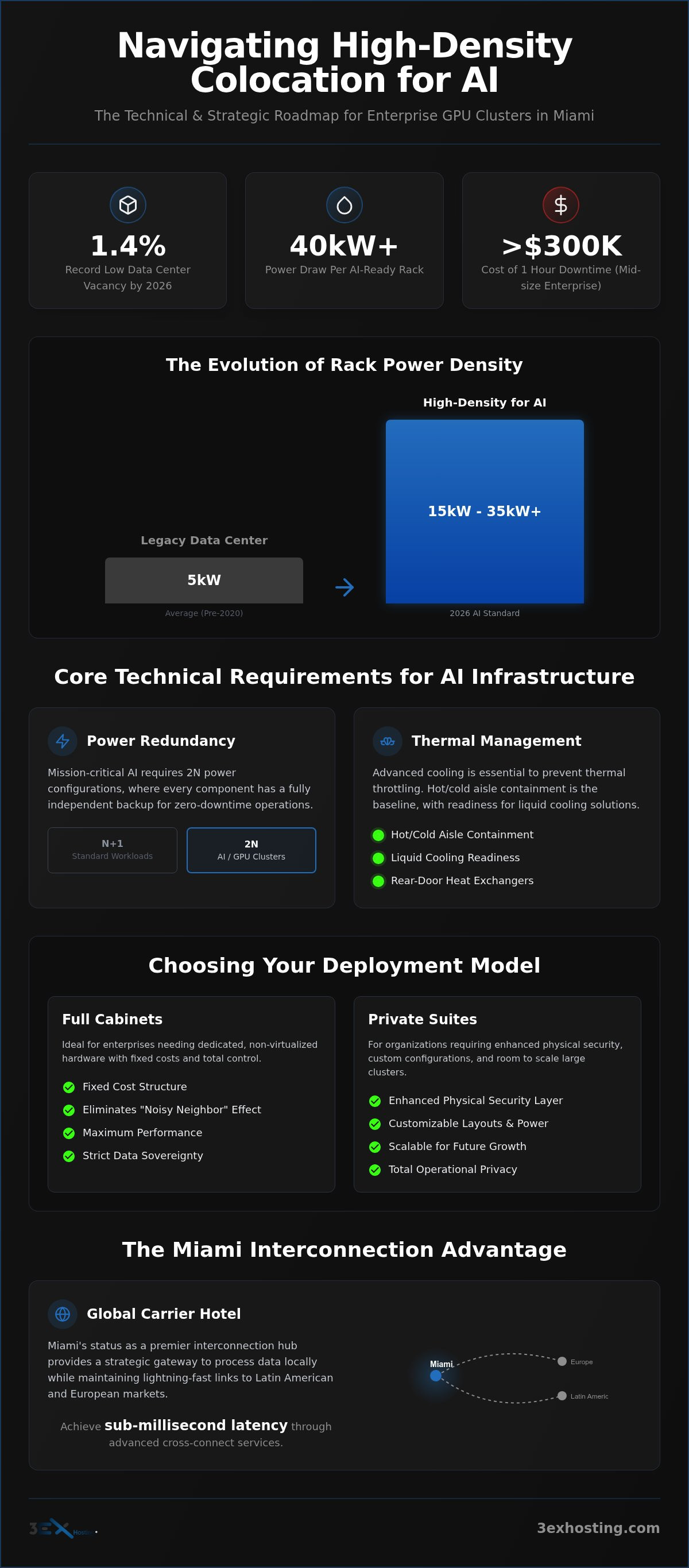
With North American data center vacancy rates hitting a record low of 1.4% in 2026, finding a facility that doesn’t buckle under the weight of AI workloads is no longer a search for space. It’s a search for power. For enterprises deploying GPU clusters, high density colocation Miami represents more than just a geographic advantage. It’s a technical necessity. When a single hour of system downtime now costs mid-size enterprises over $300,000, your infrastructure must do more than just stay online. It has to stay cool while drawing 40kW or more per rack.
You likely know that legacy data centers weren’t built for the thermal demands of modern H100 or Blackwell architectures. We understand that thermal throttling and insufficient power density are the primary bottlenecks to your scaling efforts. This guide provides the technical and strategic roadmap you need to master high-density requirements and power your AI workloads with maximum efficiency. We’ll examine the 2026 regulatory landscape in Florida, cooling innovations, and how to leverage Miami’s carrier hotels to minimize latency to international markets.
Key Takeaways
- Define the infrastructure requirements for AI and machine learning workloads, focusing on high density colocation Miami standards that support 15kW to 35kW+ per cabinet.
- Evaluate critical power redundancy configurations and cooling strategies, including hot/cold aisle containment and liquid cooling readiness, to ensure zero downtime.
- Compare full cabinet deployments against private colocation suites to determine the most secure and scalable model for your specific GPU infrastructure.
- Leverage Miami’s strategic position as a global carrier hotel to achieve sub-millisecond latency through advanced cross-connect services.
- Understand the role of 24/7 specialized remote hands support in managing the technical complexities of high-performance enterprise hardware.
Defining High Density Colocation Miami for Enterprise AI
High-density colocation isn’t just about extra power; it’s a fundamental architectural shift. In 2026, high density colocation Miami means supporting cabinets that reliably deliver between 15kW and 35kW+ to handle the intense thermal output of modern compute clusters. Traditional colocation center facilities often struggle with these requirements because their cooling systems were designed for the 5kW average of the last decade. As AI and machine learning workloads become the standard for enterprise operations, the infrastructure must evolve to prevent hardware degradation and performance throttling.
The 2026 High-Density Power Threshold
The industry has moved past the era where 10kW was considered dense. High-density colocation in 2026 is defined by the ability to support power-hungry GPU architectures like the NVIDIA H100 and newer Blackwell chips within a single, standard-footprint rack. These systems have fundamentally changed the colocation landscape by concentrating massive compute power into smaller spaces. While legacy racks capped out at 5kW, modern AI deployments frequently start at 20kW and scale upward. This concentration requires precision power delivery and specialized cooling architectures that standard providers simply don’t have.
Why Enterprise Workloads are Leaving the Public Cloud
Many organizations are shifting their AI training and inference models from public clouds back to physical infrastructure. Cloud costs become unpredictable when dealing with the massive data egress associated with large-scale machine learning. By utilizing Full Cabinet Colocation, enterprises gain fixed cost structures and eliminate the noisy neighbor effect of virtualized environments. Dedicated, non-virtualized hardware in a high-density environment offers significant performance gains. It also ensures strict data sovereignty, as you maintain total physical control over the servers processing your proprietary data.
Miami serves as the primary strategic gateway for these high-performance workloads across the Americas. Its status as a premier interconnection hub allows enterprises to process data locally while maintaining lightning-fast links to Latin American and European markets. For businesses scaling AI infrastructure, Miami offers the unique combination of high-density power availability and world-class connectivity. This geographic advantage, paired with specialized technical support, makes high density colocation Miami the logical choice for mission-critical GPU clusters.
Technical Requirements: Power Density and Thermal Management
Deploying high-performance hardware requires more than just floor space. It demands a facility engineered to handle the physical and electrical strains of 2026 enterprise workloads. High density colocation Miami providers must address floor load capacity first. Modern GPU clusters can weigh over 3,000 pounds per rack. This requires reinforced flooring that exceeds standard data center specifications. Beyond the physical weight, intelligent PDUs are essential for monitoring high-density loads in real time. These units provide the granular visibility needed to prevent circuit overloads and manage power distribution at the rack level.
Power Redundancy for AI Infrastructure
N+1 redundancy is often sufficient for standard web servers, but mission-critical AI training requires 2N power configurations. In a 2N setup, every component has a completely independent backup. If one power source fails, the system continues without interruption. For high-density cabinets drawing 25kW to 40kW, dedicated circuits are a baseline requirement. Metered power allows you to pay for what you use while ensuring your infrastructure has the headroom to spike during intense compute cycles. Carrier hotels manage these massive draws by utilizing robust utility feeds and industrial-grade UPS systems that maintain stability across the entire grid.
Overcoming the Thermal Wall
Heat is the primary enemy of high-density hardware. Standard open-room cooling can’t keep up with the 35kW thermal output of a single rack. Effective thermal management relies on hot and cold aisle containment. By physically separating the intake and exhaust air, containment systems prevent hot air recirculation and maximize cooling efficiency. While air cooling remains dominant, we’re seeing a rapid shift toward liquid cooling readiness. Facilities must be prepared for rear-door heat exchangers or direct-to-chip cooling to support the next generation of processors.
Miami’s technical infrastructure is bolstered by its role as a global connectivity hub. Recent subsea cable developments have further solidified the city’s status, ensuring that high-density clusters have the low-latency bandwidth required for real-time data processing. This combination of power, cooling, and connectivity makes the region ideal for scaling enterprise AI. If you’re planning a deployment, it’s often best to get a technical quote to ensure the facility can meet your specific thermal and power requirements.
Full Cabinets vs. Private Suites: Choosing Your Deployment Model
Selecting the right deployment model is a critical strategic decision for 2026 infrastructure. While individual high-density clusters often begin in a full cabinet, larger enterprise operations require the isolation of a private suite. The U.S. Data Center Energy Usage Report highlights the rapid escalation in power requirements across the nation, making the efficiency of your chosen model paramount. In high density colocation Miami, the goal is to balance physical security with the massive power draws required for GPU-intensive training and inference.
For organizations that need physical isolation without the footprint of a full suite, Cage Solutions provide a viable middle ground. Cages allow you to partition your hardware within a shared data hall, providing a physical barrier while still leveraging the facility’s centralized cooling and power distribution. This model works well for businesses planning 3-year growth cycles. It allows for the incremental addition of racks within a secured, predefined perimeter as your compute needs expand.
When to Upgrade to a Private Colocation Suite
Compliance is often the primary driver for moving beyond shared halls. If your workloads fall under SOC2 or HIPAA regulations, physical isolation isn’t just a preference; it’s a requirement. Private Colocation Suites provide a dedicated environment where you can customize power and cooling configurations to an exact specification. Some enterprises even integrate executive office space within these suites, allowing on-site technical teams to work in close proximity to the mission-critical hardware they manage.
The Economics of High-Density Racks
High-density is fundamentally about maximizing ROI per square foot of data center space. By packing 30kW of compute into a single rack rather than spreading it across six legacy 5kW racks, you significantly reduce your physical footprint and simplify cabling. When evaluating the cost-per-kW, specialized cabinet colocation services often prove more efficient for GPU clusters. This approach allows you to scale compute power vertically. Every dollar spent on floor space yields the highest possible processing capacity, which is essential for maintaining a competitive edge in high density colocation Miami deployments.
The Interconnection Advantage: Miami as a Global Carrier Hotel
A carrier hotel is a specialized facility where dozens or hundreds of network service providers terminate their fiber optic lines. For enterprises seeking high density colocation Miami, this infrastructure is as vital as power density. It transforms a data center from an isolated island of compute into a central nervous system for global traffic. By housing your GPU clusters in a carrier-neutral facility, you gain direct access to a diverse ecosystem of carriers, ISPs, and cloud on-ramps without being locked into a single provider’s ecosystem. This neutrality ensures you can always choose the most efficient route for your specific data needs.
Miami’s geographic position makes it the primary landing point for subsea cables connecting North America to Latin America and the Caribbean. This unique connectivity ensures that data processed in Miami reaches international markets with significantly lower hop counts than facilities located further inland. For global enterprises, this means more efficient traffic routing and reduced operational costs for international bandwidth. It’s a strategic edge for any organization that treats connectivity as a mission-critical component of their stack.
Low-Latency Connectivity for Real-Time AI
AI inference requires immediate response times. Physical proximity to network backbones is the only way to achieve the sub-millisecond latency necessary for real-time applications. The process of establishing a high-speed cross-connect is a simple, physical layer-1 connection. A fiber patch cable is run between your cabinet and your chosen carrier’s point of presence (PoP) within the same building. This eliminates the unpredictability of the public internet; it provides a dedicated, high-bandwidth pipe for financial services, high-frequency data processing, or global content delivery.
Disaster Recovery and Business Continuity
The same robust data center infrastructure that supports primary AI training also makes Miami an ideal node for disaster recovery. Many national organizations use Miami as a secondary site to ensure geographic redundancy. If a primary node in the Northeast or West Coast fails, the high-density capabilities in Miami can absorb the workload immediately. This ensures that mission-critical services remain online regardless of regional outages or connectivity disruptions in other parts of the country.
To optimize your network routes and reduce latency for your high-performance clusters, you should request a cross-connect consultation to see which carriers are currently available in the facility.
Operational Excellence: Remote Hands and Deployment Support
Operational excellence is the final, critical layer of a successful deployment. While previous sections focused on power specs and connectivity, the human element determines your long-term stability. Managing high density colocation Miami involves working with specialized hardware that generates extreme heat and requires precise cable management to maintain airflow. This isn’t standard enterprise gear. It’s high-performance infrastructure that demands a support team capable of handling complex GPU swaps and intricate power configurations without risking downtime.
The complexity of modern AI hardware means that traditional “rack and stack” services are no longer sufficient. Technicians must understand the specific thermal requirements of high-wattage cabinets and the sensitivity of high-speed fiber interconnects. For national enterprises, having a trusted partner on the ground in Miami ensures that your infrastructure is managed with the same level of care your internal team would provide, but with the added benefit of 24/7 on-site availability.
Maximizing Uptime with 24/7 Remote Hands
A reliable remote hands support team acts as a permanent on-site extension of your IT department. In a high-density environment, even a minor cable obstruction can lead to thermal throttling. Our technicians provide round-the-clock intervention, performing tasks that keep your clusters running at peak efficiency:
- Real-time troubleshooting and diagnostic support for mission-critical nodes.
- Intelligent PDU configuration and granular power cycle management.
- Precision fiber cabling to ensure maximum throughput and unobstructed airflow.
- Physical hardware swaps for failed GPU components or high-density power supplies.
This level of expertise eliminates the need for your primary IT staff to travel to the facility for routine maintenance or emergency repairs. It significantly reduces operational overhead and ensures that experts are always seconds away from your hardware. For teams managing hybrid strategies, this support can also assist in integrating managed cloud resources with your physical high-density assets.
Planning Your High-Density Migration
Migrating to a high-density environment is a logistical challenge that requires careful coordination. As noted earlier, the weight of modern AI racks can exceed 3,000 pounds, requiring specialized handling equipment just to reach the data hall. Professional move-in assistance streamlines this transition by managing the end-to-end logistics. This includes coordinating the delivery of high-value hardware, verifying power-up sequences, and ensuring that all cross-connects are tested before the system goes live.
The complexity of AI infrastructure leaves no room for error. To ensure your deployment is engineered for 2026 standards, Request a high-density colocation quote today to begin your technical assessment.
Future-Proof Your AI Infrastructure in Miami
Mastering high density colocation Miami requires a shift from managing simple floor space to engineering complex power and thermal ecosystems. The technical demands of 2026 GPU clusters necessitate 2N power redundancy and advanced containment strategies to prevent thermal throttling. By leveraging a carrier-neutral facility, your enterprise gains the interconnection advantage needed to process real-time AI workloads with global sub-millisecond latency.
Success in this high-stakes environment depends on the quality of your on-site support and the flexibility of your deployment model. Whether you require customizable private suites or secure cages, the right infrastructure ensures your mission-critical hardware remains stable and scalable. 3EX Hosting provides the technical foundation you need, offering a carrier-neutral Miami facility backed by 24/7 expert remote hands to manage every hardware swap and cabling requirement with precision.
Don’t let legacy infrastructure limit your AI training or inference capabilities. Secure Your High-Density Infrastructure at 3EX Hosting today and give your enterprise the speed and reliability it deserves. We’re ready to help you scale.
Frequently Asked Questions
What is considered high density colocation in 2026?
High density colocation in 2026 is defined by cabinets that support power draws between 15kW and 35kW+. This threshold has shifted significantly from the 5kW standards of previous years. Modern facilities must provide the specialized electrical and cooling infrastructure required to sustain these massive loads. Without this capacity, high-performance GPU clusters can’t operate at full power, leading to performance bottlenecks and potential hardware instability during intense compute cycles.
How does high density colocation support AI and GPU workloads?
High-density infrastructure provides the electrical overhead and thermal management required for modern GPU architectures. These workloads generate extreme heat that standard data center cooling cannot dissipate. By offering concentrated power and precision cooling, high-density environments prevent thermal throttling. This ensures that AI training and inference models run at maximum speed without the interruptions caused by power fluctuations or overheating issues, which are common in legacy facilities.
What are the cooling requirements for a 20kW rack?
Cooling a 20kW rack requires advanced airflow management strategies like hot and cold aisle containment. This separation prevents hot exhaust air from mixing with cold intake air, which increases cooling efficiency. For 2026 standards, facilities must also be liquid cooling ready, as rear-door heat exchangers or direct-to-chip systems are becoming necessary for racks exceeding 30kW. Proper cooling is essential to maintain the lifespan and performance of your enterprise hardware.
Why is Miami a strategic location for high-density data centers?
Miami is a premier interconnection hub and the primary landing point for subsea cables connecting North America to the Americas. This makes high density colocation Miami a strategic choice for organizations that require sub-millisecond latency for international traffic. The city’s carrier hotel status ensures access to hundreds of network providers. This diversity is vital for real-time AI applications and national disaster recovery strategies that demand high-bandwidth, redundant paths.
What is the difference between N+1 and 2N power redundancy?
N+1 redundancy includes the required power components plus one extra backup unit to handle a single failure. In contrast, 2N redundancy provides two completely independent power systems, each capable of supporting the full load. For mission-critical AI workloads, 2N is the preferred standard because it protects against facility-wide power system failures. This level of redundancy ensures that your high-density hardware remains online even during major utility disruptions or maintenance.
Can I customize the security of my high-density deployment?
Yes, you can customize security through private colocation suites or cage solutions. These options provide physical isolation for your hardware within the data hall, which is often required for SOC2 or HIPAA compliance. Private suites offer the highest level of control, allowing for customized access protocols and even dedicated technical office space. This ensures your high-density deployment meets both your technical requirements and your organization’s internal security and compliance standards.
What role does remote hands support play in high-density environments?
Remote hands support acts as an essential on-site extension of your IT team, providing 24/7 technical assistance. In high-density environments, technicians handle specialized tasks like fiber cabling, hardware swaps, and power cycling. Having expert support available at the facility reduces the need for your staff to travel and ensures that issues are resolved in minutes. This immediate response is critical for maintaining the uptime of expensive, high-performance compute clusters.
How do cross-connects improve the performance of colocation services?
Cross-connects establish direct, physical fiber connections between your hardware and a network provider’s point of presence. This bypasses the public internet, which dramatically reduces latency and increases security. For high-density environments, cross-connects provide the high-bandwidth throughput necessary for processing massive datasets. This direct connectivity is essential for financial services, content delivery, and real-time AI inference, where every millisecond of network delay can impact the performance of the entire system.