 SUPPORT


 3EX United States
 Blog
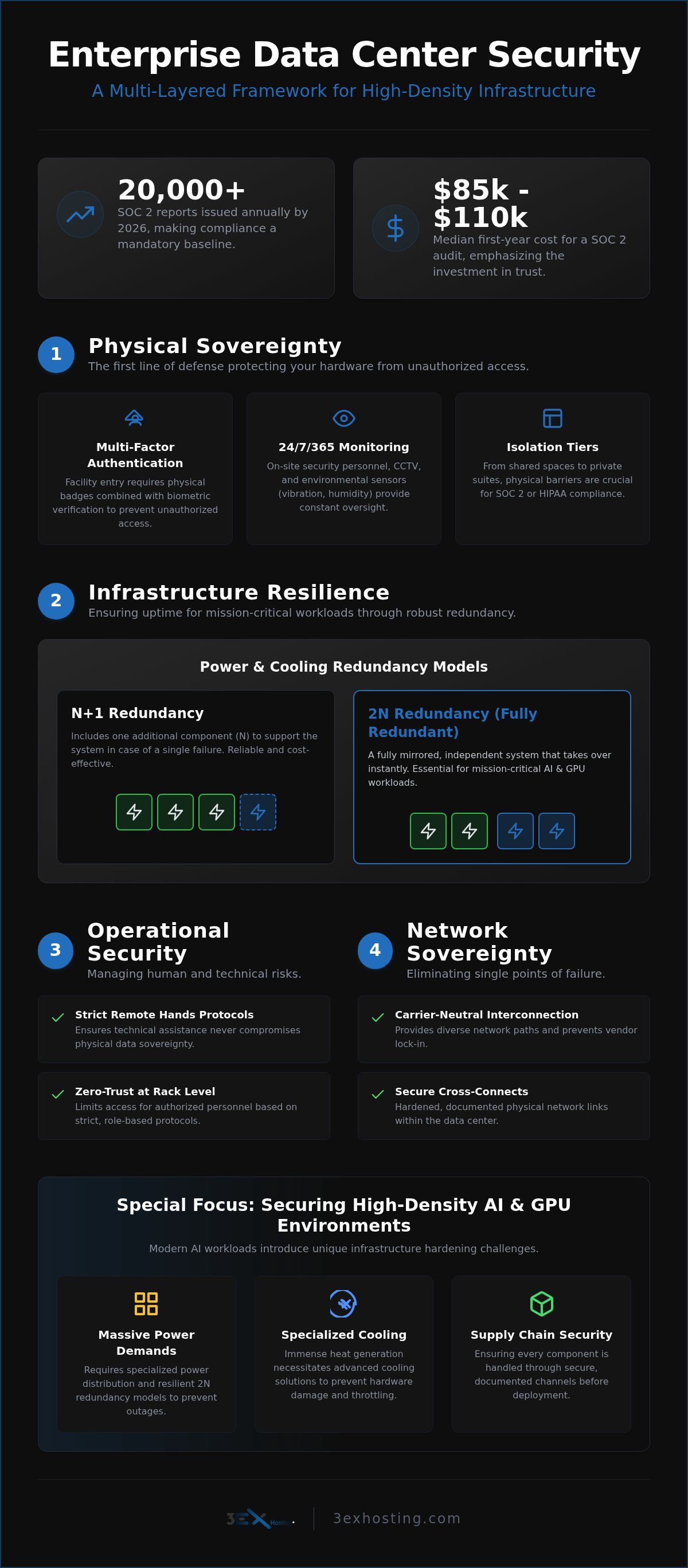
With over 20,000 SOC 2 reports issued annually in 2026, the baseline for infrastructure trust has shifted from a competitive advantage to a mandatory requirement. You understand that a single hour of downtime or a minor physical breach doesn’t just damage your bottom line; it erodes years of hard-earned client confidence. Maintaining robust enterprise data center security is no longer just about firewalls. It’s about the physical sovereignty of your hardware and the stability of your power and cooling systems.
It’s frustrating to balance strict regulatory compliance like HIPAA or PCI-DSS with the massive power demands of modern AI and GPU workloads. You need a facility that offers more than just floor space. This guide provides the multi-layered security protocols required to protect high-density enterprise infrastructure from both physical and digital threats. We’ll walk through a comprehensive checklist of physical and logical requirements, a framework for evaluating colocation providers, and the specific configurations needed to secure high-density AI environments. By the end, you’ll have a clear roadmap for mission-critical protection that keeps your operations stable and your data sovereign.
Key Takeaways
- Master the convergence of physical and digital protocols to build a modern enterprise data center security framework that protects high-density hardware.
- Identify the specific biometric and multi-factor authentication requirements needed to secure private colocation suites and individual equipment racks.
- Compare N+1 and 2N redundancy models to determine the most reliable way to guarantee uptime for mission-critical GPU and AI workloads.
- Establish strict operational oversight for remote hands support to ensure technical assistance never compromises your physical data sovereignty.
- Leverage carrier-neutral interconnection and secure cross-connects to eliminate single points of failure in your network infrastructure.
The Evolving Landscape of Enterprise Data Center Security in 2026
By 2026, the definition of enterprise data center security has shifted from a digital-first approach to a holistic model of infrastructure sovereignty. Traditional perimeter defenses are no longer sufficient to protect the high-density loads required for modern operations. As AI workloads demand massive power and specialized cooling, the hardware itself becomes a high-value target for both physical and digital interference. A security failure in this environment doesn’t just result in data loss; it leads to total operational paralysis.
The cost of a breach has climbed significantly. Beyond the median first-year SOC 2 audit costs of $85,000 to $110,000, businesses face the threat of permanent hardware damage or long-term reputational ruin. Effective enterprise data center security requires a 360-degree integration of physical barriers, environmental monitoring, and logical access controls to maintain uptime in an increasingly volatile threat environment.
Beyond Firewalls: The Physical-Logical Security Nexus
A firewall can’t stop an unauthorized person from physically accessing a server rack or tampering with cooling systems. This is why Data center security must be viewed as a single, unified discipline. Physical access vulnerabilities are often the silent precursors to logical network breaches. If an intruder gains entry to a private colocation suite, they bypass almost every digital barrier your IT team has built.
Environmental monitoring now plays a critical role in preventing hardware-based theft. Sensors that track vibration, humidity, and airflow provide telemetry that can indicate tampering or unauthorized equipment movement. By integrating facility-wide security telemetry with your IT security operations center, you create a responsive environment where a door sensor alert is treated with the same urgency as a network intrusion attempt.
AI-Powered Threats and Infrastructure Hardening
Protecting high-density GPU clusters requires more than just standard locking mechanisms. These systems generate immense heat and require specialized infrastructure that introduces new surface areas for potential interference. Securing the supply chain for this hardware is the first step in a modern security protocol. You must ensure that every component, from the GPU itself to the power distribution unit, has been handled through secure, documented channels before arriving at your Cage Solutions datacenter.
Infrastructure hardening in 2026 is the strategic process of eliminating non-essential physical and logical access points to ensure that high-density AI clusters remain resilient against both environmental failure and targeted tampering. This includes implementing zero-trust principles at the rack level and ensuring that even authorized personnel are limited by strict, role-based access protocols. When your infrastructure is hardened, your focus shifts from reacting to incidents to maintaining a state of constant, verified stability.
Physical Sovereignty: Advanced Access Control and Monitoring
Physical sovereignty ensures that your hardware is protected by more than just digital encryption. It is the first line of defense in a comprehensive data center security strategy. In 2026, facility entry requires multi-factor authentication (MFA) that combines physical badges with biometric verification. This dual-layer approach prevents badge cloning and ensures that only verified personnel enter the premises. If a badge is lost or stolen, the biometric requirement remains an impassable barrier.
On-site security personnel monitor the facility 24/7/365. They don’t just watch screens; they manage strict visitor protocols and maintain the integrity of the physical environment. For enterprise clients, the hierarchy of isolation is a critical decision point. While shared colocation spaces offer cost efficiency, they lack the physical barriers required for highly sensitive data. Understanding the difference between shared space, cages, and suites is essential for maintaining robust enterprise data center security.
Rack-Level Security: Cages and Private Suites
Custom cage solutions provide a dedicated physical perimeter within a shared hall. This is often the minimum requirement for meeting SOC2 or HIPAA compliance, as it prevents unauthorized personnel from standing directly in front of your equipment. However, for organizations requiring absolute control, private colocation suites offer a fully enclosed environment with floor-to-ceiling walls and dedicated cooling infrastructure.
Security doesn’t stop at the suite door. Individual rack locks with biometric readers and intrusion detection sensors provide a final layer of protection. These sensors alert your team immediately if a rack door is opened without authorization, ensuring that your enterprise data center security remains intact at the most granular level. If you are planning a transition to higher security standards, you can request a custom configuration quote to see which isolation level fits your specific needs.
Surveillance and Audit Trails
Surveillance in a modern facility involves high-definition CCTV coverage that leaves no blind spots in the data halls or mechanical corridors. Long-term data retention is standard, allowing for forensic review months after an event occurs. Every visitor is logged electronically, and non-authorized personnel must follow mandatory escort protocols at all times. There are no exceptions to this rule.
These measures create a robust audit trail for your compliance team. When auditors review your adherence to PCI-DSS or other frameworks, they look for documented evidence of physical access control. A facility that tracks every entry, exit, and rack access event simplifies your compliance journey. It proves that your physical sovereignty is actively managed and verified through consistent, automated logging.
Infrastructure Resilience: Power, Cooling, and Redundancy
Power redundancy is a fundamental pillar of enterprise data center security. It ensures that mission-critical operations remain online during localized outages or grid instability. In 2026, the complexity of high-density infrastructure means that a power failure is more than just an operational hurdle. It is a security event that can disable surveillance systems, compromise biometric access controls, and lead to hardware-level data corruption. Maintaining a stable, uninterruptible environment is essential for comprehensive enterprise data center security and long-term hardware health.
Choosing between N+1 and 2N redundancy depends on your specific risk tolerance and the nature of your workloads. N+1 architecture provides one extra component for every ‘N’ units required. While this allows for routine maintenance without downtime, it doesn’t protect against a total path failure. 2N redundancy, however, provides two completely independent power paths from the utility to the rack. This is the preferred standard for mission-critical loads where even a millisecond of interruption is unacceptable. Resilience also extends to disaster recovery protocols. Facilities must maintain substantial fuel reserves and conduct regular generator load testing. These testing protocols ensure that when the utility grid fails, the transition to backup power is instantaneous and sustained.
Resilient Power Architecture for High-Density AI
High-density GPU hosting requires a specialized power strategy that moves beyond standard commercial electrical designs. Metered power and dedicated circuits provide the visibility needed to prevent overloads and ensure that each rack receives stable current. UPS systems serve as the critical bridge between utility power and backup generators. They filter out electrical anomalies like sags, surges, and harmonic distortion that can damage sensitive AI hardware. Properly managing power density involves a balanced approach to rack distribution and circuit protection. When you evaluate full cabinet colocation, ensure the provider can support the specific amperage required for your GPU clusters without compromising the safety of the surrounding infrastructure.
Cooling Security and Environmental Control
Thermal management is a security requirement. In 2026, modern building energy efficiency standards emphasize the need for precision cooling in high-density environments. If a cooling system fails, high-density hardware can reach critical temperatures within minutes, leading to immediate system shutdowns and potential permanent damage. Redundant cooling units are essential to prevent thermal-induced hardware failure and maintain the integrity of the hardware sovereignty discussed earlier. For data centers integrated into hazardous industrial sites, specialized equipment from ExSafe ensures that ventilation and power distribution systems meet rigorous safety certifications.
Environmental security also includes leak detection and advanced fire suppression. VESDA (Very Early Smoke Detection Apparatus) systems detect smoke at the molecular level, providing an early warning long before a traditional smoke detector would trigger. Clean agent fire suppression systems then extinguish fires without damaging electronics. This ensures that a localized incident doesn’t lead to a total loss of your enterprise assets or an extended period of downtime.
Physical barriers and redundant power systems are only as effective as the people who manage them. In a high-stakes environment, human error or insider threats can bypass even the most advanced hardware protections. Robust enterprise data center security requires strict vetting and recurring training protocols for all technical staff. Background checks are the starting point, but they must be followed by specialized education on physical sovereignty and the specific security needs of high-density AI clusters.
Standard Operating Procedures (SOPs) govern every action within the facility. Whether it’s a routine hardware deployment or emergency maintenance, every step is documented and verified. Inventory management is another critical component often overlooked. Every component that enters or leaves the data hall is tracked to prevent unauthorized hardware from being introduced to the network. When hardware reaches its end of life, secure e-waste disposal protocols ensure that data is permanently destroyed before the physical components are recycled, meeting strict regulatory standards for data remanence.
Managed Infrastructure and Remote Hands Security
For organizations that don’t have staff on-site 24/7, remote hands support is an essential service. However, giving a third party physical access to your hardware requires a high level of trust and strict authorization protocols. Authorization must be handled through secure, encrypted ticketing systems that provide real-time reporting and operational transparency. You should always have a clear audit trail of who accessed your rack, what task was performed, and exactly how long they were inside your cabinet.
Operational security balances 24/7 availability with uncompromising access control. Technical teams must be trained to follow your specific security requirements, ensuring that remote assistance never compromises your physical sovereignty. If you need immediate technical support without sacrificing oversight, you can request remote hands assistance through a verified secure portal.
Compliance and Third-Party Audits
Annual third-party audits are the only way to verify that operational protocols are being followed consistently. The Statement on Standards for Attestation Engagements (SSAE) No. 18 is the current standard under which SOC 2 reports are issued in 2026. A SOC 2 Type II audit doesn’t just look at a single point in time; it evaluates the effectiveness of security controls over a period of months. This provides enterprise clients with the assurance that security isn’t just a policy on paper, but a daily operational reality.
Maintaining compliance in a carrier-neutral environment allows you to choose the best network providers while keeping your infrastructure within a secure, audited facility. This flexibility is vital for businesses that must adhere to HIPAA, PCI-DSS, or the updated ISO/IEC 27001:2022 standards. You can explore our full range of data center services to see how our operational framework supports your specific compliance goals.
Network Security and Interconnection Sovereignty
Network security is often discussed as a software problem, but for mission-critical infrastructure, it begins at the physical layer. Securing physical cross-connects within a carrier hotel is a vital component of enterprise data center security. These physical cables are the lifelines of your data. If they aren’t protected within a secure, monitored environment, your digital encryption is only half the battle. Private cloud on-ramps allow you to bypass the public internet entirely. This creates a direct, low-latency path between your colocated hardware and your cloud providers. This reduces exposure to common external threats and ensures that your most sensitive data transfers remain sovereign and protected from interception. This focus on infrastructure sovereignty is essential for high-security digital asset platforms like n.exchange, which provide secure, non-custodial swaps for enterprise-grade applications.
Carrier-neutral facilities offer a distinct security advantage by allowing you to build network redundancy through multiple providers. If one carrier experiences a backbone failure or a targeted DDoS attack, you can reroute traffic instantly to maintain uptime. Modern enterprise data center security protocols include automated threat detection and mitigation at the infrastructure edge. This prevents malicious traffic from even reaching your servers. By scrubbing traffic at the facility gateway, the provider protects your high-density workloads from the operational paralysis caused by volumetric attacks. It’s a proactive layer of defense that keeps your bandwidth available for legitimate business operations.
Private cross-connects significantly reduce your attack surface. Instead of traversing multiple public hops, your data moves through a single, physical cable within the data center. The security of meet-me rooms (MMRs) is paramount here. These rooms act as the nexus of connectivity and must be as secure as the data halls themselves. They should feature strict access control, biometric verification, and constant surveillance to ensure no unauthorized tampering occurs. This physical isolation is a key differentiator for high-security environments. You can learn more about managing these complex environments in our guide to cabinet colocation and high-density infrastructure.
Disaster Recovery and Business Continuity
True resilience requires geographically diverse redundancy. While your primary infrastructure is hardened, a secondary site ensures that mission-critical data remains available during a regional catastrophe or major utility failure. Your security planning must define clear Recovery Time Objectives (RTO) and Recovery Point Objectives (RPO). These metrics dictate how quickly you can restore operations and how much data loss is tolerable for your specific business model. Managed disaster recovery solutions integrate directly with your physical security protocols. This ensures that your backup environment is just as sovereign and protected as your primary production site. To see how these protocols support your operations, explore our full range of data center services.
Securing Your Infrastructure for the Next Era of Performance
Securing high-density workloads in 2026 requires a shift from reactive digital measures to proactive physical sovereignty. You’ve seen how integrating biometric access, redundant power paths, and carrier-neutral connectivity creates a resilient foundation for your most sensitive data. True enterprise data center security depends on the seamless coordination between hardened infrastructure and strict operational oversight. This dual approach ensures that your AI clusters and mission-critical systems remain stable even as global threat landscapes evolve.
Don’t settle for generic floor space when your business continuity is on the line. You need a partner that provides SOC2 compliant infrastructure and the technical expertise to manage complex hardware deployments. With 24/7 remote hands support and direct cross-connects, you can maintain absolute control over your environment without needing staff on-site at all times. It’s time to build a foundation that matches your technical ambitions. Get a Custom Quote for Your High-Security Enterprise Infrastructure today and ensure your operations are built for long-term stability.
Frequently Asked Questions
What are the main components of physical data center security?
Physical security involves multiple layers of defense starting at the facility perimeter. Key components include 24/7 on-site security personnel, biometric multi-factor authentication for all entry points, and high-definition surveillance with long-term data retention. Within the data hall, security extends to floor-to-ceiling cages and individual rack locks equipped with intrusion sensors. These systems work together to ensure that physical access is strictly limited to authorized personnel, protecting your hardware from tampering or theft.
How does N+1 redundancy differ from 2N redundancy in an enterprise data center?
N+1 redundancy means there is one extra component for every group of units required to support the load. If you need four power modules, N+1 provides five. 2N redundancy is a more robust standard, providing two completely independent and mirrored systems. This ensures that if an entire power path fails, the secondary path carries the load without interruption. 2N is typically required for mission-critical enterprise data center security and maximum uptime.
Why is carrier neutrality important for data center security?
Carrier neutrality allows you to connect with multiple network providers within the same facility. This is a critical security feature because it eliminates single points of failure at the network level. If one carrier suffers a major outage or a targeted DDoS attack, you can instantly reroute traffic through a different provider. It also prevents vendor lock-in, giving you the flexibility to choose carriers that meet your specific encryption and routing standards.
What compliance certifications should an enterprise data center hold?
A modern facility should maintain several key certifications to verify its operational and physical security. SOC 2 Type II is the industry standard for evaluating security, availability, and confidentiality over time. Depending on your industry, you should also look for HIPAA for healthcare data, PCI-DSS for financial transactions, and ISO/IEC 27001:2022 for information security management. These audits provide third-party validation that the facility follows strict, documented protocols.
How does a private colocation suite improve security over shared space?
A private colocation suite provides a fully enclosed environment with solid walls and dedicated entry points. Unlike shared spaces or open cages, a suite ensures that no other customers can even see your equipment. It allows for the implementation of custom security measures, such as dedicated CCTV and internal biometric scanners. This level of isolation is essential for organizations that require absolute physical sovereignty over their high-density infrastructure and sensitive data.
What security protocols should be in place for remote hands support?
Secure remote hands support requires a strict authorization framework. Every request must be submitted through an encrypted ticketing system that identifies the authorized user. Technicians should only perform tasks within a clearly defined scope, and all actions must be logged in real-time. For high-security environments, you can request video logs or two-person integrity protocols, where a second staff member verifies all physical changes made to your equipment.
How do high-density GPU clusters affect data center security requirements?
High-density GPU clusters significantly increase the demand for power and cooling, which introduces new security risks. Thermal failure can lead to hardware damage and operational downtime, making redundant cooling a critical part of enterprise data center security. These clusters also represent high-value targets, requiring enhanced physical isolation like private suites. Security must also account for the specialized supply chain protocols needed to verify the integrity of expensive AI hardware before deployment.
Can I integrate my own security hardware into a colocation cage?
Yes, most enterprise-grade facilities allow you to install your own security hardware within your dedicated cage or suite. This often includes proprietary rack-level cameras, custom biometric locks, or independent environmental sensors. Integrating your own hardware allows you to maintain a unified security posture across your hybrid infrastructure. You should coordinate with the facility management to ensure that your hardware complies with local fire codes and doesn’t interfere with shared cooling systems.