 SUPPORT


 3EX United States
 Blog
By the end of 2026, global data center electricity consumption is projected to exceed 1,000 TWh, more than doubling in just a few years. For most enterprises, this surge directly translates to rising IT budgets and a desperate need to decode the technical reality of data center PUE. You’re likely tired of vague green marketing claims that don’t reflect your actual monthly bill. It’s frustrating when you can’t clearly calculate the ROI of high-density colocation while your energy costs keep climbing.
This guide will help you master the financial and technical implications of Power Usage Effectiveness so you can optimize your infrastructure and significantly reduce your total cost of ownership. We’ll provide a clear framework to evaluate provider efficiency, explain the direct link between PUE and metered power costs, and show you how to future-proof your systems for massive AI and GPU workloads. Managing power density is no longer just a technical task; it’s a critical business strategy for the AI era.
Key Takeaways
- Learn why 1.2 is the modern efficiency target for 2026, replacing the legacy industry average of 1.5.
- Understand the direct link between data center PUE and your colocation bill through the calculation of the Effective kWh Rate.
- Discover how high-density GPU hosting and AI infrastructure at 30kW+ per rack demand a more sophisticated approach to cooling-to-power ratios.
- Gain a clear framework to audit your provider’s reporting methodology to ensure you aren’t paying for hidden facility inefficiencies.
- Identify immediate infrastructure improvements like hot/cold aisle containment that help stabilize costs and boost system reliability.
Understanding Data Center PUE: Definition and Core Principles
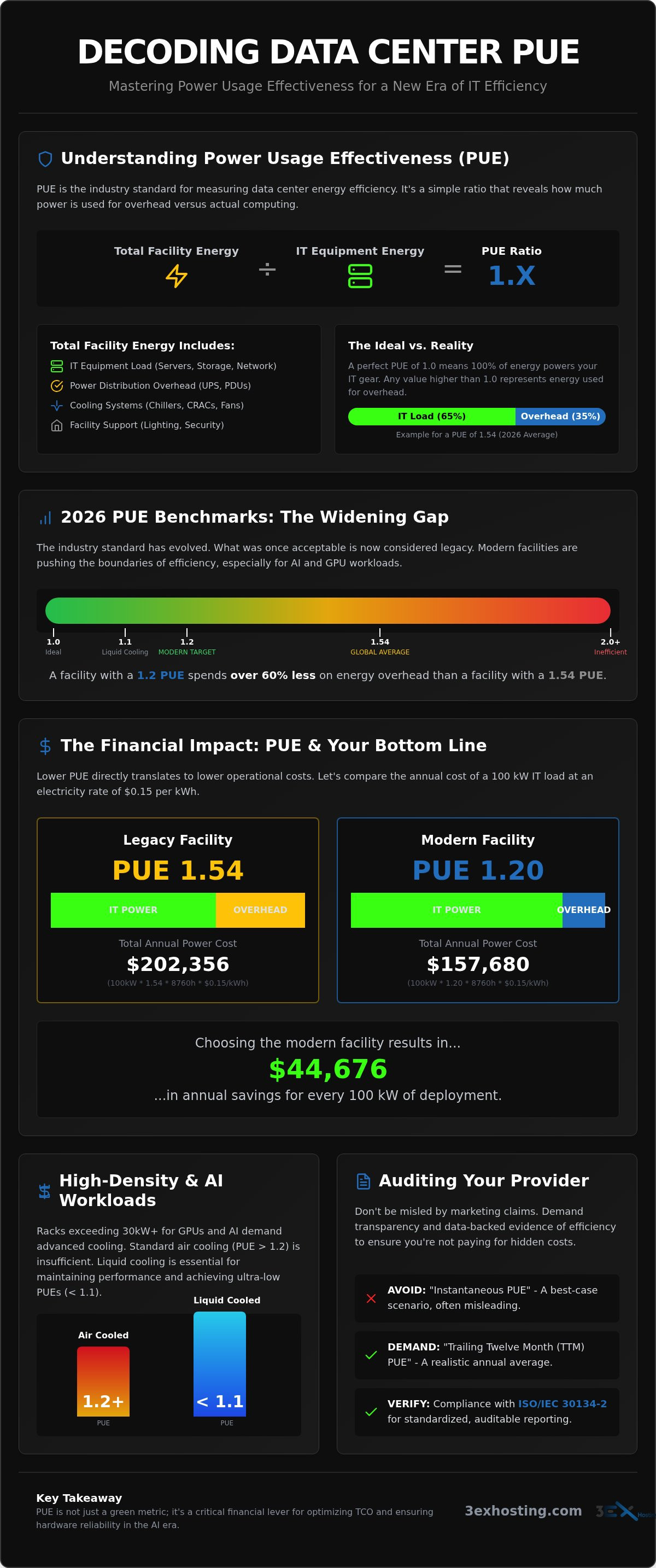
Efficiency starts with measurement. To manage infrastructure effectively, you must first quantify how energy is consumed across the facility. Power Usage Effectiveness (PUE) is the global industry standard for this calculation. It represents the ratio between the total amount of energy entering the data center and the power actually delivered to the IT equipment. When you look at a data center PUE metric, you’re seeing a multiplier that determines your total energy overhead.
A value of 1.0 represents the theoretical ideal where 100% of the energy powers your servers, storage, and networking hardware. In reality, every facility has overhead components that draw power without performing computation. These components typically include:
- Cooling systems: CRAC units, chillers, and fans required to maintain thermal stability.
- Power distribution: Energy lost as heat through UPS systems, transformers, and PDUs.
- Facility support: Lighting, security systems, and building management sensors.
While PUE remains the dominant metric, some engineers also track Data Center Infrastructure Efficiency (DCIE). It’s simply the inverse of PUE, expressed as a percentage. For instance, a PUE of 2.0 equals a DCIE of 50%, meaning only half of the facility’s power reaches the IT load. Understanding this relationship is the first step toward optimizing your full cabinet colocation strategy.
The Evolution of PUE Standards (ISO/IEC 30134-2)
The Green Grid introduced PUE in 2006 to provide a common language for efficiency. Today, it’s formalized under ISO/IEC 30134-2. This standardization is vital for corporate ESG reporting in 2026. Modern audits now prioritize operational PUE, which reflects actual measured performance, over design PUE, which only shows theoretical capability. Reliable reporting ensures that your sustainability claims are backed by audited data rather than optimistic projections.
Why PUE Matters for Modern Enterprise IT
High efficiency isn’t just about being green. It directly impacts hardware health. Facilities with optimized data center PUE often maintain more stable thermal environments, which extends the lifespan of your expensive GPU and server hardware. Efficient power distribution also reduces the risk of localized heat spikes that can trigger performance throttling. PUE is the primary metric for gauging how much of your utility bill actually powers your servers. For enterprises scaling high-density loads, every fraction of a PUE point saved represents a significant reduction in operational waste and improved system reliability.
Calculating PUE in 2026: Benchmarks and Reporting Standards
A static data center PUE reading is rarely enough to build an accurate financial model. In 2026, the global average PUE sits at approximately 1.54. While this 1.5 range was the industry standard for a decade, it’s now considered a legacy benchmark. Modern enterprise facilities are aggressively targeting 1.2 or lower to stay competitive and compliant with new energy directives. If you’re evaluating a provider, you need to look past the marketing headlines and examine how they calculate their efficiency metrics.
The most common reporting trap is the use of “Instantaneous PUE.” Providers often report their best possible number, typically recorded on a cold winter night when cooling systems run at minimum load. This doesn’t help your annual budget. You should demand “Trailing Twelve Month (TTM) PUE” data instead. TTM PUE accounts for seasonal variations and summer heat spikes, providing a realistic average of what you’ll actually pay for cooling throughout the year. If you’re unsure how your current provider measures efficiency, you can request a technical audit to see the real numbers.
The 2026 Efficiency Benchmarks for Enterprise Facilities
According to the Uptime Institute 2026 Global Survey, the gap between average and best-in-class facilities is widening. Tier III facilities often achieve lower PUEs than Tier IV sites. This happens because the extra redundant components in a Tier IV environment, such as additional UPS systems and cooling loops, create more electrical distribution loss. While air-cooled facilities struggle to drop below 1.2, liquid-cooled infrastructure designed for AI workloads can consistently reach benchmarks of 1.1 or lower. These efficiency gains are essential for managing the thermal output of modern high-density hardware.
Transparency in Measurement Boundaries
Accuracy depends entirely on where the measurement occurs. Some facilities measure “IT Load” at the UPS output, which ignores the energy lost in the cables and power distribution units (PDUs) leading to your rack. This makes the PUE look better than it is. For full cabinet colocation, measurement at the PDU level is the only way to get a true reading. Sub-metering at the individual rack level ensures you aren’t subsidizing the “PUE tax” of other, less efficient clients in the same hall. Transparent boundaries prevent facility managers from hiding office lighting or lobby cooling costs within the general facility power total.
The Business Impact: How PUE Influences Colocation Costs and ROI
For many IT directors, the most frustrating part of a colocation bill isn’t the rack rental. It’s the “PUE Tax.” This hidden surcharge occurs when an inefficient provider passes their excessive cooling and distribution losses directly to your monthly invoice. If you’re operating in a facility with a high data center PUE, you’re essentially subsidizing the provider’s outdated infrastructure and poor thermal management. Every watt wasted on an inefficient chiller is a watt you pay for without receiving any computational value.
To see the real impact, you must calculate your “Effective kWh Rate.” The formula is simple: Utility Rate x PUE = Actual Cost per IT Watt. If your utility charges $0.12 per kWh and your provider’s PUE is 1.6, your actual cost is $0.192 per kWh. In a more efficient facility with a PUE of 1.25, that same power costs you only $0.15. This 0.35 difference might seem small on paper; however, for a single 10kW rack running 24/7, a 0.2 PUE reduction can save over $1,700 annually in power costs alone. Across a full suite of cabinets, these savings scale into the tens of thousands.
Efficiency also dictates how much hardware you can pack into a single footprint. High-efficiency facilities manage airflow more precisely, allowing you to deploy high-density racks without triggering “hot spot” surcharges. When a facility is already struggling with its thermal load, providers often charge premiums for high-density deployments to cover the extra strain on their cooling loops.
Metered Power vs. Fixed Power Models
In a metered power model, data center PUE transparency is your greatest asset. You pay for exactly what your servers draw, plus a clearly defined multiplier for cooling. This rewards you for using efficient hardware and modern power management settings. Conversely, fixed power or “all-inclusive” models often bake a high PUE assumption into the base price. This forces you to pay for a level of waste that you might not actually be generating. Our approach to 3EX Hosting Cabinet Colocation prioritizes this transparency, ensuring you only pay for the energy your infrastructure actually requires.
ROI Analysis: High Efficiency vs. Low Rent
Don’t be misled by a low “per-U” or monthly rack rental fee. A cheaper facility with a high PUE often becomes the more expensive option within the first 18 months of operation. When projecting your 3-year or 5-year TCO, the energy overhead usually dwarfs the initial setup and lease costs. For high-density loads, PUE is a more significant cost driver than the monthly rack rental fee. Investing in a more efficient facility protects your budget against future utility rate hikes and ensures your infrastructure can scale without financial friction. This long-term perspective is essential for maintaining a predictable IT budget as your computational needs grow.
High-Density Challenges: AI, GPU Hosting, and the Evolution of PUE
AI is fundamentally rewriting the rules of infrastructure efficiency. In 2026, a single NVIDIA Blackwell rack can draw between 120 and 140 kW, making traditional air cooling systems insufficient for modern enterprise needs. This shift to extreme density dramatically alters the cooling-to-IT power ratio. When you deploy high-density infrastructure, standard data center PUE metrics often fail to provide a complete picture of operational health. The sheer volume of heat generated by these clusters requires a more sophisticated approach to thermal management than legacy server loads.
Liquid cooling has become the baseline for these workloads. Direct-to-Chip (DTC) and immersion solutions remove heat far more efficiently than air, often yielding PUE values below 1.1. However, focusing solely on power usage is no longer enough. The industry is moving toward secondary metrics like Water Usage Effectiveness (WUE) and Carbon Usage Effectiveness (CUE) to provide a holistic view of resource efficiency. WUE measures liters of water used per kilowatt-hour of IT power, while CUE tracks total carbon emissions relative to the load. These are now essential for meeting 2026 ESG mandates.
Managing Heat in AI Infrastructure
Managing the thermal output of a 30kW+ rack requires a departure from standard CRAC units. Facilities are transitioning to Rear Door Heat Exchangers (RDHx) that capture heat directly at the source. These complex systems require specialized remote hands support to manage coolant loops and thermal sensors. Interestingly, PUE can sometimes appear to “improve” as IT load increases. This happens because the fixed facility overhead becomes a smaller percentage of the total power draw, which can mask underlying cooling inefficiencies that only become apparent during maintenance cycles.
The “Beyond PUE” Era: Total Resource Efficiency
We are entering the “Beyond PUE” era. For AI training clusters, IT Power Efficiency (ITPE) is becoming a critical metric. It ensures the servers themselves aren’t wasting energy through inefficient internal fans or power supplies. Leading managed IT infrastructure providers are already adapting their facilities to support these 2026 standards by integrating liquid cooling manifolds and enhanced power distribution. If you’re planning an AI deployment, get a quote for high-density infrastructure designed specifically for GPU workloads.
Optimizing Your Infrastructure: Beyond the PUE Metric
Mastering your data center PUE requires moving from passive observation to active infrastructure management. While the facility provider controls the primary cooling and power systems, your deployment choices significantly influence the final efficiency ratio. Small configuration errors at the rack level can lead to massive energy waste, driving up your metered power costs. You can take immediate steps to ensure your hardware operates at peak efficiency without compromising reliability.
Follow this four-step framework to optimize your colocation footprint:
- Step 1: Audit reporting methodology. Verify exactly where your provider measures IT load. Ensure they aren’t bundling facility lighting or office power into your specific cage’s consumption data.
- Step 2: Optimize airflow. Install blanking panels in every open rack unit to prevent hot air recirculation. Use hot or cold aisle containment to ensure cooling reaches the server intakes without mixing with exhaust air.
- Step 3: Right-size power distribution. Avoid running UPS systems or transformers at very low loads, as efficiency drops significantly outside the 40-80% utilization range.
- Step 4: Minimize network overhead. Leverage high-performance cross-connect services to reduce the distance data travels, which lowers the energy required for high-speed transmission between cabinets.
Operational Best Practices for Colocation Clients
Visibility is the foundation of efficiency. Implementing Data Center Infrastructure Management (DCIM) tools allows you to track real-time power draw and thermal trends. This data helps identify “Ghost Servers”—idle machines that draw significant power while performing zero computational work. These zombies can degrade your effective data center PUE by wasting energy that provides no business value. You can utilize remote hands to perform physical airflow audits, ensuring that cables don’t block exhaust fans and that all containment seals remain intact during hardware swaps.
Evaluating a Provider’s Efficiency Roadmap
When you conduct a data center tour, look beyond the current specs. Ask about the facility’s roadmap for supporting liquid cooling transitions as AI densities increase. Inquire about the efficiency ratings of their UPS fleet and their strategy for managing peak summer thermal loads. A provider committed to long-term stability will have a clear plan for renewable energy integration and equipment lifecycle management. Once you understand their technical capabilities, you can request a custom colocation quote that reflects a realistic, optimized power budget for your specific 2026 infrastructure needs.
Future-Proofing Your Infrastructure for the AI Era
Managing data center PUE in 2026 is no longer just a technical exercise; it’s a fundamental pillar of your financial strategy. The shift from legacy 1.5 benchmarks toward modern 1.2 targets can save thousands in annual power costs per rack. High-density GPU clusters require more than standard air cooling. They demand a holistic approach to thermal management and resource efficiency to prevent performance throttling. By auditing TTM reporting and implementing precise rack-level optimizations, you’ll secure both your hardware’s longevity and your company’s long-term ROI.
3EX Hosting offers the technical stability and speed your enterprise needs to scale. Our Tier III infrastructure supports specialized AI and GPU hosting capabilities with ease. With 24/7 technical remote hands support, you can rest assured that your critical systems are in expert hands. Don’t let inefficient infrastructure drain your IT budget. Request a High-Density Colocation Quote from 3EX Hosting and take control of your infrastructure efficiency today.
Frequently Asked Questions
What is a “good” PUE for a data center in 2026?
A “good” PUE in 2026 depends on your specific workload, but 1.2 is the modern efficiency target for enterprise facilities. While the global average remains around 1.54, leading hyperscale operators are achieving values as low as 1.08. If your provider is still reporting a ratio above 1.5, they’re likely using legacy cooling infrastructure. Aiming for 1.2 ensures you aren’t overpaying for facility overhead while maintaining a competitive operational budget.
How does PUE affect my monthly colocation bill?
Your data center PUE serves as a direct multiplier for your metered power costs. If you consume 10 kW of IT power in a facility with a 1.5 PUE, you’ll be billed for 15 kW to cover the cooling and distribution losses. Choosing a provider with a lower ratio directly reduces this surcharge. Over a multi-year contract, even a 0.1 improvement in efficiency can lead to thousands of dollars in savings per rack.
Is a low PUE always better than a high PUE?
Lower isn’t always better if it compromises system reliability. For example, Tier IV facilities often have slightly higher PUEs than Tier III sites because the additional redundant components draw more power. A very low number might also indicate a facility is running without enough cooling headroom for peak summer loads. You should balance efficiency with the redundancy levels required for your specific mission-critical applications to ensure maximum uptime.
What is the difference between Design PUE and Operational PUE?
Design PUE is a theoretical value based on the facility’s engineering specs under ideal conditions. Operational PUE is the actual measured performance of the data center during day-to-day use. You should always prioritize operational data, specifically Trailing Twelve Month (TTM) figures, when evaluating a provider. This accounts for real-world variables like fluctuating IT loads and seasonal weather changes that a theoretical design number simply cannot capture accurately.
How does AI and GPU hosting impact a data center’s PUE?
High-density AI and GPU hosting can actually make a data center PUE look better because the IT load increases significantly relative to the fixed facility overhead. However, these 30kW+ racks generate intense heat that traditional air cooling can’t handle efficiently. Transitioning to liquid cooling or direct-to-chip solutions is often necessary. These advanced systems can drive PUE values below 1.1, but they require specialized infrastructure and expertise to manage safely.
Can PUE be used to measure the efficiency of individual server racks?
PUE is fundamentally a facility-wide metric, not a tool for measuring individual rack efficiency. To understand how well your specific hardware is performing, you should look at IT Power Efficiency (ITPE). This involves sub-metering at the PDU level to track how much power your servers actually use versus what’s lost in internal power supplies. Combining facility-level PUE with rack-level sub-metering provides the most accurate view of your total infrastructure performance.
What other metrics should I look at besides PUE?
You should evaluate Water Usage Effectiveness (WUE) and Carbon Usage Effectiveness (CUE) alongside PUE for a holistic view of sustainability. WUE tracks how much water is consumed for cooling per kilowatt-hour of IT power, which is critical in water-stressed regions. CUE measures the total carbon emissions associated with the facility’s energy mix. Looking at these three metrics together ensures your infrastructure is both financially optimized and compliant with modern ESG reporting standards.
Why is PUE often lower in colder climates?
Facilities in colder climates can leverage free cooling or economizers for a large portion of the year. Instead of running energy-intensive chillers, they pull in cold outside air to dissipate heat from the server room. This significantly reduces the energy overhead required for thermal management, leading to a lower annual PUE. In warmer regions, providers must rely more heavily on mechanical refrigeration, which increases the facility’s total power draw and raises the efficiency ratio.