 SUPPORT


 3EX United States
 Blog
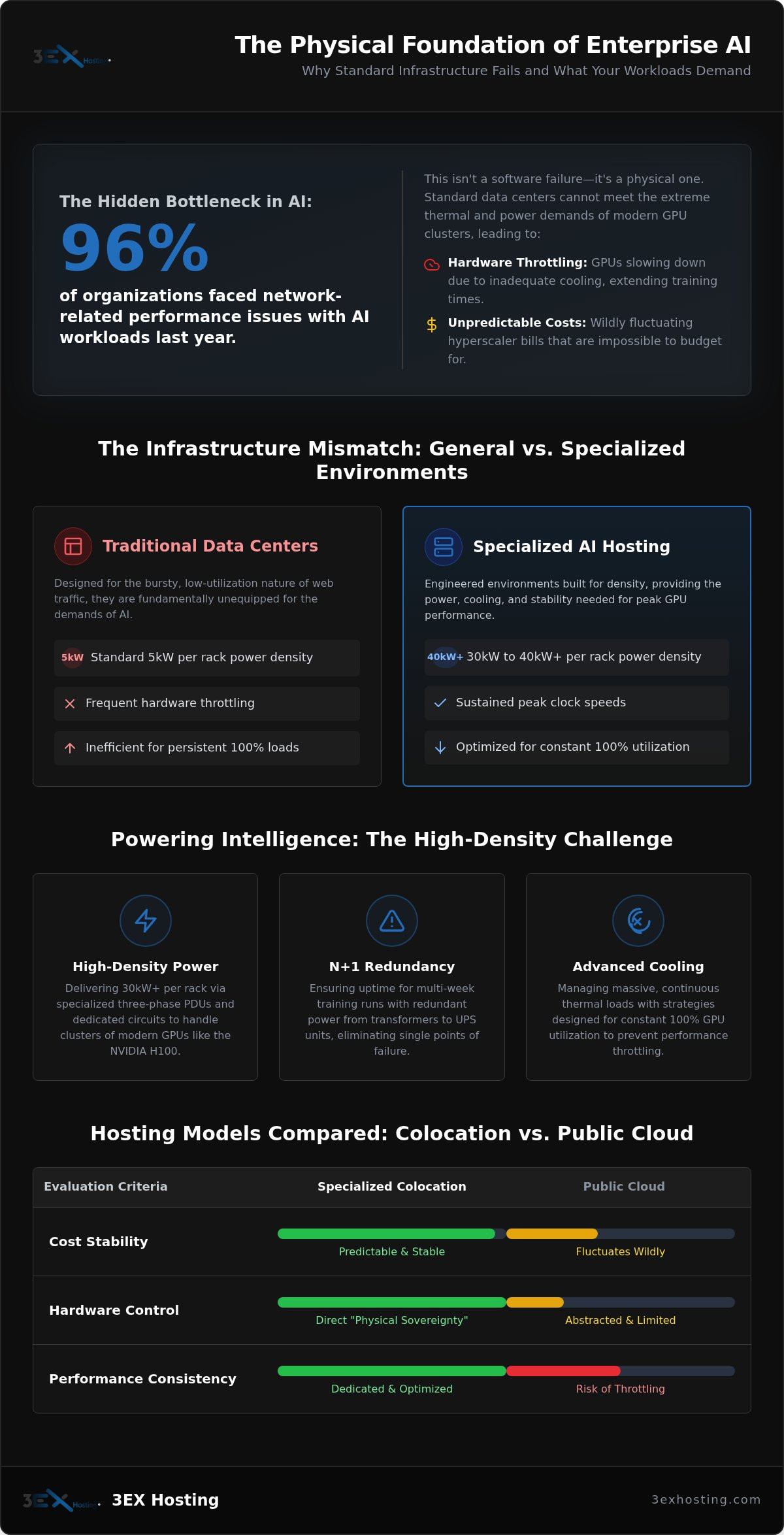
Recent industry data reveals that 96% of organizations experienced network-related performance issues with their AI workloads over the last year. This isn’t a software failure; it’s a physical one. When you’re running NVIDIA H100 clusters at scale, standard data centers often can’t keep up with the extreme thermal and power demands. You’ve likely dealt with the frustration of hardware throttling or the shock of a hyperscaler bill that fluctuates wildly month to month. Relying on generic cloud environments often means sacrificing the physical control you need over your proprietary models and hardware configurations.
We understand that enterprise AI infrastructure hosting is a high-stakes engineering challenge where stability is the only metric that matters. You need an environment built for density, not just floor space. This guide provides a technical roadmap to architecting, scaling, and securing the physical foundations of your AI clusters. We’ll examine how to achieve maximum GPU performance through advanced cooling and N+1 power redundancy. You’ll learn how to stabilize your infrastructure costs while leveraging 24/7 remote hands to eliminate operational complexity. By the end, you’ll have the framework to build a secure, high-density environment that keeps your most intensive workloads running at peak efficiency.
Key Takeaways
- Understand why standard data centers fail and how specialized AI infrastructure hosting provides the physical stability required for modern GPU workloads.
- Learn to calculate power draw for high-density AI racks and why N+1 redundancy is critical for maintaining maximum performance.
- Compare the economics of colocation versus public cloud to eliminate unpredictable billing and regain direct control over your hardware.
- Discover how carrier-neutral facilities and dedicated cross-connect services minimize latency for real-time AI inference.
- Scale your operations with 24/7 remote hands support to manage complex physical hardware without increasing in-house overhead.
The Architecture of AI: Beyond the Algorithm to Physical Infrastructure
Modern AI development often focuses on neural network weights and training sets. However, the true bottleneck is the physical environment. AI infrastructure hosting is the specialized layer of power, cooling, and networking designed specifically for high-performance GPU and TPU workloads. Unlike traditional computing, AI requires an AI data center environment that can sustain massive, continuous thermal loads without throttling performance. As models grow in complexity, the demand for hardware density increases. This shift has introduced the concept of Physical Sovereignty. Enterprises now realize that to protect and optimize proprietary models, they need direct control over the physical silicon and the environment where it lives.
Why AI Workloads Demand Specialized Hosting Environments
Traditional data centers were built for the bursty nature of web traffic. Servers sit idle until a user clicks a link. AI training is different. It’s a persistent, 100% utilization load that generates constant, intense heat. If your cooling system isn’t designed for this, your hardware will throttle. This extends training times and increases costs. Standard 5kW racks, common in general-purpose facilities, simply can’t handle a single modern GPU server. A cluster of NVIDIA H100s can easily push a single cabinet’s requirements past 30kW or 40kW. Specialized hosting ensures your full cabinet colocation setup has the airflow and power density to keep these chips running at peak clock speeds.
The Shift from General Computing to High-Density AI Clusters
The industry has moved rapidly from CPU-centric architectures to GPU-centric clusters. In the past, you could scale by adding more standard servers. Today, scaling requires packing more compute power into smaller physical footprints. AI infrastructure is the fusion of high-density power and low-latency networking. This evolution is driven by specialized accelerators like NVIDIA H100s, A100s, and custom TPUs. These units require specialized private colocation suites that offer the power headroom necessary for multi-node training. Without this physical foundation, even the most advanced algorithm will struggle with latency and throughput issues. It’s about moving from generic rack space to engineered compute environments.
Powering Intelligence: Managing High-Density Requirements
Power is the lifeblood of high-performance computing. It’s not just about total capacity; it’s about stability and density. AI infrastructure hosting requires a radical rethink of power distribution compared to traditional enterprise IT. Reliability starts with N+1 redundancy at every stage of the electrical path. This architecture ensures that if a transformer, UPS, or generator fails, your multi-week training run doesn’t crash. Calculating power draw for an enterprise AI rack involves more than summing up plate ratings. You must account for peak surge during model weights loading and the persistent, heavy draw of high-performance networking fabrics.
When centralizing AI infrastructure, organizations must look beyond raw kilowatts to the granularity of metered power. This precision allows for accurate cost allocation across departments. It also helps identify inefficient nodes before they lead to hardware failure. If you’re scaling a private cluster, you can request a custom power configuration to match your specific GPU requirements.
Solving the 30kW+ Per Rack Challenge
Engineering power for a 30kW+ rack requires specialized three-phase PDUs and dedicated circuit redundancy. Traditional power delivery can’t handle the concentrated heat and electrical demand of eight-GPU systems like the NVIDIA H100. A full cabinet colocation environment provides the necessary physical headroom to scale. It allows you to deploy dense clusters without the risk of tripping breakers or overwhelming local cooling capacity. This setup provides the stability needed for long-term growth and hardware reliability.
Cooling Strategies for GPU-Intensive Hardware
Thermal management is the second half of the density equation. Air cooling alone often fails when racks exceed 20kW. Hot aisle and cold aisle containment systems are now mandatory to prevent air mixing. These systems ensure that chilled air reaches the intakes of your GPUs directly rather than bypassing them. This prevents the hot exhaust from recirculating, which is the primary cause of thermal throttling.
Modern facilities are also transitioning toward liquid-to-chip cooling to maintain optimal PUE. Global energy efficiency directives now require data centers with an IT power demand of 500 kW or more to report PUE and water usage annually. High-density colocation prevents thermal throttling by maintaining a consistent, controlled environment. This keeps your GPUs running at their maximum rated clock speeds. It’s the difference between a model that finishes training in weeks and one that finishes in days.
Evaluating AI Hosting Models: Colocation vs. Public Cloud
Deciding where to deploy your GPU clusters is a strategic choice that impacts both performance and the bottom line. Public cloud providers excel at rapid prototyping, but their ‘black box’ nature creates long-term risks. You often lack visibility into the specific health or exact version of the silicon processing your data. Virtualized instances also introduce hypervisor overhead, which can slow down training cycles. Bare metal AI infrastructure hosting eliminates these variables. It provides raw access to the hardware, ensuring your models run at their theoretical maximum speed. This level of control is essential for aligning with the national AI infrastructure policy regarding high-performance computing clusters.
Ending the Hyperscaler Egress Fee Cycle
Public clouds often charge significant fees to move data out of their ecosystem. When you’re dealing with terabytes of training data, these egress costs become a massive, unpredictable line item. For stable, 24/7 workloads, the economic breakeven for purchasing hardware like NVIDIA H100s versus renting them from a hyperscaler is typically 12 to 18 months. After this period, owning your hardware and using a colocation model is almost always more cost-effective. Fixed-cost infrastructure provides the budget predictability that enterprise CFOs require for multi-year AI initiatives. You don’t have to worry about usage spikes or surprise billing at the end of the month.
Data Sovereignty for Proprietary AI Models
Shared-tenant environments pose a subtle but real risk to intellectual property. In a public cloud, your data and models exist on the same physical machines as other users. For companies in healthcare or finance, this lack of physical isolation can be a compliance deal-breaker. Utilizing private data center suites provides a dedicated physical perimeter for your hardware. This ensures that your proprietary models and sensitive datasets remain under your exclusive control. It’s the highest level of security available, meeting strict regulatory standards while maintaining the performance of a high-density environment. You own the silicon, the data, and the physical space it occupies.
Connectivity and Latency: The Backbone of AI Inference
AI performance relies on the speed at which data moves between compute nodes and the end user. High-quality AI infrastructure hosting must provide more than just a standard internet pipe; it requires a sophisticated, low-latency networking fabric. Carrier-neutral facilities allow you to choose the most efficient path for your specific traffic. This flexibility is vital for real-time inference where every millisecond of latency impacts the user experience. A well-engineered network ensures that your GPUs aren’t left idling while waiting for data ingestion or model weights to distribute across the cluster.
Carrier Hotels and Low-Latency Cross-Connects
Strategic placement in a carrier hotel provides direct access to hundreds of network providers. Using cross-connect services allows you to bypass the public internet entirely. This creates a secure, private link between your GPU clusters and major cloud on-ramps or ISPs. It reduces the hop count and eliminates the jitter that often plagues virtualized environments. For global AI applications, this direct interconnection ensures that model responses reach users with minimal delay. You gain the ability to scale your bandwidth vertically as your training datasets grow in size and complexity.
Disaster Recovery for Mission-Critical AI Training
Many teams rely on “resume from checkpoint” strategies for training failures. While useful, this doesn’t account for the massive cost of lost compute time. If your network fails during a multi-week training run, the financial impact extends beyond data loss to include idle hardware and missed deadlines. Implementing robust disaster recovery solutions is essential for protecting these high-value workloads. Loss of connectivity during a critical training phase can set a project back by weeks, making redundancy a primary requirement rather than an optional feature.
A resilient network for distributed AI training requires redundant failover paths. If one carrier goes down, your systems must switch instantly to a secondary provider to maintain continuous model availability. High-speed data ingestion also requires a network capable of handling massive bursts when loading new datasets. Stalling your GPUs because of a slow network is an expensive mistake that impacts your total cost of ownership. Ensure your clusters remain accessible and resilient by securing full cabinet colocation with carrier-neutral connectivity.
Future-Proofing Your AI with 3EX Hosting Infrastructure
The rapid evolution of machine learning requires more than just static rack space. It demands a partnership with a provider that understands the physical nuances of high-density GPU colocation. 3EX Hosting provides the technical stability and engineering expertise needed to sustain maximum performance for the most intensive workloads. Our AI infrastructure hosting environments are designed to adapt as your needs evolve, ensuring that your hardware remains secure and operational. Whether you’re deploying a single cluster or an enterprise-wide platform, our infrastructure supports the specialized requirements of modern silicon. We focus on the physical layer so your team can focus on the algorithm.
Managed Support for AI Hardware Teams
Maintaining complex GPU clusters requires specialized physical attention that software-defined teams often lack. This is where remote hands support becomes a critical extension of your internal IT department. Our technicians handle everything from physical hardware troubleshooting to component replacement and cable management. We understand that downtime during a training cycle is unacceptable. To ensure a smooth transition, we provide move-in assistance to facilitate the rapid deployment of your hardware. This hands-on approach removes the operational burden from your engineers. It allows them to focus on model optimization while we manage the physical layer with precision.
Designing Your AI Infrastructure Roadmap
Scaling an AI initiative is a multi-phase journey. You might start with a full cabinet colocation setup and eventually transition to cage solutions or private suites as your data requirements grow. We design our environments with the next generation of AI accelerators in mind. This ensures your power and cooling configurations can handle the increased demands of future hardware. This roadmap approach prevents the need for expensive, time-consuming migrations as your clusters expand. We provide the national reach and high-density capabilities required for enterprise growth.
Customized infrastructure design allows us to tailor power delivery and cooling paths to your unique hardware specs. This flexibility ensures you don’t overpay for unused capacity while maintaining the headroom necessary for peak performance. Our facility serves as a stable foundation for your most sensitive proprietary models. Ready to scale your AI? Get a custom infrastructure quote today and build your clusters on a foundation of technical excellence.
Securing the Physical Foundation of Your AI Strategy
Transitioning from experimental AI to enterprise-scale deployment requires a shift in focus from code to cabinet. True performance depends on a facility’s ability to handle 30kW+ rack densities and sustain 100% GPU utilization without thermal throttling. By choosing a dedicated environment over the unpredictable costs and shared-tenant risks of the public cloud, you regain sovereignty over your proprietary models and hardware. This shift ensures that your AI infrastructure hosting strategy is built on a foundation of technical excellence rather than virtualized compromises.
3EX Hosting provides the specialized environment your clusters need to thrive. We combine high-density power specialists with enterprise carrier-neutral connectivity to eliminate networking bottlenecks. Our 24/7 remote hands support ensures that your physical hardware is managed with the same precision as your software. We handle the complexity of the data center so your engineers can focus on pushing the boundaries of machine learning. Our systems are designed for the speed and reliability that modern AI workloads demand.
Don’t let physical constraints bottleneck your innovation. You have the opportunity to build a scalable, secure, and cost-effective environment that puts you in total control of your technical roadmap. Build Your High-Density AI Infrastructure with 3EX Hosting and start scaling your clusters with confidence today.
Frequently Asked Questions
What is the minimum power density required for AI infrastructure hosting?
Modern AI clusters typically require a minimum power density of 15kW to 30kW per rack. Standard data centers often max out at 5kW, which is insufficient for high-performance GPU systems. High-density environments are engineered for 30kW and above to support the continuous electrical draw of NVIDIA H100 or A100 clusters. Without this headroom, your hardware may experience thermal throttling or frequent circuit trips during intensive training cycles.
How does colocation differ from GPU cloud hosting for AI training?
Colocation provides direct physical control over your hardware and predictable monthly costs. In contrast, GPU cloud hosting offers rapid deployment but often includes hidden egress fees and higher long-term TCO. For stable, 24/7 AI workloads, purchasing your own silicon and using AI infrastructure hosting is usually more cost-effective after 12 to 18 months. You also gain hardware transparency that virtualized cloud instances cannot match.
Can I host liquid-cooled GPU clusters in a standard colocation facility?
Standard colocation facilities generally lack the specialized plumbing and heat exchange infrastructure required for liquid cooling. Most are designed for air-cooled containment only. While some providers are retrofitting for liquid-to-chip cooling, you must verify the facility floor load capacity and coolant distribution units. High-density specialists are better equipped to handle these unique requirements compared to general-purpose data centers that rely on traditional air cooling.
What security measures are in place for proprietary AI models?
Security for proprietary models starts with physical isolation. Private colocation suites and cage solutions provide a dedicated perimeter that prevents unauthorized access to your hardware. Unlike shared-tenant cloud environments, your data sits on a physical machine you exclusively control. We implement strict access protocols and continuous monitoring to ensure your intellectual property remains protected from the rack level up, meeting the needs of regulated industries.
How do remote hands services assist with AI hardware management?
Remote hands services act as an on-site extension of your technical team. Technicians handle physical tasks like component replacement, cable management, and hardware troubleshooting. This is critical for AI clusters where a single failed GPU can stall a massive training run. Having 24/7 support ensures that hardware issues are resolved immediately without your engineers needing to travel to the data center, reducing operational complexity and downtime.
What is the role of carrier hotels in AI inference latency?
Carrier hotels serve as central hubs for global networking, offering direct access to hundreds of providers. Hosting your inference engines in these facilities minimizes the distance data travels to reach the end user. By using high-performance cross-connect services, you bypass the public internet and reduce jitter. This architecture is essential for real-time AI applications where low-latency responses are a primary requirement for a stable and smooth user experience.
Is it possible to scale from a single cabinet to a private suite?
Scaling is a standard part of our infrastructure roadmap. You can begin with full cabinet colocation and expand into cage solutions or private suites as your compute requirements grow. This modular approach allows you to manage capital expenditure while ensuring you have the physical space and power headroom for future accelerators. It provides a flexible foundation for long-term AI projects that require increasing compute density over time.
How does 3EX Hosting handle disaster recovery for AI workloads?
We provide comprehensive disaster recovery solutions that include redundant power paths and carrier-neutral network failover. Our AI infrastructure hosting is designed to protect long-running training jobs from interruptions. We implement N+1 redundancy across all critical systems to maintain uptime during hardware failures. This ensures your model weights and datasets are protected, preventing the financial loss associated with idle GPU time or corrupted training checkpoints.