 SUPPORT


 3EX United States
 Blog
At 10kW per rack, your standard cooling strategy isn’t just inefficient; it’s a liability that can throttle your AI hardware before it even reaches peak capacity. Deploying high-density 10kw rack hosting in 2026 requires more than just high-amperage circuits. It demands a sophisticated approach to thermal management and power distribution to prevent the catastrophic downtime that follows a cooling failure. You’ve likely felt the pressure of rising energy costs and the constant fear that a single hotspot could trigger thermal throttling across your entire cluster.
We understand that managing this level of density involves balancing extreme performance with financial predictability. You need a stable environment where power-intensive applications run without interruption or hidden overage fees. This guide provides the technical and commercial roadmap to mastering high-density colocation. We’ll show you how to secure maximum uptime for your enterprise workloads while ensuring your hardware stays within safe operating temperatures. We’ll explore the essential infrastructure requirements for N+1 redundancy, advanced cooling configurations, and the remote management tools you need for a seamless deployment this year.
Key Takeaways
- Identify the critical infrastructure differences between traditional 4kW setups and high-density 10kw rack hosting to properly scale your AI and enterprise workloads.
- Ensure maximum uptime by prioritizing N+1 power redundancy and 3-phase power delivery designed for sustained high-amperage loads.
- Select a carrier-neutral provider to secure the low-latency cross-connects and national redundancy required for mission-critical data processing.
- Utilize 24/7 remote hands support and optimized cable management to maintain peak airflow and handle complex hardware deployments without being on-site.
- Focus on infrastructure engineering and thermal management capabilities over simple pricing to avoid hidden costs and thermal throttling risks.
Understanding the Shift to 10kW Rack Hosting
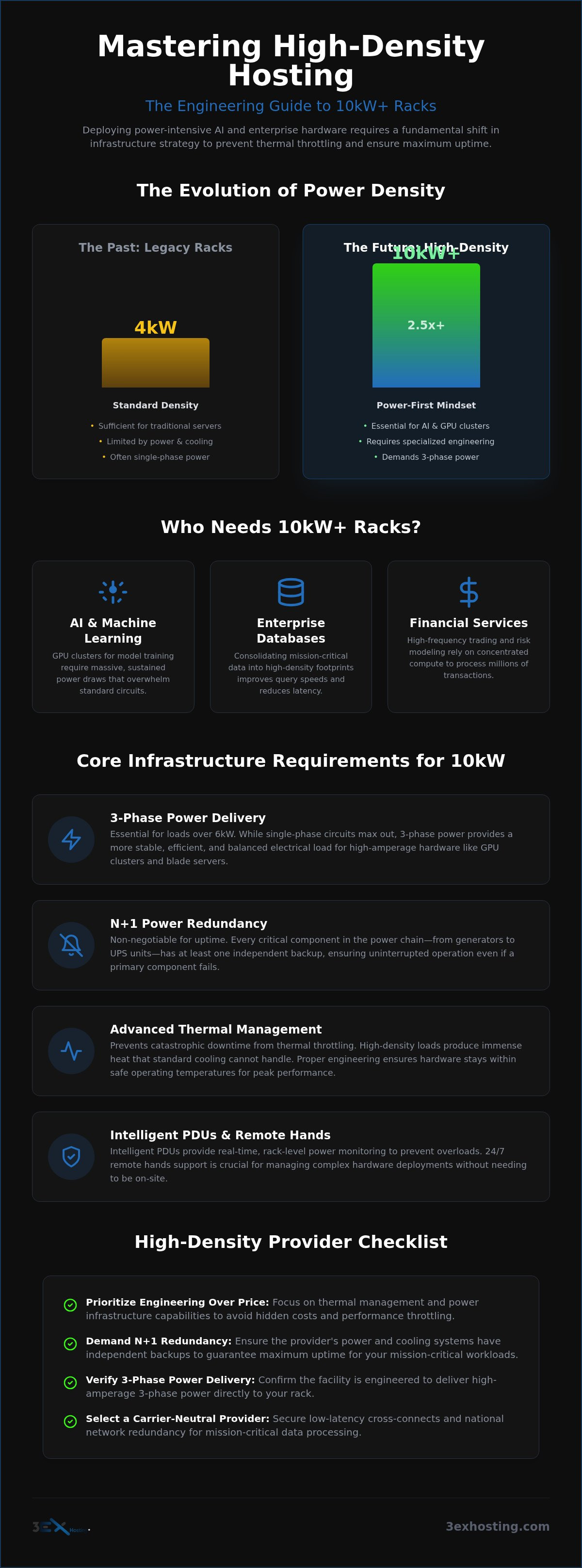
10kw rack hosting represents a specialized tier of colocation engineered specifically for high-performance hardware. For years, the 4kW rack was the enterprise workhorse, sufficient for standard web servers and storage arrays. Today, that legacy density is insufficient. Modern compute demands have pushed power requirements upward, making 10kW the new entry point for high-density environments. This shift isn’t just about more power. It’s about the facility’s ability to deliver that power consistently and remove the resulting heat efficiently.
Traditional deployments focused on rack units (Us) to determine capacity. In 2026, the industry has adopted a “Power-First” mindset. You might have 42U of space, but if you’re drawing 10kW, you’ll likely hit your power or thermal ceiling long before the rack is physically full. Understanding a data center overview helps clarify why modern facilities prioritize power distribution units (PDUs) and cooling over simple square footage. When you prioritize power availability, you ensure your hardware can run at its rated capacity without the risk of forced shutdowns due to circuit overloads.
The Evolution of Power Density in 2026
Hardware manufacturers are packing more processing power into smaller chassis. A single 2U GPU server can now draw as much power as an entire rack did a decade ago. This reduction in footprint has made 10kW the baseline for any competitive enterprise infrastructure. High-density colocation is the integration of extreme power delivery with specialized thermal management. By concentrating compute power, you reduce the physical complexity of your network while increasing overall performance and reducing the cost of cross-connects between distant cabinets.
Primary Use Cases for High-Density Racks
Several sectors drive the immediate need for 10kW+ configurations:
- AI and Machine Learning: GPU clusters used for model training require massive, sustained power draws that would trip standard enterprise circuits.
- Enterprise Database Scaling: Consolidating mission-critical data into high-density footprints improves query speeds and reduces latency between nodes.
- Financial Services: High-frequency trading and risk modeling rely on concentrated compute power to process millions of transactions in real-time.
Transitioning to full cabinet colocation at these densities ensures your hardware operates at peak efficiency. It prevents the thermal throttling that occurs when cooling systems can’t keep up with the heat output of modern silicon. For national enterprises, moving to a high-density model is the most effective way to future-proof infrastructure as AI workloads become standard operations.
Engineering for 10kW: Power and Cooling Requirements
Supporting a 10kW load requires a fundamental departure from standard data center electrical design. While traditional racks often rely on single-phase 208V circuits, these typically max out around 5kW to 6kW of usable power. To achieve 10kw rack hosting reliably, 3-phase power delivery is essential. This configuration balances the electrical load across three conductors, providing a more stable and efficient stream of energy to high-density GPU clusters and enterprise blade servers. This shift is a direct response to the increasing electricity demand seen across the global infrastructure landscape in 2026.
Power Distribution and Redundancy
In a high-density environment, N+1 power redundancy is non-negotiable. This means every critical component in the power chain has at least one independent backup. If a single UPS or generator fails, the system continues to operate at full capacity without interruption. We differentiate between metered and capped power models to give enterprises better financial control. Capped power provides a fixed price for a specific limit, while metered power allows you to pay only for the electricity your hardware actually consumes.
Managing these loads effectively requires Intelligent PDUs (Power Distribution Units). These aren’t simple power strips. They provide real-time, rack-level monitoring of amperage, voltage, and power factor. This granular data allows you to identify potential overloads before they trip a breaker. It also helps in calculating precise PUE (Power Usage Effectiveness) metrics for sustainability reporting. If you’re planning a high-density rollout, you can request a technical consultation to determine the best circuit configuration for your specific hardware mix.
Advanced Cooling for 10kW Loads
Standard Computer Room Air Handler (CRAH) units often struggle with 10kW racks because they rely on general room pressurization. In a high-density setup, air tends to mix, creating “hot spots” where the temperature at the top of the rack exceeds safe operating limits. This leads to thermal throttling, where your CPUs or GPUs automatically slow down to protect themselves, destroying the performance you’re paying for.
To prevent this, we utilize Hot and Cold Aisle Containment systems. By physically separating the cold supply air from the hot exhaust air using vinyl curtains or rigid glass partitions, we eliminate air mixing. This targeted approach ensures that 100% of the chilled air passes through your servers. Implementing aisle containment increases cooling efficiency by up to 30%, allowing the facility to maintain stable temperatures even when every rack in the row is drawing a full 10kW. This precision engineering ensures that your full cabinet colocation environment remains stable, regardless of how hard you push your processors.
Evaluating High-Density Providers: A Buying Framework
Price is a common starting point, but for high-density loads, it’s a secondary metric. You must evaluate a provider’s ability to sustain 10kw rack hosting without thermal degradation or power fluctuations. Carrier neutrality is the first pillar of this framework. A facility that restricts you to a single carrier creates a single point of failure for your entire national network. True redundancy requires access to multiple Tier 1 providers. This allows you to route traffic dynamically and maintain connectivity even during regional outages. Many low-cost providers sacrifice this neutrality to pad their margins, which puts your mission-critical workloads at risk.
Look closely at the Service Level Agreement (SLA). In 2026, a 100% uptime guarantee must explicitly include cooling performance alongside power delivery. If the cooling fails but the power stays on, your servers will still shut down due to built-in thermal protection. You need a contract that protects your hardware against these specific thermal events. Physical security and compliance are equally vital. Enterprise workloads often handle sensitive data, making SOC2 Type II, HIPAA, and PCI-DSS certifications mandatory. These aren’t just checkboxes. They’re evidence of the rigorous operational standards required to host national-scale infrastructure safely.
Direct Provider vs. Broker: Knowing the Difference
Choosing between a direct facility owner and a broker impacts your long-term agility. Working directly with the operator allows for highly specific power configurations tailored to your rack layout. You don’t have to wait for a middleman to relay technical requests to a third-party team. You gain direct access to on-site engineers who understand the facility’s specific cooling dynamics and power distribution architecture. This direct relationship accelerates deployment speeds and simplifies troubleshooting when every minute of downtime counts. For enterprises requiring specialized, high-density setups, 3EX Hosting Cabinet Colocation provides the direct infrastructure partnership needed for high-density success.
Connectivity and Latency Considerations
Network performance is the silent partner of power density. High-density compute power is wasted if the data cannot move fast enough to the end user or other cloud nodes. Locating your infrastructure within a carrier-neutral facility provides access to high-performance cross-connect services. These direct physical links between networks reduce latency to the absolute minimum by bypassing the public internet. For AI workloads and large-scale virtualization, network density must complement power density to ensure data-hungry GPU clusters stay fed. You can explore our full range of 3EX Hosting Data Center Services to see how we integrate high-speed connectivity with high-density power.
Operational Readiness: Managing 10kW Infrastructure
Managing 10kw rack hosting from a distance in 2026 requires more than just high-level software access. It demands a reliable physical presence that acts as a local extension of your engineering team. While some organizations attempt DIY management for lower-density setups, the complexity of a 10kW environment makes this approach risky. A single hardware failure or a loose cable in a high-density rack can lead to rapid heat buildup and immediate service degradation. Operational readiness means having the tools and the people in place to address physical issues before they impact your uptime.
The ROI of Remote Hands
Mean Time to Repair (MTTR) is the defining metric for high-density colocation. When your mission-critical AI workloads are at stake, you can’t wait for an engineer to travel to the facility. 24/7 technical support ensures that tasks like hard-reboots, cable audits, and hardware replacements happen within minutes. For national enterprises, utilizing Remote Hands Support is a strategic decision that reduces operational overhead and travel costs. It provides the peace of mind that a qualified professional is always on-site to handle physical maintenance. For a deeper dive into these efficiencies, see our sibling guide, “Remote Hands Support: The Enterprise Guide to Data Center Efficiency in 2026.”
Deployment and Move-In Assistance
Successful deployment starts long before the first server is racked. You must plan your rack layout with a focus on weight distribution and power balancing. High-density cabinets are significantly heavier than standard racks, requiring careful consideration of floor load capacities and rail strength. Utilizing professional Move-In Assistance ensures your hardware is installed according to thermal best practices. Proper cable dressing prevents thermal traps by ensuring that hot exhaust air can exit the rear of the chassis without being blocked by disorganized wiring. This attention to detail is what separates a stable 10kW environment from one prone to intermittent hotspots.
Effective management also relies on Data Center Infrastructure Management (DCIM) tools. These platforms provide real-time monitoring and alerting for power consumption and temperature at the rack level. By setting granular thresholds, you can identify a failing fan or a power spike before it triggers a system-wide shutdown. Finally, ensure your 10kW racks are fully integrated into your disaster recovery plan. Your secondary site must be capable of supporting the same high-density power and cooling requirements to ensure a seamless failover during a crisis. If you’re ready to secure a stable environment for your hardware, request a quote for your high-density needs today.
Scaling with 3EX Hosting: Enterprise High-Density Solutions
3EX Hosting serves as the direct infrastructure partner for national enterprises requiring the technical stability of 10kw rack hosting. We’ve engineered our facility to handle the specific thermal and power demands of 2026, where AI workloads and GPU clusters are the standard. Our approach goes beyond providing floor space. We provide a high-density environment backed by N+1 power redundancy and 24/7 remote hands. This ensures that your mission-critical hardware operates at peak efficiency without the risk of thermal throttling or power overages. You gain a partner that understands the nuances of high-density silicon and the cooling required to keep it running.
The advantage of our carrier-neutral facility lies in its connectivity. High-speed cross-connect services allow your infrastructure to communicate with Tier 1 providers and cloud on-ramps with minimal latency. This network density is essential for scaling AI training models that require massive data throughput. By integrating your physical colocation with our Managed Cloud and Disaster Recovery Solutions, you create a resilient hybrid infrastructure. This multi-layered approach protects your data and ensures business continuity even during large-scale network disruptions. We handle the complexity of the physical layer so you can focus on your core applications.
For organizations with specific security or sovereignty requirements, we offer private suites and cage solutions. These environments allow for ultra-high-density AI clusters with customized cooling and security protocols. Whether you’re deploying a single 10kW rack or an entire private suite, our facility provides the scalable foundation your enterprise needs to thrive. We avoid the generic, one-size-fits-all approach of brokers and instead offer direct engineering support for your specific deployment.
Future-Proofing Your Infrastructure
The hardware you deploy today at 10kW will likely be replaced by 20kW+ units within the next hardware cycle. 3EX Hosting is designed to support this upward trajectory. Our facility architecture allows for seamless scaling as your power density requirements evolve. Accessing 3EX Hosting Private Data Center Suites provides your organization with maximum sovereignty and dedicated cooling resources. For more information on specialized hardware setups, see our guide on “High-Density GPU Colocation: The Enterprise Guide to AI Infrastructure in 2026”.
Get a Customized High-Density Quote
We’ve simplified the RFP process for 10kw rack hosting to help you move from planning to deployment faster. Our engineers consult directly with your team on power and cooling specifications to ensure your rack layout is optimized for airflow. We don’t believe in generic pricing models. We provide transparent, predictable costs based on your specific amperage and redundancy needs. This direct communication eliminates the guesswork and ensures your deployment meets your technical requirements from day one. Get a Quote for 10kW Rack Hosting today and secure the high-density environment your enterprise requires.
Securing Your High-Density Infrastructure for 2026
Transitioning to 10kw rack hosting is no longer a choice for national enterprises; it’s a foundational requirement for sustaining AI and GPU-intensive workloads in 2026. We’ve explored how 3-phase power delivery and aisle containment systems are critical for maintaining thermal stability and preventing performance throttling. Success in this high-density landscape depends on choosing a provider that offers direct engineering expertise and a facility built for extreme power demands. Standard colocation simply isn’t equipped for the heat and power density of modern silicon.
3EX Hosting provides the stable foundation your mission-critical applications require. With N+1 Power Redundancy Guaranteed and Carrier-Neutral Interconnections, your infrastructure stays connected and powered regardless of external grid pressures. Our 24/7/365 On-site Remote Hands Support ensures your hardware is managed by experts who understand the specific needs of high-density cabinets. It’s time to move beyond legacy data center limitations and secure an environment engineered for peak performance. Your hardware deserves a facility that matches its capabilities. Request a Custom High-Density Colocation Quote and start your deployment today.
Frequently Asked Questions
What is the difference between standard and 10kW high-density rack hosting?
Standard enterprise racks typically operate between 4kW and 6kW, which is sufficient for legacy web servers. In contrast, 10kw rack hosting utilizes 3-phase power delivery and specialized thermal management to support the extreme heat output of modern silicon. This high-density solution allows you to consolidate more compute power into a smaller physical footprint. It reduces network complexity and long-term infrastructure costs while supporting the advanced AI and machine learning workloads common in 2026.
Do I need special PDUs for a 10kW rack?
Yes, 10kW configurations require Intelligent PDUs capable of handling 3-phase power loads. Standard single-phase power strips don’t provide the amperage or the monitoring capabilities needed for high-density environments. These specialized PDUs allow you to monitor metered power consumption at the outlet level, ensuring you don’t exceed circuit limits. They also provide the granular data necessary to identify failing hardware through abnormal power draw patterns before a system-wide failure occurs.
Is 10kW density safe for standard air cooling?
Standard air cooling without containment is usually insufficient for 10kW densities due to the risk of air mixing and localized hotspots. While traditional CRAH units provide the cooling capacity, they often struggle to direct chilled air precisely where it’s needed. High-density environments rely on Hot and Cold Aisle Containment to physically separate air streams. This ensures that 100% of the cold air passes through your hardware, preventing thermal throttling and maintaining hardware longevity.
What happens if my rack exceeds the 10kW power limit?
Exceeding your power limit can trigger circuit breakers or lead to thermal throttling as the facility’s cooling system struggles to keep up. Most modern providers use Intelligent PDUs to set alerts when you approach your 10kW threshold. If you consistently require more power, you can scale into private suites or cage solutions designed for even higher densities. Monitoring these limits is essential to prevent unexpected downtime and ensure your AI infrastructure remains stable during peak processing periods.
How does N+1 redundancy protect my 10kW infrastructure?
N+1 redundancy ensures that every critical component in the power and cooling chain has at least one independent backup available. If a single UPS module, generator, or cooling unit fails, the redundant component takes over the load instantly without interrupting your operations. This architecture is non-negotiable for 10kW loads because the high concentration of hardware makes any cooling or power failure catastrophic. It provides the technical stability required for mission-critical enterprise applications in 2026.
Can I host GPU servers in a 10kW rack?
Yes, GPU servers are the primary driver for 10kW and higher rack configurations. Modern GPU clusters used for AI training and large-scale rendering draw significantly more power than standard CPUs. 3EX Hosting specializes in high-density GPU server hosting, providing the 3-phase power and aisle containment necessary to keep these units running at peak performance. Concentrating your GPUs in a high-density rack reduces the cost of high-speed cross-connects and simplifies your internal network cabling.
What is the typical lead time for deploying a 10kW cabinet?
Lead times for 10kW deployments vary depending on your specific power and network requirements. A standard full cabinet colocation setup generally requires a few weeks for the facility to commission 3-phase circuits and install the necessary PDUs. This timeline ensures that all thermal management systems are properly configured before your hardware arrives. For specialized environments like private suites, our engineers work directly with your team to establish a deployment schedule that meets your project deadlines.
How do Remote Hands services assist with high-density management?
Remote Hands services provide an on-site technical presence to handle physical tasks that can’t be performed through software. In a 10kW environment, this includes hard-reboots, cable audits, and hardware replacements to maintain optimal airflow. Because high-density racks are sensitive to thermal traps, professional cable dressing and rack layout assistance are vital. Having 24/7 technical support on-site reduces your Mean Time to Repair (MTTR) and eliminates the need for your engineers to travel to the data center.