 SUPPORT


 3EX United States
 Blog
A software replication license isn’t a safety net if an outage corrupts your production systems and offsite replicas at the same time. Building dependable disaster recovery for virtualized environments requires far more than running routine snapshot schedules and hoping for clean execution. If you oversee complex multi-hypervisor fleets, you already understand the friction of platform sprawl, unpredictable failover latency, and the constant threat of ransomware infecting live recovery volumes. When disaster strikes, unvalidated recovery scripts and shared network bottlenecks turn tight recovery windows into operational chaos.
Your failover process shouldn’t feel like a high-stakes gamble. You need predictable execution backed by resilient, isolated hardware targets. In this guide, you’ll learn how to architect, test, and deploy resilient disaster recovery strategies for complex multi-hypervisor and hybrid virtual workloads. We walk through establishing clean air-gapped replication, overcoming throughput constraints, and validating recovery protocols to secure near-zero RTO and RPO targets across your entire enterprise.
Key Takeaways
- Modern disaster recovery for virtualized environments leverages workload encapsulation to bypass bare-metal dependencies and enable rapid virtual machine portability.
- Matching hypervisor-level replication with storage array mechanics ensures granular rollback points while keeping data traffic predictable across wide-area networks.
- Evaluating target infrastructure across colocation and cloud targets prevents operational surprises related to compute reservation limits and egress bandwidth during mass failovers.
- Establishing non-disruptive automated testing schedules validates strict RTO and RPO thresholds without interrupting active production workloads.
- Pairing virtualization management tools with dedicated physical infrastructure guarantees predictable computing power and network throughput during enterprise-wide failover events.
What Is Disaster Recovery for Virtualized Environments?
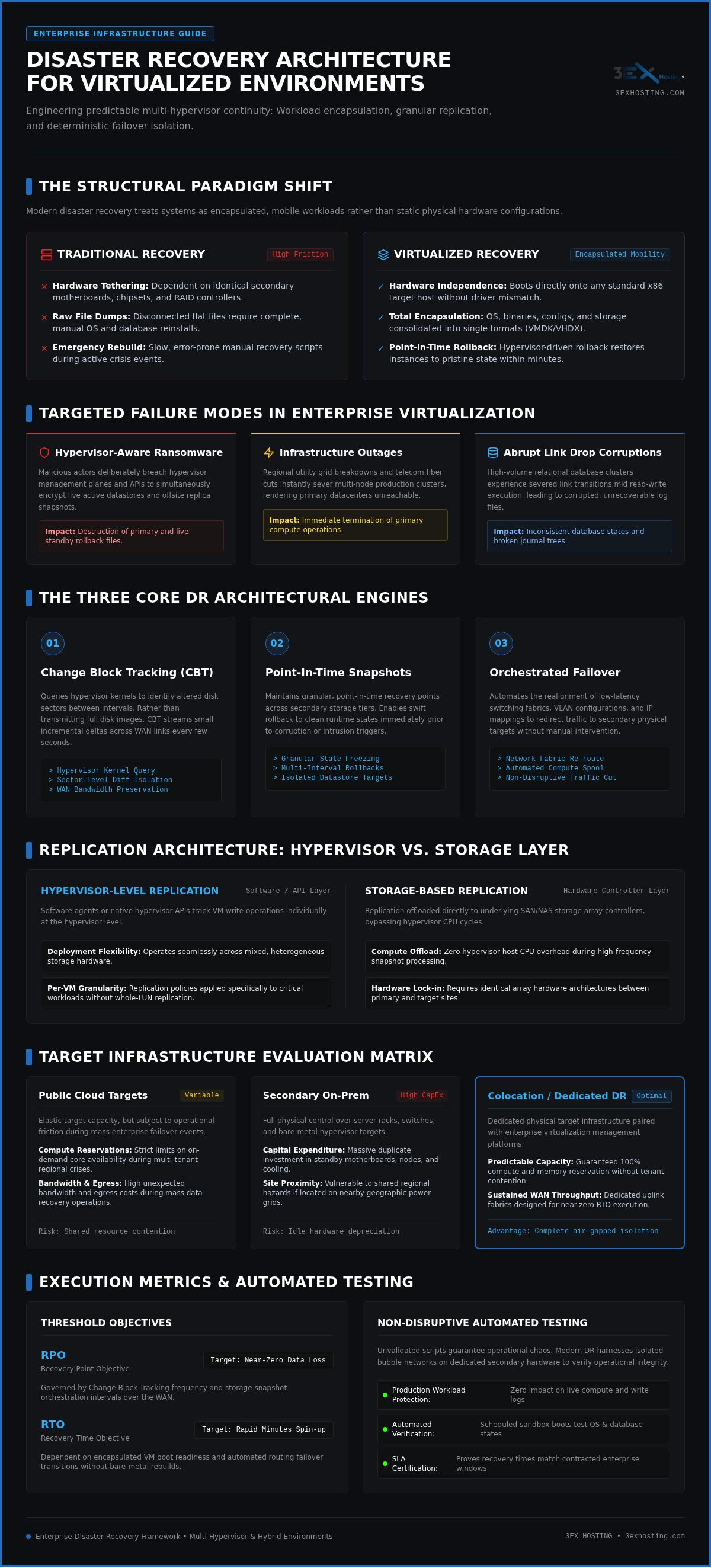
Disaster recovery for virtualized environments is the practice of capturing, replicating, and restoring entire virtual machine (VM) states to secondary infrastructure. Unlike traditional recovery that focuses on copying raw file structures, virtual disaster recovery treats compute, memory state, networking configurations, and system disks as a unified, encapsulated package. This operational model transforms recovery from an emergency rebuild into an automated workload mobility process, ensuring mission-critical services spin up cleanly within minutes of a production outage.
True operational resilience requires treating this capability as a real-time continuity system rather than a passive backup archive. Comprehensive business continuity planning demands independent secondary infrastructure designed to absorb production loads without contention. When an outage occurs, your secondary site must sustain the live application layer immediately. Replicating images to unverified storage arrays won’t protect operational uptime if your standby compute layer lacks the capacity to run them.
Core Differences Between Traditional and Virtualized DR
Traditional recovery tethered systems to matching physical components, turning restoration into a manual slog. Modern virtualization eliminates those hardware dependencies entirely.
- Hardware independence: Encapsulated VMs boot on any compatible x86 host architecture, removing the need for identical secondary server motherboards, chipsets, or storage controllers.
- Total encapsulation: The guest operating system, application binaries, registry settings, and data reside within standard disk files like VMDK or VHDX, enabling seamless migration across disparate clusters.
- Rapid point-in-time recovery: Granular hypervisor snapshots allow administrators to roll systems back to a pristine state in seconds, bypassing tedious operating system reinstallation routines.
The Evolving Threat Landscape Facing Enterprise VMs
Deploying virtual workloads introduces distinct failure modes that demand targeted mitigation protocols across your secondary infrastructure stack.
Hypervisor-aware ransomware presents the most acute danger. Threat actors intentionally target hypervisor management planes and API interfaces to encrypt live datastores and offsite recovery snapshots simultaneously. At the same time, regional utility grid failures or upstream telecom cuts can instantly drop entire production clusters. High-volume relational databases introduce additional failure points during abrupt transitions; sudden link drops during intensive read-write cycles risk corrupting active log files. Implementing robust disaster recovery for virtualized environments safeguards these mission-critical services by ensuring clean, isolated recovery targets exist far beyond the reach of primary site failures.
Architectural Mechanisms: Replication, Snapshots, and Orchestrated Failover
Modern disaster recovery for virtualized environments relies on three foundational engines working simultaneously: tracking changed data blocks, orchestrating point-in-time snapshots, and automating network path transitions. When workloads fail over, synchronization software alone cannot guarantee uptime. True recovery requires real-time coordination between underlying storage arrays, hypervisor abstraction layers, and low-latency switching fabrics to prevent data loss while meeting tight recovery windows.
Change block tracking (CBT) serves as the primary engine for bandwidth efficiency. By querying the hypervisor kernel to identify only the unique disk sectors altered since the last replication interval, CBT drastically reduces replication payloads. Instead of transferring gigabytes of raw disk images across WAN links, your replication engine transmits small, incremental changes every few seconds, preserving upstream network throughput.
Hypervisor-Level Replication vs. Storage-Based Replication
Architects must decide whether to orchestrate replication inside the hypervisor layer or offload it directly to storage arrays.
- Hypervisor-level replication: Software agents or native hypervisor APIs track VM writes individually. This approach provides tremendous flexibility across heterogeneous compute nodes, letting you replicate between differing storage vendors or bridge mixed estates running VMware vSphere, KVM, and containerized clusters.
- Array-based storage replication: SAN and NAS controllers mirror entire storage volumes at the hardware level. This eliminates compute overhead on production hypervisors but locks you into matching storage arrays at both sites.
- Snapshot delta management: Hypervisor-based snapshots generate delta disks. If left open during prolonged high-write operations, these deltas expand rapidly, degrading storage IOPS and creating severe latency penalties during snapshot consolidation routines.
Network Re-Configuration and Split-Brain Prevention
A comprehensive IT disaster recovery plan must account for network topology transitions long before servers boot at a secondary facility. When virtual machines spin up on failover clusters, they require instantaneous access to production IP subnets or automated re-IP mapping via software-defined networking. Without precise routing orchestration, external traffic cannot reach the standby hosts.
Simultaneously, active-active or clustered multi-site designs require an independent, third-site quorum witness. If the interconnecting WAN link drops unexpectedly, both sites might assume the other has failed and attempt to mount the same storage volumes. A dedicated witness node arbitrates ownership, preventing split-brain conditions that irreversibly corrupt active VM filesystems.
Immutable Backups and Air-Gapped Target Environments
Ransomware attacks increasingly target VM backup repositories, making immutability a core technical requirement. Leveraging Write-Once-Read-Many (WORM) storage mechanics locks virtual machine disks, preventing modification or deletion by compromised hypervisor administrative credentials until the designated retention policy expires.
Combining logical immutability with physical infrastructure isolation ensures unauthorized lateral movement stops at your replication boundaries. If you need dedicated physical hardware configured and secured offsite, relying on expert Remote Hands Support allows your engineering team to verify physical connections and maintain air-gapped target environments without costly travel delays.
Comparing Target Infrastructure: Public Cloud, Secondary On-Prem, or Colocation
Replication software is only half the equation. The physical infrastructure underpinning your secondary site determines whether a failover succeeds or stalls under production pressure. Selecting a target environment for disaster recovery for virtualized environments requires balancing immediate compute availability, steady-state storage expenditure, and raw networking throughput during a crisis. Enterprise architects generally evaluate three landing zones: public cloud platforms, secondary on-premises private facilities, or dedicated enterprise colocation.
Secondary on-premises buildouts deliver complete hardware authority, but they tie up substantial internal resources in facility maintenance, backup generators, and cooling upkeep. Most enterprises find higher reliability and lower operational friction by choosing between hyperscale public clouds and purpose-built colocation facilities.
Public Cloud DR Targets: Flexibility vs. Unpredictable Egress
Public cloud environments appear cost-effective during steady-state operations because you pay primarily for resting storage. The friction begins during an actual failover invocation.
- On-demand compute spikes: Spinning up hundreds of enterprise VMs instantly converts dormant storage into active, unreserved compute instances running at peak burst pricing.
- Restoration egress penalties: Failing back to your primary data center triggers massive outbound network transfer fees, turning disaster recovery into an open-ended operational expense.
- Shared-tenant I/O bottlenecks: High-transaction databases frequently suffer from storage latency throttling on shared multi-tenant block storage during regional cloud utilization spikes.
Enterprise Colocation: Deterministic Performance and Security
Enterprise colocation eliminates the noisy-neighbor variables inherent in public cloud environments. By placing dedicated physical servers and high-speed SAN arrays in an offsite facility, your engineering team preserves absolute hardware sovereignty. You retain full control over hypervisor configurations, CPU core oversubscription ratios, and low-latency storage fabrics.
High-density power architectures with fully redundant A/B utility feeds and automated generator backups guarantee that standby compute capacity is ready whenever needed. Organizations requiring heightened compliance and zero physical co-mingling can deploy their secondary failover clusters within custom Private Colocation Suites to ensure physical isolation alongside uncompromised processing speed.
Hybrid Architectures: Combining Colocation with Managed Cloud
A hybrid topology often yields the best balance between performance and expenditure across enterprise disaster recovery for virtualized environments. Workloads rarely share identical recovery tiers, making rigid all-or-nothing architectures inefficient.
Leading enterprises route mission-critical Tier 1 databases and core application servers to high-performance colocation environments where dedicated compute eliminates spin-up delays. Concurrently, Tier 3 development stacks or archival systems can replicate directly to cold cloud targets. Selecting a carrier-neutral data center enables cross-connect interconnections to major telecom carriers and cloud providers, granting the low-latency switching required to bridge hybrid recovery sites seamlessly.
Building an Enterprise DR Plan: RPO, RTO, and Automated Testing
A disaster recovery blueprint is only as credible as its last live test. Engineering dependable disaster recovery for virtualized environments requires translating broad business continuity mandates into granular technical targets, mapping workload dependencies, and regularly validating failover automation. Without a disciplined operational framework, complex application stacks stumble over missing authentication services, out-of-order database starts, and unexpected boot storms when executing an emergency switchover.
Executing an effective virtual continuity plan requires five core steps:
- Audit and classify: Inventory all virtual machines, datastores, and network mappings across your production clusters.
- Establish tier thresholds: Assign precise Recovery Point Objectives (RPO) and Recovery Time Objectives (RTO) to each workload group.
- Map dependencies: Document multi-tier startup orders and inter-service authentication requirements.
- Automate boot scripts: Script failover sequencing, DNS updates, and network virtual adapter configurations.
- Validate continuously: Run unannounced failover simulations inside isolated networks to verify data integrity.
Defining Metric Thresholds: RPO and RTO by Workload Tier
Not every virtual machine requires continuous replication. Grouping infrastructure into defined operational tiers keeps storage consumption and WAN replication traffic balanced.
- Tier 0 (Mission-Critical): Core transactional databases and customer-facing revenue engines. These demand near-continuous data protection, aiming for sub-minute RPO and an RTO under 15 minutes.
- Tier 1 (Business-Critical): Internal enterprise resource planning, messaging platforms, and operations management. These target an RPO of 15 to 60 minutes and an RTO under two hours.
- Tier 2 (Non-Critical): Development servers, internal documentation wikis, and testing environments. These operate effectively with 24-hour snapshot RPO targets and recovery windows extending to 24 hours.
Dependency Mapping and Startup Orchestration
Booting a virtual machine without its upstream dependencies creates immediate application failures. A high-transaction database cannot serve requests if the domain controller providing identity validation is still offline.
Orchestration runbooks must enforce deterministic boot delays and health checks. Domain controllers, DNS hosts, and network security appliances must boot and reach steady operational states first. Database clusters fire up next, allowing storage caches to settle before intermediate application servers and front-end web load balancers begin accepting user traffic. Additionally, administrators must verify that software licensing servers validate virtual hardware signatures correctly in the secondary cluster environment to prevent license lockout during a failover.
Non-Disruptive Failover Drills and Continuous Auditing
Scheduled maintenance windows shouldn’t be the only time you test recovery readiness. Hypervisor orchestration tools allow engineering teams to stand up isolated sandbox networks using private test VLANs that mirror production subnets without routing to live production traffic. This setup allows realistic disaster recovery drills that verify database consistency and failover scripts without risking production disruption or split-brain network errors.
Routine automated testing provides the documented verification required by regulatory frameworks and cyber-insurance underwriters. To establish a reliable secondary environment equipped to handle these stringent recovery drills on dedicated hardware, request a quote for custom disaster recovery infrastructure from 3EX Hosting.
Executing Your Continuity Strategy: Disaster Recovery Solutions with 3EX Hosting
Replication algorithms and orchestration runbooks require an equally resilient physical foundation to function when production fails. 3EX Hosting provides enterprise-grade Disaster Recovery Solutions designed to anchor disaster recovery for virtualized environments on high-availability data center infrastructure. Rather than leaving your team to navigate shared public cloud latency or costly private facility upkeep, our facilities deliver the sovereign physical foundation needed to execute deterministic failovers under any operational condition.
Carrier-neutral architecture and diverse carrier feeds ensure fast data replication between your primary site and secondary storage. Direct cross-connect interconnections establish low-latency failover switching, allowing your virtual machines to sync continuously without degrading daytime application performance. With dedicated physical deployments, your standby environment avoids the noisy-neighbor resource competition that stalls recovery efforts during widespread regional incidents.
Enterprise Colocation Engineered for Mission-Critical Uptime
Hosting your secondary virtual clusters requires high-density power and strict environmental stability. 3EX Hosting equips enterprises with the physical floor space and infrastructure reliability necessary to support heavy hypervisor clusters.
- High-density power redundancy: A/B utility power paths backed by automated uninterruptible power supplies and industrial diesel generators maintain continuous system availability.
- Industrial climate protection: Advanced environmental controls keep secondary compute clusters, hypervisor storage arrays, and network cores running at optimal thermal thresholds.
- Sovereign hardware footprints: Secure your standby compute and dedicated SAN fabrics by deploying within standard or high-density Full Cabinet Colocation environments built to enterprise security specifications.
Rapid Recovery Supported by 24/7 Remote Hands
Hardware incidents rarely occur at convenient times. When a failed storage controller or dead network switch threatens replication integrity, your internal engineering team can’t afford hours of transit time to reach an offsite facility.
Our round-the-clock 24/7 on-site Remote Hands Support acts as a seamless extension of your engineering staff. Certified data center technicians remain stationed on premise to execute physical power cycles, hot-swap drive arrays, verify fiber cross-connect paths, and inspect status diagnostics immediately. This rapid hands-on response eliminates physical bottlenecks, keeping your disaster recovery for virtualized environments continuously operational and fully validated.
Architect Your Custom Disaster Recovery Infrastructure
Every enterprise manages a unique profile of virtual hypervisors, storage arrays, and recovery thresholds. Off-the-shelf hosting packages often force compromises between unneeded compute headroom and inadequate bandwidth pipelines.
3EX Hosting collaborates directly with your infrastructure team to tailor your secondary failover environment. We evaluate your active hypervisor footprint, data change rates, and target RTO requirements to configure the exact mix of cabinet space, dedicated power feeds, and low-latency network interconnects your workloads require. Protect your mission-critical virtual infrastructure against unplanned downtime and request an enterprise quote today.
Build Resilient Virtual Recovery on Proven Infrastructure
Achieving true operational resilience demands more than routine hypervisor snapshots. A dependable strategy for disaster recovery for virtualized environments requires strict dependency orchestration, disciplined workload tiering, and dedicated target hardware that eliminates shared-resource contention. When unexpected system failures or cyber threats strike, validated automation combined with physical infrastructure isolation ensures your enterprise workloads resume without delay.
3EX Hosting provides the dependable physical foundation your recovery systems require. With redundant high-density power infrastructure engineered for continuous availability, high-throughput Cross-Connect Services enabling low-latency replication links, and on-site 24/7 Remote Hands Support providing immediate physical incident response, your standby clusters remain protected and primed for action. Don’t leave business continuity to chance. Speak with an infrastructure architect to secure your disaster recovery solution and ensure your enterprise remains operational through any challenge.
Frequently Asked Questions
How does disaster recovery for virtualized environments differ from traditional backup?
Traditional backups store static copies of files and databases for archival purposes, whereas disaster recovery for virtualized environments replicates running system states to restore active compute operations immediately. Traditional restores require manually provisioning hardware, reinstalling operating systems, and retrieving files. Virtualized DR maintains synchronized, encapsulated VM images on standby hypervisors. This architectural difference shrinks recovery timelines from days of rebuilding to mere minutes of automated boot execution.
What is the ideal RPO and RTO for enterprise virtual machines?
Ideal RPO and RTO thresholds depend on workload criticality rather than a single enterprise-wide standard. Mission-critical Tier 0 systems, like core transaction databases, typically require near-zero RPOs measuring under a minute and RTOs under 15 minutes. Less vital Tier 1 business applications often balance resources with a one-hour RPO and a two-hour RTO. Non-essential internal services can safely tolerate 24-hour thresholds without threatening customer operations or corporate revenue.
Can I replicate virtual machines across different hypervisor platforms?
Yes, you can replicate across different hypervisors using modern software-defined replication engines that convert disk formats and hypervisor drivers on the fly. These tools intercept changed blocks at the guest or API layer and translate them between formats, such as converting VMware VMDK files into KVM or Hyper-V disks. While cross-platform replication introduces slight translation overhead during failovers, it prevents vendor lock-in and simplifies multi-hypervisor management.
How do immutable backups protect virtual machines against ransomware attacks?
Immutable backups prevent unauthorized modification or deletion by enforcing strict Write-Once-Read-Many (WORM) storage flags at the underlying storage repository layer. Even if attackers gain administrative control over your hypervisor management console, they can’t alter or encrypt these locked image blocks. This technical isolation guarantees that your engineering team always has an untainted, verified point-in-time virtual machine recovery baseline to spin up after an intrusion attempt.
Why is network configuration often the hardest part of virtual machine failover?
Network reconfiguration creates significant operational friction because moving virtual machines across physical boundaries breaks existing IP bindings, routing rules, and security policies. Standby hosts need immediate DNS propagation, internal gateway access, and synchronized firewall access controls to route live client traffic correctly. Orchestrating these transitions requires software-defined networking overlays or automated re-IP scripts so dependent virtual machines can discover and communicate with each other instantly.
How often should an enterprise test its virtual disaster recovery plan?
Enterprises should run automated, non-disruptive sandbox recovery drills monthly and perform comprehensive full-scale failover simulations at least twice a year. Frequent testing verifies that script sequences, licensing validations, and boot orders function properly as production environments evolve. Continuous validation also provides the audit documentation required to comply with modern operational regulations and cyber-insurance requirements, ensuring failover plans succeed during actual production emergencies.
What role does physical colocation play in a virtualized disaster recovery strategy?
Physical colocation provides dedicated, sovereign hardware environments that eliminate the noisy-neighbor bottlenecks and runaway compute costs common in shared public clouds. In comprehensive disaster recovery for virtualized environments, colocation facilities deliver redundant industrial power, high-throughput network cross-connects, and round-the-clock remote hands technicians. This dedicated foundation guarantees that physical hosts, storage fabrics, and networking gear perform deterministically whenever a major failover event is declared.