 SUPPORT



 3EX United States
Blog
What if the biggest risk in a shared data center isn’t the shared space, but an unclear boundary between responsibilities? A secure multi-tenant data center architecture depends on layered isolation and clear agreements about who manages each control. Without both, even well-designed safeguards can leave gaps between the facility, service provider, and tenant.
It’s reasonable to ask how multiple organizations can share infrastructure without exposing systems or data to one another. The answer isn’t a single barrier. Physical separation, network segmentation, compute and data controls, and disciplined operations need to work together, with each party’s role defined and documented.
This guide explains how those layers fit together and what to assess when reviewing a shared environment. You’ll compare full cabinets, cages, and private suites through practical security criteria, then use an actionable framework to identify control owners, test isolation assumptions, and clarify shared responsibilities. The goal is a design that matches your risk requirements without treating shared infrastructure as a security shortcut.
Key Takeaways
- Secure multi-tenant data center architecture relies on coordinated physical, network, compute, and operational controls, not a single boundary.
- Shared infrastructure isn’t automatically secure or insecure; assess separation and operational control against your workload’s needs.
- Compare full cabinets, cages, and private suites by the level of physical separation and control your environment requires.
- Map each security responsibility to its owner, then distinguish design assumptions from evidence that needs review or technical validation.
- Use colocation space as one part of a broader security plan that includes connectivity, tenant-managed systems, and operating procedures.
What Secure Multi-Tenant Data Center Architecture Actually Protects
How can tenants share a facility without sharing unauthorized access? The answer is controlled separation across physical space, technology, and day-to-day operations. Multi-tenancy means shared facility infrastructure serves multiple customers, while each tenant’s equipment, traffic, and data remain separately controlled. The Multitenancy concept describes this shared environment, where users rely on common infrastructure without receiving access to one another’s resources.
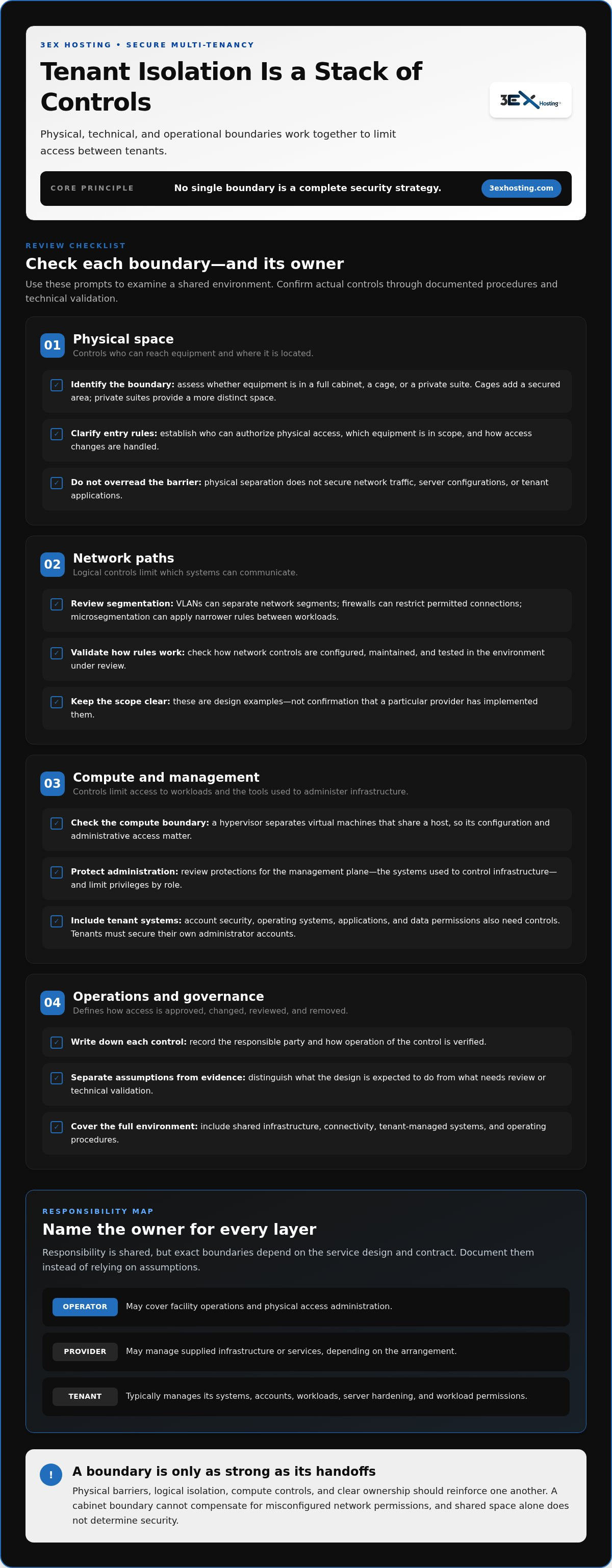
A secure multi-tenant data center architecture protects the boundaries between tenants. Physical separation governs who can reach equipment and where it is located. Logical isolation controls access through networks, compute platforms, and management interfaces. Operational governance defines how access is approved, changed, reviewed, and removed. These layers must reinforce one another. A cabinet boundary, for example, cannot prevent unauthorized network access if network permissions are misconfigured.
Shared space alone doesn’t determine security. The design, controls, and clear ownership of each responsibility matter. Colocation space is one part of a broader architecture that also includes tenant-managed systems and procedures. Learn more about the data center environment in which these layers come together.
What does tenant isolation mean in a data center?
Tenant isolation is the set of physical, technical, and operational controls that limits one customer’s ability to access another customer’s equipment, network traffic, or data. Facility-level controls apply to shared spaces and infrastructure. Customer-managed controls apply to servers, operating systems, applications, and data permissions. For example, a tenant must secure its own administrator accounts even when its equipment is housed in a managed facility.
Who is responsible for each security layer?
Responsibility is shared among the facility operator, infrastructure provider, and tenant. The operator’s scope may cover facility operations; the provider’s scope may include supplied infrastructure or services; the tenant typically manages its systems, accounts, and workloads. Exact boundaries depend on the service design and contract, so document them rather than relying on assumptions.
- Access administration: Define who approves physical access and who manages tenant system accounts.
- Server hardening: Establish who configures and maintains operating system and application security.
- Workload permissions: Assign responsibility for roles and access rights within each tenant’s services.
Clear ownership closes gaps between layers. Record each control, its responsible party, and how its operation is verified. That gives teams a practical foundation for evaluating shared infrastructure without assuming that either shared space or dedicated equipment is secure by default.
How Isolation Works Across Physical, Network, and Compute Layers
Isolation works best as a sequence of boundaries, each reducing the impact of a failure or misconfiguration in another. A useful way to picture the architecture is to move inward: from building access, to tenant space and cabinets, then to network paths, compute resources, and the management systems used to administer them. A data center overview can provide facility context, but this layered model is illustrative. It doesn’t verify the controls or implementation at any specific facility.
Each layer should have a defined purpose and owner. Physical barriers limit who can reach equipment. Network rules limit which systems can communicate. Compute and management controls limit access to workloads and the tools that administer them. If one control fails, other layers can still restrict exposure. No single boundary should be treated as a complete security strategy.
How do physical boundaries protect tenants?
Building access policies govern entry to shared areas, while cabinets establish a dedicated equipment boundary. Cages add a secured area around a tenant’s equipment; private suites provide a more distinct space. These options support different physical separation needs. Explore custom cage colocation as one example of a dedicated physical boundary. Separation helps limit direct access, but it doesn’t secure network traffic, server configurations, or tenant applications.
Translate the physical design into operational rules: identify who can authorize entry, which equipment is within scope, and how access changes are handled. The exact controls depend on the facility and service arrangement, so assess them through documented procedures rather than assuming that a cabinet or cage guarantees a particular level of protection.
How do network and compute controls limit exposure?
Logical controls protect traffic and workloads beyond the physical boundary. VLANs can separate network segments; firewalls can restrict permitted connections; microsegmentation can apply narrower rules between workloads. These are design examples, not claims about a particular provider’s network. Validate how rules are configured, maintained, and tested for the environment under review.
At the compute layer, a hypervisor separates virtual machines that share a host. Its configuration and administrative access therefore matter, as do protections for the management plane, the systems used to control infrastructure. Limit privileges by role, secure administrative access, and keep useful logs so teams can review changes and investigate activity. These safeguards complement tenant-side server hardening and application permissions; they don’t replace them.
Use this layered model to define boundaries before deployment: map physical access, network paths, compute ownership, and administrative identities. Then check that controls align across layers and that each has a clear owner. To explore 3EX Hosting’s broader infrastructure context, visit the 3EX Hosting website.
Is Shared Data Center Infrastructure Less Secure Than Dedicated Space?
Shared infrastructure isn’t automatically insecure, and dedicated space isn’t automatically secure. A secure multi-tenant data center architecture depends on how physical access, network boundaries, administration, and tenant responsibilities are designed and operated. More physical separation can address particular access or audit needs, but it doesn’t replace logical controls or sound management of the tenant’s own systems.
Compare options by the boundary they create and the work needed to manage it. The table is a planning aid, not a guarantee of any specific facility’s controls.
| Space model | Questions it helps answer | What still needs attention |
|---|---|---|
| Shared space | Can the workload use common areas with defined tenant boundaries? | Access permissions, network separation, and operational ownership. |
| Dedicated cabinet | Is a distinct equipment enclosure sufficient? | Who can access the cabinet and how are systems isolated logically? |
| Custom cage | Does the design call for a designated area around equipment? | How do access procedures and network controls support that boundary? |
| Private suite | Does the environment need a more distinct physical space? | Which controls remain shared, and who manages them? |
Shared cabinets, cages, and private suites compared
A dedicated cabinet, custom cage, or private suite can align with different physical separation preferences. None proves that another tenant cannot reach a system through a network path, compromised account, or configuration error. Review private data center suites as one dedicated-space option, then assess the complete design rather than the physical boundary alone.
When does stronger separation make sense?
Consider stronger separation when data sensitivity, internal access policies, audit expectations, or operating practices call for tighter physical boundaries. Also weigh what remains shared, how much control your team needs over day-to-day operations, and which infrastructure tasks stay with the provider. Dedicated space may change the physical arrangement, but network security, workload permissions, and server hardening still require clear ownership.
Before choosing, document the risks the organization accepts, the controls expected at each layer, and who is accountable for operating them. Tie those decisions to workload requirements and evidence that can be reviewed. This makes the trade-off explicit instead of treating “dedicated” as a synonym for “secure.” For additional context on colocation infrastructure, explore the 3EX Hosting website.
How to Evaluate a Secure Multi-Tenant Architecture
A useful review turns broad security expectations into specific design decisions, named owners, and verifiable operating practices. Use NIST SP 800-53 and ISO/IEC 27001 as reference frameworks for organizing control discussions, not as automatic proof that a particular environment is compliant or secure.
Review the architecture by inventorying workloads and data, mapping access and connectivity, assigning control owners, checking evidence, testing operations, and reassessing after meaningful changes. This sequence helps teams distinguish a proposed safeguard from one that has been implemented and shown to work.
What should a tenant assess before deployment?
Start with the workload. Record the systems involved, the sensitivity of the data, the users and service accounts that need access, required connections, and recovery needs. Then map each control to the party that operates it and the party that reviews it. For example, identify who configures tenant permissions, who manages facility access, and who documents changes to shared infrastructure.
Separate design questions from claims that require evidence. A design review can ask whether network paths are intended to be segmented. Verification calls for artifacts such as approved network diagrams, rule reviews, access records, or configuration reports. For each control, document:
- Owner: Who operates and reviews the control?
- Evidence: What record or test demonstrates how it works?
- Review cadence: How often is it checked?
- Exceptions and escalation: How are gaps recorded, approved, and raised?
Contract terms and service design help define responsibility boundaries. Keep the review grounded in the actual arrangement rather than assuming that a framework reference or a provider description establishes every control.
How should controls be tested and maintained?
Validate operation, not just documentation. Review access logs, segmentation rules, configuration changes, and incident procedures. Where technical isolation is a design requirement, use an appropriate technical test to confirm that traffic and administrative access follow the intended boundaries. Record the result, the scope of the test, and any remediation owner.
Test recovery and communication processes against documented business requirements. A recovery plan is useful only if teams understand their roles, dependencies, and escalation paths. Reassess the design when workloads, connectivity, ownership, or threats change. Updates can alter access paths or responsibilities, even when the physical space remains the same.
This disciplined process makes a secure multi-tenant data center architecture easier to review and maintain. Define the requirement, identify its owner, inspect evidence, test where needed, and track exceptions to closure. To discuss colocation infrastructure in the context of your architecture, explore 3EX Hosting’s colocation options.
Putting Secure Multi-Tenancy Into Practice With Colocation
Colocation gives your architecture a physical home, but it doesn’t secure the full environment on its own. A secure multi-tenant data center architecture connects space selection with access planning, network design, tenant-managed systems, and operating procedures. Define how each layer supports the security requirements, then make ownership clear before equipment is deployed.
How do colocation choices fit the security design?
A cabinet can provide a dedicated equipment boundary. A cage or private suite may fit requirements for a more distinct physical area. Match the option to access needs, workload sensitivity, and operational preferences, without treating physical separation as a substitute for logical controls. For equipment that needs its own cabinet space, review full cabinet colocation.
Include every connection in the threat model. A cross-connect may link systems or environments, so document its endpoints, purpose, authorized users, and the network rules governing traffic. Consider how changes to connections are approved and recorded. The same discipline applies to tenant-managed servers, applications, and permissions. Colocation is one part of the design, alongside the systems and governance the tenant operates.
Operational context matters too. Establish who handles planned changes, who receives incident escalations, and how recovery responsibilities are divided. Remote hands support, managed cloud hosting, and disaster recovery solutions can fit into a wider operational plan, with specific responsibilities defined for each arrangement.
What does a sound implementation plan include?
Use staged planning to reduce ambiguity and catch gaps before deployment:
- Requirements: Document workload needs, data sensitivity, access roles, connectivity, and recovery objectives.
- Space planning: Select a cabinet, cage, or private suite that aligns with physical separation and access requirements.
- Network design: Map connections, segmentation, allowed traffic, and the owners of each configuration.
- Access and operations: Define approvals, administrative permissions, change management, and incident escalation paths.
- Testing and review: Validate connectivity and access boundaries, test recovery procedures, and schedule periodic control reviews.
Keep the plan current. Workload changes, new connections, shifting ownership, or revised recovery needs can alter the risk picture. Record exceptions and assign responsibility for resolving or accepting them. This creates a practical link between the physical deployment and the security governance around it, without assuming that a particular space or service guarantees an outcome.
To compare infrastructure options, review 3EX Hosting data center solutions. When you’re ready to scope a deployment, request a project quote.
Build Your Colocation Plan Around Clear Security Boundaries
A secure multi-tenant data center architecture depends on layered controls and clearly assigned responsibilities. Physical separation, network and compute isolation, and operational governance should reinforce one another. Choose shared space, a dedicated cabinet, cage, or private suite based on your workload and access requirements, then validate the controls and document who owns them.
Colocation is one part of the wider design. Full cabinet colocation, private suites, and customizable cage solutions address different space needs. Remote hands support and cross-connect services can fit into operating and connectivity plans, while managed cloud hosting and disaster recovery solutions can support broader infrastructure requirements.
Move forward with a practical review of your workloads, connections, access roles, and recovery needs. Discuss your colocation requirements with 3EX Hosting to explore infrastructure options that align with your design. Clear decisions now help build a stable foundation for secure, well-governed operations.
Frequently Asked Questions
Is a multi-tenant data center secure?
A multi-tenant data center can be secure when physical, network, compute, and operational controls are designed to separate tenants and clearly assigned to responsible parties. Shared infrastructure alone doesn’t determine the level of security. Review how access is managed, how tenant traffic and systems are isolated, and how controls are maintained. Tenants also need to protect their own servers, applications, accounts, and data.
What is tenant isolation in a data center?
Tenant isolation is the combination of controls that limits one customer’s ability to access another customer’s equipment, network traffic, systems, or data. Physical boundaries can define where equipment is located and who may reach it. Logical controls, such as network rules and account permissions, restrict digital access. Operational processes govern how access is granted, reviewed, changed, and removed.
How does a multi-tenant data center separate customer data?
Customer data is separated through multiple controls rather than a single physical barrier. Network segmentation and firewall rules can restrict which systems communicate, while identity permissions limit who can access workloads and management tools. Compute environments may use separate systems or virtualization boundaries, depending on the design. Tenants should also configure their own applications and data permissions, and validate that controls match the intended separation.
What is the difference between a cage and a private data center suite?
A cage encloses a designated area for a tenant’s equipment within a larger data center environment. A private suite provides a more distinct dedicated space. The exact layout and access arrangements depend on the facility and service design. Both options address physical separation needs, but neither replaces network segmentation, secure system configuration, or clear procedures for managing access and responsibilities.
Can multiple companies share a data center without sharing network access?
Yes. Companies can share facility infrastructure while using logical network controls to restrict traffic between tenant environments. Network segmentation, firewall policies, and carefully limited administrative permissions can help enforce those boundaries. The design should identify allowed connections, owners of network rules, and how changes are reviewed. Physical separation alone doesn’t ensure network isolation, so technical validation is an important part of the review.
How should a company evaluate a colocation provider’s security architecture?
Review the architecture layer by layer. Map facility access, tenant space, network and compute boundaries, management access, and incident procedures. For each control, identify its owner, the evidence available to demonstrate operation, how often it is reviewed, and how exceptions are handled. Distinguish design descriptions from controls supported by documents or technical testing, and align the review with your workload and recovery requirements.
Does a private suite eliminate the need for tenant security controls?
No. A private suite can provide a more distinct physical space, but tenant responsibilities remain. Organizations still need to secure server configurations, application permissions, user and service accounts, network connections, and data. They should also define incident escalation and recovery responsibilities. Treat the suite as one part of the security design, then review how physical, logical, and operational controls work together.
What should a secure multi-tenant data center architecture include?
A secure multi-tenant data center architecture should include defined physical boundaries, logical separation for networks and workloads, controlled administrative access, and documented operational responsibilities. It should also specify how access changes are reviewed, how incidents are escalated, and how recovery requirements are addressed. Assign an owner and review method to each control, then reassess the design when workloads, connections, or responsibilities change.