 SUPPORT



 3EX United States
Blog
What if a cage looks secure but still leaves your audit with unanswered questions? Compliant cage colocation can create a controlled physical boundary, but a barrier alone doesn’t establish that your environment meets a compliance requirement. The arrangement’s value depends on how facility controls, access records, and your own security practices work together.
That distinction matters when you assess a colocation environment. The provider typically manages physical safeguards and facility operations, while your organization remains responsible for protecting systems, data, and access within the cage. Clear responsibilities and usable records help demonstrate how that division works during an audit.
This guide explains what a colocation cage can and can’t contribute to a broader compliance program. You’ll learn which physical controls to assess, how to evaluate access records and supporting documentation, and how to assign operational ownership before deployment. It also compares cages with cabinets and private suites, so you can match physical separation and access needs to your requirements without assuming that any setup guarantees compliance or audit readiness.
Key Takeaways
- Use compliant cage colocation as one layer of a customer-managed compliance program, not as proof of compliance on its own.
- Assess access authorization, visitor handling, monitoring, incident escalation, and change procedures, then review evidence that controls operated as described.
- Compare cages, cabinets, and private suites against documented separation, access, and oversight needs rather than assuming one model is always more secure.
- Build an audit-ready review by defining scope, assigning control owners, mapping responsibilities, reviewing evidence, and recording gaps.
- Consider how customizable cage configurations and remote hands support fit your operations while keeping customer oversight clear.
What Compliant Cage Colocation Can, and Cannot, Do for Your Security Program
A colocation cage is a physically separated area for customer equipment inside a shared data center. The facility provides the wider environment, such as space, power, cooling, and connectivity; the cage creates a defined boundary around designated rack space. A colocation centre can host multiple customers while separating parts of their infrastructure. The actual boundaries and access procedures depend on the facility’s design and operations.
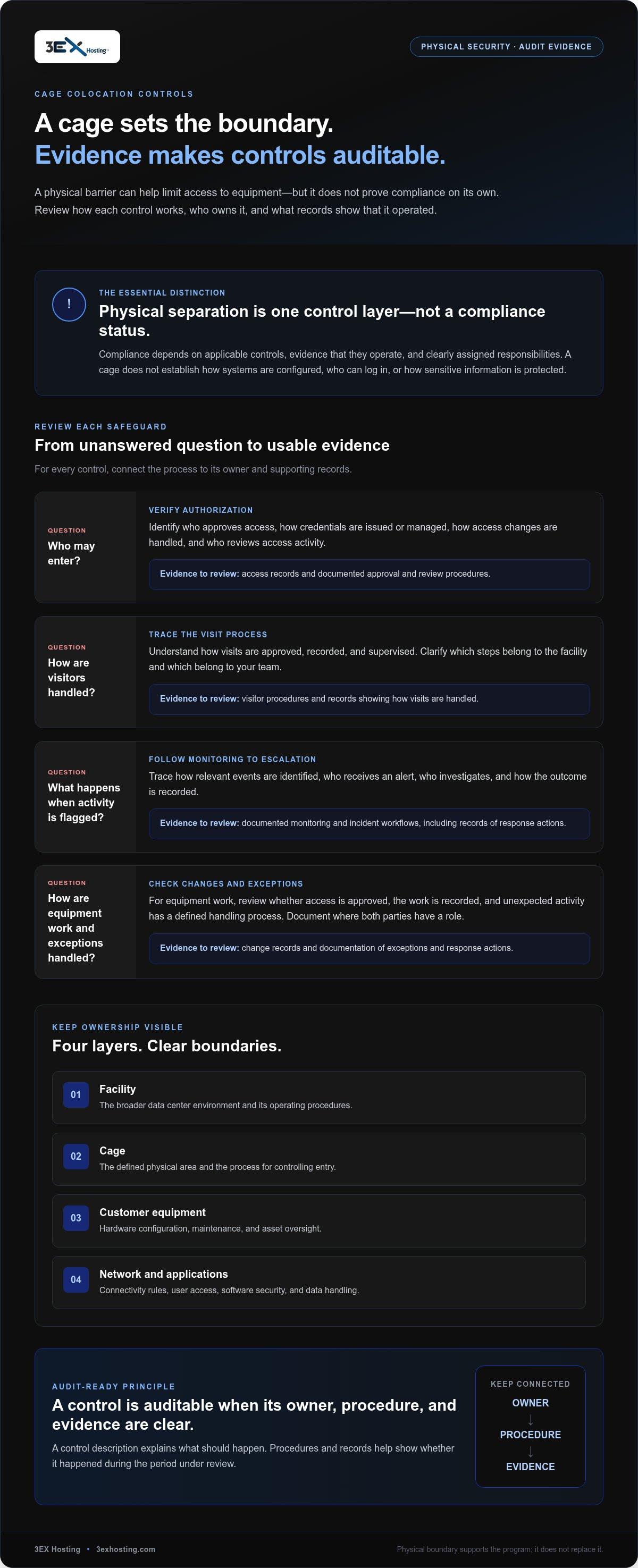
Compliant cage colocation is a physical-infrastructure control, not a compliance status. Compliance depends on applicable controls, evidence that they operate, and clearly assigned responsibilities. A cage can help limit physical access to equipment. It doesn’t, by itself, establish how systems are configured, who can log in, or how sensitive information is protected.
What does a colocation cage control?
A cage can define a restricted physical area and support procedures for authorizing entry. Before deployment, document the boundary: which equipment it covers, who may enter, how visitors are handled, and how access is approved and recorded. Base your control design on the actual configuration and procedures rather than assuming a particular lock, monitoring system, or access-log process.
Think in control layers. The provider manages facility operations; cage access concerns entry to the separated area; your organization manages its servers, network configuration, credentials, data, and applications. Some procedures involve both parties, so assign an owner to each task and define how shared responsibilities connect.
Does a cage make a data center compliant?
No. A cage may support a physical-security control, but it isn’t a certification or a complete compliance program. Requirements depend on the applicable framework, your organization’s obligations, and the systems included in scope. A physical boundary can be relevant, but it cannot replace organizational policies or technical safeguards for accounts, software, data, and network traffic.
Evidence matters. A description of an access process explains how a control should work; procedures and records help show whether it operated during the period under review. Map each requirement to its control owner and supporting evidence. Don’t treat the presence of a cage as proof that every related control is effective.
For a practical boundary review, identify what each layer is intended to protect and where your responsibility begins:
- Facility: The broader data center environment and its operating procedures.
- Cage: The defined physical area and the process for controlling entry.
- Customer equipment: Hardware configuration, maintenance, and asset oversight.
- Network and applications: Connectivity rules, user access, software security, and data handling.
This separation helps expose gaps, such as controlled cage entry but unclear ownership of equipment access or credential management. 3EX Hosting’s customizable cage colocation provides a physical-infrastructure option within a broader customer-managed program. Define the boundary and responsibilities before including it in your control design.
Which Physical Controls and Audit Evidence Matter in Cage Colocation?
A useful review goes beyond asking whether a cage is access-controlled. Trace how each safeguard works, who operates it, and what records can demonstrate its operation during the period under review. Access authorization, visitor handling, monitoring, incident escalation, and change procedures have different owners and evidence needs. Keep the review tied to the systems and risks in scope rather than treating a facility overview as a complete control assessment.
How should teams assess access control and monitoring?
Start with authorization. Identify who approves access, how credentials are issued or managed, how visitors are handled, and who reviews access activity. Then trace monitoring events to an escalation path: who receives an alert, who investigates it, and how the outcome is recorded. Focus on the documented process and its fit with your needs rather than assuming a specific technology or log-retention period.
Include changes and exceptions in the review. For example, equipment work may require an approved access request, a record of the work, and a process for addressing unexpected activity. Separate the steps owned by the facility from those owned by your team, and document where both have a role.
- Authorization: Review approval roles, access changes, and periodic reviews.
- Visitors: Understand how visits are approved, recorded, and supervised.
- Monitoring: Trace how relevant events are identified and escalated.
- Incidents and changes: Check how response actions, exceptions, and work affecting the space are documented.
What evidence helps support a compliance review?
A control is auditable when its owner, procedure, and evidence are clear. A policy or control description states what should happen; evidence helps show whether it did happen. Relevant materials may include access records, visitor procedures, incident workflows, change records, and assessment documentation. Check that each item is current, attributable to the responsible party, within scope, and suitable for the audit question.
A broad security statement isn’t a substitute for evidence. A record also won’t help if it covers a different location, period, or process than the control being assessed. Note gaps explicitly, including missing records or unclear ownership, and record how they affect the review.
SOC 2, PCI DSS, HIPAA, and ISO/IEC 27001 can provide context for different assessments, but their relevance depends on your organization, obligations, and system scope. Don’t assume a framework applies simply because equipment is housed in a cage, or that one document addresses every requirement. Use appropriate guidance, such as publications from the National Institute of Standards and Technology (NIST), alongside your organization’s scope and control mapping.
Include remote hands support in planned work and incident workflows. It can assist with operational tasks, while your team retains oversight of approvals, security decisions, and the evidence required for its review.
Cage, Cabinet, or Private Suite: Which Colocation Model Fits Your Control Needs?
Choose a space model by matching its physical boundaries to your documented access, separation, and oversight requirements. A cage can provide a defined, configurable area around multiple racks; a cabinet provides a more contained equipment footprint; a private suite offers dedicated space. None is automatically the most secure or compliant. The right fit depends on what your controls need to protect and how responsibilities are assigned.
| Model | Physical separation | Access boundaries | Flexibility and oversight |
|---|---|---|---|
| Cabinet | Equipment occupies cabinet-level space within a shared data center. | Access is focused on the cabinet and its equipment, subject to facility procedures. | May suit a contained footprint; define who manages cabinet access and hardware. |
| Cage | A defined area can surround multiple racks within a shared environment. | The boundary applies to the cage area; entry and permitted work need clear procedures. | Configurable space can support evolving deployments; coordinate facility and customer oversight. |
| Private suite | Space is dedicated to one customer within the data center. | Access is organized around the suite, alongside the facility’s wider access processes. | Can fit requirements for greater space separation; clarify operations and control ownership. |
When can a cage be a practical middle ground?
A cage can suit an organization that needs a defined physical boundary around several racks but uses shared facility infrastructure. The customer’s equipment area may be separated while the wider data center and its supporting services remain shared. Customizable cage colocation solutions can align the physical footprint with deployment needs. They don’t establish that a particular framework’s requirements are met; assess applicable controls and supporting evidence separately.
When might a cabinet or private suite fit better?
A cabinet may be appropriate when equipment fits a smaller, cabinet-level footprint and the organization’s access model doesn’t require a larger enclosed area. A private suite is another option for teams evaluating greater space separation around their infrastructure. Dedicated space changes the physical arrangement, but it doesn’t remove the need to define access approval, operational ownership, and evidence expectations. 3EX Hosting’s private colocation suites provide another model to consider.
Translate requirements into practical decision criteria before comparing configurations:
- Separation: What equipment or work areas need a defined boundary?
- Access: Who needs entry, and how will permissions and visits be managed?
- Operations: How will maintenance, changes, and exceptions be handled?
- Oversight: Which party owns each control and its evidence?
If your documented scope references an information security management system, review the ISO 27001 overview as context, not as proof that a particular colocation configuration satisfies your requirements. Select the model that supports your control design, then validate its boundaries and operating procedures.
How to Build an Audit-Ready Colocation Review Before Deployment
Prepare the review before equipment arrives. That gives your team time to resolve unclear ownership, organize evidence, and align deployment tasks with the controls in scope. Treat compliant cage colocation as one part of an operational plan, not a substitute for one. Use this five-step workflow to make responsibilities and review materials easier to follow.
1. Define the scope. Record which systems, equipment, data, and business processes will use the colocation environment. Note the applicable assessment scope and the physical areas or activities it covers. This prevents a facility document or access record from being treated as relevant when it concerns a different process or area.
2. Assign owners. Identify the facility contact and the internal owner for each customer-controlled process. Include access approval, credentials, equipment administration, incident response, and change approval. Assign a backup owner where needed so requests and escalations don’t stall when the primary owner is unavailable.
3. Map controls and responsibilities. Create a responsibility matrix with a row for each control and columns for the control owner, operating procedure, evidence source, and review frequency. Mark each item as facility-owned, customer-owned, or shared. For shared tasks, state who initiates the action and who records its completion.
How should organizations map shared responsibilities?
Separate physical entry from work performed on equipment. The facility may manage access to the space, while your organization controls who can administer systems and credentials. For operational tasks, remote hands support can assist with assigned work; document the request, authorization, task boundaries, and completion record. Keep security decisions and oversight with the designated customer owner.
4. Review evidence. Match each control to records that demonstrate its operation, such as access approvals, visitor records, equipment work requests, incident notes, or change documentation. Check that evidence identifies the relevant owner, scope, and period. A procedure describes what should happen; dated records help show what did happen.
What should teams document before moving equipment?
Before deployment, record the approved equipment scope, authorized personnel, access procedures, escalation contacts, and applicable handling steps. Maintain configuration baselines and document material changes according to internal policy. Coordinate the move so equipment delivery, placement, connection, and acceptance are traceable.
5. Document gaps and decisions. List missing evidence, unresolved ownership, exceptions, and corrective actions. Assign each item an owner and a next step, then retain the decision record with the review materials.
Checklist principle: Record who owns each control separately from where its evidence is collected. For infrastructure that supports a defined physical boundary, explore 3EX Hosting’s colocation solutions as part of your deployment planning.
How 3EX Hosting’s Cage Colocation Fits a Compliance-Focused Infrastructure Plan
3EX Hosting’s customizable cage solutions provide physical infrastructure for organizations that need a defined equipment area within a broader compliance program. Treat the cage as one part of the design. Its value depends on how the physical setup aligns with documented access processes, customer-owned safeguards, deployment needs, and the evidence plan. Compliant cage colocation can support a control strategy, but it doesn’t establish a certification or guarantee a compliance outcome.
How can cage infrastructure support a wider control plan?
Translate requirements into practical infrastructure decisions: what equipment needs physical separation, who needs access, and which work requires approval or documentation? Then connect those decisions to customer-managed safeguards, including system administration, credential management, network configuration, and application security. The cage supports the physical environment; your organization remains accountable for the technical controls it operates.
Operational assistance can help with on-site tasks when the request, authorization, and completion process are clear. 3EX Hosting provides 24/7 remote hands support for operational workflows. Define each task’s scope and retain customer oversight of approvals and security decisions. High-speed cross-connects can support connectivity requirements, but connectivity capability isn’t evidence that a compliance control has been met.
Infrastructure needs may also point to a different footprint. Consider full cabinet colocation when cabinet-level space better fits the equipment plan and access model. Compare configurations against operational requirements, not an assumed security ranking.
What should decision-makers take into the next planning conversation?
Bring a concise deployment brief that connects compliance scope to physical and operational needs. Include required separation, authorized access roles, equipment and connectivity requirements, evidence expectations, and workflows for maintenance, incidents, and changes. Note which responsibilities belong to the facility, which stay with your team, and where a task requires coordination.
A focused discussion is easier when each requirement has a clear purpose. For example, distinguish a need for physical separation from a need to restrict administrator privileges. They may influence the same deployment, but require different controls, owners, and evidence. Record open decisions and assign responsibility for resolving them before deployment begins.
Use this framework to align cage configuration, operational support, and customer oversight with your infrastructure plan. Discuss your colocation infrastructure requirements with 3EX Hosting to plan a setup around your deployment and control needs.
Turn Your Requirements Into a Clear Infrastructure Plan
Turn assessment findings into decisions your technical and compliance teams can own. Define the separation your systems need, document who approves access and operational work, and identify the evidence your review process depends on. This gives you a practical basis for evaluating compliant cage colocation without treating physical separation as a substitute for your wider security program.
Bring those requirements together with deployment and connectivity needs. Custom cage configurations, remote hands support, and high-speed cross-connects can serve as infrastructure and operational capabilities within that plan. Their value depends on how they fit your workflows and clearly defined responsibilities.
With the scope established, move forward with a focused discussion about configuration, operational boundaries, and deployment priorities. Discuss your cage colocation requirements with 3EX Hosting to take the next step toward an infrastructure plan built around your needs.
Frequently Asked Questions
Does a colocation cage make a company compliant?
No. A cage can contribute to physical security, but compliance depends on the organization’s applicable requirements and the controls across its systems and operations. For example, separating hardware from general data center space won’t address whether staff accounts are promptly disabled when roles change. Treat the cage as one infrastructure decision, then evaluate how it fits with your policies, technical safeguards, and documented assessment scope.
What compliance frameworks can colocation cages support?
A cage may support physical-control objectives considered under frameworks such as SOC 2, PCI DSS, HIPAA, or ISO/IEC 27001, depending on the organization and systems in scope. These frameworks aren’t interchangeable, and a cage doesn’t automatically satisfy any of them. Map each applicable requirement to the physical control, then determine what additional safeguards and records your organization needs to demonstrate its approach.
What evidence should a colocation provider supply for an audit?
Useful evidence depends on the control being assessed. A review may call for a scoped description of physical access procedures, relevant access records, visitor-handling procedures, or incident-response documentation. Define the covered facility, process, and review period, and check whether records can be attributed to the responsible control owner. A general security overview can provide context, but it won’t establish that a specific control operated as intended.
Can multiple customers share a data center while using separate cages?
Yes. Colocation facilities can host multiple customers while assigning separate cage areas for their equipment. Shared facility infrastructure doesn’t mean customers share the same cage, but boundaries and access depend on the facility arrangement. In your review, distinguish shared services and common areas from customer-specific space, and confirm that the access procedures in scope apply to the relevant equipment and environment.
How is a colocation cage different from a private suite?
A cage defines a separated area within a shared data center environment, while a private suite provides dedicated space for one customer. The distinction concerns physical footprint and separation, not an automatic ranking of security. Consider how much space your deployment needs, which access boundaries matter, and how each arrangement aligns with operational workflows. Then document why the selected model fits your organization’s requirements.
Who is responsible for security inside a colocation cage?
Responsibility is divided according to the services and controls involved. The facility operator manages facility-side operations, while your organization remains responsible for customer-managed equipment, system configuration, credentials, and applications. Some activities require coordination, such as approved equipment work. Define who authorizes the task, who performs it, and who reviews the result. Clear boundaries help prevent assumptions about ownership from becoming gaps in day-to-day security.
Can remote hands support help with compliance-related operations?
Yes. Remote hands support can assist with authorized on-site tasks, such as equipment work within an agreed operational process. To make that work useful for a compliance review, define who can request tasks, what approvals are required, and how completion is recorded. Operational assistance doesn’t transfer responsibility for security decisions or audit oversight. Keep the task record connected to your internal change or maintenance process.