 SUPPORT



 3EX United States
Blog
When searching for a Disaster Recovery as a Service provider, the key is to assess what a provider can demonstrate for your systems, not rely on broad promises. A recovery plan may meet its targets on paper but still fail to restore your most important workload when an incident hits.
Recovery time and acceptable data loss vary by workload. Set clear Recovery Time Objectives (RTOs) and Recovery Point Objectives (RPOs), and establish who handles each step during an incident. A plan should also be tested under conditions that reveal whether it works in practice.
This guide explains how 3EX Hosting helps you set recovery objectives, assess a provider’s operational responsibilities, and compare capabilities using verifiable criteria. You’ll also learn how disaster recovery connects to the infrastructure and support behind your workloads. The goal is a recovery approach that fits your business, reduces uncertainty, and supports continuity when systems are disrupted.
Key Takeaways
- Separate data backup from full disaster recovery by identifying the applications, data, and operations your business must restore.
- Map the recovery sequence from incident declaration through validation, and clarify responsibilities at each stage.
- Evaluate a DRaaS provider by documented scope, recovery evidence, testing approach, security measures, and escalation process.
- Set RTO and RPO according to each workload’s business impact, then map dependencies that could affect recovery.
- Assess whether disaster recovery, managed cloud hosting, and infrastructure support can work together to meet your enterprise continuity needs.
What a DRaaS Provider Does, and What Your Business Needs to Recover
Disaster Recovery as a Service (DRaaS) is a managed recovery capability that helps restore workloads and the infrastructure they depend on after a disruption. A backup gives you a protected copy of data, but it doesn’t define how applications, systems, and business processes will return to operation. DRaaS brings recovery resources and agreed responsibilities into an organized service relationship.
Start by identifying what your organization needs to recover and how quickly it needs to resume. Recovery supports business continuity, but no plan can prevent every incident. Its purpose is to reduce disruption by making technical recovery steps and business decisions clearer before a crisis.
DRaaS, backup, and business continuity: where each fits
Think of backup as a protected copy, DRaaS as the capability to restore services, and business continuity as the wider plan for keeping essential work moving. DRaaS may coordinate workload recovery, but business leaders still need to decide what takes priority, how employees and customers will be informed, and which workarounds are appropriate. The Recovery as a Service (RaaS) overview on Wikipedia provides additional context on the service model and its relationship to backup.
Start with critical workloads and business impact
Not every system has the same effect on operations. Identify applications and processes that directly support revenue, customer service, production, or essential internal work, then map their dependencies. A customer portal, for example, may rely on identity services, a database, network connectivity, and an external payment service. Restoring the portal alone won’t restore the customer journey if a critical dependency remains unavailable.
Rank workloads by business impact and document the dependencies and teams involved in restoring them. A practical inventory can distinguish essential services from systems that can wait:
- Business function: What work stops if this workload is unavailable?
- Dependencies: Which identity, database, network, infrastructure, or third-party services must operate first?
- Recovery priority: What should be restored first, and which teams need to validate it?
Use that impact assessment to set two business objectives. The Recovery Time Objective (RTO) is the maximum acceptable time a workload can remain unavailable. The Recovery Point Objective (RPO) is the maximum acceptable amount of data, measured by the time since the last recoverable point, that the business could lose.
These objectives reflect the consequences of downtime and data loss for each workload, not generic provider benchmarks. A system that supports a core transaction may need a different recovery target from an internal tool with a manual workaround. Defining those differences gives your recovery plan a sound basis for prioritizing workloads, dependencies, and operational decisions.
How DRaaS Recovery Works Across Infrastructure, Data, and Operations
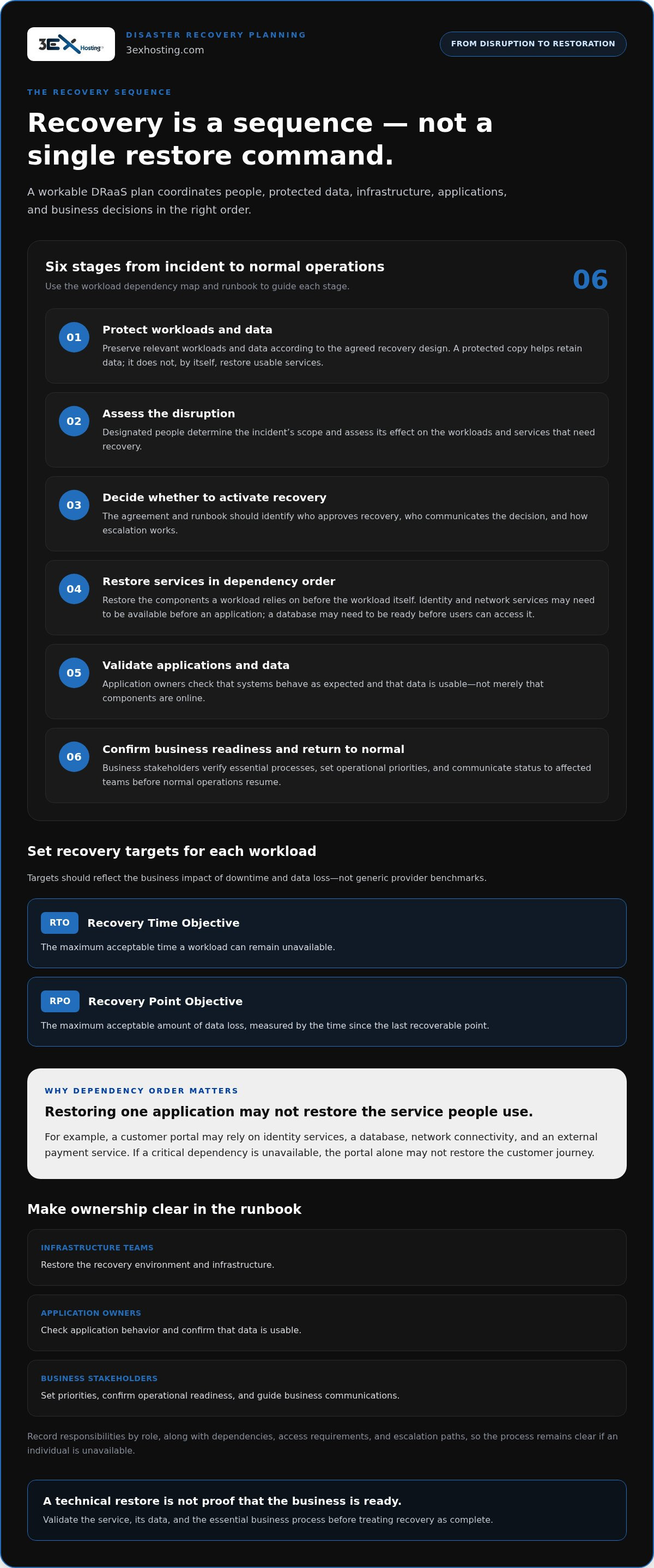
A recovery plan is a sequence of coordinated actions, not a single restore command. Backup preservation and operational recovery solve related but different problems: a protected copy helps retain data, while recovery restores the systems and services people need to use that data. IBM’s definition of Disaster Recovery as a Service also describes how DRaaS arrangements can use data center, cloud, or hybrid environments.
When evaluating a draas provider miami, focus on how the recovery sequence applies to each workload. The architecture, activation process, and division of responsibilities depend on the workload and the provider agreement. Treat the steps below as a planning model, not a universal technical design.
The recovery sequence from disruption to service restoration
Recovery generally moves through protection, incident assessment, activation, restoration, validation, and return to normal operations. First, workloads and relevant data are protected according to the agreed design. When disruption occurs, designated people assess its scope and determine whether recovery should be activated. The agreement and runbook should explain who makes that decision and how it is communicated.
Next, teams restore services in a deliberate order, using the dependency map from the workload inventory. Identity and network services may need to be available before an application can function, while a database may need to be ready before users can access the application. Restoring components out of sequence can leave a service technically online but unusable.
Before resuming normal operations, application owners should confirm that systems behave as expected and data is usable. Business stakeholders can then verify that essential processes are working and communicate status to affected teams. A completed technical restore is not, by itself, proof that the business can safely resume work.
People, runbooks, and infrastructure during recovery
Clear ownership reduces uncertainty. A current runbook should identify who assesses the incident, approves recovery actions, restores infrastructure, checks applications, and communicates operational decisions. It should also record dependencies, access requirements, and escalation paths. Assign responsibilities to roles, not just individuals, so the process remains clear if someone is unavailable.
Technical teams coordinate across infrastructure and application layers. Infrastructure staff restore the environment; application owners check service behavior and data; business stakeholders confirm operational readiness and set priorities. If hosted equipment requires physical intervention, remote hands support can be included in the coordination plan, with its scope defined in the service agreement.
The physical environment is one part of the design. Power, cooling, connectivity, and space support the systems that recovery depends on. Consider a provider’s data center infrastructure alongside cloud resources, workload dependencies, and operational responsibilities. 3EX Hosting provides disaster recovery solutions and managed cloud hosting for enterprise needs. Explore 3EX Hosting’s infrastructure services to see how these elements can fit into a recovery approach.
How to Compare DRaaS Providers Using Evidence, Not Promises
Provider claims are a starting point, not proof that a recovery plan fits your workloads. Compare proposals against the same applications, dependencies, recovery objectives, and assumptions. A draas provider miami search should lead to an evidence-based assessment, not a ranking based on broad claims or marketing language.
Use a consistent scorecard. Record what each provider documents, what your team must do, and what the agreement commits to deliver.
| Evaluation area | Evidence to review | What to clarify |
|---|---|---|
| Scope | Workloads, data, and infrastructure included | Which systems or dependencies are outside scope? |
| Responsibilities | Roles for incident declaration, restoration, validation, and communications | Which actions belong to the provider and which remain with your team? |
| Recovery evidence | Current plans and procedures for comparable workloads | What has been demonstrated, and under what assumptions? |
| Testing | Exercise scenarios, results, and documented follow-up | Do exercises test both technical recovery and business handoffs? |
| Security | Documented access controls and data-handling practices | How are access and incident-related concerns managed? |
| Escalation | Communication paths and escalation roles | Who coordinates updates and decisions during recovery? |
What evidence demonstrates recovery readiness?
Look for current plans tied to the workloads you need to protect, rather than generic process documents. Evidence should show how teams would execute relevant procedures and coordinate handoffs. An exercise that restores a technical component but excludes application owners or business decision-makers may leave important gaps undiscovered.
Review how exercise findings are recorded, assigned, and incorporated into plan updates. The Disaster Recovery Journal’s business continuity insights offer broader context on continuity and risk management, but your decision should rest on evidence tied to your own recovery needs.
Responsibilities, security, and service boundaries
Make service boundaries explicit. For each stage, identify who can declare an incident, initiate restoration, validate applications and data, and communicate with stakeholders. Review documented access controls and data-handling practices alongside escalation procedures. Ambiguous ownership can delay decisions even when technical resources are available.
Separate demonstrated capability from a contractual guarantee. A successful exercise shows what happened under its specific conditions; it doesn’t automatically promise the same outcome in every incident. Treat service levels and other commitments as binding only when they appear in the agreement and match your business requirements.
Provider fit depends on workload complexity, internal expertise, and the operational support your team needs. Compare equivalent workloads and assumptions, including dependencies and customer responsibilities. This makes differences meaningful and prevents unlike proposals from appearing comparable. 3EX Hosting provides disaster recovery solutions alongside managed cloud hosting for enterprise needs. Explore 3EX Hosting’s infrastructure services as you shape a project-specific recovery approach.
How to Set DRaaS Requirements for Your Workloads
Set recovery requirements workload by workload. A single target for every system can waste resources on low-impact services while leaving critical operations underprotected. A draas provider miami search is more useful when you can describe what must recover, what delays the business can tolerate, and how you’ll verify the plan.
Use this sequence to turn business needs into requirements you can discuss and test:
- Inventory workloads. Record the applications, data, infrastructure, and business processes the organization relies on. Note who owns each workload and where it runs.
- Rank business impact. Identify the operational consequences of an outage for each workload. Consider whether teams can use a workaround and how disruption affects customers, transactions, or essential internal work.
- Set recovery objectives. Define acceptable restoration time and data loss for each workload with the business owner. Treat objectives as requirements to evaluate against the agreed service scope, not generic provider benchmarks.
- Map dependencies. Document what must be available for each workload to function, such as identity services, databases, networks, and third-party systems. Set a recovery sequence that accounts for those dependencies.
- Validate the plan. Define an exercise that checks whether the sequence, responsibilities, and success criteria work together. Record gaps and assign follow-up actions.
Recovery objectives should reflect each workload’s business impact and be assessed through documented testing. Objectives without clear scope and validation can sound precise while leaving important assumptions unresolved.
Set workload-level recovery objectives
The Recovery Time Objective (RTO) is the target time to restore a service within the scope agreed for that workload. The Recovery Point Objective (RPO) is the acceptable data-loss interval, not the time needed to restore a service. For every objective, record the assumptions, dependencies, and accountable business owner. These details help teams understand what the target means in practice and what the service is expected to cover.
Turn requirements into a testable recovery plan
Translate the dependency map into a restoration order. Then define the exercise scenario, who has authority to make recovery decisions, how teams will communicate, and what counts as success. Criteria might include confirming that a service starts, data is accessible, and the relevant business process can proceed. A test provides evidence about the scenario exercised; it doesn’t prove the plan will cover every possible disruption.
Review objectives and procedures after material changes to applications, infrastructure, dependencies, or business operations. A new system or altered workflow can change which services matter most and what must be restored first. Keep the inventory, ownership, assumptions, and test findings aligned as the environment evolves.
3EX Hosting provides disaster recovery solutions and managed cloud hosting to support enterprise continuity planning. Discuss a project-specific recovery approach with 3EX Hosting based on your workload inventory and operational requirements.
Choosing a DRaaS Provider for Integrated Enterprise Recovery
The right provider scope should align with your prioritized workload inventory, business-approved recovery objectives, and the operational responsibilities your team expects to retain. Connect each protected workload to its dependencies, recovery sequence, and accountable decision-makers. This gives you a clear basis for assessing a draas provider miami search result without relying on broad claims about recovery performance.
For enterprise environments, recovery planning also involves the infrastructure supporting each workload. 3EX Hosting provides disaster recovery solutions alongside managed cloud hosting and data center infrastructure. Consider these capabilities together when designing a continuity approach, while documenting the project scope and avoiding assumptions that integration alone guarantees a particular recovery outcome.
When an integrated infrastructure relationship can help
Aligning recovery planning with cloud and data center operations can give technical teams a shared view of system dependencies and service boundaries. For example, a plan may need to account for workloads in managed cloud hosting alongside equipment housed in a colocation environment. Full cabinet colocation may form part of an organization’s broader infrastructure design, while the recovery plan defines how related systems and teams fit into restoration. Integration is an architectural consideration, not proof of a specific recovery result.
A shared operational context can help clarify coordination: which systems are involved, who owns each step, and how infrastructure activity connects to application validation. Document the project’s scope, responsibilities, and recovery commitments.
What to prepare before discussing a DRaaS project
A focused project discussion starts with clear inputs. Bring documents that show how the business operates and what recovery must support, rather than relying on a general description of the IT environment. Prepare:
- A prioritized workload inventory and dependency map, including key applications, infrastructure, and external services.
- Business-approved recovery objectives, assumptions, and known operational constraints.
- Current continuity documentation, including decision authority, escalation paths, and recovery responsibilities.
- The names or roles of technical owners and business stakeholders who can approve activation and confirm restored services are ready for use.
These materials connect enterprise requirements to a project-specific recovery approach. They also help identify open questions about scope, handoffs, and how the plan will be evaluated. 3EX Hosting’s disaster recovery and managed cloud services can be considered as part of that continuity design, with infrastructure and operational needs discussed in context.
Ready to apply the evaluation framework to your environment? Discuss your recovery project with 3EX Hosting and outline the workloads, objectives, and responsibilities your plan needs to address.
Make Recovery Planning Part of Ongoing Operations
Recovery planning works best as an ongoing business discipline, not a document created once and set aside. As priorities shift, ownership changes, and systems evolve, keep recovery decisions connected to the people responsible for approving and carrying them out. That continuity helps teams act with greater clarity when normal operations are disrupted.
Use your evaluation as a starting point for a practical conversation about where responsibilities sit, how infrastructure supports recovery, and how the plan will stay relevant as the business changes. Whether you’re assessing a draas provider miami or comparing options for a broader enterprise environment, focus on an approach that fits your operations rather than a generic template.
3EX Hosting’s enterprise portfolio includes disaster recovery solutions, managed cloud hosting, and data center infrastructure. Discuss your enterprise recovery requirements and take the next step toward a recovery approach shaped around your organization’s needs.
Frequently Asked Questions
What is a DRaaS provider?
A DRaaS provider supplies and coordinates services that help an organization recover IT workloads after a disruption. Depending on the agreement, its role may include protecting selected systems, providing recovery infrastructure, and supporting restoration activities. For example, recovering an order-processing platform may require more than bringing servers online; application owners still need to verify transactions before business use resumes. The written scope defines where provider work ends and customer responsibility begins.
How does disaster recovery as a service work?
DRaaS works by preparing selected workloads for recovery and following an agreed process when disruption affects them. Teams assess the incident, activate the relevant procedures, restore systems, and verify that applications and data function as intended. The exact method depends on the workload and service agreement. A useful practical check is whether a restored application can complete a real business task, not only whether its infrastructure appears online.
What is the difference between DRaaS and backup as a service?
Backup as a service focuses on creating and retaining copies of data, while DRaaS addresses how systems and services return to operation. A backup might preserve customer records, for example, but the business may also need its application, identity access, and network connections restored to use those records. The services can complement each other, but a backup subscription alone doesn’t necessarily cover the coordinated steps needed to resume work.
How do I choose a DRaaS provider?
Choose a provider by matching its documented scope to your business-critical workloads and operating model. Compare equivalent scenarios, including which systems are covered, what your staff must do, how recovery is demonstrated, and what the agreement commits to. A search for “draas provider miami” is only a starting point; evaluate the actual service terms and workload fit rather than relying on broad marketing claims.
What are RTO and RPO in disaster recovery?
RTO, or Recovery Time Objective, describes the target time to restore a service. RPO, or Recovery Point Objective, describes the acceptable interval of data loss. They measure different business tolerances. For instance, a team may accept a longer outage for an internal reference tool than for a customer transaction system, while still requiring a tighter data recovery point for the latter. Set both targets with the business owners who understand the impact.
How often should a DRaaS recovery plan be tested?
There’s no single testing schedule that suits every environment. Set a cadence based on workload criticality, system complexity, and the risks of an untested procedure, then revisit it after significant application or infrastructure changes. Exercises can range from reviewing roles and decision paths to attempting a technical restoration. Record what each test covered, who participated, and what needs correction so the next exercise addresses known gaps.
Can DRaaS support business continuity?
Yes, DRaaS can support business continuity by helping restore IT services that essential operations depend on. It doesn’t replace decisions about customer updates, staff communications, or temporary ways to keep work moving. For example, a team might need an approved manual process while a business application is unavailable. Define those workarounds and communication owners alongside technical recovery so the continuity plan addresses people and processes as well as systems.
What should a DRaaS service agreement specify?
A DRaaS agreement should state which workloads and services are in scope, the recovery objectives that apply, and the provider’s and customer’s responsibilities. It should also describe incident escalation, data handling, access expectations, testing arrangements, and how service commitments are measured. Make important assumptions and exclusions explicit. Clear terms help both sides understand what happens during activation and how restored services will be accepted back into use.