 SUPPORT



 3EX United States
Blog
What if the cable isn’t the reason your cross-connect is taking so long? Delays often start earlier: incomplete requirements lead to rework, approvals wait across organizations, or teams can’t see which dependencies are still open. Reducing cross-connect installation time means preparing the technical details and coordinating the people involved before provisioning begins.
It’s reasonable to expect installation to move quickly once a request is submitted, but physical work is only one stage. Endpoint and media details, authorization, carrier coordination, site readiness, and testing all need to line up. When one item is unclear, progress can stall while teams resolve it.
This guide explains how to prepare an accurate request, coordinate stakeholders and dependencies, and track readiness through provisioning and validation. It also covers how on-site tasks and documentation fit into the workflow. 3EX Hosting’s high-speed cross-connect services and 24/7 remote hands support help teams coordinate the physical work as part of an integrated data center environment.
Key Takeaways
- Identify both endpoints and document the technical requirements before submitting a request.
- Reducing cross-connect installation time starts with mapping workflow steps and assigning owners to customer-controlled inputs.
- Use a preparation checklist to capture media, connector, authorization, and testing requirements.
- Track milestones in a shared log so teams can spot open dependencies and respond to questions promptly.
- Plan remote hands support for on-site physical tasks, and include customer approvals and connection testing in the deployment plan.
Why reducing cross-connect installation time starts before the order
A cross-connect is a physical link between specified endpoints within a data center. It creates a direct connection between equipment or network services at those locations. For a concise overview of the term and its uses, see What is a Cross-Connect?
The cable work is only one part of a deployment. The request must identify the intended endpoints and technical requirements, receive the necessary approvals, and provide enough information to plan provisioning. After installation, teams still need to validate the connection against the intended design. That is why reducing cross-connect installation time starts with readiness, not simply with submitting an order sooner.
Separate preparation into two areas. Your team can provide accurate requirements, identify decision-makers, secure customer-side authorization, and respond promptly to questions. The facility manages its provisioning process and scheduling, including work that depends on its infrastructure or coordination with other parties. Clear preparation can prevent avoidable pauses, though it can’t remove every external dependency.
Which steps commonly create avoidable waiting?
Requests can stall when endpoint names are ambiguous, media or interface details are missing, or the specified connection doesn’t match the equipment plan. For example, identifying a cabinet without specifying the device or port may leave the team without enough information to plan the work. Resolve these details with the technical teams before submission where possible.
Approvals create a separate source of delay. A technically complete request may still wait if the authorized contact is unavailable or another organization hasn’t approved its portion. Distinguish customer-controlled gaps from facility dependencies, such as provisioning capacity, scheduling, or coordination for work within the data center. For every open item, record its owner and next action. This makes the cause of a pause visible instead of treating every delay as a cabling issue.
What does installation readiness mean?
Installation readiness means the connection requirements are approved, technically complete, and coordinated among the people responsible for the work. It gives the facility a clear basis for handling the request and gives your teams a shared understanding of what is being connected. Readiness supports orderly execution, but it doesn’t guarantee a fixed installation date because provisioning and scheduling depend on facility-controlled processes.
Before submitting, gather the planning inputs your team controls:
- Endpoint details: Identify both ends of the connection, including the relevant equipment and location details.
- Technical requirements: Document the selected media and interface information so the request can be assessed without guesswork.
- Contacts and authorization: Name the technical and approval contacts, and prepare the required customer-side authorization.
- Dependencies: Note related carrier, network, or internal work that could affect sequencing or testing.
Check these inputs for consistency before sending the order. If a requirement is undecided, assign someone to resolve it rather than circulating an incomplete request. This helps reduce clarification loops and lets customer teams and facility staff focus on the work each is responsible for.
How to map the cross-connect workflow and expose delays
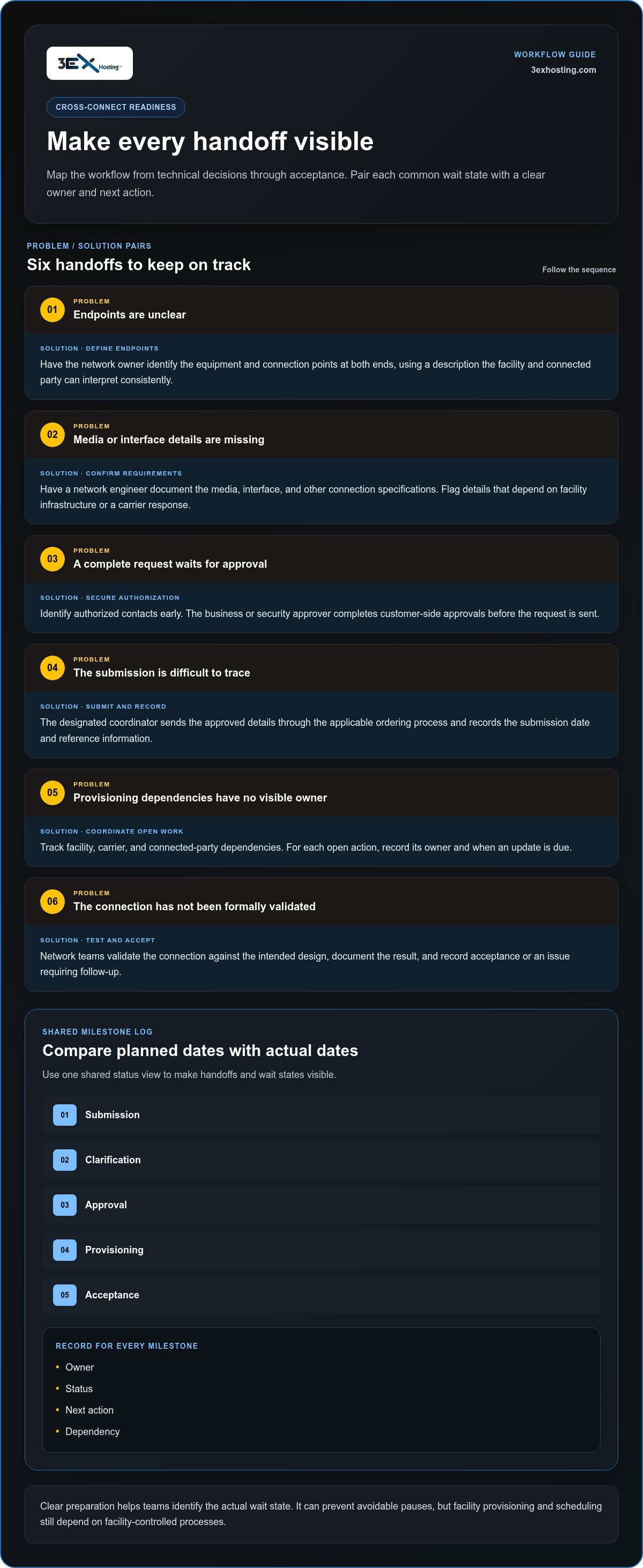
A workflow map makes handoffs visible. It shows what your team controls, where facility or external coordination is needed, and who owns the next action. This helps teams identify the actual wait state instead of treating every pause as a provisioning delay. To reduce cross-connect installation time, track progress from the first technical decision through acceptance.
- Define endpoints. The network owner records the equipment and connection points at both ends. The result should be a clear description that the facility and connected party can interpret consistently.
- Confirm requirements. A network engineer documents the media, interface, and other connection specifications. Flag any detail that depends on facility infrastructure or a carrier response.
- Secure authorization. The business or security approver completes customer-side approvals. Identify authorized contacts early so a complete technical request doesn’t wait for sign-off.
- Submit the request. The designated coordinator sends the approved details through the applicable ordering process and records the submission date and reference information.
- Coordinate provisioning. The coordinator tracks facility, carrier, and connected-party dependencies, recording the owner of each open action and when an update is due.
- Test and accept. Network teams validate the connection against the intended design, document the result, and record acceptance or any issue requiring follow-up.
Maintain a shared milestone log with planned and actual dates for submission, clarification, approval, provisioning, and acceptance. For each milestone, record the owner, status, next action, and dependency. This makes handoffs visible and gives everyone one reliable status view.
How should teams identify workflow bottlenecks?
Compare planned dates with actual dates to identify recurring wait states. Track clarification cycles separately from provisioning and external coordination. A request waiting on endpoint details presents a different problem from a facility scheduling dependency. Escalate blocked items through the agreed operational contacts, including the request reference, open action, owner, and impact so the right team can respond.
Who needs to participate before submission?
Include network and data center teams, plus carrier, security, and business approvers when their work or authorization is required. Name one accountable coordinator to consolidate answers and maintain the milestone log. For physical tasks that require an on-site presence, remote hands support can help coordinate the work. It doesn’t replace customer approvals or network testing.
Clear ownership keeps the process moving without confusing customer actions with facility-controlled scheduling. If you’re planning a deployment, review how 3EX Hosting’s data center environment can fit into a coordinated cross-connect plan.
Which preparation choices reduce cross-connect rework?
Good preparation aligns technical details, approvals, and validation plans. A rushed request may be quick to submit but incomplete. A coordinated request takes time to assemble, but gives reviewers and installation teams one consistent set of requirements. For reducing cross-connect installation time, prioritize completeness over speed of submission alone.
Complete technical details reduce clarification loops by giving each party one consistent description of the connection. Use the connected equipment and its requirements as the source of truth. Don’t choose media or connector types from habit, or assume a familiar specification applies to a different device.
Compare these preparation approaches before submitting:
- Partial details: Submit only known information, then resolve gaps through follow-up. This can create extra review cycles and complicate coordination.
- Complete technical package: Align endpoint, media, interface, and connector information across the request and equipment records. This makes the connection easier to review and validate.
- Early coordination: Confirm approvals and external endpoint dependencies before submission. This reduces the chance that a technically complete order waits on a separate stakeholder.
Use a requirements table as a final consistency check. Follow the facility’s order forms and standards, adapting these prompts to the applicable process.
| Requirement | What to record | Check before submission |
|---|---|---|
| Endpoint | Both connected devices or locations, including rack or cabinet references and responsible organizations | Do the endpoint details match current equipment records? |
| Media | The media required by the connected equipment and connection design | Is the selection consistent at both ends? |
| Connector | The connector requirement for each relevant interface | Does it match the actual equipment specification? |
| Authorization | Authorized requestor and required customer or connected-party approvals | Are the approvers identified and ready to act? |
| Testing | Acceptance checks and the teams responsible for completing them | Do the parties agree on how the connection will be validated? |
How do accurate technical details prevent revisions?
Capture both endpoints, rack or cabinet references, interfaces, and the organizations responsible for each side. Record media and connector requirements consistently in the order request and equipment records. If the two sources disagree, resolve the mismatch before submission. Follow the facility’s ordering form and technical standards. General examples can help with preparation, but they don’t override facility-specific requirements.
How can approval and authorization be prepared early?
Identify authorized requestors and required business, security, or technical approvers before initiating the order. If a carrier or connected party controls an endpoint or dependency, coordinate its input early and assign an owner to follow up. A clear view of the data center environment also helps teams plan how endpoints and on-site work fit into the deployment.
How to prepare, coordinate, and validate a cross-connect efficiently
A reliable handoff needs more than a completed order. Prepare the request, keep the approved design aligned with the submitted details, and agree on how the connection will be accepted before physical work begins. This makes reducing cross-connect installation time a coordinated process, with fewer gaps between preparation, provisioning, and validation.
What should a pre-submission checklist include?
Use one checklist as the final review point. Assign an owner to confirm each item, then keep the approved design and submitted order consistent. If a detail changes after submission, record the change and share it with the parties responsible for the affected work.
- Endpoints: Confirm identifiers for both ends, including equipment and rack or cabinet references.
- Connection specifications: Match interfaces, media, connector requirements, and intended connection to the actual equipment and approved design.
- Ownership and contacts: Name the request owner, technical contacts, and people responsible for responding to questions.
- Authorization: Check that the required requestor permissions and customer-side approvals are in place.
- Dependencies: List external parties or related work that could affect either endpoint or the planned sequence.
How should teams test and accept the completed connection?
Agree on the test plan and responsible technical contacts before physical work begins. Installation completion and service acceptance are separate milestones: a connection may be physically in place while testing or customer sign-off remains open. Record the agreed checks and what evidence will show that the connection meets the intended design.
After provisioning, capture link status, relevant interface checks, test results, the person completing validation, and the acceptance decision. If a result doesn’t match expectations, report the exact endpoints, observed status, and checks performed. Specific evidence helps the responsible teams investigate without restarting the entire conversation.
Keep the milestone log current through acceptance. The status owner should record completed checks, outstanding issues, and the next action, while technical contacts respond promptly to clarification requests. This helps distinguish an installation task from an unresolved configuration or sign-off item.
If cross-connect work is part of a broader equipment transition, include related deployment activities in the same coordination plan so their dependencies stay visible.
Plan a coordinated cross-connect deployment with 3EX Hosting’s cross-connect services.
How 3EX Hosting supports a coordinated cross-connect deployment
A well-prepared request connects technical planning with the physical work at the data center. 3EX Hosting’s high-speed cross-connect services and 24/7 remote hands support fit into a coordinated deployment plan. Cross-connect requirements guide the connection work, while remote hands can support on-site physical tasks within the agreed scope. These services help project teams organize handoffs from preparation through installation.
Remote hands support doesn’t replace customer approvals, decisions about technical requirements, or end-to-end service testing. Your team remains responsible for authorizing the request and confirming that the connection meets its intended purpose. Define those responsibilities before work begins so everyone knows which actions they own.
Where can remote hands support help?
Remote hands can assist with on-site physical tasks when instructions and scope are clear. Provide precise steps, equipment and endpoint references, and any access coordination needed for the task. For example, identify the relevant equipment and describe the specific action rather than relying on a broad instruction such as “connect the network.” 3EX Hosting’s remote hands support can be part of the deployment plan.
Before the task, align the people performing physical work with the technical contacts who will verify the result. Share changes to the approved plan through the agreed coordination process. This keeps on-site instructions consistent with the connection design and helps the right team respond if the work reveals a discrepancy.
What information helps start a deployment discussion?
Bring the readiness checklist into the initial discussion so project scope and dependencies are clear from the start. Include:
- Endpoints and purpose: Identify both connection endpoints and explain what the link needs to support.
- Technical requirements: Provide known interface, media, and connector details from the connected equipment and design.
- Readiness window: Share the target window for readiness without assuming it sets an installation date.
- Approvals and dependencies: Note completed or outstanding authorization, external-party coordination, and related work.
- Contacts and testing: Name the accountable coordinator and technical contacts, and outline the validation criteria and acceptance process.
This information creates a practical handoff: the project team can see what is ready, what remains open, and who owns each next step. It also gives everyone a shared basis for discussing sequencing without confusing readiness with a promised schedule.
For teams focused on reducing cross-connect installation time, start the deployment discussion with the requirements, approvals, dependencies, and testing plan assembled. Submit your cross-connect requirements to 3EX Hosting to begin planning a coordinated deployment.
Make the Next Connection Easier to Plan
Use this deployment to establish a repeatable handoff for future connectivity work. Keep the approved design, ownership details, and acceptance record together, then update them when equipment or dependencies change. A current shared reference helps teams start the next request with fewer unknowns and avoid rebuilding context from scattered tickets and messages.
That discipline is the practical foundation of reducing cross-connect installation time. It gives technical teams and facility staff a clearer starting point while leaving room for project-specific requirements and scheduling dependencies. Align the connection purpose, endpoints, readiness needs, and responsible contacts in one project discussion.
Plan your cross-connect deployment with 3EX Hosting. A clear starting point helps your team move forward with confidence.
Frequently Asked Questions
Is there a standard timeline for cross-connect installation?
No, there isn’t one timeline that applies to every facility, order, or connection. The schedule can depend on request completeness, authorization, technical specifications, coordination with connected parties, and facility processes. To reduce cross-connect installation time, ask for the applicable milestones rather than planning around a universal turnaround. Track dependencies separately, respond promptly to clarification requests, and distinguish confirmed scheduling commitments from internal target dates. Readiness supports coordination, but it can’t guarantee a completion date.
Can a cross-connect be installed faster by paying for expedited service?
Expedited options and terms vary by provider and facility, so don’t assume they’re available or that they remove other dependencies. Faster handling won’t resolve an unclear endpoint, missing approval, or a third party’s unfinished work. Before making project plans around an expedited request, separate confirmed scheduling commitments from your own target dates. Complete specifications, responsive technical contacts, early approvals, and an agreed testing plan remain useful preparation, regardless of the scheduling pathway.
How long does cross-connect testing take after installation?
Testing time depends on the connection design, endpoint availability, equipment configuration, and acceptance criteria. For example, a link may be physically present while one endpoint is unavailable for the agreed checks. Set expectations with the technical contacts before installation, including who will run each check and how results will be recorded. Document exceptions and outstanding actions. Don’t treat a completed physical connection alone as proof that it’s ready to carry production traffic.
What information should a cross-connect request include?
Include enough detail for the facility and connected parties to identify the exact work: both endpoints, equipment or rack references, interfaces, media and connector requirements, and the connection’s purpose. Add authorized contacts, required approvals, dependencies involving other organizations, and planned acceptance criteria. Use the facility’s current request format and terminology. Compare the request with the approved equipment design and resolve inconsistencies before submission.
Does remote hands support install or test a cross-connect?
Remote hands can support on-site technical tasks within the agreed scope, but that doesn’t automatically include every installation or testing activity. Provide clear instructions and equipment references, and coordinate access and task ownership in advance. Customer network teams still need to approve the intended connection and define how it will be validated. Treat on-site assistance as one part of the deployment workflow, not a replacement for customer authorization or end-to-end service acceptance.
What happens if cross-connect details change after an order is submitted?
A change may require updated technical information, authorization, review, or coordination with affected parties. For instance, changing an endpoint can affect equipment references and who needs to participate in acceptance testing. Route updates through the designated coordinator, preserve a record of the approved request, and notify relevant contacts promptly. The impact depends on the change and facility process, so confirm the revised scope and schedule instead of assuming the original plan still applies.