 SUPPORT



 3EX United States
Blog
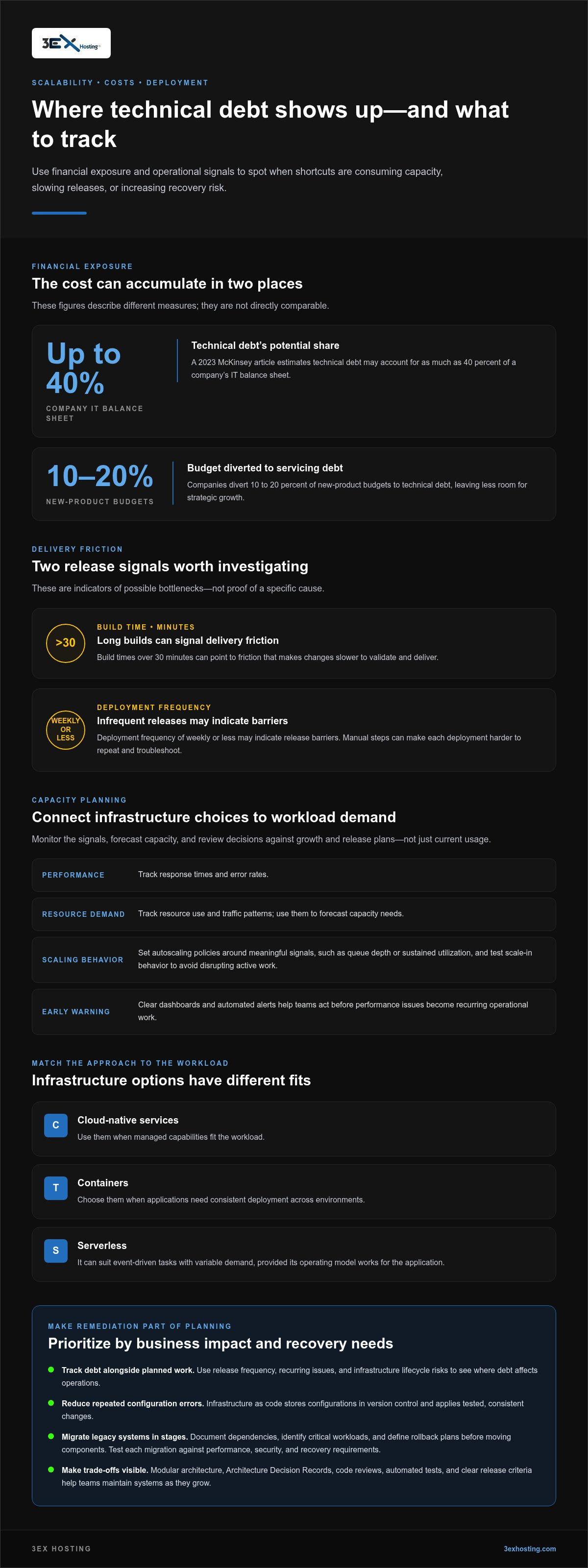
A system that scales only after it starts struggling can turn early shortcuts into lasting operational drag. Avoiding technical debt with scalable infrastructure means designing systems to grow, stay maintainable, and support reliable deployment instead of relying on temporary fixes. Technical debt can also affect the balance sheet: a 2023 McKinsey article estimates it may account for as much as 40 percent of a company’s IT balance sheet.
It’s understandable to prioritize getting new services live quickly. But when infrastructure can’t keep pace with demand, teams may face slower releases, rising maintenance effort, and less confidence in recovery.
This article explains what infrastructure technical debt is, how it develops, and how it affects costs and deployment agility. You’ll also learn how scalable architecture, lifecycle planning, and dependable infrastructure choices can help limit that debt as your business grows.
Key Takeaways
- Recognize how architectural, code, documentation, infrastructure, and process shortcuts can create debt beyond the software itself.
- Track release delays, recurring issues, and infrastructure lifecycle risks to see where technical debt is affecting operations.
- Prioritize debt by its business impact and recovery risk, and make repayment part of planning rather than postponing it indefinitely.
- Match infrastructure decisions to current needs and expected growth so teams can scale capacity without adding avoidable operational complexity.
What Is Technical Debt and Why Does It Matter?
Ward Cunningham introduced the term technical debt in 1992. It describes a system’s departure from its nonfunctional requirements, such as maintainability, reliability, or security. Like financial debt, shortcuts can save time initially but create work that compounds as software and infrastructure grow.
Technical debt can build up across several layers. Architectural debt stems from choices that make components difficult to change. Data-model debt comes from rigid schemas that complicate new features. Code debt includes duplicated logic, deprecated libraries, and hardcoded settings. Test debt leaves changes without reliable checks. Infrastructure debt includes unsupported operating systems, weak monitoring, and single points of failure.
Documentation and process debt also slow operations. Missing runbooks, change logs, and rollback plans can leave teams dependent on individual knowledge. Operational debt builds when manual deployments or inconsistent environments make routine maintenance risky. System reviews, dependency checks, and incident patterns can help assess these areas.
There is no single U.S. scalability rule prescribing one architecture. Applicable security, privacy, and industry requirements depend on the data, business activity, and contractual obligations involved.
Use cloud-native services when managed capabilities fit the workload. Choose containers when applications need consistent deployment across environments. Serverless can suit event-driven tasks with variable demand, provided its operating model works for the application.
Migrate legacy infrastructure in stages. Document dependencies, identify critical workloads, and define rollback plans before moving components. Test each migration against performance, security, and recovery requirements so old constraints don’t follow the workload into its new environment.
Modular architecture lets teams update one component without destabilizing the whole system. Architecture Decision Records explain why a design was chosen, helping teams evaluate later changes. Pair them with code reviews, automated tests, and clear release criteria. A quality culture treats maintainability as part of delivery, not cleanup after a deadline. These practices support scalable, maintainable systems and make trade-offs visible and manageable.
Scalability, operational costs, and deployment agility
Scalable infrastructure helps teams add capacity and release changes without multiplying manual work. Track release frequency, operational complexity, and resource use to see where growth is exposing costly constraints.
The Future Cost of Technical Debt
Technical debt is future effort and risk created by shortcuts that make later changes harder. Its costs compound when each new feature depends on outdated systems, fragile integrations, or manual configuration. Companies divert 10 to 20 percent of new-product budgets to servicing technical debt, leaving less room for strategic growth. Infrastructure as code and automation reduce repeat errors by storing configurations in version control and applying tested, consistent changes. Track debt alongside planned work, then prioritize remediation by business impact and recovery needs.
Effects on Maintenance and Feature Delivery
Technical debt increases the effort required to maintain systems and can delay features customers need. A deployment process that relies on manual steps, for example, makes each release harder to repeat and troubleshoot. Build times over 30 minutes can signal friction, while deployment frequency of weekly or less may indicate release barriers. These metrics help teams locate bottlenecks instead of treating every delay as a staffing problem. As maintenance takes more capacity, planned improvements can slip, making existing complexity more expensive to manage.
Monitoring and Capacity Planning
Monitoring and capacity planning connect resource decisions to workload demand. Track response times, resource use, error rates, and traffic patterns; then use those metrics to forecast capacity needs. Set autoscaling policies around meaningful signals, such as queue depth or sustained utilization, and test scale-in behavior to avoid disrupting active work. Review forecasts against growth and release plans, not just current usage. For compute-intensive workloads, assess whether data center infrastructure options align with deployment and capacity requirements. Clear dashboards and automated alerts help teams act before performance issues become recurring operational work.
Causes and consequences of infrastructure technical debt
Infrastructure debt often starts with a specific compromise, such as keeping an unsupported legacy server because an application depends on it. That choice may preserve service today, but it also adds maintenance effort and operational risk while limiting future changes.
Common Causes of Infrastructure Debt
Common causes include rushed capacity decisions, undocumented configurations, and systems kept beyond vendor support. For example, a manually configured database may differ from its recovery copy, making restoration uncertain. Hardcoded settings and deprecated dependencies also complicate upgrades. Technical debt grows when deadlines reward immediate delivery but nobody records the shortcut, its impact, or the planned fix. Inventorying dependencies, support status, and recovery requirements helps reveal these causes before they spread across connected systems.
Consequences of Technical Debt
Infrastructure debt creates future costs and risk because every dependent service adds constraints. An unsupported operating system can block security patches, while a single point of failure can turn routine maintenance into an outage. Weak backups complicate recovery and increase the risk of data loss during emergencies. Refactoring then competes with feature work, and fixes grow harder as integrations accumulate. Prioritize remediation by service impact, risk, and recoverability. Restore backups and document emergency runbooks before addressing less urgent components.
Premature Scaling and Overengineering
Premature scaling means adding capacity before workload needs justify it. Overengineering adds components whose operational burden exceeds their value. Both can consume financial and engineering resources without improving service. Risks include idle capacity, additional failure points, and slower releases caused by unnecessary dependencies. For example, a multi-region design can add replication and recovery complexity before a service needs it. Start with measured demand, isolate components that need independent scaling, and expand when performance evidence supports the decision. This keeps architecture aligned with growth without mistaking elaborate design for resilience.
Deliberate and accidental technical debt
Technical debt can be a conscious shortcut or an unintended consequence of inherited systems, rushed decisions, or knowledge gaps. The distinction matters: teams can manage a deliberate compromise when they record the trade-off, while hidden debt may go unnoticed until a change or incident exposes it.
A deliberate shortcut may help meet a deadline. For example, a team might postpone automating an application deployment to release a needed feature. The decision becomes manageable when the team records its reason, owner, impact, and repayment condition. Set a review point, such as the next release that touches the deployment workflow, and include the follow-up in routine planning. Without an owner or repayment plan, a shortcut can quietly become permanent infrastructure.
Accidental debt often comes with inherited systems. A team might take over a legacy service with undocumented manual steps, an unfamiliar dependency, or configuration known by only one employee. Skills gaps can also lead to choices that later prove difficult to maintain. Start by mapping dependencies and documenting how the service is deployed, monitored, and restored. This turns vague operational risk into specific work the team can assess.
Use a shared debt register to reduce and track technical debt. For each item, record the affected system, practical consequence, work required, and condition that would raise its priority. Examples include recurring deployment failures, unsupported components, and missing recovery procedures. Review the register during sprint planning alongside feature work. Track whether remediation is helping by monitoring resolution time, repeat incidents, and release delays.
Quality culture makes the process sustainable. Add review of shortcuts to architecture discussions, require tests for fixes to known bugs, and document significant decisions in Architecture Decision Records. These steps give future maintainers context instead of leaving them to rediscover why a compromise exists. For workloads whose capacity or hosting model is part of the debt, explore infrastructure options that fit the application’s operating needs.
3EX Hosting: Full Cabinet Colocation
3EX Hosting’s Full Cabinet Colocation provides dedicated physical space for server hardware when workloads need a dependable infrastructure foundation. It can suit organizations that want to retain control of their hardware while placing it in a data center environment. For broader space requirements, Private Colocation Suites and Cage Solutions datacenter offer additional colocation options; Managed Cloud Hosting supports workloads hosted as a managed cloud service. Match the option to your architecture, operational responsibilities, and growth plans. If you’re assessing where your infrastructure should run, visit 3EX Hosting’s website to learn more.
Make Your Next Infrastructure Decision Count
A durable approach to avoiding technical debt with scalable infrastructure starts with a clear decision about what your organization needs next. Identify changing workloads, the operational responsibilities your team can support, and the requirements that should guide future growth. This context turns infrastructure planning into a deliberate business choice.
For organizations evaluating where their hardware should run, 3EX Hosting offers Full Cabinet Colocation, Private Colocation Suites, and Cage Solutions datacenter. Each provides a different physical environment for infrastructure, so align the option with your deployment model, control needs, and capacity plans.
Use the next conversation to clarify your infrastructure priorities and discuss an appropriate path forward. Contact 3EX Hosting to discuss your infrastructure and take a considered next step toward a stable foundation for future work.
Frequently Asked Questions
How early should founders start thinking about scalability?
Founders should consider scalability while defining a product’s first version, before core choices become difficult to change. Identify expected workload patterns, data sensitivity, and the parts likely to evolve quickly. A small application may not need distributed services, but clear interfaces and configurable settings can leave room to grow without adding unnecessary complexity upfront. For organizations launching new digital projects, partnering with web development providers like Ajberry helps establish a solid, maintainable foundation from the start.
What is technical debt in infrastructure, and what causes it?
Infrastructure technical debt is the ongoing effort and risk created when infrastructure choices make systems harder to operate or change. It can result from inherited environments, rushed configuration, unsupported components, or decisions made without ownership and maintenance plans. For example, a new team may inherit a production environment whose deployment depends on undocumented steps known only to a former administrator.
How do you design scalable infrastructure to prevent technical debt?
Design around clear service boundaries, replaceable components, and observable behavior. Define which workloads need independent scaling, how services communicate, and what happens when a dependency fails. Avoid tightly coupling application logic to a single infrastructure platform. To avoid technical debt with scalable infrastructure, test architecture choices against real workload scenarios, document the trade-offs, and revisit them as requirements change.
How should infrastructure architecture change as a company grows?
Architecture should respond to measured workload and operational needs, not company size alone. A growing application may first need clearer separation between background jobs and user-facing services. Later, distinct components may need independent deployment or capacity. Review dependency maps, incident patterns, and team ownership regularly. Change the design to remove a demonstrated constraint rather than adding layers preemptively.
How do teams balance infrastructure costs with scalability and reliability?
Balance costs by comparing resource use with the business impact of slowdowns or outages. Identify workloads that need steady capacity and those with variable demand, then choose appropriate scaling and redundancy approaches for each. Review idle resources, peak usage, and recovery requirements together. This avoids optimizing only for the lowest operating expense while overlooking the impact of insufficient capacity on service.
How do you assess and prioritize infrastructure technical debt?
Assess debt by mapping affected services, dependencies, support status, and operational consequences. Compare each issue by business impact, security exposure, recovery difficulty, and remediation effort. A failing backup path for a critical service may warrant attention before a low-impact configuration inconsistency. Assign an owner and review date to each priority so remediation stays visible during planning.