 SUPPORT



 3EX United States
Blog
Keeping data within one country is only one aspect of data residency. Data localization applies when national or sector-specific rules require certain information to remain within a country’s borders. In the United States, there is no single federal data residency mandate, so managing data residency requirements starts with identifying which rules apply to your data and where it is stored, processed, and accessed.
It’s easy to focus on the primary database and overlook copies created by logs, analytics, support workflows, backups, and disaster recovery. These data paths matter too: processing information in another region may raise transfer considerations even when the original data remains in place.
This article explains data residency in the U.S. and practical ways to manage controls across systems and vendors. It covers why region settings, support access, exports, deletion, and exit planning belong in the same discussion, helping you understand where data goes and keep its handling aligned with your obligations.
Key Takeaways
- Map where data is stored, processed, accessed, and copied, including logs, backups, analytics, and support workflows.
- Set regional controls for telemetry and support access, then retain evidence showing how data moves and which safeguards apply.
- Assess vendors’ transfer terms, access practices, and data handling so cross-border processing is visible before it creates surprises.
- Plan exports, deletion, and infrastructure exit together to maintain control over data copies throughout a transition.
What is data residency?
Data residency concerns where information is stored. Managing data residency requirements also means identifying which rules apply. In the United States, no single federal data residency mandate covers all organizations.
Residency, Localization, and Sovereignty
Data residency identifies the geographic location where data is stored, while data localization requires designated data to remain within a country’s borders. Data sovereignty concerns the laws and authorities that may apply based on information’s location, owner, or custodian. These concepts overlap, but they are not interchangeable.
For example, a company may store records in the United States while a vendor processes support logs elsewhere. The original storage location does not answer every question about access, processing, or applicable rules. Map these data paths separately to see where information resides and which jurisdiction may govern it.
Regulated Industry Requirements
Healthcare, financial services, government, and other regulated industries face requirements tied to data type and activity, not one universal residency rule. HIPAA is relevant to health information, and GLBA is relevant to financial institutions. Neither law alone means all covered data must remain in the United States.
For covered defense information, DFARS clause 252.204-7012 requires contractors to implement NIST SP 800-171 security requirements. When a cloud service stores or processes that information, the clause requires security requirements equivalent to the FedRAMP Moderate baseline. ITAR also treats release of controlled technical data to foreign persons as an export, wherever it happens.
GDPR adds specific breach duties: organizations must notify regulators within 72 hours of becoming aware of a breach, according to European Union (EUR-Lex). GDPR violations can result in fines of up to 4% of global annual revenue, according to European Union (EUR-Lex). These rules make classification and jurisdiction mapping important before selecting storage or support arrangements.
Costs and trade-offs depend on the workload, architecture, and safeguards required. Regional infrastructure and separate operating processes can add complexity, while tighter geographic controls can limit where data is handled. Weigh these factors against each workload’s obligations, access needs, and resilience requirements.
Residency controls for logs, telemetry, analytics, and support
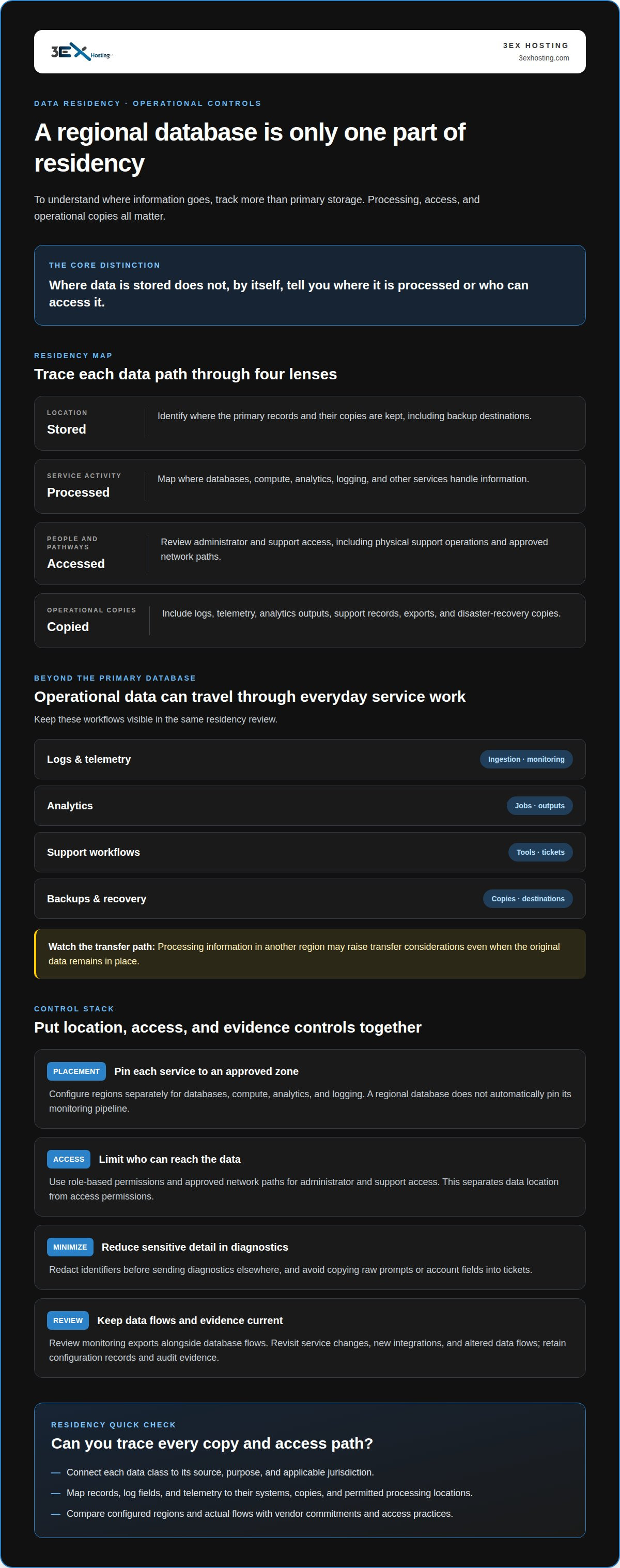
Controls must extend beyond primary storage. Identify location-bound data, pin each processing service to an approved zone, and govern operational copies and access.
Identifying Data Location Requirements
Identify location-bound data by connecting each data class to its source, purpose, and applicable jurisdiction. Start with an inventory, then label records, log fields, and telemetry that could identify a person or account. For example, an error log may contain a customer identifier alongside technical details. Map that field to its system, copies, and permitted processing locations to make requirements actionable.
Regional Placement and Access Controls
Regional placement pins storage and processing to approved zones, while geo-fencing can limit access based on location. Configure regions separately for databases, compute, analytics, and logging; a regional database does not automatically pin its monitoring pipeline. Restrict administrator and support access through role-based permissions and approved network paths. Periodic technical testing from security providers like OAD Technologies can help validate these defenses and identify potential access vulnerabilities. This distinguishes where information is stored from who can reach it, revealing gaps between placement and access policies.
Residency for Operational Data
Operational data includes logs, telemetry, analytics outputs, and support records created during routine service work. Keep log ingestion, dashboards, analytics jobs, and support tools within approved zones. Redact identifiers before sending diagnostics elsewhere, and avoid copying raw prompts or account fields into tickets. Troubleshooting or support that processes data in another region may trigger international transfer rules, even when storage remains local. Review monitoring exports alongside database flows.
Contractual Controls and Ongoing Reviews
Contractual controls document geographic commitments and define how vendors handle access, transfers, and location changes. Set review points for service changes, new integrations, and altered data flows, and retain configuration records and audit evidence. This helps identify risks before a vendor change creates an untracked transfer. Regulatory penalties and contractual remedies depend on the applicable rule and agreement; exposure may include enforcement, breach claims, audit findings, or service interruption. Include physical support operations in the same access review.
Vendor due diligence and transfer mechanisms
A vendor’s data location includes more than its primary storage region. Review processing, support access, subcontractors, and transfer arrangements together.
Assessing Vendor Data Locations
Verifying vendor locations means tracing where information is stored, processed, accessed, and transferred across the service. Request a data-flow description covering hosting regions, backup destinations, support workflows, and subprocessors. Compare it with the vendor’s data processing agreement and service configuration. For example, a U.S.-hosted database may still send diagnostic logs to another region. Record findings, supporting documents, and approved exceptions in a residency register.
Keep evidence tied to the specific service and data category. Save regional settings, contract versions, transfer terms, and review dates in an audit-ready record. Revisit it when a vendor changes subprocessors, adds analytics, or updates its support model. Comparing promised locations with actual configurations makes gaps easier to identify and correct.
International Privacy Laws and Transfers
For U.S. companies handling personal data from abroad, the destination country’s transfer rules can apply alongside U.S. obligations. GDPR does not require personal data to remain in the European Union, but it regulates international transfers. Transfers outside the European Union or European Economic Area may use adequacy decisions, standard contractual clauses, or binding corporate rules. The appropriate mechanism depends on the transfer and the parties involved.
International data transfers can raise compliance considerations, so organizations should assess the safeguards relevant to each transfer. A U.S. company should map each transfer, identify the applicable mechanism, and assess the destination and vendor access involved. The U.S. CLOUD Act also allows authorities to request data from U.S.-based providers regardless of where that data is stored. Consider jurisdiction, access rights, and contractual commitments together.
For each vendor, connect the transfer mechanism to the actual data flow. A signed clause alone does not show whether support logs or subprocessors follow the same route. Keep the assessment, contract, and technical location records aligned, and update them when the service or transfer changes.
Data exports, deletion, and exit planning
An exit plan should track the full data lifecycle, from export through verified deletion. Before changing platforms, define what will move, where it will go, and how remaining copies will be handled. For example, a customer database may have separate exports for records, attachments, audit logs, and configuration files. Track each category as a distinct work item.
Prepare the export to meet the destination system’s requirements. Document formats, dependencies, encryption, and transfer paths, then validate the result before cutover. Compare record counts or sample critical files to identify incomplete exports. Keep a controlled copy of the export manifest, including its creation date, source, destination, and validation outcome. This gives technical teams a clear reference during migration.
Deletion must cover more than the live database. List replicas, snapshots, archives, caches, logs, and support attachments that may contain the same information. For example, removing a customer profile from an application will not automatically remove a separate analytics export. Assign each copy an owner and record its deletion status. Align deletion handling with applicable retention needs and documented contractual terms.
Build the exit sequence around dependencies: export essential data, validate it in the destination, redirect workloads, then retire the old environment. Preserve access to necessary records during the transition without creating uncontrolled duplicate copies. Define who approves each stage and how completion will be documented, such as through a migration record or vendor deletion confirmation. A named owner can resolve gaps between infrastructure, application, and compliance teams.
For an infrastructure transition, include your data and hosting requirements in the planning process. A defined destination, export scope, and deletion record help keep the move orderly and clarify responsibilities.
3EX Hosting: Full Cabinet Colocation
3EX Hosting’s Full Cabinet Colocation provides physical space for business server hardware. It can suit organizations that need a defined facility for infrastructure they operate while retaining control over system configuration and data flows.
Residency planning extends beyond physical placement. Map where applications process information, where backups are kept, and how logs and support access are handled. Your architecture and operating procedures determine the paths data takes beyond the cabinet. Private Colocation Suites and Cage Solutions datacenter offer alternative physical-space configurations.
Discuss your infrastructure needs and residency priorities with 3EX Hosting. Contact 3EX Hosting to explore whether Full Cabinet Colocation fits your environment.
Build Residency into Every Change
Make residency part of change management, not a one-time architecture decision. A new analytics integration, support workflow, or platform migration can change where data is processed and who can access it. Assign an owner to assess these changes before they reach production. Keep decisions linked to the systems and vendors they affect.
This gives managing data residency requirements a practical rhythm. Teams can compare proposed changes with approved locations, transfer terms, and deletion plans, then update controls before operations shift. It also gives technical and compliance teams a shared basis for prioritizing work, rather than treating residency as a final sign-off.
For infrastructure planning, consider whether a dedicated physical environment aligns with your placement objectives and operational model. 3EX Hosting can discuss how its colocation options may fit those requirements. Contact 3EX Hosting to discuss residency and take the next step toward a clear, workable plan.
Frequently Asked Questions
What does data residency mean, and how does it differ from data sovereignty and data localization?
Data residency identifies where information is physically stored. Data localization is a rule requiring certain data to stay within a defined territory, while sovereignty concerns which jurisdiction’s laws may apply. For example, a U.S. company could store records domestically but use a service operated under another jurisdiction’s legal authority. Consider storage location, legal reach, and geographic restrictions separately when evaluating a system.
Which U.S. federal and state laws impose data residency or data localization requirements?
The United States has no single federal data residency mandate. HIPAA and GLBA are sector-specific laws relevant to healthcare and financial institutions, but HIPAA does not require protected health information to remain in the United States. For state-level analysis, identify the applicable jurisdiction, data category, and activity; do not assume a privacy obligation automatically requires local storage.
How do cloud providers support data residency, and what are their regional storage options?
Cloud providers may support residency through region selection for storage and, where available, processing services. Regions and controls vary by platform and service. For example, selecting a database region alone may not determine where its analytics or management functions operate. Map each workload component to its region and record the configuration behind your organization’s placement decisions.
Do data residency requirements cover backups, disaster recovery, metadata, logs, and support access?
They can, depending on the applicable rule, contract, and data involved. A backup may contain the same personal information as its production database, while metadata or support logs may reveal account details. Treat each copy and access route as a separate item in your data inventory. Classify its contents, purpose, storage location, and processing path to determine which controls apply.