 SUPPORT



 3EX United States
Blog
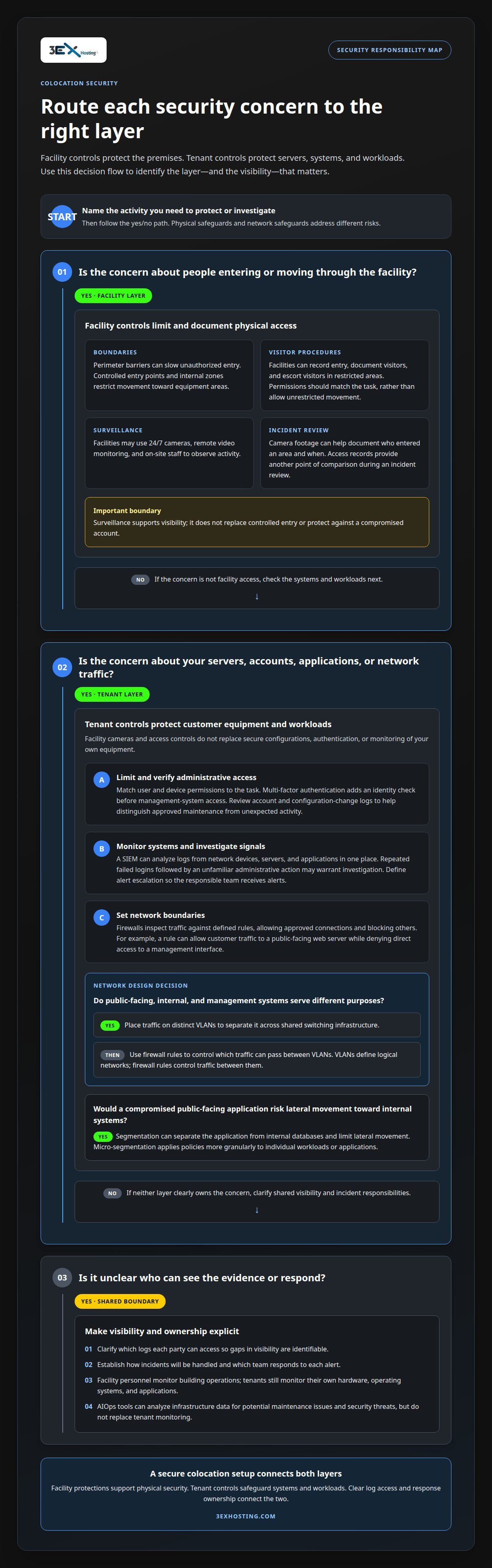
Your servers may be yours, but the facility around them is part of the security model. A colocation data center provides space and infrastructure such as power, cooling, and network connectivity while businesses install their own hardware. Network security in a colocation environment combines facility-level protections, including controlled entry, visitor procedures, access records, and surveillance, with the tenant’s security for its servers and systems.
That division matters: cameras and access controls can help deter and document unauthorized entry, but they do not replace secure configurations, authentication, or monitoring of your own equipment. Understanding who protects each layer makes it easier to assess how a colocation arrangement works and where each party’s responsibilities begin and end.
This article explains colocation, how shared security responsibilities work, and how physical access controls and surveillance support a secure facility. It also shows how network safeguards complement those physical measures, helping you distinguish infrastructure protections from the security controls your own workloads need.
Key Takeaways
- Understand how controlled entry, visitor procedures, and surveillance help protect colocation facilities, and what these controls can and can’t do.
- Separate facility security responsibilities from the protections you need to manage for your own servers and systems.
- See how firewalls and network segmentation can limit exposure between public-facing, internal, and management systems.
- Compare colocation with cloud and on-premises setups to identify which approach best fits your infrastructure and security needs.
Physical access controls and surveillance
Physical security starts before a technician reaches a server rack. A data center can use perimeter barriers, controlled entry points, and internal zones to limit movement across its premises. Each layer serves a distinct purpose: a perimeter barrier slows unauthorized entry, while a restricted equipment area keeps access closer to the infrastructure. In a cabinet-based layout, cabinet colocation places equipment within a defined space, helping organize physical access around hardware.
Access procedures make those boundaries meaningful. Facilities can maintain entry records, document visitors, and use escorted access when appropriate. For example, a visitor entering a restricted area can be logged and accompanied rather than moving freely through the data center. Permissions should match the task: a technician handling a specific maintenance job needs access to the relevant area, not unrestricted movement across the premises. Clear procedures also help distinguish authorized work from unexpected activity.
Surveillance adds visibility between entry checks. Colocation facilities may use 24/7 camera surveillance, remote video monitoring, and on-site staff to observe activity. Cameras can help document who entered an area and when; access records provide another point of comparison if an incident occurs. Neither measure replaces controlled entry. Together, they create complementary records that support incident review and security monitoring across the facility and its region.
These physical security protections support, but don’t replace, network safeguards. Cameras cannot block a compromised account, and a locked room won’t detect unusual traffic from an application. That is why network security in a colocation environment depends on distinct controls for people, premises, and systems. Healthcare organizations may also consider relevant facility and data-protection needs; the U.S. Department of Health and Human Services identifies HIPAA as an example relevant to healthcare data centers. A clear division of responsibilities helps connect physical protection with the tenant’s security of its own equipment.
What is Secure Colocation?
Secure colocation combines facility, operational, and network protections with security measures for customer equipment. Its effectiveness depends on visibility into the controls and a clearly defined boundary between facility monitoring and workload monitoring.
Security Visibility Limitations
Security visibility means being able to observe relevant activity across facility systems, networks, and customer workloads. In colocation, tenants may not have direct access to every facility or network measure, which can leave gaps in their view. For example, the facility may record an access event while the tenant monitors activity on its servers. Clarify which logs each party can access to identify blind spots and establish how incidents will be handled, or work with FaultLine Cyber & Security Ltd to perform thorough exposure assessments across cyber, physical, and operational vulnerabilities.
Administrative Access Monitoring
Administrative access monitoring limits privileged actions and records who performs them. Access controls can help limit users’ and devices’ permissions to what their tasks require. Multi-factor authentication adds an identity check before users access management systems. These measures matter because administrators can change configurations or expose workloads. Reviewing account and configuration-change logs can help distinguish approved maintenance from unexpected activity.
Continuous Monitoring and Threat Detection
Continuous monitoring collects activity signals so teams can identify threats and investigate unusual behavior. A SIEM solution can analyze logs from network devices, servers, and applications in one place. For example, repeated failed logins followed by an unfamiliar administrative action may warrant investigation. Align monitoring and alerts with the organization’s security guidelines, and set escalation procedures so alerts reach the responsible team.
Facility Monitoring and AIOps
Facility personnel monitor building operations, while AIOps tools can analyze infrastructure data for potential maintenance issues and security threats. These provide different views: staff oversee facility conditions, while AIOps can help generate and triage incidents across systems. For example, an alert about a developing equipment issue can prompt investigation before workloads are disrupted. Neither replaces tenant monitoring of its own hardware, operating systems, and applications. Define which team handles each alert and response.
Firewalls, VLANs, and Segmentation in Colocation
Network controls in a colocation facility can protect OSI layer 3, the network layer. Firewalls inspect traffic against defined rules, allowing approved connections and blocking others. For example, a rule can permit customer traffic to a public-facing web server while denying direct access to a management interface. To enhance traffic inspection through advanced application visibility and web content filtering, organizations can deploy solutions from security specialists like Lionic. This keeps network boundaries explicit instead of treating every connected system as equally trusted.
VLANs logically separate traffic across shared switching infrastructure. A network plan might place public-facing servers, internal applications, and management interfaces on distinct VLANs. This helps prevent routine traffic from crossing into systems serving a different purpose. VLANs define the logical networks, while firewall rules control which traffic can pass between them. Configure both to match the intended workload design.
Segmentation creates boundaries between network areas or workloads. If an internet-facing application is compromised, separating it from internal databases can limit lateral movement. Micro-segmentation applies these controls more granularly, using policies for individual workloads or applications, even within shared infrastructure. The key design decision is which systems need to communicate and which connections should stay blocked.
Private links connect separate environments directly, such as a colocation facility and a cloud platform. They can provide predictable communication paths for workloads exchanging sensitive or time-critical data. A private connection does not replace traffic protection: encrypt data moving between colocation facilities and cloud platforms. Firewalls can still restrict which systems use the link and which services they can reach.
These controls work best as a coordinated network plan. Separate internal, management, and public-facing networks, define permitted traffic between them, and monitor for unexpected connection changes. For example, an application server that suddenly initiates database connections outside its normal pattern may signal a configuration problem or threat. Clear segmentation makes this activity easier to isolate and investigate without treating the entire network as one trust zone.
How do colocation network security compare with cloud hosting and on-premises data centers?
The key difference is who controls the hardware and facility. In colocation, a business installs and manages its own servers, while the provider operates core facility infrastructure. This gives teams direct control over hardware and system configurations without requiring them to manage the entire building. Network security in a colocation environment therefore depends on coordinated protections: facility controls from the provider and equipment-level safeguards from the tenant.
Cloud hosting shifts more infrastructure management to the cloud provider. Customers use hosted computing resources instead of maintaining physical servers, while still configuring access, applications, and data protections. This can reduce hands-on hardware management, but changes how teams access and observe the underlying infrastructure. Colocation may suit workloads that require customer-managed hardware or closer control over legacy applications.
An on-premises data center places facility and equipment operations within the organization’s own environment. This offers direct oversight, but the organization also manages building systems, physical access, hardware, and network infrastructure. For example, expanding an on-premises server room means handling facility work alongside server deployment. Colocation transfers much of that facility responsibility to a provider, while customers remain responsible for their own equipment.
Make security ownership explicit in all three models. In colocation, define who manages facility access, network infrastructure, server administration, incident response, and breach notifications. In cloud hosting, distinguish provider-managed infrastructure from customer-managed identities, configurations, and data. For on-premises operations, document which internal teams own each control. These boundaries determine who investigates an alert and who acts when a system is compromised.
Choose based on workload needs, operational capacity, and required control. Colocation fits teams that want to use existing hardware while offloading facility management. Cloud hosting can suit workloads that benefit from provider-managed infrastructure. On-premises facilities may fit organizations that need direct control over the building and equipment. To explore facility infrastructure for a colocation deployment, review data center infrastructure options.
3EX Hosting
3EX Hosting provides colocation space for businesses operating their own server hardware within data center infrastructure. Full Cabinet Colocation, Private Colocation Suites, and Cage Solutions offer different physical environments for equipment. Managed Cloud Hosting is another option for workloads better suited to a managed hosting model.
When planning network security in a colocation environment, align facility requirements with the security tasks your teams manage. Account for server access, monitoring, incident response, and connections between workloads and other environments. A clear plan for network security in a colocation environment also helps assign responsibility for changes and alerts.
Contact 3EX Hosting to discuss colocation options for your infrastructure needs.
Put Your Security Model Into Practice
Turn security expectations into an operating model your infrastructure and teams can sustain. Map how equipment is deployed, who approves changes, and how teams respond when monitoring identifies unusual activity. Keep the model aligned with evolving workloads, new connections, and changing business priorities. Clear ownership helps prevent gaps between technical controls and day-to-day operations.
Use your deployment plan to define the balance of control, facility support, and operational effort that suits your organization. The right approach to network security in a colocation environment should fit how your systems are managed, not just how they are installed. Revisit these decisions as your infrastructure changes so protections remain practical and responsibilities clear.
For a focused discussion about colocation options and your infrastructure needs, contact 3EX Hosting to discuss colocation. A clear next step can help you move forward with confidence.
Frequently Asked Questions
How does colocation protect servers from cyber threats?
Colocation can reduce exposure through controlled facility operations and network infrastructure, but it does not secure every server automatically. Customers still need to protect operating systems, applications, user accounts, and data. For example, facility access controls will not stop malware on an unpatched server. Combine facility safeguards with current software, strong authentication, backups, and monitoring suited to each workload.
What network security controls are used in colocation data centers?
Controls can include firewalls, intrusion detection and prevention systems, DDoS protection, network segmentation, and centralized log analysis. The right arrangement depends on which network services the provider operates and which systems remain customer-managed. For example, a tenant can separate management traffic from public-facing application traffic and review alerts for unexpected connections. Encryption and strong identity controls also help protect access and data.
Who is responsible for network security in a colocation environment, the provider or customer?
Responsibility is shared, with the division set by the service arrangement. The provider manages core facility infrastructure, while customers protect their own equipment and systems. Facility access procedures and server operating-system updates, for example, may belong to different teams. Document ownership of network changes, administrative accounts, incident handling, and breach notifications so alerts have a clear response path.
What physical and network security certifications should a colocation provider have?
Review assurance evidence relevant to your organization’s security and compliance needs. ISO 27001 addresses information security management, while SOC 2 reports cover areas such as security, availability, and confidentiality. NIST publications can help evaluate security controls, but NIST itself is not a facility certification. Assess the scope and date of any report, since a label alone doesn’t show which systems it covers.
What DDoS protection and bandwidth options do colocation providers offer, and what do they cost?
Colocation arrangements may include network-level DDoS mitigation, customer-managed filtering, or bandwidth options tailored to traffic needs. The right design depends on traffic patterns, resilience requirements, connectivity, and the mitigation required. Do not assume that every deployment includes a particular capacity or protection method. For a quoted arrangement, pricing depends on these requirements and is provided after a quote request.
How should customers secure remote access and out-of-band management in a colocation facility?
Use multi-factor authentication for administrative access, strong unique passwords, and role-based permissions. Keep out-of-band management on a separate control network rather than exposing management interfaces to production traffic. For example, restrict console access to approved administrators and record sessions or login events for review. Test whether authorized staff can reach management systems through the alternate network during a production-network disruption.