 SUPPORT



 3EX United States
Blog
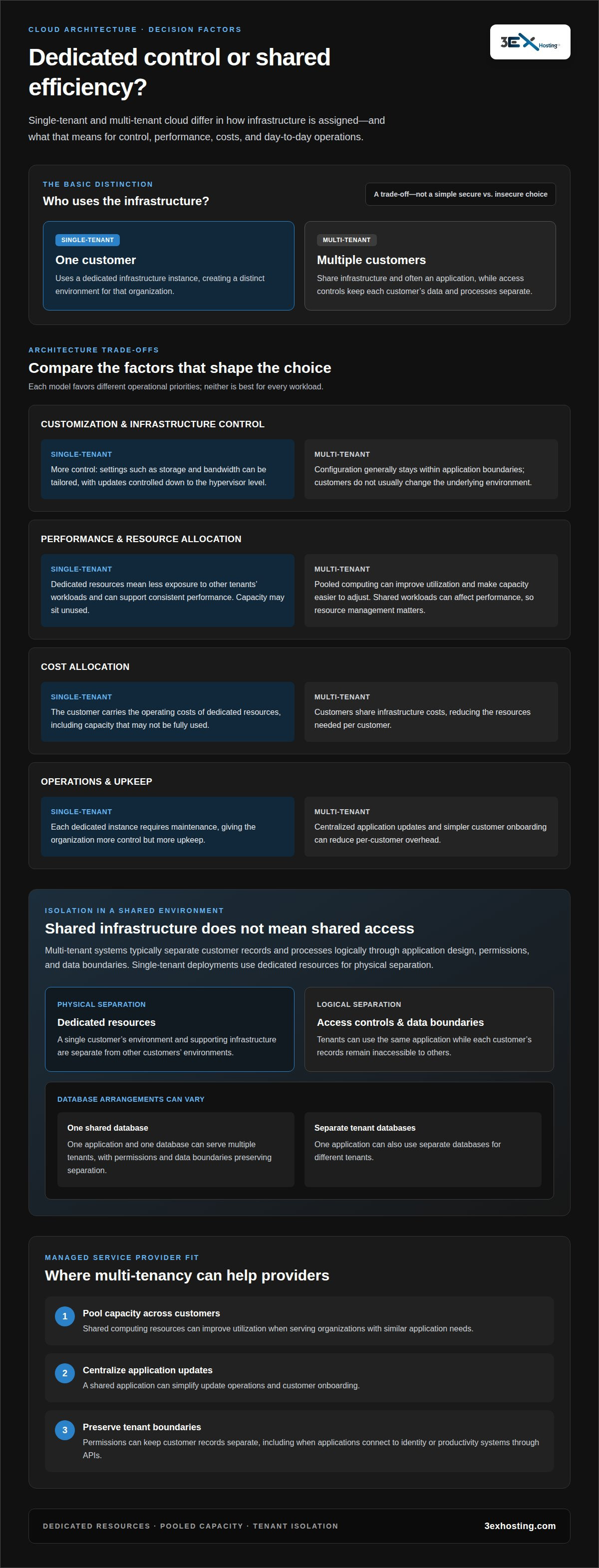
Dedicated infrastructure offers stronger physical separation, while shared cloud infrastructure can make services easier to scale and manage. The single-tenant vs multi-tenant cloud decision is a trade-off between control and shared efficiency, not a simple choice between secure and insecure. In a single-tenant environment, one customer uses dedicated infrastructure. In a multi-tenant environment, customers share infrastructure while their data and processes remain logically separated.
It’s reasonable to focus first on data isolation. The practical differences also include performance, customization, operating effort, and resource allocation. Multi-tenancy can help managed service providers centralize updates and pool capacity across customers, while single tenancy gives an organization more control over its environment.
This comparison explains how each architecture works, how multi-tenant systems separate customer data, and where the trade-offs matter. You’ll also see how managed service providers can benefit from multi-tenancy, then use a decision guide to match the architecture to your workloads, isolation needs, and operational priorities.
Key Takeaways
- Match the architecture to the level of customization and infrastructure control your workloads require.
- Understand how tenant data stays separate, and which isolation model best fits your security priorities.
- See how shared capacity and centralized operations can simplify service delivery for managed service providers.
- Use the decision guide to weigh workload needs, operational effort, and resource efficiency before choosing.
What Is Single-Tenant Cloud Architecture?
Single-tenant cloud dedicates an infrastructure instance to one customer; multi-tenant cloud shares infrastructure across customers. Choose dedicated architecture for deep customization or stronger physical separation; choose shared architecture when pooled computing and simpler operations matter. Single tenancy offers control and predictable access to resources, but requires more upkeep. Multi-tenancy can reduce per-customer overhead, but offers less infrastructure control.
Customization and Control
A dedicated instance lets an organization tailor infrastructure settings, such as storage and bandwidth, and control updates down to the hypervisor level. In a shared structure, customers generally configure the application within set boundaries rather than changing its underlying environment. For example, APIs can connect a cloud application with other systems, while tenant-specific permissions keep customer data and processes separate.
Cost, Performance, and Resource Efficiency
Dedicated resources reduce exposure to noisy-neighbor effects because another tenant’s workload doesn’t use the same infrastructure. That separation can support consistent performance, but unused capacity may sit idle, and each instance requires maintenance. Multi-tenant systems pool computing resources, which can improve utilization and make capacity easier to adjust. Shared workloads can affect performance, so architecture and resource management matter.
Cost Allocation and Customer Economics
With single tenancy, the customer carries the operating costs of dedicated resources, including capacity that may not be fully used. With multi-tenancy, customers share infrastructure costs, reducing the resources needed per customer. This model can suit providers serving many organizations with similar application needs. Dedicated environments may fit better when per-customer revenue supports specialized infrastructure and deeper customization.
Multi-tenant services can also simplify customer onboarding and centralize application updates. A shared application may use one database or separate databases for different tenants; either way, permissions and data boundaries must preserve customer privacy. For example, an organization can connect an application to identity or productivity systems through APIs without giving other tenants access to its records.
| Option | Control | Performance | Resource use |
|---|---|---|---|
| Single-tenant | More infrastructure customization | Less exposure to other tenants’ workloads | Dedicated capacity may be underused |
| Multi-tenant | Configuration within application boundaries | Shared workloads can affect performance | Pooled capacity can improve utilization |
Choose based on whether customization and dedicated performance outweigh shared-resource efficiency and simpler customer operations.
Definitions of single-tenant and multi-tenant architecture
The single-tenant vs multi-tenant cloud distinction comes down to how a service assigns application and infrastructure resources. A tenant is a customer using that service, whether its environment is dedicated or shared.
Single-Tenant Architecture
In single-tenant architecture, one customer uses a dedicated cloud environment. The application instance and supporting infrastructure serve that organization rather than multiple customers. This creates a distinct deployment for each tenant and keeps its application resources separate from other customers’ environments. Private clouds are commonly described as single-tenant, but the defining feature is dedicated tenancy, not simply where the infrastructure is located.
Multi-Tenant Architecture
A multi-tenant architecture serves multiple customers through shared infrastructure. In a common SaaS structure, one application instance supports multiple tenants, while access controls keep each tenant’s data and processes isolated. Customers use the same application without access to one another’s records. Public clouds are commonly characterized as multi-tenant, although the application and database design determine how tenant data is organized.
Database arrangements can vary within multi-tenancy. One model uses a single application with one database for multiple tenants; another uses one application with separate databases for different tenants. The application remains shared in both cases, but the database structure changes. A tenant-specific subdomain can identify an organization’s application access, while permissions separate its records from other customers’ information.
For a practical single-tenant vs multi-tenant cloud comparison, identify the application instance, database arrangement, and infrastructure boundary. Two SaaS products may both be multi-tenant yet use different database designs. Those details clarify how each tenant is isolated and what the architecture means for an organization’s workloads.
Data isolation in multi-tenant environments
Multi-tenant isolation keeps each customer’s data and processes private while infrastructure is shared. The distinction from single tenancy is whether separation is logical or physical.
Logical and Physical Data Separation
Single-tenant deployments use dedicated resources for physical separation, while multi-tenant systems usually isolate records logically within shared infrastructure. For example, one application may serve several organizations while each tenant’s data remains invisible to others. Application design and data boundaries are central: shared infrastructure does not mean customers share access to records. Dedicated tenant solutions reduce reliance on logical separation between customers.
Infrastructure Ownership and Data Isolation
In a single-tenant environment, infrastructure is dedicated to one customer; multi-tenant architecture shares resources across customers. This changes the isolation model, not necessarily who owns the underlying hardware. A customer may use a dedicated instance without owning the physical equipment. In multi-tenancy, access controls and tenant boundaries must keep each organization’s application activity and data separate as the service scales.
Data residency concerns where information is stored or processed. A tenancy model alone doesn’t specify that location, so deployment choices and infrastructure placement also matter. For an organization handling sensitive records, map where its tenant environment runs and how its data is separated. Physical separation may help with frameworks such as HIPAA, PCI-DSS, or FedRAMP, but tenancy alone does not establish compliance.
Multi-tenant data protection software needs to enforce boundaries throughout the application. That includes associating each record with the correct tenant and preventing one customer’s session from accessing another’s information. For example, a database query should return only the requesting organization’s records. This logical approach supports scalability, but a flaw in access rules can expose shared data. Review the isolation design across application, database, and administrative access paths.
Multi-tenancy benefits for managed service providers
For managed service providers, multi-tenancy turns a shared cloud architecture into a repeatable service model. One application deployment can serve multiple customers, while tenant-specific configuration supports each organization’s settings. Providers can onboard customers without building a separate server environment for every account.
Centralized operations reduce repeated work. With a single-tenant setup, updates and patches must be applied to each instance. A multi-tenant application can receive updates through one deployment, simplifying maintenance across customer environments. The provider can also centralize database tasks, backups, restores, and disaster recovery rather than managing each customer’s application separately.
Shared hardware changes how capacity is planned. A provider can pool computing resources and allocate them across tenants as demand shifts. For example, when one customer’s workload rises, available shared capacity can help absorb the increase without assigning every customer a permanently dedicated server. Scaling still depends on available resources and sound workload management.
Shared infrastructure also changes customer economics. Tenants share operational costs instead of each carrying the full cost of a dedicated environment. This can make the model practical for services with many customers and similar requirements. Managed service providers can use the same operating processes across accounts, while tenant boundaries keep each customer’s data and activity separate.
Consistency is useful, but configuration has limits. A standardized application makes onboarding and maintenance simpler, yet unusual integrations or customer-specific infrastructure needs may require a different design. Providers should distinguish settings that can vary by tenant from changes that affect the shared application. That separation helps prevent one customer’s custom request from disrupting service for others.
For MSPs, the key benefit is operational leverage: centralize routine service work, pool resources, and preserve tenant-specific access. Explore managed cloud hosting as an option for workloads that fit a managed environment.
3EX Hosting
3EX Hosting helps organizations align cloud decisions with the infrastructure their workloads need. Managed Cloud Hosting supports cloud-based requirements, while Full Cabinet Colocation, Private Colocation Suites, and Cage Solutions provide physical space for customer server hardware. These options are relevant when workload control, infrastructure location, or dedicated equipment affects the choice between shared and dedicated environments.
Bring your workload requirements and isolation priorities into the conversation. 3EX Hosting can discuss which of its cloud hosting and colocation options best fits your infrastructure needs. Contact 3EX Hosting to discuss your requirements.
Make the Next Cloud Decision With Clarity
Turn the single-tenant vs multi-tenant cloud decision into a workload plan before changing infrastructure. Identify which applications need dedicated control, which can use shared capacity, and where integrations or data boundaries shape deployment. Then map those needs to a practical operating model, including who manages configuration, maintenance, and future changes.
This approach can also reveal where different workloads need different environments. A business doesn’t have to force every application into one tenancy model. For example, while standard SaaS tools work well in shared environments, privacy-sensitive tasks like running AI agents often utilize self-hosted solutions such as NovaCortex to ensure strict data control. Match each workload to its requirements, then plan how the environments will work together as demand and operations evolve.
For infrastructure planning that includes cloud hosting or colocation, discuss your requirements with 3EX Hosting. A clear workload plan is a strong starting point for building an environment that fits your business.
Frequently Asked Questions
What is multi-tenancy?
Multi-tenancy is a service design where one software environment serves multiple customers, called tenants. For example, a business software provider can operate one platform for separate client organizations. Each organization uses its own account and settings. This model lets the provider deliver a common service while applying tenant-specific access rules and configurations.
What is an example of single-tenant software?
A software application deployed as a dedicated instance for one organization is a single-tenant example. For instance, a company might run its own instance of a business application rather than share an application environment with other customers. The key is the deployment: the instance serves one tenant. A product name alone doesn’t establish whether its deployment is single-tenant.
What is the difference between single-tenant and multi-tenant cloud architecture?
Single-tenant cloud architecture assigns a customer a dedicated environment, while multi-tenant architecture serves multiple customers through shared infrastructure. Consider a company with separate divisions: it could give each division a dedicated deployment or use one shared application with separate accounts. The right structure depends on whether separate environments or centralized service operation better supports the organization’s applications.
What are the cost differences between single-tenant and multi-tenant cloud hosting?
Single-tenant hosting assigns dedicated resources to one customer, so that customer bears the cost of its environment, including capacity it may not fully use. Multi-tenant hosting spreads infrastructure costs among customers. For a provider serving customers with similar needs, shared resources can reduce per-customer overhead. Actual spending depends on required capacity, customization, and management responsibilities.
How do single-tenant and multi-tenant clouds compare for security and data isolation?
Single-tenant clouds separate customers through dedicated environments; multi-tenant clouds rely on logical boundaries within shared infrastructure. Neither label alone proves that a deployment meets an organization’s security requirements. For example, a team handling sensitive records should assess data access, administrative permissions, and where information is stored. The application’s isolation design and operating controls matter alongside tenancy.
How do single-tenant and multi-tenant deployments compare for performance and scalability?
Single-tenant deployments give one customer dedicated resources, which can reduce performance effects from other workloads. Multi-tenant deployments pool capacity, helping providers allocate resources as demand changes. A workload with sharply varying usage may benefit from pooled capacity; an application needing predictable resource access may favor dedicated deployment. Scalability depends on how the system can add resources and manage competing demand.