 SUPPORT


 3EX United States
 Blog
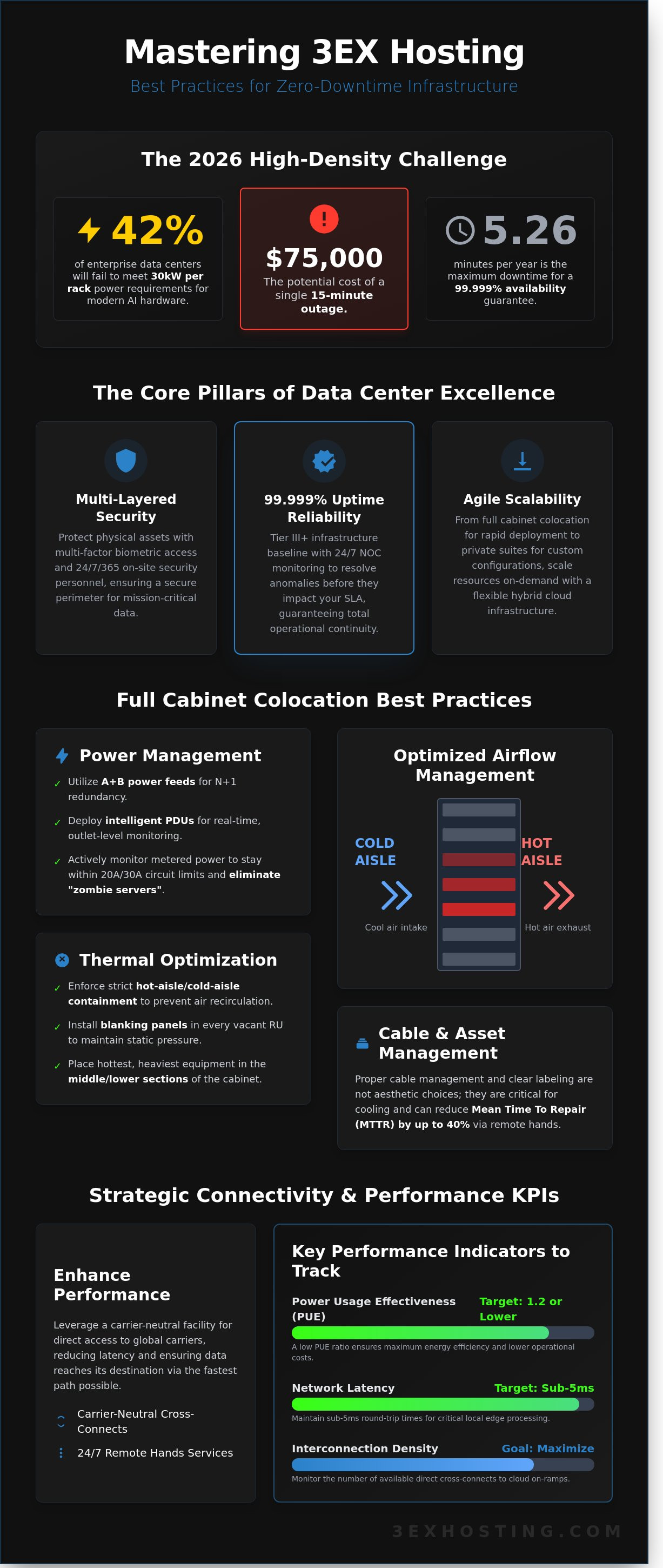
By 2026, 42% of enterprise data centers will fail to meet the 30kW per rack power density requirements demanded by modern AI hardware. It’s a reality that makes infrastructure management more complex than ever before. Mastering the best practices for 3EX Hosting ensures your systems remain super-fast and stable even as hardware demands intensify. You’ve likely felt the anxiety of a migration window closing or the uncertainty of managing high-density racks from 500 miles away without a single technician on-site.
We agree that the fear of a 15-minute outage costing your firm $75,000 is a valid concern for any IT leader. This article promises to provide the technical and operational strategies you need to achieve a zero-downtime environment within the 3EX Hosting ecosystem. You’ll gain a clear roadmap for integrating colocation with managed cloud services while optimizing cooling for 2026 standards. We’re breaking down the exact steps to maintain a secure, high-performance infrastructure that runs with total reliability.
Key Takeaways
- Optimize your physical footprint by mastering high-density power calculations and advanced hot-aisle/cold-aisle containment strategies.
- Reduce latency and enhance connectivity through the strategic use of carrier-neutral cross-connects and remote hands services.
- Implement mission-critical best practices for 3EX Hosting to establish a multi-layered security perimeter and a resilient disaster recovery roadmap.
- Leverage the agility of hybrid cloud hosting to scale resources on-demand while maintaining full physical control over your core infrastructure.
- Future-proof your enterprise operations with professional strategies designed to maximize uptime and deliver superfast performance across the 3EX ecosystem.
Optimizing Your Enterprise Footprint with 3EX Hosting Infrastructure
The 3EX Hosting ecosystem represents a sophisticated convergence of high-density colocation and managed cloud services designed for the 2026 digital economy. Enterprise workloads now demand more than just floor space; they require environments capable of supporting 40kW per rack for AI and machine learning applications. Implementing the right best practices for 3EX Hosting starts with understanding that your physical footprint is the primary driver of your digital performance.
Infrastructure best practices aren’t just technical checklists. They’re the foundation of business continuity. In a landscape where a single hour of downtime can cost a Tier 1 enterprise upwards of $540,000, the choice of a carrier-neutral colocation centre becomes a strategic necessity. These facilities provide direct access to multiple global carriers, ensuring that your data reaches its destination via the shortest, fastest path possible.
To maintain a competitive edge, you must establish clear, measurable KPIs for your environment. We recommend tracking the following metrics:
- Power Usage Effectiveness (PUE): Aim for a ratio of 1.2 or lower to ensure energy efficiency.
- Network Latency: Maintain sub-5ms round-trip times for local edge processing.
- Interconnection Density: Monitor the number of direct cross-connects available to cloud on-ramps.
The Core Pillars of Data Center Excellence
Security and reliability define the 3EX experience. We utilize multi-factor biometric access control and 24/7/365 on-site security personnel to protect your physical assets. Uptime isn’t a goal; it’s a baseline. Our Tier III+ infrastructure ensures 99.999% availability, which translates to less than 5.26 minutes of downtime per year. Our NOC teams provide 24/7 technical monitoring to resolve hardware anomalies before they impact your SLA.
Aligning Business Goals with Infrastructure Choice
Scalability requires choosing the right deployment model from day one. For mid-sized enterprises or specific project nodes, 3EX Hosting Cabinet Colocation offers a superfast path to deployment with standardized power and cooling. If your 2026 roadmap includes managing over 500TB of localized data or proprietary hardware configurations, private suites provide the necessary isolation and custom cooling paths. Adopting these best practices for 3EX Hosting allows your team to focus on software innovation while we handle the heavy lifting of power, cooling, and connectivity.
Hardware Deployment Best Practices for Full Cabinet Colocation
Deploying hardware in a 42U cabinet requires more than just sliding rails into place. It’s a precise engineering task where every millimeter of space and every watt of power counts. Following best practices for 3EX Hosting ensures that your enterprise infrastructure remains stable under heavy 2026 workloads. AI-driven nodes can easily push a single rack beyond 15kW. Calculating power density is the first step to prevent circuit overloads that cause cascading failures.
Effective airflow management relies on strict hot-aisle/cold-aisle containment. If you leave open gaps, hot air recirculates, creating thermal pockets that shorten hardware lifespans. Proper cable management isn’t just about aesthetics; it’s a cooling necessity. Bundling cables neatly at the sides of the rack prevents them from blocking the exhaust fans of high-density servers. Every piece of hardware needs clear, durable labeling. This allows remote hands to identify and troubleshoot components in seconds, reducing mean time to repair (MTTR) by up to 40%.
Power Management and Redundancy
Stability starts with electrical architecture. Always utilize A+B power feeds to achieve N+1 redundancy. This setup ensures that if one PDU or circuit fails, your equipment stays online. Select intelligent PDUs that offer outlet-level monitoring. These units provide real-time data on consumption, helping you identify “zombie servers” that consume power without performing useful work. Monitoring metered power helps you optimize operational costs and stay within your 20A or 30A circuit limits without guessing.
Thermal Optimization and Rack Layout
Strategic placement of high-heat servers is vital for long-term reliability. Place your heaviest, hottest equipment in the middle or lower sections of the cabinet to maintain a stable center of gravity and better airflow. Use blanking panels in every vacant RU to maintain static pressure within the rack. Thermoregulation in high-density environments refers to the active and passive control of heat dissipation to maintain hardware within specific ASHRAE A1 to A4 thermal envelopes. When you manage your hybrid cloud, the physical hardware layer must remain as agile and cool as the virtual one.
Physical Security at the Rack Level
Enterprise data requires layers of protection that go beyond the data center lobby. Implementing biometric or RFID locks on your private 42U cabinets prevents unauthorized physical access. For businesses with strict compliance needs like SOC2 or HIPAA, investing in Cage Colocation Solutions provides an extra layer of perimeter defense. These physical barriers are essential for sensitive enterprise data that can’t coexist in shared rack environments. You should evaluate our cabinet colocation options to find the right fit for your density and security requirements.
Strategic Connectivity: Maximizing Cross-Connects and Remote Hands
Connectivity defines the performance ceiling for any enterprise infrastructure. Implementing Best practices for 3EX Hosting requires a shift from simple internet access to a sophisticated mesh of physical and virtual interconnections. High-performance cross-connects eliminate the unpredictability of the public internet by creating direct, physical links between your hardware and service providers. This reduces latency to sub-1ms levels, which is critical for high-frequency trading or real-time data processing. Carrier-neutral environments provide the flexibility to switch providers without moving hardware, ensuring you aren’t locked into a single vendor’s pricing or performance limitations.
Optimizing Network Architecture
Choosing between direct peering and blended IP transit depends on your specific traffic patterns. Blended IP transit offers superior reliability by automatically rerouting traffic across multiple Tier-1 carriers if one path fails. For mission-critical applications, redundant uplink configurations using diverse entry points into the facility prevent single points of failure. You should utilize Cross-Connect Services to establish direct links to cloud on-ramps and ISP backbones. This architecture supports 100Gbps throughput requirements that modern AI and big data workloads demand in 2026.
Effective Use of Remote Hands Support
Physical distance shouldn’t compromise your operational speed. Remote hands services act as your on-site eyes and ears, handling everything from basic power cycles to complex cable management. Provide technicians with precise, step-by-step documentation for physical hardware resets to minimize human error. Effective inventory management includes maintaining a detailed log of spares and utilizing the data center’s shipping and receiving protocols for rapid hardware replacement. As businesses look toward enterprise IT cost optimization, leveraging local experts reduces the need for expensive travel and on-site staff. 3EX Hosting ensures a 15-minute initial response time for emergency 24/7 remote hands requests to maintain continuous uptime.
Standardizing your patching protocols is another pillar of Best practices for 3EX Hosting. Use color-coded cabling and labeled ports to speed up troubleshooting during high-pressure events. Documentation must be updated in real-time within your DCIM (Data Center Infrastructure Management) tool. This discipline allows your team to deploy new capacity 40% faster than non-standardized environments. A superfast network is useless if the physical layer is a disorganized mess. Professional cable dressing and clear labeling ensure that routine maintenance doesn’t accidentally trigger a localized outage. By focusing on these technical details, you create a stable environment that supports long-term growth and technical excellence.
Security and Disaster Recovery: Protecting Mission-Critical Data
Enterprise data protection requires more than a simple firewall. Best practices for 3EX Hosting involve a multi-layered defense strategy that treats physical security and digital encryption as equal priorities. In 2026, 84% of enterprise data breaches involve a human element or physical access flaw; we eliminate these risks through strict biometric access and 24/7 onsite monitoring. A secure environment starts at the rack level and extends through every packet of data moving across the network.
Security isn’t a static setup. It’s a continuous process of auditing and refinement. We maintain rigorous standards by reviewing physical access logs every 24 hours and conducting quarterly security audits. This ensures that only authorized personnel interact with your hardware. For businesses running mission-critical applications, these protocols provide the stability needed to scale without fear of intrusion. Reliability comes from knowing every entry point is locked and logged.
Automation plays a vital role in modern data preservation. Manual backups are prone to failure, so we implement automated off-site backups within the 3EX network. This system ensures that data is replicated in real-time across high-speed NVMe storage arrays. If a localized hardware failure occurs, your data remains intact and accessible. By removing the risk of human error, we guarantee that your information is always ready for recovery.
Disaster Recovery Best Practices
A robust DR roadmap focuses on two metrics: Recovery Time Objective (RTO) and Recovery Point Objective (RPO). We target an RTO of less than 15 minutes for critical systems to ensure business continuity. Utilizing geographic redundancy is essential; we leverage secondary suites for immediate failover if the primary site experiences an outage. For organizations that need comprehensive oversight, our Managed IT Support Services provide the expertise to design and test these failover protocols regularly.
Cybersecurity at the Edge
Edge security stops threats before they reach your core infrastructure. We deploy hardware firewall configurations specifically tuned for colocation clients to filter malicious traffic at the carrier level. Our intrusion detection systems (IDS) monitor for patterns indicative of zero-day exploits. To combat the rising scale of network attacks, we utilize 400Gbps DDoS mitigation capacity. This ensures that even massive volumetric attacks don’t impact your server performance or availability.
Ready to secure your enterprise infrastructure with industry-leading protection? Explore our private data center suites to find the perfect fit for your security needs.
Future-Proofing with Managed Cloud and Hybrid Infrastructure
Hybrid infrastructure is the definitive standard for enterprise resilience as we move through 2026. You don’t need to sacrifice physical control for cloud agility. A hybrid model allows your team to maintain core, high-security databases on dedicated hardware while using the cloud for burstable workloads. This approach typically results in a 15% reduction in total cost of ownership compared to pure cloud setups. One of the best practices for 3EX Hosting is utilizing this dual-layer strategy to optimize your budget. You can keep your predictable costs as CapEx through colocation and handle seasonal spikes as OpEx via managed cloud services.
Staying ahead of technology refreshes is vital. Hardware lifecycles in 2026 are shorter, with significant performance gains appearing every 18 to 24 months. 3EX support helps you manage these cycles without disrupting your operations. We provide the technical roadmap to swap out aging NVMe drives or upgrade processors before they become bottlenecks. This ensures your stack remains modern, fast, and secure against evolving digital threats. Our team handles the heavy lifting of migration, so your internal IT staff can focus on high-level strategy rather than swapping cables.
Managed Cloud Integration
Successful integration depends on bridging physical servers with virtualized environments. This creates a unified ecosystem where data flows without friction. Data sovereignty is a major concern now, with 74% of enterprises requiring strict control over where their information resides. By using 3EX, you maintain physical ownership of your data while leveraging the speed of virtualized nodes. You can review the available cloud options on our site to find the right fit for your compliance needs. We focus on low-latency connections that make your hybrid setup feel like a single, cohesive unit.
Continuous Improvement and Monitoring
We use advanced analytics to predict hardware failure before it impacts your business. Our monitoring systems track thermal patterns and voltage fluctuations, allowing us to replace components during scheduled maintenance windows. This level of foresight is what maintains our high availability standards. As your business grows, your needs will change. Moving from standard cabinets to private suites is a logical step when your power requirements exceed 10kW per rack. This transition offers better airflow management and enhanced physical privacy. To start planning your next phase of growth, get an instant quote for 3EX services and see how our infrastructure scales with you.
Future-Proof Your Infrastructure Strategy for 2026
The enterprise IT landscape in 2026 demands a shift from reactive maintenance to proactive optimization. Implementing the Best practices for 3EX Hosting ensures your business utilizes a 100% carrier-neutral environment. This configuration eliminates single points of failure and provides the path to achieving 99.999% uptime across your entire server footprint. High-density cabinet deployments now integrate directly with hybrid cloud layers to support sub-10ms latency for global applications. You’ll find that technical stability is the only way to maintain a competitive edge in a data-driven market.
You don’t need to manage complex hardware lifecycles on your own. Our 24/7/365 Remote Hands Support functions as your on-site engineering team, while Carrier-Neutral Connectivity gives you the flexibility to scale bandwidth instantly. By leveraging Enterprise-Grade Security Protocols, your mission-critical data remains protected against evolving physical and digital threats. A stable, superfast infrastructure isn’t just a luxury; it’s the backbone of your digital success. We’re here to provide the professional foundation your systems require.
Secure Your Infrastructure with 3EX Hosting Colocation
Let’s build a faster and more reliable foundation for your enterprise operations today.
Frequently Asked Questions
What are the power density limits for a full cabinet at 3EX Hosting?
Full cabinets at 3EX Hosting support a standard power density of 15 kW per rack. We also provide specialized high-density zones that accommodate up to 30 kW for high-performance computing clusters. These limits ensure stable power delivery and thermal management for your enterprise hardware. You’ll track your specific usage through our client portal, which provides real-time monitoring with 99.99% accuracy.
How does remote hands support work for international clients?
Our remote hands service provides 24/7 technical support with a guaranteed 30-minute response time for critical incidents. International clients rely on our certified technicians for hardware swaps, cabling, and visual inspections without traveling. We use a secure ticketing system where you track every action in real-time. This is one of the best practices for 3EX Hosting to maintain global infrastructure efficiency.
Can I integrate my existing hardware with 3EX managed cloud services?
You can integrate your physical hardware with 3EX managed cloud services using 10 Gbps low-latency fiber links. Our hybrid architecture allows seamless data flow between your colocated servers and our scalable cloud environment. We configure these private VLANs within 24 hours of your initial request. This setup gives you the control of dedicated hardware and the flexibility of the cloud.
What cooling technologies does 3EX Hosting use to protect high-density racks?
We protect high-density racks using a combination of hot/cold aisle containment and Rear Door Heat Exchangers. These systems maintain an ambient temperature of 22 degrees Celsius with a 1.2 Power Usage Effectiveness ratio. Sensors placed every 3 feet monitor airflow and humidity to prevent hotspots. This cooling precision ensures your superfast NVMe storage and processors operate at peak performance levels.
Is N+1 redundancy standard across all 3EX colocation tiers?
N+1 redundancy is the minimum standard across all colocation tiers at 3EX Hosting. Our power and cooling systems include at least one independent backup component for every active unit. For mission-critical operations, we offer 2N redundancy configurations that provide 100% power uptime guarantees. We test our backup generators and UPS systems every 30 days to ensure total reliability for your business.
How do I request a cross-connect between my cabinet and a specific carrier?
You request a cross-connect by submitting a Letter of Authorization through our centralized client portal. Our team completes standard fiber or copper cross-connects within 4 business hours of the request. We support connections to over 50 global carriers and cloud on-ramps. Following best practices for 3EX Hosting involves documenting your port assignments early to speed up this connectivity process for your team.
What physical security measures protect my hardware at 3EX Hosting?
Five distinct layers of security protect your hardware, starting with perimeter fencing and 24/7 on-site armed guards. Access to the data hall requires dual-factor authentication, including biometric palm vein scans and encrypted keycards. We maintain 360-degree 4K surveillance coverage with 90-day video retention. Every cabinet features individual digital locks that log every entry attempt to keep your data safe.
How does 3EX Hosting handle disaster recovery for colocation clients?
We handle disaster recovery by providing secondary site replication in geographically diverse zones located 500 miles apart. Clients can utilize our automated failover services to achieve a 1-hour Recovery Time Objective. We provide dedicated workspace recovery areas for your staff in the event of a primary office outage. Our 100 Gbps backbone ensures your data synchronizes instantly between sites without any lag.