 SUPPORT


 3EX United States
 Blog
What if your enterprise network didn’t just survive a major backbone ISP outage, but ignored it entirely? Achieving 100% uptime requires moving beyond basic failover scripts toward a sophisticated implementation of BGP routing for network redundancy. In 2026, simply having two internet lines is no longer enough. You need a strategy that integrates logical peering, physical path diversity, and provider-independent infrastructure to ensure your services remain reachable regardless of local carrier issues.
It’s understandable to feel frustrated by the rising costs of ARIN ASNs or the perceived complexity of managing multiple BGP neighbors. You want a fail-safe architecture that operates without manual intervention, yet the technical hurdles of IP space portability often stall enterprise progress. This guide will show you how to master BGP to eliminate single points of failure and secure your network’s independence. We’ll break down the 2026 registry fee structures, the transition to the latest BGP-4 standards, and the exact steps to build a truly redundant multi-homed environment. From securing your own ASN to optimizing cross-connects in a Miami data center, you’ll gain the blueprint for a network that never sleeps.
Key Takeaways
- Eliminate manual failover delays by replacing static routes with dynamic BGP routing for network redundancy to ensure continuous connectivity.
- Establish true provider independence by securing your own Autonomous System Number (ASN) and Provider Independent (PI) IP address space.
- Remove hardware bottlenecks by implementing a dual-router multihoming architecture instead of relying on a single router entry point.
- Audit physical path diversity to confirm that redundant carrier connections do not share common fiber conduits or building entry points.
- Leverage managed colocation and remote hands support to streamline the deployment and 24/7 maintenance of complex BGP environments.
The Role of BGP Routing in Enterprise Network Redundancy
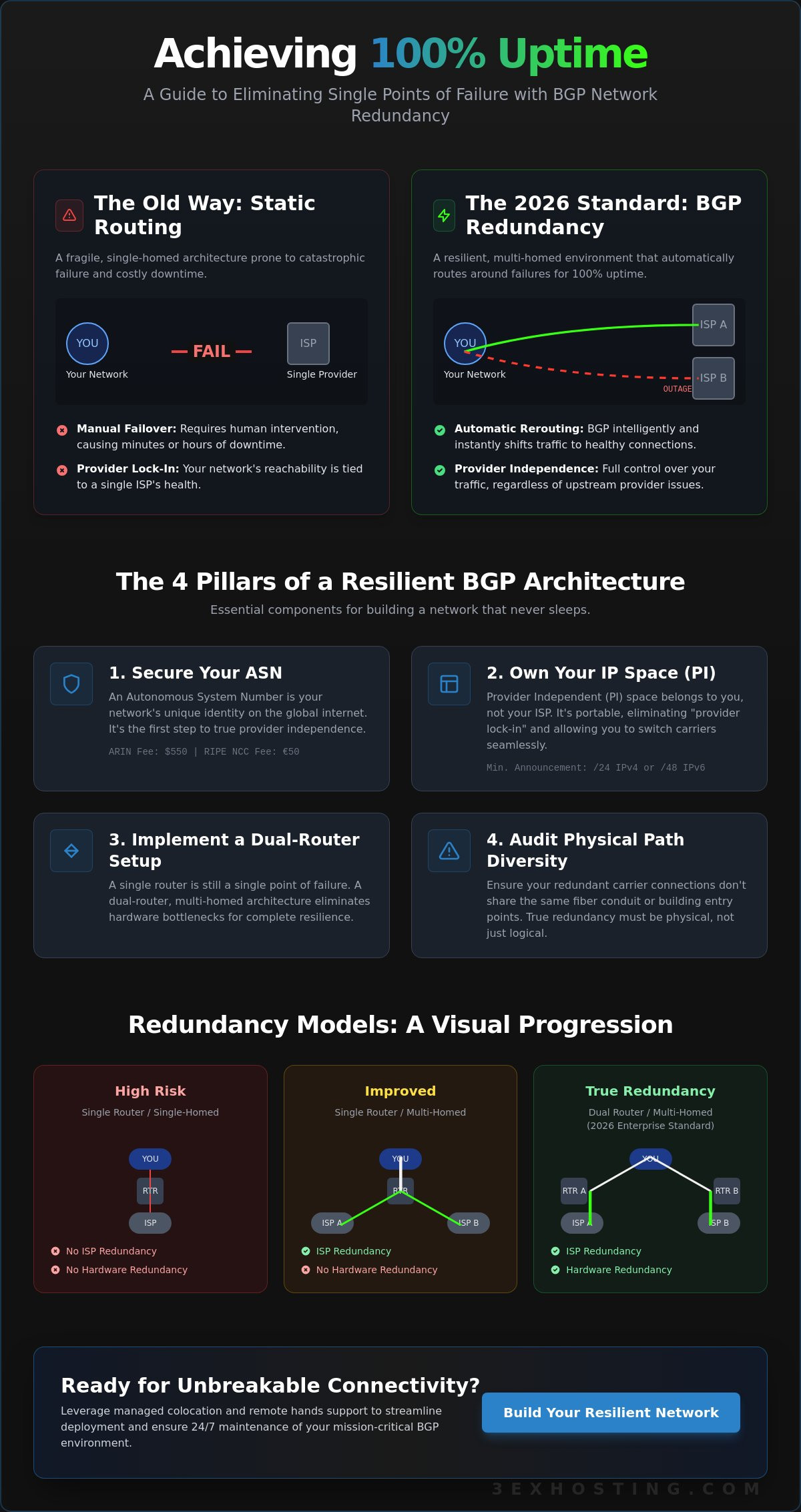
Border Gateway Protocol (BGP) is the foundational mechanism that governs how data travels across the internet’s vast web of interconnected networks. In high-availability networking, BGP serves as the decision-making engine that determines the most efficient and stable path for your traffic. Unlike internal protocols that manage data within a single office, BGP communicates between different Autonomous Systems (AS), making it indispensable for any organization that cannot afford a single second of disconnection. Implementing BGP routing for network redundancy ensures that your network remains reachable even when an upstream provider experiences a catastrophic failure.
Static routing is a relic that lacks the intelligence required for modern enterprise loads. If a primary link fails in a static setup, traffic simply stops. Manual intervention is then required to point traffic toward a backup, a process that often takes minutes or even hours. BGP eliminates this human bottleneck. It continuously monitors the health of your connections and automatically reroutes traffic the moment a primary ISP link shows signs of instability or total failure. This shift from a fragile, single-homed architecture to a resilient, multihomed environment is the only way to achieve 100% network uptime in 2026.
Understanding Multihoming: Beyond Single ISP Links
Relying on a single ISP is a gamble that eventually leads to downtime. Many businesses attempt to solve this by purchasing a secondary ‘backup’ link, but without BGP coordination, these links often sit idle and may fail to initialize correctly during an emergency. True multihoming requires at least two distinct upstream providers connected via BGP. This setup allows for active-active traffic engineering, where both links are utilized simultaneously to balance the load. It also enables active-passive configurations where the failover to the secondary provider happens instantly and invisibly to the end user. By 2026, enterprise standards demand at least two diverse carrier handoffs to mitigate the risk of provider-specific outages.
The Business Case for BGP-Driven Redundancy
The financial argument for BGP is straightforward. When you calculate the cost of a single hour of downtime, including lost revenue, diminished employee productivity, and brand damage, the investment in BGP infrastructure is easily justified. For many enterprises, a single hour of total network failure can cost hundreds of thousands of dollars. BGP routing for network redundancy provides a technical insurance policy against these losses. Beyond simple uptime, BGP improves global reachability by selecting paths with the lowest latency, ensuring your applications perform at peak speed. This level of control is essential for meeting strict Service Level Agreements (SLAs) and supporting mission-critical workloads in a cabinet colocation environment.
Core Components of a Redundant BGP Architecture
Building a resilient infrastructure requires more than just software configuration. It starts with establishing a unique identity on the global internet. The Autonomous System Number (ASN) acts as this identifier. Without an ASN, your network remains a subset of your ISP’s infrastructure, making true independence impossible. In 2026, the American Registry for Internet Numbers (ARIN) maintains a $550 issuance fee for these numbers, while RIPE NCC charges €50 for assignments. These resources are the bedrock of BGP routing for network redundancy, allowing your network to speak directly to the world’s backbone providers.
A critical distinction in architecture is the choice between Provider Independent (PI) and Provider Aggregatable (PA) IP space. PA space is leased from an ISP and must be returned if you switch providers. This creates “provider lock-in,” which is the antithesis of redundancy. For enterprise-grade reliability, PI space is non-negotiable for anyone implementing BGP routing for network redundancy. It belongs to your organization, allowing you to announce your prefixes through any carrier. To be globally routable via BGP, you must generally announce at least a /24 IPv4 prefix or a /48 IPv6 prefix. This ensures your routes are accepted into the global BGP routing table, which is the master list of all reachable paths on the internet.
Securing Your Own ASN and IP Prefixes
Regional Internet Registries (RIRs) like ARIN, RIPE, and APNIC manage these vital resources. While costs for IP resources are increasing, with ARIN implementing a 5% fee increase in 2026, the control they provide is invaluable. Owning your prefixes means your public-facing services don’t change even if you swap ISPs during a crisis. This portability is why many firms choose a carrier-neutral data center to host their edge equipment, providing the physical access needed to connect with multiple upstream partners.
BGP Neighbor Relationships and Peering Sessions
Once resources are secured, you establish peering sessions. External BGP (eBGP) connects your edge routers to your ISPs. Internal BGP (iBGP) then ensures all your internal routers stay synchronized with the latest external path data. Security is paramount here. Use MD5 authentication to verify the identity of your BGP neighbors and implement Time-to-Live (TTL) security to prevent remote spoofing attacks. These layers of protection ensure your peering sessions remain stable, which directly influences how quickly your network can detect a failure and execute a failover.
Redundancy Models: Single-Router vs. Multi-Router BGP
Logical BGP sessions are useless if the physical hardware supporting them fails. When implementing BGP routing for network redundancy, enterprises must choose between single-router and multi-router architectures. Single-router multihoming involves connecting one edge router to two or more ISPs. While this protects against carrier outages, the router itself remains a single point of failure. If the power supply fails or the motherboard fries, your network goes dark regardless of how many upstream providers you have. It’s a cost-effective entry point, but it’s rarely sufficient for mission-critical operations.
Multi-router multihoming is the standard for enterprise-grade reliability. By deploying two independent edge routers, each connected to a different ISP, you eliminate hardware bottlenecks. These routers use Internal BGP (iBGP) to synchronize their routing tables, ensuring they both have a consistent view of the global internet. To manage internal traffic, protocols like Virtual Router Redundancy Protocol (VRRP) or Hot Standby Router Protocol (HSRP) provide a virtual gateway for your internal network. If one router fails, the other assumes the virtual IP address instantly, maintaining connectivity without manual reconfiguration or lost sessions.
Designing for Hardware Failover
Designing for hardware failover requires more than just buying a second device. You need physical path diversity. This means ensuring your ISP handoffs enter the building through different conduits and connect to your routers using redundant cabling. Within your private data center suite, use A+B power feeds to ensure that a single PDU failure doesn’t take down both edge routers simultaneously. iBGP synchronization is the glue in this setup, allowing the standby router to assume the BGP routing for network redundancy duties the moment the primary device stops responding.
Inbound vs. Outbound Traffic Control
Traffic engineering allows you to control how data enters and leaves your network. For outbound traffic, use Local Preference. This attribute tells your routers which ISP is the preferred exit point. A higher value wins, allowing you to prioritize a faster or more cost-effective link for your users. Inbound traffic is harder to control because it depends on how other networks see you. You can influence this using AS-PATH prepending. By artificially lengthening the path on one link, you make it look less attractive to the rest of the internet. This helps mitigate asymmetric routing, where traffic leaves through ISP A but returns through ISP B, which can cause performance issues or stateful firewall drops.
Critical Implementation Steps for Seamless Failover
Logical configuration is only half the battle. To truly master BGP routing for network redundancy, you must address the physical and administrative layers with precision. A failure in any of these steps can lead to “fate sharing,” where a single incident takes down every supposedly redundant path you’ve built. Implementation requires a methodical approach that starts at the street level and ends with secure, filtered peering sessions.
Success depends on five key pillars: auditing physical diversity, securing independent resources, filtering prefixes, establishing diverse sessions, and rigorous testing. Skipping the audit phase is the most common mistake. Many organizations assume that two different ISPs automatically provide two different paths. In reality, these carriers often lease the same underground conduit or enter the building through the same “meet-me room” bottleneck. You must verify that your infrastructure has no common points of failure before you touch a single line of code.
Physical Path Diversity and Carrier Neutrality
True redundancy requires a carrier-neutral environment. In these facilities, you can use cross-connect services to link directly to multiple backbone providers without relying on a single local loop carrier. Verify that your facility offers diverse fiber entries and separate vertical risers. This ensures that a physical event, such as a fire in a riser or a cable cut outside the building, doesn’t sever all your connections simultaneously. Selecting ISPs that operate on entirely different backbone infrastructures further mitigates the risk of a provider-wide outage affecting your reachability.
Route Filtering and Security Best Practices
Security is the most overlooked aspect of BGP implementation. Without strict prefix filters, your network could accidentally become a “transit AS,” attempting to route third-party internet traffic through your internal edge routers. This often leads to immediate CPU exhaustion and network collapse. Ensure your BGP routing for network redundancy strategy includes Resource Public Key Infrastructure (RPKI) to prevent route hijacking. By signing your prefixes, you ensure that other networks only accept legitimate route advertisements from your ASN. Additionally, set strict prefix limits on your peering sessions. This protects your router’s memory by dropping sessions if a provider accidentally sends you the full global routing table when you only requested partial routes.
Before moving to production, schedule maintenance windows for rigorous failover testing. Pull the plug on your primary link and observe how quickly BGP converges. If the transition isn’t seamless, audit your timers and path attributes. Ready to secure your edge? Get a quote for our carrier-neutral colocation solutions and start building a network that doesn’t fail.
Optimizing BGP Redundancy in a Managed Infrastructure Environment
Deploying a robust BGP strategy requires a physical environment capable of supporting high-density hardware and diverse connectivity. Managed infrastructure providers offer the specialized power and cooling necessary to run the redundant edge routers discussed in previous sections. By utilizing full cabinet colocation, your organization gains the dedicated space needed to scale your network stack as traffic demands grow. This physical foundation is what makes BGP routing for network redundancy effective in the long term, moving your critical logic away from unconditioned office closets and into hardened, professional facilities.
The Carrier-Neutral Advantage
A carrier-neutral facility is the ultimate environment for BGP optimization. Instead of being locked into a single provider’s ecosystem, you gain direct access to dozens of Tier 1 carriers and regional ISPs under one roof. This proximity allows you to establish peering sessions at a major network exchange, significantly reducing latency for your global users. Standardized cross-connects within a carrier-neutral data center simplify the multihoming process. They provide a consistent way to manage your upstream links without the complexity of traditional local loop installations. It turns the difficult task of managing multiple BGP neighbors into a streamlined operational routine.
Future-Proofing with High-Density Solutions
As we move through 2026, network requirements are shifting toward AI and GPU-intensive workloads. These technologies demand massive data throughput and extremely low latency, placing immense pressure on your BGP edge. High-density colocation solutions ensure your power and cooling infrastructure can keep pace with these advanced hardware requirements. You don’t want your redundancy strategy to fail because of a thermal shutdown during a peak load. Consulting with infrastructure experts helps you design a roadmap that accounts for both logical BGP routing for network redundancy and the physical realities of next-generation computing.
Integrating these strategies with professional managed IT infrastructure provides total peace of mind. While the BGP protocol handles the logical failover, remote hands support serves as your eyes and ears on the ground. They provide 24/7 physical layer troubleshooting, from swapping out a failed transceiver to verifying fiber light levels. This combination of automated routing logic and expert on-site support ensures that your network remains resilient against both software glitches and physical hardware failures. It’s the most reliable way to maintain 100% uptime in an increasingly connected world.
Securing Your Network’s Resilience for 2026 and Beyond
Achieving total network uptime requires a shift from passive backup links to an active, provider-independent strategy. By mastering BGP routing for network redundancy, your enterprise eliminates the risks of carrier lock-in and hardware bottlenecks. Success hinges on a multi-router architecture, owning your ASN, and ensuring physical path diversity within a carrier-neutral environment. These elements combined transform your network from a vulnerable system into a self-healing infrastructure that ignores ISP failures.
3EX Hosting provides the technical foundation needed to execute this high-level strategy. Our Miami facility offers the carrier-neutral connectivity and enterprise-grade N+1 infrastructure required for mission-critical deployments. With 24/7 Remote Hands Support, you have expert technicians available to manage the physical layer while your BGP logic handles the traffic. Don’t wait for the next major outage to test your limits. Design your redundant network architecture with a 3EX Hosting expert today and ensure your operations remain uninterrupted.
Frequently Asked Questions
What is the difference between BGP multihoming and simple failover?
BGP multihoming offers dynamic path selection across multiple active providers simultaneously. Simple failover typically relies on a basic check on a primary link, which often leaves a secondary line idle and untested until a crisis occurs. BGP routing for network redundancy allows your network to use both links for traffic engineering, ensuring that if one carrier experiences latency, traffic shifts to the healthier path automatically.
Do I really need my own ASN for network redundancy?
An ASN is essential for true provider independence. Without your own ASN and Provider-Independent (PI) IP space, you’re forced to use IP addresses owned by your ISP. If that ISP fails, those addresses can’t be announced through a secondary provider. Securing an ASN from registries like ARIN, which has a $550 issuance fee in 2026, ensures your network identity remains portable across any carrier you choose.
How many ISPs should I peer with for optimal BGP redundancy?
Peering with two ISPs is the minimum requirement for a redundant setup. However, three providers are often considered the ideal configuration for enterprise reliability. This protects your connectivity if one ISP fails while another is undergoing scheduled maintenance. Using three carriers also gives your BGP logic more options to find the lowest latency path for your specific data types.
What is a ‘BGP Transit’ risk and how do I avoid it?
BGP Transit risk occurs when your network accidentally acts as a bridge between two ISPs. If you don’t configure proper prefix filters, your routers might try to carry third-party internet traffic from ISP A to ISP B. This can saturate your bandwidth and crash your routers within seconds. You avoid this by applying strict outbound route maps that only permit the advertisement of your own registered IP prefixes.
Can BGP help with DDoS mitigation and network stability?
BGP is a powerful tool for maintaining network stability during DDoS attacks. By using BGP Flowspec or Remote Triggered Black Hole (RTBH) routing, you can signal your upstream providers to drop malicious traffic before it reaches your edge. This keeps your local bandwidth clear for legitimate users. It’s a proactive component of BGP routing for network redundancy that ensures your services remain reachable even under pressure.
How long does a BGP failover typically take to propagate?
Standard BGP convergence typically takes between 30 and 90 seconds. This is the time required for routers to detect a link failure and update the global routing table. You can reduce this to sub-second levels by implementing Bidirectional Forwarding Detection (BFD). BFD works with BGP to provide near-instant failure detection, allowing your routers to switch paths before users notice a disruption.
What hardware is required to run a full BGP routing table in 2026?
Handling the full global BGP table in 2026 requires routers with substantial RAM, typically 16GB or more for enterprise-grade performance. The IPv4 and IPv6 tables continue to grow as more networks come online globally. If your hardware has limited resources, you can request “default routes” from your ISPs instead. This significantly reduces the memory load while still allowing BGP to manage your outbound failover effectively.
Is BGP redundancy necessary for cloud-only businesses?
Redundancy is critical if you use dedicated on-ramps like AWS Direct Connect or Azure ExpressRoute. These connections are physical circuits that can fail just like any other internet line. Running BGP over these private links ensures that your hybrid cloud traffic automatically reroutes to a secondary circuit or a VPN backup if the primary path is severed. It’s the only way to guarantee consistent cloud access.