 SUPPORT


 3EX United States
 Blog
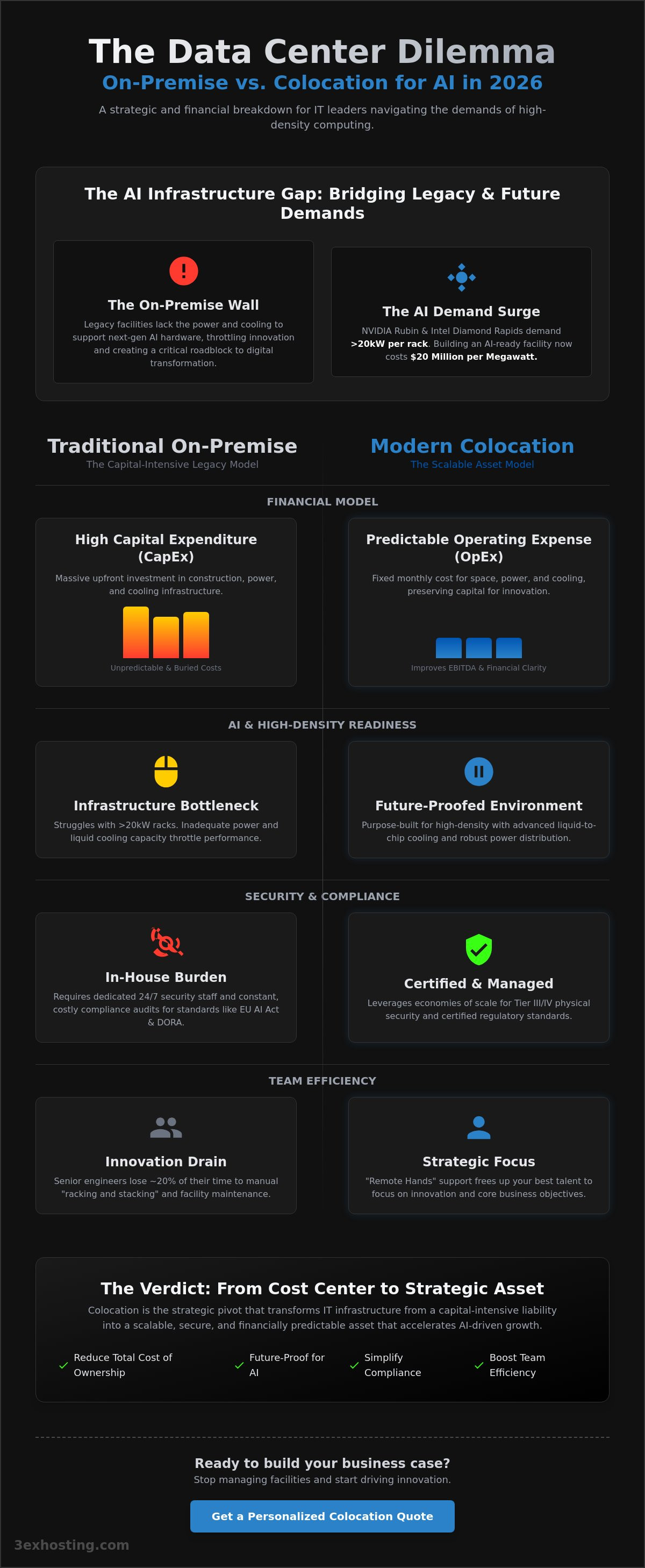
Building an AI-ready data center in 2026 costs $20 million per megawatt, which is nearly double the cost of standard enterprise builds. This massive capital barrier makes building a business case for data center colocation the most critical task for IT leaders today. If your on-premise racks can’t handle the liquid cooling requirements of NVIDIA’s Rubin architecture or Intel’s Diamond Rapids chips, your digital transformation is already hitting a wall.
You probably agree that managing unpredictable public cloud egress fees while trying to reduce CapEx feels like a zero-sum game. It doesn’t have to be. This guide provides the strategic and financial frameworks you need to win over your CFO and board. We’ll provide a clear TCO comparison, a roadmap for high-density scalability, and a risk mitigation strategy that satisfies even the most cautious compliance officers. Here is how you bridge the gap between legacy constraints and superfast, AI-driven growth.
Key Takeaways
- Modernize your infrastructure strategy by moving high-density AI and GPU workloads to facilities equipped for advanced liquid cooling and power parity.
- Learn how to quantify the Total Cost of Ownership by comparing CapEx reductions against the rising costs of on-premise power and specialized facility maintenance.
- Master the strategic frameworks for building a business case for data center colocation to secure immediate stakeholder buy-in and financial predictability.
- Simplify your compliance roadmap by leveraging the physical security and certified regulatory standards of a professional colocation provider to satisfy risk officers.
- Follow a structured implementation plan that prioritizes asset auditing and partner selection based on PUE efficiency and technical support capabilities.
Strategic Drivers for Colocation in the 2026 IT Landscape
The enterprise data center is undergoing a fundamental transformation. By 2026, the gap between what legacy on-premise facilities can provide and what modern AI workloads require has widened significantly. Building a business case for data center colocation starts with acknowledging that your current server room likely can’t support the next generation of hardware. High-performance computing now demands power and cooling capacities that exceed the design limits of most corporate buildings. When you migrate to a professional data center colocation facility, you aren’t just renting space. You’re accessing a specialized environment built for technical stability and speed.
This shift also serves as a catalyst for clearing technical debt. Many organizations use colocation as a forced hardware refresh point. It’s an opportunity to replace aging, inefficient servers with high-density systems that offer better performance per watt. Beyond hardware, sovereignty and data control have become non-negotiable. With regulations like the EU AI Act and DORA in full effect, maintaining physical access to your infrastructure is a critical compliance requirement. You need to know exactly where your data sits and who can touch the hardware.
The Shift from General Purpose to High-Density
Modern workloads in 2026 require rack densities that were unthinkable a decade ago. If you’re deploying NVIDIA Rubin GPUs or Intel Diamond Rapids processors, your power needs will likely exceed 20kW per rack. Most on-premise facilities struggle to distribute this much power safely. They certainly can’t cool it. Colocation providers have already made the capital investment in liquid-to-chip cooling and robust power distribution. Choosing Full Cabinet Colocation ensures your AI and machine learning initiatives aren’t throttled by inadequate infrastructure.
Cloud Repatriation and Hybrid IT Strategy
The “Cloud Tax” is real. Enterprises are discovering that keeping steady-state, predictable workloads in the public cloud leads to ballooning egress fees and unpredictable monthly bills. This has triggered a wave of cloud repatriation. Colocation provides the ideal middle ground. It offers the financial predictability of fixed monthly costs while maintaining the low-latency connectivity you expect from the cloud. By using high-speed cross-connects, you can keep your data close to cloud on-ramps without losing control of the physical layer. It’s about finding the right balance between agility and cost-efficiency.
The Financial Framework: Quantifying TCO vs. OpEx
Shifting from strategy to financial reality requires a cold look at the balance sheet. Building a business case for data center colocation is often a battle of CapEx versus OpEx. Many enterprises underestimate the true cost of maintaining an on-premise facility. Hard costs like power, specialized cooling maintenance, and 24/7 physical security are just the beginning. These expenses are often buried in general facility budgets, masking the inefficiency of the IT department’s footprint.
Moving to a colocation model transforms these unpredictable expenses into a single, fixed-rate monthly cost. This transition significantly improves EBITDA by offloading the heavy lifting of facility management. In a high-interest environment, preserving capital for core business innovation is smarter than sinking it into UPS battery replacements or HVAC overhauls. You can see the immediate impact by requesting a personalized colocation quote to compare against your current facility spend.
Calculating Total Cost of Ownership (TCO)
A true TCO analysis must account for N+1 redundancy. Achieving this level of reliability on-premise requires doubling your investment in power and cooling hardware. You must also factor in the ongoing costs of compliance auditing and physical security personnel. Professional colocation providers amortize these costs across hundreds of clients. This allows your organization to access Tier III or Tier IV infrastructure standards at a fraction of the build-out cost. It’s about buying into an economy of scale that individual enterprises simply can’t match.
Soft Costs and Labor Efficiency
The most overlooked expense in the data center is the opportunity cost of your senior engineers. Every hour a highly paid specialist spends “racking and stacking” hardware is an hour lost to strategic innovation. By utilizing remote hands support, organizations can reclaim roughly 20% of their team’s time. This managed infrastructure approach eliminates travel expenses and ensures that technical issues are resolved by on-site experts instantly. When you quantify the value of a 100% uptime SLA against the “best-effort” reality of an internal team, the financial choice becomes clear. Colocation isn’t just a space play. It’s a labor optimization strategy.
Future-Proofing for AI and High-Performance Computing
Building a business case for data center colocation in 2026 means preparing for the extreme demands of AI. Standard enterprise server rooms are designed for 5kW to 10kW per rack. Modern GPU clusters running NVIDIA’s Rubin architecture easily push those requirements past 30kW. If your facility can’t deliver that power density, your hardware won’t run at peak performance. Professional colocation environments provide the stable, high-capacity power distribution necessary to keep your most expensive assets productive.
Cooling is the other half of the equation. Traditional air cooling can’t keep up with the thermal output of high-performance computing. We’re seeing a standard shift toward liquid-to-chip cooling and rear-door heat exchangers in 2026. These technologies are expensive to retrofit into an existing office building. By choosing a facility already equipped for these loads, you bypass the massive CapEx of a facility overhaul. You can start with a few racks and eventually expand into private colocation suites as your model training needs grow.
Interconnectivity is the final pillar. Data centers act as carrier-neutral hotels, providing direct access to hundreds of network providers. For AI applications that require massive data ingestion from multiple sources, this proximity is vital. Direct fiber cross-connects eliminate the latency and security risks of the open internet. This ensures your data moves at superfast speeds between your private infrastructure and your cloud partners.
Infrastructure for GPU Clusters
Traditional data centers fail because they weren’t built for the concentrated heat of modern GPUs. When building a business case for data center colocation, emphasize the specialized high-density GPU colocation environments that offer N+1 or N+2 power redundancy. This level of reliability is non-negotiable for mission-critical AI training runs that can last weeks. A single power blip could cost thousands in lost compute time and corrupted data.
Network Performance and Cross-Connects
Latency kills user experience. In a multi-cloud world, your infrastructure must sit at the intersection of major fiber routes. Carrier-neutrality allows you to switch providers or blend multiple connections to ensure superfast delivery to a national user base. Direct cross-connects provide a dedicated path to your cloud partners, reducing “hops” and improving application stability. This level of network agility is nearly impossible to replicate in a standalone corporate office.
Risk Management: Security, Compliance, and Continuity
Security isn’t just about software updates and firewalls. In 2026, protecting the hardware layer is just as vital. Building a business case for data center colocation allows you to outsource the massive cost of physical security to specialists. Professional facilities provide a level of protection that most corporate offices simply can’t justify. This includes 24/7 on-site surveillance, biometric access controls, and reinforced perimeters. It’s about creating a “security as a service” model that protects your servers from physical tampering or unauthorized access.
Compliance is another major driver for enterprise migration. Achieving SOC2, HIPAA, or PCI-DSS certification on your own is a multi-year, six-figure project. By moving to a certified colocation provider, you leverage their existing audits. This “Compliance as a Service” approach simplifies your own regulatory hurdles. It satisfies risk officers and compliance auditors who demand a clear chain of custody for enterprise data. If you have specific hardware isolation needs, you can request a custom quote to see how a dedicated environment fits your budget.
Physical Security and Sovereignty
Strict audit requirements often demand more than just a locked rack. This is where cage solutions become essential. They provide a physical barrier within the data center, ensuring that only authorized personnel can touch your specific hardware. Combined with man-traps and biometric scanners, this creates a secure enclave for your data. It ensures sovereignty and a verifiable chain of custody that is often required for government or financial contracts. You maintain the control of on-premise with the security of a fortress.
Resiliency and Redundancy
Building a business case for data center colocation must highlight the value of uptime. A 99.999% availability guarantee protects your brand reputation and prevents revenue loss. This level of stability is achieved through N+1 or 2N power and cooling architectures. If a generator fails or a chiller goes offline, the backup systems take over instantly. Diverse fiber entries are also critical. They ensure that a single backhoe incident outside the building won’t take your entire network offline. This redundancy forms the backbone of a robust disaster recovery roadmap, ensuring your business stays online no matter what happens.
Navigating the Transition: Implementation and Partner Selection
The final stage of building a business case for data center colocation is the execution strategy. A well-planned migration minimizes risk and proves the ROI promised to stakeholders. The process begins with a comprehensive audit and inventory. You must map every physical asset, virtual dependency, and network connection. Missing a single legacy database link can cause cascading failures during the move. This phase is about visibility and technical precision.
Selection criteria must go beyond the monthly rental price. In 2026, Power Usage Effectiveness (PUE) is a primary metric for both cost control and sustainability reporting. A partner with a lower PUE directly reduces your pass-through power costs. Logistics are equally critical. Leveraging professional move-in assistance ensures that hardware is transported, racked, and cabled according to enterprise standards. This reduces the physical strain on your internal team and prevents accidental damage to sensitive high-density components.
Operational handover is the final step. Integrating remote hands into your daily workflows acts as a massive labor multiplier. Instead of sending a senior engineer to the facility for a simple power cycle or cable swap, on-site technicians handle the task immediately. This allows your team to focus on high-value architecture and innovation while maintaining technical stability. It’s the point where colocation stops being a project and starts being a strategic advantage.
Choosing the Right Colocation Partner
Responsiveness is the most important trait in a colocation partner. You need to know that technical support is available 24/7 without delays. Evaluate the facility’s roadmap for future power upgrades. As AI workloads evolve, you’ll eventually need higher densities than you require today. Look for transparent billing and clear SLAs that guarantee 100% uptime. A carrier-neutral facility with diverse fiber entries provides the superfast connectivity needed for modern enterprise applications. You can request a detailed quote to evaluate how these services align with your specific budget and technical requirements.
The Migration Execution Plan
Successful migrations happen in phases. Moving non-critical development environments first allows you to test network continuity and latency before migrating production workloads. This phased approach mitigates the risk of downtime and allows for real-time troubleshooting. Once the physical move is complete, conduct a post-migration ROI audit. Compare the actual utility savings and labor efficiency gains against your original projections. This finalizes the business case for data center colocation by proving the financial and operational benefits to your leadership team.
Secure Your Infrastructure Advantage for 2026
The 2026 IT landscape doesn’t leave room for infrastructure that can’t scale. Success hinges on your ability to pivot from the high maintenance of legacy on-premise facilities to the high-density stability of modern colocation. Building a business case for data center colocation is about more than just saving on utility costs. It’s about securing a foundation for AI-driven growth and ensuring your organization meets the latest regulatory compliance standards without the massive CapEx of a private build.
Professional colocation provides the technical parity your enterprise needs to stay competitive. You gain immediate access to high-density N+1 power infrastructure and carrier-neutral interconnectivity that traditional server rooms simply can’t match. With 24/7/365 on-site remote hands support, your senior engineers are finally free to focus on strategic innovation rather than routine hardware maintenance. This shift transforms your data center from a cost center into a resilient asset.
Ready to quantify the impact on your bottom line? Request a custom TCO analysis and quote for your colocation project to see exactly how we can stabilize your operational costs. Let’s build a faster, more reliable future for your enterprise data today.
Frequently Asked Questions
What is the difference between CapEx and OpEx in a colocation business case?
CapEx represents the large, upfront capital expenditures required to build and equip a private data center, such as purchasing industrial-grade UPS systems and cooling units. OpEx refers to the predictable monthly operating expenses paid to a colocation provider. This shift is a core component when building a business case for data center colocation, as it preserves cash flow and improves EBITDA by eliminating the need for massive facility-related debt.
How does colocation improve my disaster recovery capabilities?
Colocation improves disaster recovery by providing geographic diversity and infrastructure redundancy that most on-premise facilities can’t match. By placing hardware in a facility with N+1 power and cooling, your systems remain online even during local utility failures. Many enterprises use colocation as a secondary failover site to ensure 100% uptime and data availability during regional emergencies or local site disasters.
Can colocation handle the high-density power requirements of AI servers in 2026?
Modern colocation facilities are specifically designed to handle the 20kW to 30kW per rack power densities required by 2026 AI hardware like NVIDIA’s Rubin platform. Unlike older corporate server rooms, these facilities utilize advanced liquid-to-chip cooling and rear-door heat exchangers. This specialized infrastructure prevents thermal throttling, ensuring your high-performance compute clusters run at maximum efficiency without risking hardware damage.
What are soft costs, and why should they be included in a data center business case?
Soft costs are indirect expenses like the opportunity cost of senior IT staff performing manual maintenance instead of strategic innovation. These should be included in your business case because they represent a significant drain on productivity. Quantifying the value of reclaimed engineering hours and reduced travel expenses provides a more accurate picture of the total ROI achieved through a colocation migration.
How do remote hands services reduce the need for on-site IT staff?
Remote hands services eliminate the need for your IT staff to be physically present at the data center for routine tasks like server reboots or cable swaps. On-site technicians are available 24/7/365 to act as your local “eyes and ears.” This reduces travel costs and ensures that technical issues are resolved immediately, allowing your team to manage infrastructure remotely from any location without interruption.
Is colocation more secure than an on-premise data center?
Colocation is typically more secure because providers invest in industrial-grade protections that are cost-prohibitive for individual companies. This includes biometric access, man-traps, and 24/7 surveillance by trained security personnel. Additionally, colocation facilities maintain rigorous certifications like SOC2 and HIPAA. These external audits provide a higher level of verifiable security and compliance than most internal corporate offices can maintain.
What is carrier-neutrality, and why does it matter for my business case?
Carrier-neutrality means a data center allows multiple network providers to offer their services within the facility. This is vital for your business case because it fosters price competition and prevents vendor lock-in. It also provides the redundancy needed for superfast connectivity. If one carrier experiences an outage, you can instantly route traffic through another provider to maintain technical stability and uptime.
How long does a typical data center migration take?
A typical data center migration can take anywhere from three to six months depending on the complexity and scale of the infrastructure. The process involves a thorough audit, network configuration, and a phased move-in to minimize downtime. Using professional move-in assistance can accelerate this timeline while ensuring that critical hardware is handled safely during the transition to the new facility.