 SUPPORT



 3EX United States
Blog
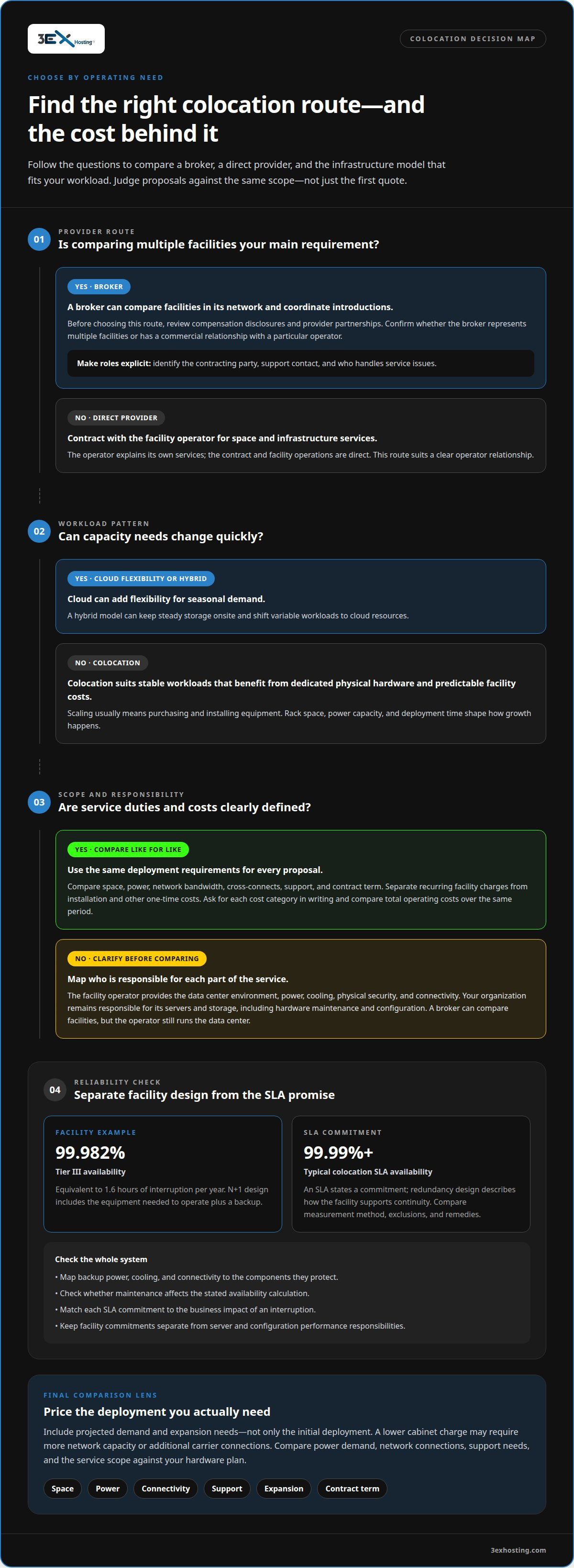
The direct option isn’t automatically the lower-cost choice. In a colocation broker vs. direct provider comparison, the better fit depends on the full operating cost and who’s responsible for each part of the service. Compare the same space, power, connectivity, support, expansion needs, and service terms before deciding.
It’s easy to focus on the initial quote, but choosing a colocation broker vs direct provider also affects how you scale, manage equipment, and resolve service issues. This comparison explains how the two routes differ in total costs, scalability, service responsibilities, reliability, and provider qualifications, so you can choose the model that fits your infrastructure and operating needs.
Key Takeaways
- Compare the full cost structure, including facility services, connectivity, support, and the work your team still manages.
- Map responsibilities for hardware, facility operations, and incident response before choosing a service arrangement.
- Assess reliability through redundancy design and the specific commitments in the service-level agreement.
- Match provider qualifications and available space to your compliance needs, workload, and expected growth.
Colocation provider responsibilities for facility, power, cooling, security, and connectivity
Buying colocation directly means contracting with the facility operator for space and infrastructure services. The operator provides the data center environment, power, cooling, physical security, and connectivity. Your organization retains responsibility for its servers and storage, including hardware maintenance and configuration. For example, a team with legacy equipment can continue using it while connecting to external networks.
A broker can compare facilities and coordinate introductions, but the operator still runs the data center. Potential concerns include unclear compensation, limited visibility into provider relationships, or confusion about who handles contracts and service issues. Before comparing options, identify the contracting party, the support contact, and who is responsible for each service.
To assess a broker’s independence, review its compensation disclosures and provider partnerships. Establish whether it represents multiple facilities or has a commercial relationship with a particular operator. Then compare the proposed facility’s power capacity, cooling design, security controls, connectivity, and monitoring with your workload. A small deployment may need only a cabinet, while specialized equipment may require higher-density capacity.
| Option | Facility access | Selection support | Service relationship |
|---|---|---|---|
| Direct provider | One operator’s facility | Operator explains its own services | Contract and facility operations are direct |
| Broker | Facilities in its network | Can compare multiple options | Broker and operator roles must be clear |
To contract directly, define the deployment first: cabinet or suite, power demand, network connections, and support needs. Share those requirements with the facility operator, review the service scope, and align the agreement with your workload and operational responsibilities. If your team needs hands-on facility support, distinguish it from managed system administration.
Match the facility to the systems it will host. A compact server deployment differs from a high-density configuration in power, cooling, and space demands. For cabinet deployments, compare the relevant cabinet colocation details with your hardware plan. Choose the direct route for a clear operator relationship; use an independent adviser when comparing facilities is the main requirement.
Redundancy, uptime, and service-level agreements
Reliability depends on both facility design and the service commitments. Compare redundancy, uptime terms, and responsibilities in each proposal.
Performance and Uptime
Performance measures how consistently systems deliver their required service; uptime measures whether infrastructure is available. Redundancy supports both by providing backup capacity when a component fails. A Tier III facility has 99.982% availability, equivalent to 1.6 hours of interruption per year. Its N+1 design includes the equipment needed to operate plus a backup. For an enterprise workload, that spare capacity can help maintain operations during planned maintenance or equipment failure.
Service-Level Agreements
A service-level agreement (SLA) sets out the provider’s uptime commitment and how service performance is measured. Colocation SLAs typically guarantee 99.99% or higher availability. An SLA is not the same as a redundancy design: it states a commitment, while infrastructure design describes how the facility supports continuity. Compare the stated availability, measurement method, exclusions, and remedies, then align them with your application’s outage tolerance.
Assess the whole system, not a single headline percentage. Redundant cooling cannot make up for a weak network path, and facility uptime alone doesn’t measure server performance. For example, an internet connection may be available while a workload slows because of hardware or configuration issues. Separate the facility’s commitments from the performance responsibilities your organization retains.
- Map backup power, cooling, and connectivity to the components they protect.
- Check whether maintenance affects the stated availability calculation.
- Match each SLA commitment to the business impact of an interruption.
In a broker arrangement, confirm that the facility operator’s SLA governs the service, not just the broker’s coordination. With a direct provider, compare the operator’s commitment and redundancy details together. Reviewing data center infrastructure against these criteria helps keep the discussion focused on operational needs.
Cost efficiency and scalability
Compare the full deployment cost, then assess whether the infrastructure can grow with demand. Colocation and cloud suit different workload patterns.
Scalability and Flexibility
Colocation suits stable workloads that benefit from dedicated physical hardware and predictable facility costs. Scaling usually means purchasing and installing equipment, so rack space, power capacity, and deployment time shape growth. Cloud can add flexibility for seasonal demand, while a hybrid model can keep steady storage onsite and shift variable workloads to cloud resources. Choose based on how quickly capacity needs to change.
Comparing Colocation Quotes
Compare quotes against the same requirements: space, power, network bandwidth, cross-connects, support, and contract term. Separate recurring facility charges from installation and other one-time costs. For example, a lower cabinet charge may come with a need for more network capacity or additional carrier connections. Ask for each cost category in writing and compare total operating costs over the same period.
A line-by-line comparison shows whether proposals support the same workload. Include projected demand and expansion needs, not just the initial deployment.
Broker Pricing and Contract Negotiation
A broker may negotiate terms by presenting a facility with a defined deployment and comparing alternatives. This can help clarify contract length, expansion options, or included services, but it doesn’t guarantee a better deal. Direct negotiations put your organization in contact with the operator. Compare the final terms, not the route to negotiation, and confirm that power, connectivity, and growth provisions meet your requirements.
Broker Fees and Commissions
A broker may receive a commission from a provider or charge the buyer a fee. The arrangement varies, so establish who pays, how compensation is calculated, and whether it affects which facilities the broker presents. Include any buyer-paid advisory fee in your comparison. Clear disclosure helps separate the broker’s fee from the operator’s facility charges.
Evaluating colocation providers by track record, certifications, services, and financials
Assess a provider across four areas: operating history, security evidence, support scope, and financial stability. Relate the evidence to your servers, hardware maintenance needs, and backup plan rather than relying on general capability statements.
For security assurance, review the specific reports and certifications relevant to your organization. Colocation facilities may hold ISO 27001 certification to support businesses’ regulatory compliance, according to the International Organization for Standardization. Regulated organizations can also assess SOC 2 Type II reports. Treat each document as evidence of defined controls, not as a substitute for reviewing the service agreement and operational responsibilities.
Service scope determines how much technical work remains with your team. Colocation provides facility infrastructure, while your organization remains responsible for its equipment and systems. Remote Hands can assist with physical tasks at the facility; managed services can cover a broader operating scope. Define example tasks, such as replacing a failed component or checking a server connection, and identify who is responsible for each.
Compare customer service through practical operating details: escalation routes, incident communication, support scope, and request tracking. In a broker arrangement, distinguish the broker’s coordination role from the facility operator’s responsibilities. For a direct agreement, identify the operator’s support process and the services included in the contract.
Evaluate financial stability in terms of continuity and long-term capacity, not speculation. Review the provider’s ability to maintain the facility and deliver the contracted services. Compare capital commitments, recurring charges, expansion terms, and exit provisions across proposals. A provider’s track record is most relevant when it involves deployments like yours, such as high-density hardware or a hybrid environment.
Document these findings in a comparison sheet, then connect each certification, service, and contract term to a business requirement. If physical server tasks are part of your plan, explore remote hands support as one support option.
3EX Hosting: Full Cabinet Colocation
3EX Hosting provides Full Cabinet Colocation for organizations that want dedicated space for their server hardware in a data center. It’s a practical fit when your team needs a physical deployment while keeping control of its systems. For larger or more distinct infrastructure footprints, Private Colocation Suites and Cage Solutions datacenter offer alternative colocation formats.
Compare the space and support model with your workload before choosing. Managed Cloud Hosting can suit organizations seeking a managed cloud environment alongside colocation, rather than placing every system on physical hardware. These options help align infrastructure decisions with operational needs without relying solely on a broker to identify a facility.
Visit 3exhosting.com to discuss which colocation approach fits your deployment.
Turn your comparison into a deployment plan
A colocation broker vs direct provider decision is more useful when it leads to a practical internal plan. Name the person responsible for coordinating infrastructure, finance, and operations. Give that person a clear record of deployment priorities, expected growth, and the business impact of service disruption. This helps the team make a consistent decision and carry it into implementation.
Before moving forward, outline the decisions that follow site selection: equipment preparation, migration sequencing, network dependencies, and operational handoffs. Note which tasks stay with your team and where external support is needed. A shared plan gives technical and business stakeholders the same understanding of scope, reducing avoidable confusion as the deployment progresses.
For a direct conversation about your colocation requirements, contact 3EX Hosting to discuss your options. A clear starting point can help you move toward an infrastructure setup that fits your organization.
Frequently Asked Questions
Which Option is Best for Your Business?
Choose the route that fits your sourcing needs and operating model. A broker may suit an organization comparing facilities or coordinating a complex search. Direct contracting may suit a team that has identified its preferred facility and wants a direct relationship with the operator. For example, a company planning a new deployment can compare both paths against procurement workload, decision ownership, and expansion plans.
Who owns the hardware and facility?
Ownership depends on the arrangement. In conventional customer-owned colocation, the organization owns its servers, while the provider owns and operates the facility. 3EX Hosting’s terms differ: 3EX owns the equipment, and the customer has no rights to it. Separate ownership from operational responsibilities in the agreement, especially when reviewing equipment access, maintenance, replacement, and removal requirements.
What does a colocation broker do?
A colocation broker helps organizations identify and compare facilities, coordinate discussions, and support negotiations. The broker doesn’t operate the data center or replace the facility operator. For instance, a broker may organize proposals around a company’s capacity and connectivity needs, while the selected operator remains responsible for facility services. Clarify the broker’s compensation and responsibilities before relying on its recommendations.
Are colocation prices different through a broker versus direct?
A broker doesn’t automatically make colocation cheaper or more expensive. Total cost depends on facility space, power, connectivity, support, contract terms, and any broker compensation. Colocation pricing depends on the deployment and is provided after a quote request. Compare equivalent proposals and identify whether the broker is paid by the provider or charges the buyer separately.
What contract terms and service-level agreements should colocation buyers compare?
Compare contract length, renewal and termination terms, expansion provisions, and the process for resolving service disputes. For each service-level agreement, check what availability covers, how it’s measured, which maintenance events are excluded, and what remedies apply. Distinguish facility commitments from network or support commitments. A practical review maps each clause to an owner, a reporting process, and a business consequence.