 SUPPORT



 3EX United States
Blog
A data center’s certificate may cover the building’s design but not the service your workloads depend on. That distinction is central to understanding data center certifications and what they mean. Familiar labels can sound interchangeable, but standards and audit reports examine different controls, facilities, and operating periods.
A recognized certification or attestation can support an infrastructure review, but its name alone can’t confirm that a specific site or service is in scope, show how controls operate day to day, or guarantee uptime or security. The practical question is whether the credential’s scope and supporting evidence address your risks.
This guide explains what the ANSI/TIA-942 standard, Uptime Institute Tier Certifications, ISO/IEC 27001 certification, and SOC 2 reports assess, and where their limits lie. Use it to review covered locations, services, validity, and audit evidence, then match assurance requirements to your workloads and business priorities. This gives you a clearer basis for evaluating colocation, cloud hosting, and other infrastructure decisions.
Key Takeaways
- Learn how certifications, audit attestations, compliance statements, and marketing claims differ, so you can interpret assurance evidence accurately.
- Compare major frameworks by what they assess, the evidence they provide, and the limits of their claims.
- Use a repeatable review process to check who issued a document, what it covers, which standard version it references, and when it remains valid.
- Understand why data center certifications and what they mean can inform risk decisions without guaranteeing future uptime or security.
- Connect assurance evidence to workload needs and colocation choices, including cabinet, cage, and private-suite requirements.
Data Center Certifications and What They Mean for Buyers
A data center certification is an assessment of a defined facility, system, process, or control against a standard’s requirements. When evaluating data center certifications and what they mean, start with one question: exactly what was assessed? A credential can support procurement and risk reviews by providing evidence about facility resilience, security practices, or business continuity. It applies only to its documented scope, however, and doesn’t guarantee uninterrupted service or prevent every security incident.
What does a data center certification verify?
An assessment checks specified criteria within a defined boundary. That boundary might cover a facility’s physical infrastructure, an organization’s information security management system, or particular operational processes. These are not interchangeable. Evidence about power and cooling design, for example, doesn’t automatically establish how an organization manages access to information.
Assessment methods vary by framework. An assessor might review design documents, inspect controls, interview staff, or examine operating records over a stated period. The resulting evidence reflects the framework’s requirements and the assessment’s scope, not every possible risk. Check whether the named site, service, and relevant systems fall within that boundary.
Certification, accreditation, compliance, and attestation
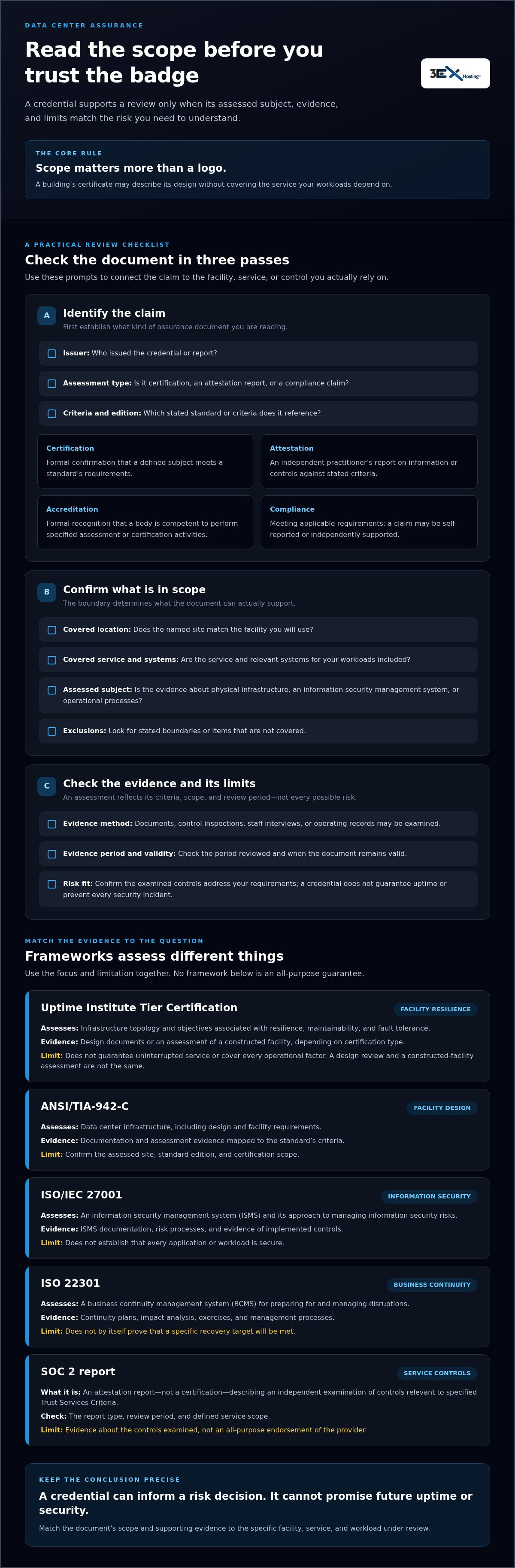
Certification is formal confirmation that a defined subject meets a standard’s requirements, typically following an assessment by a certification body. Accreditation is formal recognition that a body is competent to perform specified assessment or certification activities. Compliance means meeting applicable requirements. A compliance claim may be self-reported or supported by independent evidence. Attestation is an independent practitioner’s report on information or controls against stated criteria.
SOC 2 is an attestation report, not a certification. It describes an independent examination of controls relevant to specified Trust Services Criteria and a defined service scope. The report type and review period matter: the document provides evidence about the controls examined, not an all-purpose endorsement of the provider.
Scope matters more than a logo: the value of an assurance claim depends on what was examined, where, and for which services. Before relying on a credential, review the issuer, assessment boundary, criteria, evidence period, and any stated exclusions.
This distinction helps separate facility resilience from organizational security and service operations. For an example of facility classification, Data center tiers describes the Uptime Institute’s tier framework. A tier classification addresses infrastructure topology and related objectives. It isn’t a promise that every service will meet a particular uptime outcome. Buyers evaluating cabinet, cage, or private-suite colocation can compare facility evidence with the physical infrastructure their workloads will use. The data center infrastructure overview provides context for those colocation considerations.
Major Data Center Standards: Tiers, Facility Design, and Security
Different frameworks answer different questions. A facility design assessment, a security management certification, and a continuity standard don’t provide interchangeable evidence. Use the comparison below to connect each framework to the risk it can help assess, then confirm the document’s scope and assessment type.
| Framework | Focus | Typical evidence | Important limitation |
|---|---|---|---|
| Uptime Institute Tier Certification | Data center infrastructure topology and related resilience objectives | Design documents or assessment of a constructed facility, depending on certification type | Doesn’t guarantee uninterrupted service or cover every operational factor |
| ANSI/TIA-942-C | Data center infrastructure, including design and facility requirements | Documentation and assessment evidence mapped to the standard’s criteria | Confirm the assessed site, standard edition, and certification scope |
| ISO/IEC 27001 | Information security management system (ISMS) | ISMS documentation, risk processes, and evidence of implemented controls | Doesn’t establish that every application or workload is secure |
| ISO 22301 | Business continuity management system (BCMS) | Continuity plans, impact analysis, exercises, and management processes | Doesn’t by itself prove that a specific recovery target will be met |
What Uptime Institute Tier certification tells you
Uptime Institute’s Tier framework assesses infrastructure topology against objectives associated with resilience, maintainability, and fault tolerance. The certification type matters: a design-document review evaluates plans, while a constructed-facility certification assesses the implemented site. Neither is a blanket uptime promise. Read the exact credential and scope. The Data center tiers overview outlines the classification system.
How security and continuity standards differ
ISO/IEC 27001:2022 specifies requirements for an ISMS, a structured approach to managing information security risks. ISO 22301 addresses a BCMS, which helps an organization prepare for and manage disruptions. Both examine management systems, not the security or recovery performance of every hosted application. Match the evidence to the specific service and workload being procured.
ANSI/TIA-942-C is the current edition of the data center infrastructure standard, released in April 2024. Its requirements include edge data centers and higher power densities. The current edition reference includes the standard’s publication details. For colocation buyers, applicability depends on business requirements, assessment scope, and the service being procured. Compare facility evidence with the cabinet, cage, or private-suite arrangement your workload needs, alongside relevant security and continuity controls. Explore 3EX Hosting enterprise infrastructure options as you define those requirements.
How to Read a Data Center Certificate, Audit, or Compliance Claim
An assurance document is useful only if it relates to the infrastructure and service under review. Assess the evidence in a consistent order rather than relying on a logo or summary statement. Understanding data center certifications and what they mean helps procurement and risk teams compare claims on the same basis.
- Identify the document. Is it a certificate, an independent audit or attestation report, a compliance statement, or a marketing summary? These documents disclose different levels of evidence. A public summary may describe a control environment, while a full report can specify criteria, scope, review period, and exceptions.
- Check the issuer. Note the certification or auditing body and the role it performed. Confirm the document type and the standard or criteria assessed. A recognized standard name doesn’t, by itself, show who examined the controls or how.
- Read the scope. Match the named legal entity, facility, service, and locations to the arrangement being considered. Check boundaries and exclusions, including whether the scope covers the data center, a cloud service, or both.
- Review dates and findings. Record issue and expiry dates, surveillance details where applicable, the standard version, and any stated exceptions. For audit reports, note the period examined and the controls included.
- Compare with the contract. Map the evidence to the specific service, site, and operational responsibilities in the proposed agreement. Log gaps or open questions in procurement and risk records.
Check the scope, site, and covered services
Scope defines the boundary of an assessment. A certificate may name one facility or legal entity, while the contract involves another entity, location, or service. Don’t assume a certified site automatically covers a separate facility, or that evidence for colocation extends to managed cloud hosting. Compare the document’s exact wording with the infrastructure and services your team plans to use.
Review evidence, dates, and exceptions
Dates show when an assessment was issued and, where stated, how long it remains valid or when surveillance occurs. For audit reports, a control may have been examined over a defined period. Exceptions or qualifications can affect how the results apply to your risk. A summary is a useful starting point, but it isn’t a substitute for the underlying report when detailed assurance is required. Record what the evidence covers and what remains unresolved. For additional reference material, see this assurance documentation reference.
Do Data Center Certifications Guarantee Uptime or Security?
No. Certifications provide evidence that defined criteria were assessed within a stated scope. They aren’t a blanket promise of future uptime, security, or recovery performance. A facility assessment can offer insight into infrastructure design, while an information security certification addresses a management system. Neither proves that every service will operate without interruption or that every incident will be prevented.
Verified controls show what was assessed; they don’t guarantee a particular business outcome. Outages, cyber incidents, human error, and supplier dependencies can still affect service. A facility resilience credential also isn’t the same as a contractual service-level commitment, an incident history, or a tested recovery arrangement. Review each separately.
What certifications cannot promise
A certification is evidence against defined requirements at a particular time or over a stated assessment period. It doesn’t eliminate operational risk or establish how a provider will respond to every failure scenario. Don’t convert a tier or certification label into an uptime percentage unless a relevant, documented commitment supports that figure. Compare the assurance evidence with service terms, operating processes, and recovery responsibilities.
Match assurance evidence to your workload
The right review depends on what the workload needs and what could happen if it becomes unavailable or exposed. Use this checklist to focus due diligence:
- Availability: For critical systems, examine evidence relevant to power, cooling, connectivity, maintenance practices, and incident handling. Compare facility resilience claims with the service-level commitments in the contract.
- Security: For sensitive or regulated data, map the security evidence to your organization’s applicable requirements. Confirm which entity, systems, and services the assessment covers, and identify controls that remain your responsibility.
- Continuity: Review recovery plans, test evidence, dependencies, and the division of responsibilities between your team and the provider. Check that recovery objectives align with the workload’s business impact.
- Operational support: Understand how incidents are communicated, who takes action, and how escalation and maintenance processes fit your operating model.
Multiple certifications can complement one another. Facility evidence may inform an infrastructure resilience review, while security and continuity evidence address organizational controls and disruption planning. Together, they offer a broader view, but they don’t replace technical due diligence or prove that a specific workload is protected end to end.
Use data center certifications and what they mean as a starting point for risk assessment, not as a substitute for matching evidence to your architecture and contract. Once you’ve defined the workload’s availability, security, and recovery needs, explore infrastructure options that can support your requirements.
Using Certification Evidence to Evaluate Colocation and Infrastructure
Turn assurance documents into a practical decision process: define the risks your workload needs to manage, identify evidence that addresses those risks, then compare the evidence’s scope with the service you’re procuring. Understanding data center certifications and what they mean helps you distinguish relevant assurance from credentials that don’t cover your intended environment.
A practical due-diligence checklist for enterprise buyers
Start with workload requirements, not a preferred certification label. Record availability, security, continuity, and physical infrastructure needs, then map each one to a specific standard, report, control, or contractual commitment. For example, a facility assessment may inform infrastructure review, while a continuity plan and recovery objectives address disruption planning.
- Identify the facility, legal entity, and service covered by each document.
- Record assessment dates, standard versions, scope exclusions, and reported exceptions.
- Compare the evidence with contract responsibilities and note who owns any remaining risks.
Translate requirements into an infrastructure decision
Connect facility assurance to the colocation footprint and operating model your workload requires. A cabinet, cage, or private suite can suit different needs for dedicated space, access, capacity, and operational separation. Evaluate the evidence alongside the arrangement itself, including which responsibilities stay with your team. Managed cloud hosting and disaster recovery solutions can also support broader continuity planning, depending on workload design and recovery needs.
Review the data center facility overview to understand the infrastructure context, then compare your requirements with the appropriate colocation arrangement. If a cabinet is the right fit, explore colocation options as a next step.
Keep a short decision record before selecting a solution: the risks identified, evidence reviewed, scope gaps, and the rationale for the service choice. This gives procurement, technical, security, and continuity teams a shared basis for discussion.
Ready to discuss how your requirements map to infrastructure? Share your colocation needs with 3EX Hosting.
Make Assurance Evidence Part of a Better Infrastructure Decision
Data center certifications and what they mean become clearer when you look beyond a credential’s name. Each framework assesses defined criteria, and its value depends on whether the documented scope matches the facility, service, and workload you’re evaluating. Review the issuer, dates, standard version, and exceptions, then connect that evidence to your availability, security, and continuity requirements.
Certifications can strengthen due diligence, but they don’t guarantee uninterrupted service or eliminate operational risk. Pair them with service commitments, recovery arrangements, and a clear understanding of who owns each responsibility. Then choose the infrastructure model that fits your operational needs, whether that means cabinet colocation, a cage, a private suite, or complementary cloud and disaster recovery solutions.
With your requirements defined, take the next step at your pace. Explore colocation options with 3EX Hosting and move forward with a clearer basis for your infrastructure decision.
Frequently Asked Questions
What are the most important data center certifications?
There’s no universal shortlist that fits every buyer. Uptime Institute Tier Certification and TIA-942 address data center infrastructure in different ways. ISO/IEC 27001 focuses on information security management, while ISO 22301 addresses business continuity management. SOC 2 is an attestation report, not a certification. The right evidence depends on your workload, contract, and risks, so understanding data center certifications and what they mean is more useful than counting credentials.
Does a Tier-certified data center guarantee uptime?
No. Tier Certification assesses defined infrastructure criteria within a specific scope. It doesn’t guarantee uninterrupted service or a particular customer outcome. Review the exact certification type and facility covered, then consider maintenance practices, contractual service commitments, and operational evidence. Network connectivity, customer equipment, and recovery procedures can also affect end-to-end availability, even when facility infrastructure has been assessed against resilience objectives.
What is the difference between a data center certification and SOC 2?
A certification confirms that an assessed entity, system, or facility meets specified criteria within a defined scope. SOC 2 is an independent attestation report on controls relevant to selected Trust Services Criteria. It’s not a certification. For either document, check the organization and services covered, assessment boundaries, applicable period, and any disclosed exceptions. This helps determine whether the evidence applies to the service you’re evaluating.
Is ISO 27001 the same as a data center certification?
No. ISO/IEC 27001 specifies requirements for an information security management system. An organization can undergo an external certification assessment against the standard, but the certificate’s scope determines what it covers. It may apply to specific entities, locations, or activities rather than every facility or service. It also doesn’t independently establish that each customer workload or application is secure.
How can I verify whether a data center certification is valid?
Review the original certificate or assurance document, issuing or auditing body, named entity, scope, standard version, and validity or assessment dates. Make sure the facility and service under consideration fall within the documented boundary. For audit reports, check the period examined and any exceptions. Treat a public summary or marketing reference as a pointer to the underlying evidence, not as a replacement for reviewing its details.
Do all colocation providers need the same certifications?
No. Assurance requirements depend on workload needs, contractual obligations, security and continuity risks, and your organization’s policies. One buyer may prioritize evidence about facility infrastructure, while another may need security management or continuity documentation. Define your requirements first. Then compare the scope and evidence relevant to the service, rather than assuming a longer list of certifications is automatically stronger or more suitable.
Can a data center be secure without every certification?
Yes. Certifications provide one form of assurance, not a complete measure of security. Assess the controls, operational practices, audit evidence, documented scope, contractual responsibilities, and risks relevant to your organization. The absence of a particular certification doesn’t by itself establish that a facility is insecure. It means you’ll need to evaluate the available evidence against your requirements and identify any remaining risk.