 SUPPORT


 3EX United States
 Blog
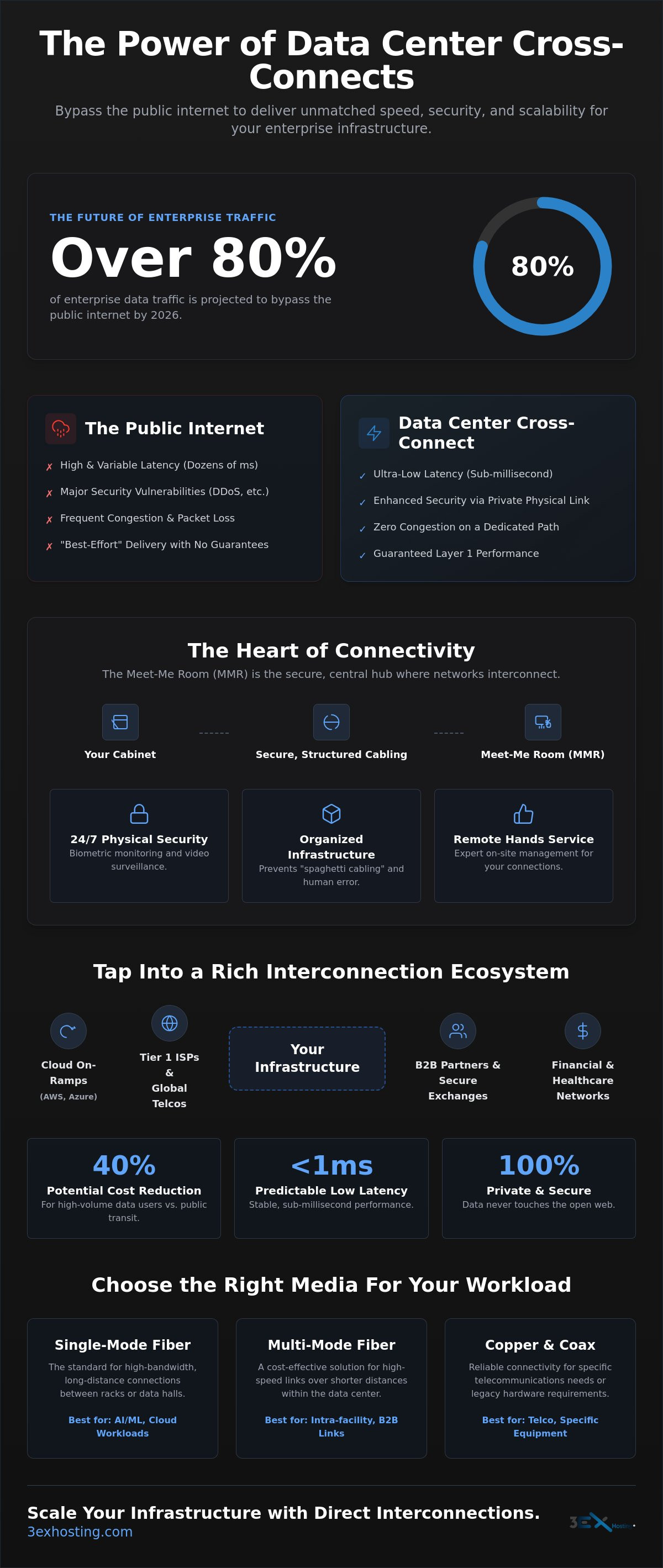
By 2026, it’s projected that over 80% of enterprise data traffic will completely bypass the public internet. If your mission-critical applications still rely on standard ISP transit, you’re likely battling high latency and unpredictable security risks that your competitors have already solved. The answer lies in data center cross-connects, which provide a direct, physical link between two points within a facility. This hardware-level connection ensures your data travels the shortest possible distance without ever touching the open web.
We understand that managing a complex hybrid cloud or a high-density AI workload requires absolute stability and predictable costs. You shouldn’t have to worry about hidden bandwidth fees or the performance degradation that comes with software-defined networking. This guide reveals how physical interconnections eliminate latency, enhance security, and scale your enterprise infrastructure efficiently. We’ll explore the technical standards of the Meet-Me-Room, the 40% cost reduction potential for high-volume data users, and how to build a resilient foundation for your most sensitive workloads.
Key Takeaways
- Understand why physical, point-to-point links are the foundation of true low-latency enterprise connectivity.
- Explore the mechanics of the Meet-Me-Room and how it secures your mission-critical network termination points.
- Learn how data center cross-connects bypass the public internet to eliminate DDoS vulnerabilities and transit bottlenecks.
- Compare media options like Single-Mode and Multi-Mode fiber to optimize your hardware for high-bandwidth AI and cloud workloads.
- Discover how to scale your infrastructure by combining direct interconnections with enterprise-grade colocation solutions.
Understanding Data Center Cross-Connects: More Than Just a Cable
A physical connection is the most reliable way to ensure network performance. In a professional environment, data center cross-connects serve as the dedicated, point-to-point cable links that bridge the gap between two separate termination points. Unlike the complex routing of the public web, these links operate at Layer 1 of the OSI model. This means your data travels over a literal piece of glass or copper without any intermediate processing or logical overhead. This fundamental simplicity is what makes it superior for high-stakes enterprise applications.
It’s vital to distinguish between your internal cabinet cabling and an official cross-connect. While you manage the patch cords within your full cabinet colocation, the data center operator manages the cross-connect. They provide the secure pathway through the facility’s structured cabling system, often utilizing overhead trays or specialized conduits to reach the Meet-Me-Room (MMR). This managed approach ensures that the physical infrastructure remains organized, labeled, and protected from accidental interference.
Understanding the broader scope of Data center interconnect strategies helps clarify why these physical links are so valuable. A carrier-neutral provider acts as the essential facilitator. By maintaining a diverse ecosystem of tenants, they allow you to establish direct lines to a variety of partners without your traffic ever leaving the building’s footprint.
The Interconnection Ecosystem
Modern enterprises don’t operate in isolation. Cross-connects enable you to plug directly into a massive ecosystem of service providers and partners. This includes Tier 1 ISPs and global telecommunications companies that maintain Points of Presence (PoPs) within the facility. Beyond basic internet access, you can establish direct peering with cloud on-ramps like AWS Direct Connect or Azure ExpressRoute. For industries like finance or healthcare, these links facilitate secure, high-speed B2B data exchanges that bypass third-party networks entirely.
Why Businesses Move Beyond the Public Internet
The public internet is built on “best-effort” delivery. Your packets might take ten different hops through various routers before reaching their destination, leading to jitter and packet loss. For real-time applications or massive database synchronizations, this variability is unacceptable. By using data center cross-connects, you gain a predictable, dedicated path with zero congestion. While public internet transit latency is measured in dozens of milliseconds with high variability, cross-connects provide stable, sub-millisecond performance measured in microseconds. This level of precision is the benchmark for modern enterprise infrastructure.
The Mechanics of the Meet-Me-Room (MMR): How Interconnection Happens
The Meet-Me Room (MMR) is the central nervous system of any carrier hotel. It’s a highly secure, restricted-access space where different network providers and tenants converge to exchange traffic. To maintain the integrity of data center cross-connects, we implement 24/7 biometric monitoring and video surveillance. This ensures that only authorized technicians interact with the critical hardware that powers your business. It’s the physical point where your private infrastructure meets the global network.
Organization is paramount in a high-density environment. We utilize sophisticated patch panels and secure overhead cable trays to manage thousands of individual strands. This structured approach prevents the “spaghetti cabling” that often leads to accidental disconnects or cooling obstructions. It also simplifies troubleshooting. When every connection is meticulously labeled and routed, the risk of human error during maintenance drops significantly. This level of order is what guarantees the high availability enterprises demand.
Many organizations manage their infrastructure from a distance. You don’t need to send a team to the facility every time you need a new link. Our Remote Hands team acts as your on-site physical layer experts. They handle the cabling, labeling, and port validation on your behalf. This allows your IT staff to focus on high-level configuration while we manage the precise physical deployment in the background.
The Step-by-Step Provisioning Process
The workflow for establishing a connection is standardized to ensure speed and accuracy. It starts with the Letter of Authorization (LOA). This document is the critical authorization that grants a data center operator the right to establish a link between your equipment and a third party. Once the LOA is verified, technicians route the cable through protected overhead infrastructure. The process concludes with termination and light-level testing for fiber optics. We don’t consider a job finished until we verify that signal loss is within strict decibel tolerances.
Carrier Neutrality and the MMR
A carrier-neutral MMR fosters a competitive marketplace for bandwidth. You aren’t locked into a single provider’s pricing or performance limitations. You can switch carriers or add redundant links with minimal friction. This flexibility is essential for long-term cost management. As your requirements grow, you can scale from a single rack to private colocation suites while maintaining the same seamless MMR access. The physical foundation remains constant even as your footprint expands.
Strategic Advantages: Latency, Security, and Throughput
Speed isn’t just about bandwidth; it’s about the time it takes for a packet to reach its destination. While public internet transit latency is often measured in dozens of milliseconds with high variability, data center cross-connects provide stable performance measured in microseconds. This level of precision is essential for financial trading platforms, real-time communication tools, and distributed database clusters. By removing the multiple router hops of the open web, you ensure your applications perform consistently regardless of external traffic spikes.
The public internet is a shared and often hostile environment. Relying on it for sensitive data transit introduces risks like DDoS attacks and man-in-the-middle interceptions. A physical cross-connect creates a private, closed-loop circuit that never touches the open web. This hardware-level isolation eliminates common network entry points for malicious actors. It’s the most secure way to handle sensitive healthcare or financial records between partners.
Budgeting for cloud transit is notoriously difficult due to variable bandwidth egress fees that fluctuate with your data usage. We replace that uncertainty with predictable, flat-rate monthly fees. This transition often leads to significant cost savings for high-volume users. Beyond the financial aspect, physical cables are inherently more reliable than logical routes. They aren’t subject to the BGP routing errors or ISP configuration mistakes that frequently cause outages on the public internet.
Network Redundancy Strategies
A single point of failure is unacceptable for enterprise operations. We recommend implementing N+1 redundancy by utilizing A and B side cross-connects. This strategy involves routing your primary and secondary links through diversified paths. We ensure these cables don’t share the same physical tray or conduit to protect against accidental damage. For total resilience, many clients integrate these links with our data center disaster recovery solutions to provide a secondary failover path across different infrastructure zones.
Performance for GPU and AI Workloads
The rise of Artificial Intelligence has redefined the requirements for data center throughput. Training large language models requires massive data ingest that would overwhelm standard network connections. This is why high density GPU colocation environments rely on dedicated fiber interconnections. Modern OS2 Single-Mode Fiber cross-connects are the universal standard for supporting the 400G and 800G network speeds required for AI clusters. These high-capacity links ensure your GPUs are never waiting for data, maximizing the ROI of your most expensive hardware investments.
Choosing the Right Media: Fiber, Copper, and Coax
The physical medium you choose for data center cross-connects dictates your long term scalability and performance ceiling. In 2026, Single-Mode Fiber (SMF) has become the universal standard for high-performance environments. Specifically, the OS2 standard is required to support the 400G and 800G speeds necessary for AI and cloud workloads. SMF provides the lowest signal attenuation and the highest bandwidth over long distances. It’s the primary choice for connecting to major carriers and cloud on-ramps.
Multi-Mode Fiber (MMF) still serves a purpose for shorter, cost-effective links within the same facility. It’s often used for connections between adjacent racks where the extreme distance capabilities of SMF aren’t required. However, copper remains relevant for specific use cases. CAT6 or CAT6A cabling is common for out-of-band management, legacy hardware, and management console access. While it lacks the speed of glass, its reliability for low-bandwidth administrative tasks is unmatched. Coaxial handoffs are less common but remain a requirement for certain CATV integrations or specific legacy telecommunications handoffs.
Connector Types and Standards
Density requirements in the patch panel often dictate your connector choice. LC connectors are the modern standard for high-density fiber environments due to their small form factor. SC connectors are still found in legacy installations but take up significantly more space. Regardless of the type, clean terminations are critical. Even microscopic dust particles can cause signal attenuation or permanent hardware damage. If your equipment uses a different media type than your provider, our remote hands team can facilitate media conversion and perform light-level testing to ensure a stable link.
Future-Proofing Your Cable Plant
Planning for 100G throughput and beyond requires a shift toward MPO/MTP fiber connectors. These multi-fiber connectors allow for higher density and simplified migration paths as your bandwidth needs grow. Many enterprises are also evaluating the role of dark fiber. This involves leasing unlit fiber strands to build private, high-capacity enterprise networks with total control over the equipment at both ends. In the 2026 data center environment, evaluating the lifespan of your cabling is vital. Investing in OS2 fiber today prevents the need for expensive “rip and replace” projects in three to five years. If you are ready to upgrade your infrastructure, you can request a custom connectivity quote to see which media best fits your deployment.
Optimizing Your Interconnection Strategy with 3EX Hosting
3EX Hosting serves as a strategic hub for national enterprise traffic. We provide the physical foundation required to bridge your infrastructure with global carriers and cloud providers. By integrating data center cross-connects with our full cabinet colocation services, you gain a high-performance environment where latency is minimized at the hardware level. This direct proximity to the Meet-Me-Room ensures that your data travels the shortest possible distance, maximizing throughput for even the most demanding applications.
Our facility is designed for flexibility. We accommodate everything from single, high-speed fiber links to complex cage solutions that require multi-faceted interconnection strategies. Having 24/7 on-site technical teams means that your infrastructure is never left unattended. We handle the physical layer management so your internal teams can focus on software and service delivery. This constant availability ensures that any hardware adjustments or new link requests are handled with professional precision and technical excellence.
On-Site Support and Deployment
Deployment speed is a core pillar of our service. We understand that network agility is a competitive advantage, so 3EX Hosting maintains a streamlined provisioning workflow to activate new interconnections as quickly as possible. Our remote hands experts are available around the clock to perform cable testing, light-level verification, and physical troubleshooting. This eliminates the need for your staff to travel for routine maintenance or emergency link repairs. For organizations transitioning from other facilities, our “Move-In Assistance” program simplifies the migration of complex network topologies. We work with you to map out every termination point, ensuring that your data center cross-connects are correctly terminated, labeled, and tested from the moment you go live.
Requesting a Connectivity Audit
Designing a high-availability network requires more than just plugging in cables. It involves a strategic analysis of your current carrier mix to identify potential cost inefficiencies or performance gaps. Our technical team helps you design a resilient architecture that utilizes diversified routing and redundant paths to protect against any single point of failure. We look at both the logical and physical layers to ensure your failover strategies are robust. Whether you are scaling an AI cluster or securing a financial database, our team provides the technical expertise to optimize your layout for long term growth. Get a quote for your cross-connect and colocation needs today to begin building a more stable enterprise foundation.
Building a Resilient Network Foundation
Establishing a high-performance network requires moving beyond the unpredictable nature of the public internet. By utilizing data center cross-connects, your enterprise gains a dedicated, physical path that ensures microsecond latency and hardware-level security. We’ve explored how the right media choices, such as Single-Mode Fiber, provide the 400G and 800G throughput necessary for modern AI and GPU workloads. This physical-layer approach is the only way to eliminate the jitter and congestion that throttle mission-critical applications.
3EX Hosting provides the stability and expertise needed to manage these complex infrastructures. As a carrier-neutral facility, we offer access to over 100 providers and maintain N+1 redundancy on all critical network paths to ensure maximum uptime. Our 24/7/365 on-site Remote Hands support means your physical connections are always monitored and maintained by experienced professionals. We’re ready to help you bridge the gap between your private infrastructure and the global network.
Maximize your network performance with 3EX Hosting cross-connect services.
Take the next step in securing your infrastructure and achieving the consistent performance your applications demand.
Frequently Asked Questions
What is the difference between a cross-connect and an interconnect?
A cross-connect is a physical, point-to-point link between two termination points within a single data center facility. In contrast, a data center interconnect (DCI) is used to link two geographically separate data center locations. While cross-connects operate at the physical layer within the building, interconnects require wider network infrastructure to span cities or regions.
How much do data center cross-connects typically cost in 2026?
Pricing for these services usually includes a one-time installation fee and a predictable monthly recurring charge. These costs vary based on the media type, such as Single-Mode Fiber or CAT6 copper, and the specific facility’s infrastructure standards. Many enterprises find that replacing variable public internet egress fees with these flat-rate costs leads to significant long-term budget stability.
Can I install my own cross-connect cable between my rack and a carrier?
No, you cannot install cabling through the facility’s shared infrastructure or the Meet-Me-Room yourself. For security and organizational reasons, the data center operator manages all cabling that leaves your specific cabinet or cage. This ensures that all data center cross-connects meet strict fire safety and performance standards while preventing accidental damage to other tenants’ links.
What is a Letter of Authorization (LOA) in the context of cross-connects?
An LOA, also known as a Customer Facility Assignment (CFA), is a formal document that grants the data center operator permission to connect your equipment to a third party’s port. It specifies the exact termination point, including the rack, panel, and port number. You must obtain this document from the service provider you wish to connect with before the physical installation can begin.
How long does it take to provision a new cross-connect?
Provisioning typically takes 24 to 48 hours once the LOA is verified and the order is submitted. The exact timeline depends on the availability of the target port and the complexity of the routing required within the facility’s overhead infrastructure. On-site technical teams can often expedite this process for urgent enterprise requirements.
Does a cross-connect provide better security than a VPN?
Yes, a cross-connect offers superior security because it creates a private circuit that completely bypasses the public internet. A VPN relies on encryption to protect data as it travels over shared, public infrastructure, which remains vulnerable to DDoS attacks and routing errors. A physical cross-connect is a closed-loop link that malicious actors cannot see or target from the open web.
What happens if a cross-connect cable fails?
If a cable fails, traffic will drop unless you have implemented a redundancy strategy. We recommend using A and B side data center cross-connects to ensure N+1 resilience. This setup routes your primary and secondary links through different physical paths, allowing your network to failover automatically without data loss if a single cable is damaged.
Are cross-connects required for managed cloud hosting?
They aren’t strictly required, but they are highly recommended for high-performance enterprise deployments. While you can access managed cloud hosting over the public internet, a cross-connect provides a direct on-ramp with lower latency and higher security. This is vital for data-intensive workloads like AI model training or real-time database synchronization.