 SUPPORT


 3EX United States
 Blog
Keeping data inside a country’s borders doesn’t automatically put it under your control. That distinction is central to data sovereignty and colocation: residency concerns where data is stored, while sovereignty also involves the laws, access rights, and operational arrangements that apply. A facility’s location matters, but it’s only one part of the picture.
If you’re comparing colocation with public cloud or an on-premises data center, the right choice depends on your workloads, risk profile, and control requirements. Colocation lets your organization operate its own hardware in a chosen facility, but it doesn’t transfer your legal or security responsibilities to the provider. Contracts, access procedures, support arrangements, and data flows all need review.
This guide explains how infrastructure choices affect data sovereignty and where colocation may fit within a broader strategy. You’ll learn to distinguish residency, sovereignty, and localization; compare colocation with cloud and on-premises models; and prepare questions for providers and qualified legal advisers. Use these checks to assess whether a deployment model fits your requirements, not just where its servers sit.
Key Takeaways
- Assess sovereignty across the full data lifecycle, including backups, logs, replicas, support access, and exit planning.
- Use data sovereignty and colocation requirements to compare who controls hardware, facility access, administrative layers, and supporting services.
- Build a data-flow map around your obligations, data categories, and business risks before evaluating providers.
- Match cabinets, private suites, or cages to your physical deployment needs, and treat colocation as one part of a broader sovereignty strategy.
What Data Sovereignty Means for Colocation Decisions
Where is your data stored? Who can access it, and which rules apply when it is stored, processed, backed up, or transferred? These questions make data sovereignty and colocation an infrastructure issue as well as a legal one. Data sovereignty concerns the authority and legal jurisdiction connected to data and how it is handled. The answer can depend on more than the server’s location.
How Data Sovereignty Differs from Data Residency
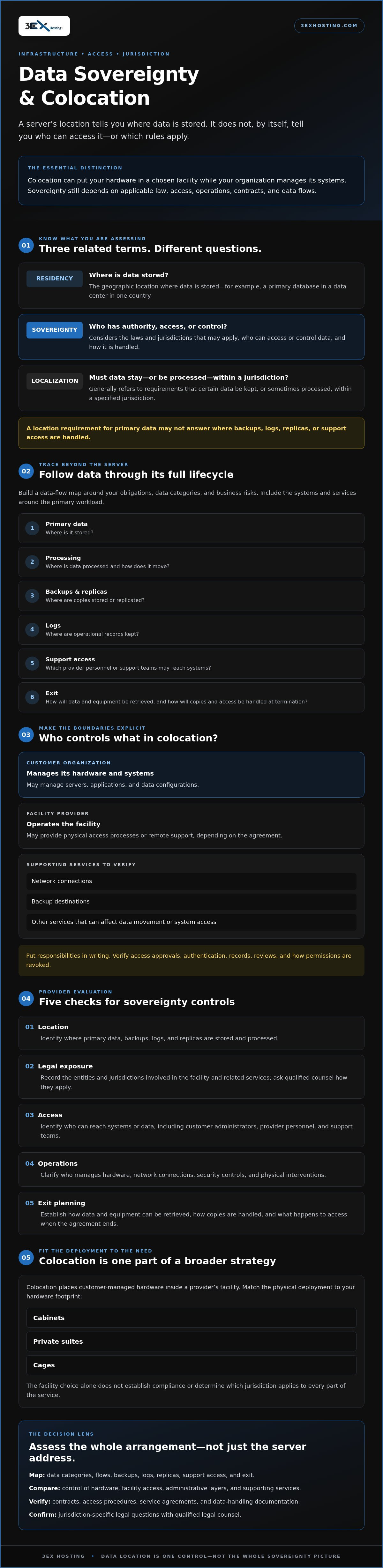
Data residency describes the geographic location where data is stored. For example, an organization may keep its primary database in a data center in one country. Data sovereignty asks broader questions: which laws may apply, which authorities may have jurisdiction, and who can control or access the data?
Data localization generally refers to requirements that certain data be kept, or sometimes processed, within a specified jurisdiction. The terms are related, but they aren’t interchangeable. A system may meet a location requirement for its primary data while backups, logs, replicas, or support access introduce other locations or legal considerations. Processing and data movement matter, too. For a foundational overview of data sovereignty and related concepts, see the linked reference. Confirm how current laws apply to your organization with qualified legal counsel.
Why Colocation Changes the Infrastructure Question
With colocation, a customer places and manages its hardware inside a provider’s facility. This can give the organization direct control over its systems and a choice of physical deployment location. For example, a cabinet colocation deployment may suit a defined hardware footprint, but the arrangement alone doesn’t establish compliance.
Separate what your organization controls from what the provider operates. Your team may manage servers, applications, and data configurations. The facility provider operates the site and may provide services such as physical access processes or remote support, depending on the agreement. Network connections, backup destinations, and other supporting services can also affect where data travels and who can reach systems. Verify these details in the facility terms, access procedures, service agreements, and data-handling documentation.
Physical location can help establish residency, but sovereignty also depends on applicable law, access, operations, and data flows.
That distinction is central to data sovereignty and colocation. Colocation can support a customer-led strategy by placing infrastructure in a chosen location and keeping hardware under the customer’s management. It doesn’t determine which jurisdiction applies to every part of the service or remove the organization’s responsibility to assess its data and legal obligations. Treat the facility as one component of the design. Trace the full path of data and verify operational and contractual boundaries.
Which Sovereignty Controls Must Colocation Address?
Assess sovereignty as a set of connected controls, not a facility label. Review where data moves, which jurisdictions may be relevant, who can access systems, how shared operations work, and what happens when the agreement ends. No facility type or location guarantees a legal outcome. Match evidence and contract terms to your organization’s requirements, and have qualified counsel review jurisdiction-specific questions.
Start with a data inventory. Trace each category through its full lifecycle, not just its primary production location:
- Location: Identify where primary data, backups, logs, and replicas are stored and processed.
- Legal exposure: Record the entities and jurisdictions involved in providing the facility and related services. Ask counsel how those facts apply to your organization.
- Access: Identify who can reach systems or data, including customer administrators, provider personnel, and support teams.
- Operations: Clarify who manages hardware, network connections, security controls, and physical interventions.
- Exit planning: Establish how data and equipment can be retrieved, how copies are handled, and what happens to access at termination.
Who Controls Data Access and Infrastructure Operations?
Put the division of customer and provider responsibilities in writing. Your organization may administer its servers and applications, while the provider operates the facility and may perform agreed physical tasks. Confirm who can approve access, how requests are authenticated, what records are retained, who reviews them, and how permissions are revoked. For remote hands or other support, define the authorized work and how completion is documented.
Then verify the claims. Request relevant policies, access records or sample reports, security documentation, audit materials, and technical evidence the provider can share. Check that the documents match the service and facility you’re evaluating. A general security statement isn’t a substitute for evidence of controls that matter to your use case.
How Contracts and Data Flows Affect Sovereignty
Review contract language on data handling, subcontractors, incident notification, access, and termination. Confirm that the agreement explains responsibilities and gives your organization a workable process for receiving information, escalating concerns, and recovering data or equipment. Have qualified counsel assess legal obligations and wording. Don’t infer a legal conclusion from a provider’s location alone.
Map connections between production systems, backup destinations, cloud services, disaster recovery environments, and support channels. A production server may remain in one facility while logs or recovery copies travel elsewhere. Verify each route, destination, responsible party, and applicable contract. For organizations assessing physical deployment and operational support, reviewing colocation and infrastructure options can help frame provider questions.
Colocation vs. Cloud vs. On-Premises for Data Sovereignty
Choosing an infrastructure model means deciding where control sits and which operational tasks your organization will retain. Colocation, cloud, and on-premises deployments can each support different sovereignty needs. Controls vary by provider, contract, architecture, and service configuration, so compare the actual operating model rather than relying on the deployment label.
| Factor | Colocation | Cloud | On-premises |
|---|---|---|---|
| Control | Customer typically manages its hardware; the provider operates the facility. Access boundaries depend on the arrangement. | Provider controls underlying infrastructure; customer control varies across service and administrative layers. | Organization controls its hardware and facility, subject to its own staffing, policies, and dependencies. |
| Operational responsibility | Shared between customer and provider, with duties defined by the contract and any support services. | Shared between customer and provider, with responsibilities depending on the services used. | Primarily the organization’s responsibility, including facility and infrastructure operations. |
| Scalability | Expansion depends on available space, power, equipment, and provider arrangements. | Capacity may be provisioned through the provider’s services; confirm limits and deployment options. | Expansion requires the organization to provide or arrange additional facility and hardware capacity. |
| Evidence to verify | Facility location, access procedures, contract terms, support arrangements, and data flows. | Service locations, administrative access, data handling, subcontractors, and contract terms. | Facility controls, internal access records, system configuration, and operational documentation. |
Sovereignty depends on the full operating model, not the hosting label. Apply the comparison to each workload, including the systems and services it relies on. A cloud environment may combine provider-managed infrastructure with customer-managed configurations, while colocation arrangements differ in space, access, and support. Neither model is uniform.
When Colocation May Fit Defined Control Requirements
Colocation may suit workloads where an organization wants to operate customer-owned hardware while placing it in a provider facility. Dedicated space, such as full cabinet colocation, can help define the physical deployment boundary. It doesn’t remove the need to evaluate provider operations, network paths, support access, backups, and contract terms. Verify how each dependency fits your control requirements.
When Cloud or On-Premises May Better Fit the Workload
Cloud may be a better fit when managed services or flexible capacity are priorities, provided the service’s access, location, and data-handling terms meet your needs. On-premises may suit organizations that require direct facility control and can support the associated operations. For a closer look at dedicated environments, review private data center suites. To compare available infrastructure options, explore 3EX Hosting’s services.
A Practical Checklist for Evaluating Sovereignty in Colocation
Make the decision traceable. Start with your organization’s obligations, the data involved, and the business impact if access, location, or service arrangements don’t meet requirements. Then assess whether the provider’s evidence and contract terms support your needs. Legal requirements can vary by circumstance and change over time, so ask qualified counsel to confirm how they apply.
- Define the scope. List applicable obligations, data categories, system owners, and business risks. Separate sensitive or restricted workloads from those with less stringent requirements.
- Map data flows. Document where primary systems, backups, replicas, logs, and disaster recovery environments are stored and processed. Include transfers to cloud services and access through provider support. Mark any unknown destination or dependency for follow-up.
- Check access and operations. Identify who administers systems, who can access hardware, and who authorizes physical interventions. Establish what records are kept, how access is reviewed, and how permissions are revoked.
- Request evidence. Ask for facility and location details, access procedures, relevant contract clauses, and available audit documentation. Match each provider statement to supporting evidence and note any gaps or limits.
- Plan for change and exit. Review how provider or subcontractor changes are communicated, how incidents are handled, and how data, equipment, and access are managed at termination.
Questions to Ask a Colocation Provider
Ask specific questions rather than relying on general assurances: Where are systems, backups, and operational records stored or processed? Who can access the hardware, and what records document that access? Which contractual commitments cover data handling, support, subcontractors, and incident notification? What independent evidence supports the stated controls, and what does it cover? Record the answers alongside the documents that substantiate them.
How to Document a Sovereignty Decision
Keep a decision record with the requirements, assumptions, system boundaries, provider evidence, and unresolved risks. Assign owners for legal review, security review, architecture, and ongoing monitoring. Set a review trigger for changes to services, data flows, contracts, or applicable requirements. Organizations assessing dedicated environments can review private colocation suites as one deployment option, then verify the facility and contractual details relevant to their workloads.
A disciplined review makes data sovereignty and colocation decisions easier to explain and revisit. To compare infrastructure options against your requirements, explore 3EX Hosting’s colocation services.
How Colocation Can Support a Sovereignty Strategy
Colocation is an infrastructure choice, not a standalone legal or compliance solution. It can give an organization a defined location for customer-managed hardware, but sovereignty depends on how the full environment is operated, connected, supported, and governed. Use your documented requirements and data-flow map to decide whether colocation fits a specific workload. Then verify provider claims, contracts, and controls against that need.
Matching Colocation Space to Control Requirements
Full cabinets, private suites, and cage configurations provide different physical boundaries. A cabinet may fit a defined equipment footprint; a private suite or cage may be worth assessing when a deployment needs a distinct space arrangement. These configurations don’t, by themselves, guarantee compliance, exclusivity, or a particular security outcome. Confirm access processes, provider responsibilities, and facility terms. If a cage may suit your requirements, review custom cage colocation as one option to evaluate.
Physical space is only part of the design. Managed cloud hosting, disaster recovery solutions, remote hands support, and cross-connect services may also be relevant, depending on how your systems operate. For each service, establish what data it handles, where it moves, who can access related systems, and which contract terms apply. Include these dependencies in the sovereignty review rather than assuming the primary hardware location tells the whole story.
Next Steps for a Provider Evaluation
Give prospective providers a clear description of the workload, data categories, physical and administrative access needs, data flows, and recovery requirements. Ask them to map their responsibilities and provide relevant facility details, contract language, and supporting security or audit evidence. Have qualified counsel review jurisdiction-specific questions and confirm current legal requirements. Treat gaps as open risks to resolve, not as assurances.
Use the evaluation to compare available options against your documented requirements. 3EX Hosting offers full cabinet colocation, private colocation suites, custom cages, managed cloud hosting, disaster recovery solutions, remote hands support, and cross-connect services. These are options to assess, not automatic answers to a sovereignty requirement. That distinction is the practical core of data sovereignty and colocation: match each part of the deployment to an explicit control need and verify the evidence.
Prepare your workload, access, data-flow, and recovery requirements, then request a colocation consultation to discuss whether an infrastructure option aligns with your evaluation.
Turn Sovereignty Requirements into a Clear Infrastructure Plan
Strong data sovereignty decisions start with more than server location. Distinguish residency from legal jurisdiction, trace primary data and supporting flows, and verify who controls hardware, facility access, support, and recovery operations. Colocation can support your strategy, but the right fit depends on documented requirements, provider evidence, contract terms, and legal review.
That’s the practical value of assessing data sovereignty and colocation together. Match physical space to deployment and access needs, then evaluate every connected service. Full cabinets, private suites, and custom cage configurations are available alongside remote hands, cross-connect, managed cloud, and disaster recovery services. Check each option against your organization’s own controls and workload requirements rather than treating it as an automatic compliance solution.
Prepare your data-flow map, access requirements, and recovery needs before comparing providers. Request a colocation consultation to discuss infrastructure options for your documented requirements. With the right questions and clear evidence, you can make a measured decision and build a more confident path forward.
Frequently Asked Questions
What is data sovereignty in colocation?
Data sovereignty in colocation concerns which laws and authorities may apply to data, based on its location, handling, and related circumstances. Your organization places its equipment in a provider-operated facility, so the facility’s location is only one part of the assessment. Consider where data flows, backups, and logs are stored, who can access systems, and how contracts assign responsibilities. Ask qualified legal counsel to interpret applicable requirements for your circumstances.
Is colocation enough to ensure data sovereignty?
No, colocation alone can’t ensure data sovereignty. It may give your organization more control over its hardware and deployment choices, but the provider still operates the facility and may perform agreed support tasks. Review data locations, access controls, backups, network dependencies, and contract terms. Then compare the arrangements with your organization’s requirements. Whether they meet a particular obligation depends on your circumstances and should be assessed with qualified legal counsel.
How does data sovereignty differ from data residency?
Data residency generally describes where data is physically stored or processed, while data sovereignty considers the laws, authorities, and control that may apply to it. A primary system might reside in one location, but backups, remote access, provider support, and transfers can introduce other considerations. Map the data’s full lifecycle, including copies and processing, rather than checking only the production server’s location. Have qualified counsel assess the relevant obligations.
Can a company use cloud services and colocation while managing sovereignty requirements?
Yes, an organization can combine cloud services and colocation, provided it understands each environment’s role and responsibilities. Map which workloads and data each service handles, where copies and backups go, who administers systems, and how information moves between providers. Compare that architecture with your business requirements and legal advice. Cloud and colocation arrangements vary, so don’t assume a service label or deployment location establishes compliance on its own.
What happens if backups or support access cross jurisdictions?
Backups or support access across jurisdictions can affect your legal, security, and operational assessment. Identify the data involved, where it is stored or accessed, who can reach it, and which providers or subcontractors participate. Review the relevant contracts and technical safeguards, then ask qualified counsel to interpret applicable requirements. Keep the data-flow map current as systems, providers, or support arrangements change, so new locations and access paths don’t go unreviewed.
How can I evaluate a colocation provider for data sovereignty?
Start by documenting data categories, applicable requirements, and a data-flow map covering production systems, backups, logs, replicas, transfers, and support access. Ask the provider for facility details, access procedures, relevant contract terms, operational information, and available audit evidence. Record which responsibilities remain with your organization and identify unanswered questions. Before committing, have legal, security, and infrastructure teams review the evidence together against your specific workload and requirements.