 SUPPORT



 3EX United States
Blog
Disaster recovery is not one person’s job. The roles and responsibilities in a DR plan are shared: a designated owner coordinates the plan’s development, updates, and routine testing, while executives provide oversight and approve its strategy, policies, and budget. A recovery team leader coordinates the response, makes decisions within their authority, and aligns recovery work with business priorities. The owner keeps the plan current; the team puts it into action.
When systems, data, and staff are under pressure, clear decision-making matters. This article explains how executives, business continuity specialists, department leaders, and technical teams set recovery priorities and coordinate tasks. It also covers how a business impact analysis identifies critical activities and resources, how recovery time and point objectives guide planning, and how teams develop, update, and test procedures. Clear ownership turns a written plan into coordinated action, so everyone knows who decides, who communicates, and what to restore first.
Key Takeaways
- Give the crisis coordinator clear authority to activate recovery, coordinate the response, and document its closeout.
- Use a business impact analysis to rank essential activities, systems, data, and the resources needed to restore them.
- Bring business and technical specialists together so recovery steps reflect operational needs and infrastructure dependencies.
- Test recovery scenarios, review the results, and update procedures as systems and business priorities change.
Disaster Recovery – Who’s Job Is It?
Disaster recovery is a shared responsibility: coordinators direct the response, and specialists restore operations. Clear ownership connects crisis decisions, business continuity, communications, and department-level recovery work.
Crisis and Disaster Coordination
A crisis management coordinator activates the recovery plan, aligns response groups, formally closes the crisis, and completes the incident report. Naming decision-makers helps prevent teams from waiting for direction. Disaster management coordinators develop the organization’s plan and put executive committee decisions into action; team leaders coordinate departmental tasks and report progress. Business continuity specialists work with recovery staff to support ongoing operations and document event-reporting procedures and contact details for critical personnel and vendors.
Disaster Communications
The communications coordinator shares recovery updates with employees, customers, and vendors through primary and backup channels, such as email, phone, and collaboration platforms. They relay progress to department heads, executives, and external vendors. If email is unavailable, the team can switch to its documented phone channel. Department leads report operational status; the coordinator keeps messages consistent and records key updates so staff know which instructions to follow.
Requirements and Role Documentation
In the United States, disaster recovery responsibilities depend on applicable industry requirements, contracts, and organizational duties; no single role chart covers every task. Document relevant reporting paths and accountable contacts in the plan. For each role, record its authority, primary and alternate contact details, escalation route, and handoff trigger. Assign an owner to review these details when personnel, vendors, or systems change, and include event-reporting procedures.
Medical directors organize, coordinate, and monitor medical staff activities, help ensure service quality, and support coverage for medical emergencies. They also participate in decisions about emergency equipment, medications, and supplies. In Texas, HMO-contracted physicians and providers are responsible for providing and coordinating care for enrollees, so the plan should identify these responsibilities and the relevant contacts.
Disaster recovery team purpose
A recovery team turns documented procedures into coordinated work to limit downtime and data loss. Clear ownership helps everyone understand decision-making, technical tasks, and handoffs before an emergency occurs.
Plan Ownership and Team Leadership
Assign a plan owner to coordinate development, regular updates, and routine testing, with specialists responsible for their own tasks. Document who has the authority to declare a disaster and activate recovery; that authority depends on the organization’s governance and incident procedures. A team leader works with executives and department heads to set recovery time objectives and recovery point objectives. Clearly documenting the roles and responsibilities in a DR plan makes decision paths easier to follow under pressure.
Core Recovery Responsibilities
The recovery team works to minimize downtime and data loss, then restore data, business continuity, and IT infrastructure after a failure. Members assess risks, coordinate technical and business tasks, and manage recovery vendors and service contracts. Technical specialists restore networks, servers, databases, and storage; business leads verify that restored services support essential operations. Document step-by-step procedures for critical systems, including dependencies and restoration order. Test data recovery, system restoration, and failover, then revise procedures based on results and lessons learned.
Backup Personnel for DR Roles
Name an alternate for each primary role so work can continue if the assigned person is unavailable. Match alternates to the required skills and authority, and document when they take over, whom they contact, and what access they need. Train backups on the same procedures and include them in exercises. For example, a database recovery alternate needs to understand recovery steps and data dependencies. Review the roles and responsibilities in a DR plan whenever personnel, systems, or dependencies change.
Prioritizing critical business activities and resources
A business impact analysis (BIA) identifies essential activities, their dependencies, and the consequences of interruption. Disaster recovery teams use its findings to rank systems, data, people, and infrastructure before allocating limited recovery resources.
Use the Business Impact Analysis to Set Priorities
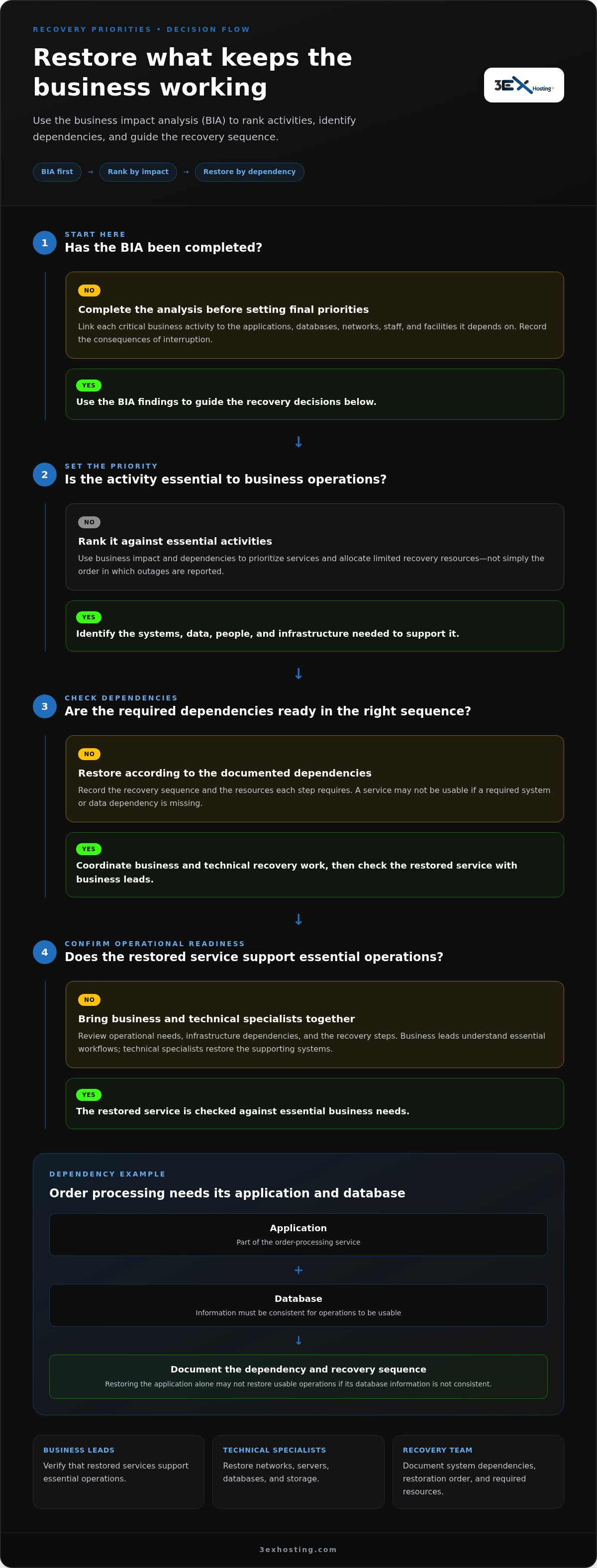
Complete the BIA before setting final recovery priorities. It links each critical business activity to the applications, databases, networks, staff, and facilities it depends on. The recovery team can then identify which systems support several departments and which serve a narrower task. Restore services according to business impact and dependencies, not simply the order in which outages are reported.
For example, order processing may rely on both an application and its database. Restoring the application without consistent database information may not make operations usable. Document these dependencies and the business impact of an interruption. Use the analysis to identify critical systems and data, then record the recovery sequence and the resources each requires.
Bring Department Leaders into Recovery Decisions
A business continuity planning manager works to keep critical technologies and business functions operating during a disaster. This requires input from department leaders who understand daily workflows, customer commitments, and the consequences of delaying tasks. Business unit advisors can explain which processes proposed recovery steps affect and whether those steps are practical. Their input helps teams make recovery decisions that reflect actual operating needs.
Coordinate recovery across HR, finance, customer support, and IT so restoring one function does not block another. For instance, customer support may need access to order information while finance needs transaction records. The IT applications monitor should work with the impact assessment and recovery team to identify restoration tasks and critical business unit requirements. Include less critical applications in planning, but schedule their recovery after essential services and dependencies.
Review priorities when business processes, systems, or dependencies change. This ongoing review keeps the BIA useful and gives recovery teams a clear basis for allocating resources during an outage.
Collaborative plan creation, updates, and testing
An effective disaster recovery plan reflects both technical expertise and how departments actually operate. Involve employees, department leaders, senior managers, and relevant stakeholders in developing it. Their input helps identify practical dependencies, clarify decision authority, and shape procedures teams can carry out under pressure.
Start with the business impact analysis, then ask system owners to document recovery steps for critical applications and infrastructure. Network, server, storage, and database specialists can explain dependencies, backup methods, and restoration requirements. Department representatives can assess whether proposed actions support essential workflows. Senior managers review strategic objectives, policies, and budgets before approving the plan, helping align it with organizational priorities.
Keep the plan current as systems, vendors, contacts, and business processes change. Assign an owner to coordinate reviews and record revisions, then involve the teams responsible for each procedure. A change to a database or application, for example, can affect recovery sequences and data consistency. Reviewing dependencies helps teams find gaps and improve recovery practices.
Test scenarios that exercise real recovery tasks, including data recovery, system restoration, and failover. Tests should show whether assigned individuals can follow documented steps, use the required communication channels, and restore dependencies in the intended sequence. Record results, gaps, and corrective actions. Update the relevant procedures, then repeat the scenario when changes affect recovery readiness.
After a recovery exercise, bring technical and business participants together to discuss what worked and what needs improvement. Use those findings to revise the plan, assign follow-up tasks, and incorporate lessons from actual incidents. To discuss infrastructure planning that supports recovery objectives, connect with the 3EX Hosting team.
3EX Hosting: Full Cabinet Colocation
3EX Hosting offers Full Cabinet Colocation for organizations that need physical space for server hardware as part of their recovery strategy. Private Colocation Suites and Cage Solutions provide additional infrastructure options for businesses planning where critical systems will operate. For teams considering hosted infrastructure alongside recovery planning, 3EX Hosting also provides Managed Cloud Hosting and Disaster Recovery Solutions.
These services may suit an organization whose business impact analysis identifies infrastructure location, hosting, or recovery resources as key dependencies. Match the environment to documented recovery priorities, system requirements, and operational responsibilities. Deciding where systems run can help teams develop practical, coordinated recovery procedures.
Contact 3EX Hosting or visit 3exhosting.com to discuss your infrastructure needs.
Put Your Recovery Priorities into Practice
The next step is to connect recovery objectives with the infrastructure that will support them. Review where critical workloads need to run, how much control your team needs over the environment, and which operating responsibilities should remain in-house. A clear ownership model for the roles and responsibilities in a DR plan also helps guide these infrastructure decisions.
3EX Hosting offers Full Cabinet Colocation, Private Colocation Suites, and Cage Solutions datacenter options for organizations planning physical infrastructure. Consider how each approach fits your documented recovery needs and operating model. The right conversation starts with your requirements, not assumptions about what every organization needs.
Contact 3EX Hosting today to discuss infrastructure options for your recovery priorities. A considered next step can help your team turn its plan into practical decisions.
Frequently Asked Questions
How Do These Responsibilities Affect the Operation of the Plan?
Clear responsibilities make recovery work easier to coordinate and track. Each team member knows when to act, what information to pass on, and who takes the next handoff. For example, a technical lead can record a system’s status before handing it to an application owner for validation. A shared decision log helps prevent repeated work and conflicting instructions.
What Are the Essential Elements of a Plan?
A useful plan includes activation criteria, decision authority, an inventory of essential systems, recovery procedures, communication paths, and a process for confirming normal operations. Add dependencies, vendor contacts, and alternate role assignments so the plan remains usable if a key person is unavailable. Include a place to record decisions and unresolved issues during an incident. These details help responders turn documented procedures into coordinated action.
Your DR planning team: Who should be included?
Involve people who understand business operations, technology, facilities, communications, and vendor relationships. For example, an application owner can explain how a service supports daily work, while a network specialist can identify connectivity dependencies. Include representatives from departments affected by an outage and someone authorized to approve priorities. Involve alternates in planning discussions so they have the context to carry out their assigned duties.
What roles are needed in a disaster recovery plan?
Most plans need an accountable plan owner, an authorized decision-maker, a recovery coordinator, technical recovery leads, business representatives, and a communications contact. Assign alternates where someone’s absence could delay a decision or task. The exact structure depends on the organization’s systems and operations. In a smaller organization, one person may hold several roles, but the plan should clearly distinguish each responsibility.
What are the responsibilities of a disaster recovery coordinator?
A disaster recovery coordinator organizes response activities and keeps teams aligned as conditions change. They gather situation updates, route decisions to authorized leaders, track open actions, and flag dependencies that could delay work. For example, if a restored system still depends on an unavailable service, the coordinator can alert the relevant teams to the blocker. They also support a clear transition from emergency response to recovery review.
What are the responsibilities of IT and system recovery teams in a DR plan?
IT recovery teams restore the technology services that business functions depend on, then verify that systems work together correctly. A server specialist may confirm operating system readiness, while database and application specialists check data consistency and service integrations. Network and security staff assess connectivity and access controls. Before returning systems to users, teams should document remaining issues and confirm that business owners can complete representative tasks.