 SUPPORT


 3EX United States
 Blog
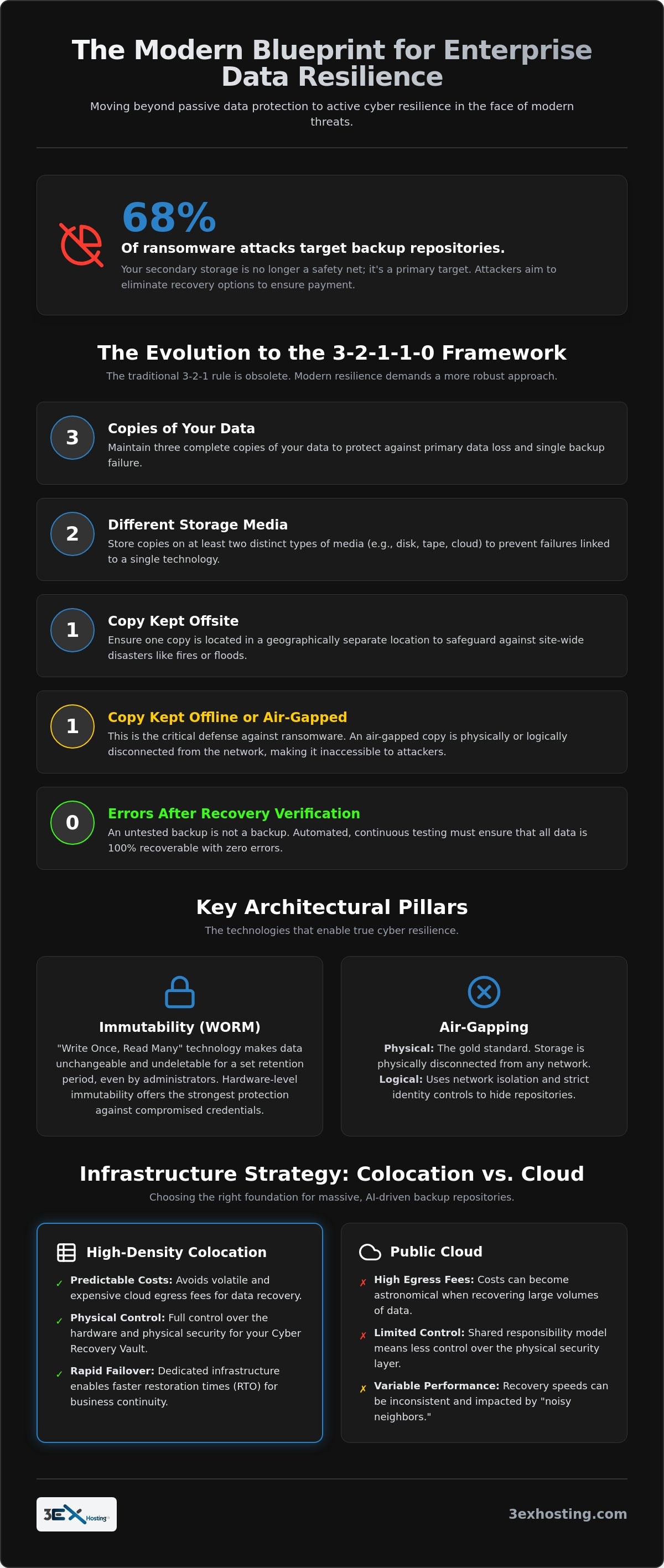
In 2025, 68% of ransomware attacks specifically targeted backup repositories to ensure victims had no choice but to pay. This shift makes it clear that your secondary storage is now a primary target. It’s a sobering reality for IT leaders already struggling with exponential data growth and the strict 24-hour reporting windows mandated by the NIS2 directive. You need a system that doesn’t just store data but actively defends it.
Finding the right enterprise data backup solutions is no longer just about capacity; it’s about building a fortress of cyber resilience. We understand that you’re looking for a way to balance predictable scaling costs with the need for absolute data integrity. This guide will show you how to master the architecture of enterprise-grade data protection, from implementing immutable storage to leveraging high-density infrastructure strategies. We’ll explore the transition to the 3-2-1-1 rule, simplified compliance auditing, and the technical requirements for automated failover and zero-loss recovery.
Key Takeaways
- Understand why the traditional 3-2-1 rule is obsolete and how the new 3-2-1-1-0 framework ensures zero-error data recovery in a post-ransomware landscape.
- Learn to architect modern enterprise data backup solutions using immutable storage and WORM technology to protect your repositories from unauthorized deletion.
- Compare the cost-efficiency of high-density colocation against public cloud egress fees for managing massive, AI-driven backup repositories.
- Master a step-by-step framework for auditing Recovery Point Objectives (RPO) and calculating the true five-year Total Cost of Ownership for your infrastructure.
- Discover how high-density cabinet solutions and 24/7 Remote Hands provide the physical foundation for rapid failover and disaster recovery.
The Evolution of Enterprise Data Backup Solutions in 2026
The definition of a robust backup strategy has fundamentally shifted. In 2026, the ecosystem for enterprise data backup solutions has moved far beyond simple replication or periodic snapshots. It’s now a high-performance infrastructure challenge. Legacy “tape and vault” strategies are failing because they can’t keep pace with the high-density requirements of AI-driven data sets. When you’re managing petabytes of training data, the recovery time objective (RTO) of physical tape retrieval is often measured in days. That’s unacceptable for modern business continuity.
We’re seeing a definitive move from passive “data protection” to active “cyber resilience.” This means your systems must do more than just store a copy; they must be capable of proactive recovery in a degraded environment. The core of this evolution lies in the separation of software logic and infrastructure performance. While software handles the deduplication and scheduling, the physical foundation, such as a Remote backup service or high-density colocation, dictates the actual speed of restoration. It’s the difference between having your data and having your business back online.
The New Regulatory Landscape
Compliance isn’t just a checkbox anymore; it’s a real-time operational requirement. The NIS2 directive and updated data sovereignty laws now dictate that enterprises must provide an “early warning” of significant incidents within 24 hours. This requires backup systems to have integrated, audit-ready reporting that can prove data integrity at a moment’s notice. National backup strategies now prioritize keeping data within specific geographic borders, making the choice of a local data center critical for legal adherence.
Ransomware and the “Backup as a Target” Trend
Ransomware actors have evolved. They don’t just encrypt production data; they spend weeks identifying and destroying backup repositories to eliminate your recovery options. Identity-based access controls and multi-person authentication are now mandatory for any recovery system. A Cyber Recovery Vault is an isolated, air-gapped environment that utilizes immutable storage and strictly controlled, identity-based access to ensure a clean copy of data remains available even if the primary production and backup networks are compromised. To support these massive, isolated repositories, many organizations are moving toward full cabinet colocation to maintain physical control over their most sensitive recovery assets.
Architecting for Resilience: Immutability and Air-Gapping
Resilience isn’t a passive state; it’s an architectural choice. In 2026, the most effective enterprise data backup solutions have transitioned to the 3-2-1-1-0 framework. This standard expands the traditional model by requiring three copies of data on two different media, with one copy offsite, one copy offline or air-gapped, and a mandatory “zero errors” verification. The “0” is the most critical addition. It demands automated, continuous testing to ensure that data isn’t just stored, but actually recoverable. An untested backup is merely a liability waiting to be discovered during a crisis.
Following the NIST Contingency Planning Guide helps organizations align their recovery strategies with federal-grade security standards. A major part of this alignment involves choosing between physical and logical air-gapping. Logical air-gapping uses network-level isolation and strict identity management to “hide” backup repositories. While efficient, it’s still vulnerable to sophisticated lateral movement. Physical air-gapping, where the storage medium is physically disconnected from any network, remains the gold standard for protecting against wide-scale encryption events. If you’re looking to strengthen your physical defense, you can request a custom infrastructure quote to see how isolated environments fit your budget.
Immutable Data Structures
Immutability is the backbone of modern ransomware defense. By utilizing WORM (Write Once, Read Many) technology, you ensure that once data is written, it cannot be modified or deleted by any user, including administrators, until the retention period expires. Hardware-level immutability is superior to software-only versions because it’s baked into the storage firmware. This prevents attackers from using compromised credentials to bypass protection layers. Managing these policies requires a balance between security and storage efficiency, as immutable blocks cannot be deduplicated after they’re locked.
High-Speed Recovery Mechanisms
Recovery Point Objectives (RPO) don’t matter if your Recovery Time Objective (RTO) is measured in days. Instant VM recovery has become a standard requirement for enterprise data backup solutions, allowing you to mount backup volumes directly as production storage to get services online in minutes. When dealing with massive datasets in a colocation environment, the speed of physical intervention is a factor. Leveraging remote hands support ensures that physical media management and hardware resets are handled by experts on-site, removing the latency of travel during a disaster recovery scenario.
Infrastructure Strategies: Colocation vs. Managed Cloud
Choosing the right physical foundation for enterprise data backup solutions is a strategic decision that affects both your budget and your recovery speed. While many vendors push a cloud-only narrative, the reality of petabyte-scale data management often favors a hybrid model. Public cloud providers offer excellent scalability, but they frequently hide significant costs behind egress fees. Industry data suggests that public cloud native services can cost between $300 and $600 per terabyte even before accounting for storage and transfer fees. This financial pressure is driving a resurgence in high-density colocation for bulk data storage.
When evaluating data backup strategies, you must consider the “egress tax” of the public cloud. A common 2026 architecture involves keeping management metadata in the cloud for accessibility while storing the actual data blocks in a private colocation environment. This setup utilizes high-speed network cross-connects to bypass the public internet. It ensures that when a recovery is triggered, the data moves at wire speed without the latency or cost fluctuations of standard cloud storage. These direct connections are essential for meeting the strict 24-hour reporting windows required by modern regulations.
The Case for High-Density Colocation
Modern backup appliances and high-capacity storage arrays generate intense heat and require significant power. Standard data centers often struggle to support these loads. High-density colocation environments are specifically designed with advanced cooling systems to handle these requirements. For organizations with strict security needs, cage colocation provides a physical layer of isolation for backup hardware. This ensures that your recovery assets are physically secure and located near your primary compute resources to minimize latency during a restore. It’s a pragmatic way to maintain physical control over your most critical data copies.
Managed Cloud as a Recovery Target
Managed cloud remains essential for bursty workloads and rapid failover. It provides the flexibility to scale resources instantly when a disaster occurs. Integrating your backup strategy with managed cloud hosting allows for automated recovery testing in a sandbox environment. You can choose between multi-tenant environments for cost-efficiency or private managed clouds for dedicated performance and tighter security controls. This flexibility ensures that your recovery target matches the specific criticality of each workload, allowing you to prioritize high-value applications during a restoration event.
A Framework for Evaluating Enterprise Backup Vendors
Selecting the right enterprise data backup solutions requires moving past marketing brochures and into technical specifics. A structured framework ensures that your chosen platform can handle the data volumes of 2026 while remaining financially sustainable. It’s not just about the software features; it’s about how those features translate into actual business continuity.
Step 1 involves auditing your Recovery Point Objective (RPO) requirements by workload. Financial transactions and real-time AI models require near-zero RPOs, while historical logs might only need 24-hour protection. Aligning backup frequency with the actual rate of data change prevents over-provisioning storage while ensuring you meet recovery mandates. In Step 2, assess the Total Cost of Ownership (TCO) over a five-year horizon. This calculation must include software licensing, storage hardware, and the operational costs of power and cooling we discussed in previous sections.
Step 3 focuses on security. Verify that the vendor supports Zero Trust architecture, including mandatory Multi-Factor Authentication (MFA) for all administrative actions. Backups must be isolated to prevent lateral ransomware movement. Finally, Step 4 requires testing support SLAs. Physical recovery often necessitates on-site intervention. Having access to Remote Hands Support is essential for tasks like drive swaps or physical server resets when your internal team can’t be on-site immediately.
Defining Mission-Critical Recovery Metrics
Security and Compliance Checklist
Compliance standards for 2026 demand that data in transit and at rest utilize AES-256 encryption at a minimum. You must also ensure that your provider adheres to national data sovereignty mandates, keeping sensitive backups within specific legal jurisdictions to avoid regulatory penalties. A SOC2 Type II certification is a non-negotiable requirement for any backup provider, as it provides an independent audit of the service’s security, availability, and processing integrity over a sustained period. If you need a foundation that meets these rigorous standards, you can get a custom quote for a secure, compliant infrastructure today.
Implementing Future-Proof Backup with 3EX Hosting
The architecture of 2026 demands more than just software logic; it requires a physical foundation capable of supporting high-density, immutable storage. 3EX Hosting provides the specialized infrastructure necessary to turn the theoretical 3-2-1-1-0 rule into a functional reality. By leveraging full cabinet colocation, your organization can deploy the massive backup repositories needed for AI-driven datasets and long-term retention. This physical control is the only way to guarantee the air-gapping and immutability discussed in previous sections without the unpredictable egress costs of the public cloud.
A resilient strategy combines the physical security of colocation with the agility of the cloud. We offer managed cloud hosting that integrates directly with your recovery infrastructure, providing a seamless failover target during an outage. This hybrid approach ensures that your metadata remains accessible while your bulk data stays protected in a high-performance environment. Our 24/7 technical expertise serves as the final layer of your defense, providing the rapid physical intervention required when seconds dictate your recovery success. Implementing modern enterprise data backup solutions requires this level of synergy between software and site management.
Customizable Disaster Recovery Solutions
Every industry has unique recovery requirements. We tailor our disaster recovery solutions to meet your specific RTOs and RPOs, ensuring that mission-critical workloads receive the highest priority. For organizations with strict compliance or data sovereignty needs, our private colocation suites offer maximum isolation and security. Integrating high-speed network cross-connects allows for rapid data synchronization between your primary compute and your backup vault, bypassing the latency issues common with standard internet-based transfers. This ensures your enterprise data backup solutions perform at wire speed when it matters most.
Expert Support and On-Site Management
Operational overhead shouldn’t be the bottleneck in your recovery plan. Our remote hands support is available 24/7 to handle physical tasks like hardware resets, cable management, or media swaps. This removes the need for your internal team to travel to the data center during a crisis. For large-scale deployments, our move-in assistance ensures that your high-density backup arrays are installed and networked correctly from day one. This expert-led approach reduces the risk of configuration errors and speeds up your time-to-protection.
Get a custom quote for your enterprise backup infrastructure to see how we can secure your data for the long term.
Building a Resilient Infrastructure for 2026
The shift from simple data protection to comprehensive cyber resilience is no longer optional. Mastering the 3-2-1-1-0 rule and implementing hardware-level immutability are the only ways to stay ahead of sophisticated ransomware. Modern enterprise data backup solutions require more than just the right software; they demand a physical foundation that can handle high-density AI workloads while providing the carrier-neutral connectivity needed for rapid synchronization.
Choosing the right partner means finding a balance between managed cloud agility and the security of private colocation. With 24/7 Remote Hands Support and high-density infrastructure designed for massive data racks, you can ensure that your recovery time objectives are always met, regardless of the disaster scenario. It’s time to move beyond passive storage and build a proactive recovery environment that scales with your business needs.
Ready to architect your recovery vault? Secure Your Enterprise Data with 3EX Hosting Solutions and gain the technical stability your business deserves. You’ve done the hard work of planning; now it’s time to deploy a foundation that won’t let you down.
Frequently Asked Questions
What is the 3-2-1-1-0 backup rule for enterprises?
The 3-2-1-1-0 rule is the modern standard for data resilience. It requires keeping three copies of your data on two different types of media, with one copy stored offsite and one copy stored offline or in an immutable state. The “zero” represents the requirement for zero errors during automated recovery testing. This framework ensures that enterprise data backup solutions remain reliable even when primary systems are compromised by ransomware.
How does immutable storage protect against ransomware?
Immutable storage uses WORM (Write Once, Read Many) technology to lock data for a specific retention period. Once the data is written to the repository, it cannot be modified, encrypted, or deleted by any user or application. This prevents ransomware from destroying your recovery points, as even an attacker with administrative credentials cannot bypass the hardware-level or firmware-level locks protecting the blocks.
What is the difference between RTO and RPO in disaster recovery?
Recovery Time Objective (RTO) measures the duration of time a business process can be down before causing significant damage. Recovery Point Objective (RPO) refers to the maximum age of files that must be recovered from backup for normal operations to resume. Essentially, RTO is about speed of restoration, while RPO is about the acceptable window of data loss between backups.
Why is colocation often cheaper than public cloud for large backups?
Colocation offers predictable monthly costs and eliminates the high egress fees associated with public cloud providers. When you need to restore petabytes of data, cloud providers often charge significant fees for transferring that data back to your compute environment. High-density colocation allows you to maintain physical control over your hardware while benefiting from fixed power and cooling costs, making it more economical for massive enterprise data backup solutions.
Can I use managed cloud hosting for my secondary backup site?
Yes, managed cloud hosting is an excellent choice for a secondary backup site because it provides rapid failover capabilities. It allows you to spin up virtual machines and applications instantly if your primary site goes offline. This hybrid approach combines the security of a physical backup with the agility of the cloud, ensuring your business stays operational during a disaster recovery event.
What should I look for in a data center for backup infrastructure?
You should prioritize high-density power and cooling capabilities to support large storage arrays. Look for a facility that offers N+1 redundancy for all critical systems and carrier-neutral connectivity to ensure multiple paths for data synchronization. Physical security features, such as private suites or cage solutions, are also vital for protecting the integrity of your backup hardware from unauthorized access.
How does air-gapping work in a modern cloud environment?
Modern air-gapping is often logical rather than physical, using strict API isolation and network-level security to separate the backup vault from the production network. Data is pushed to an isolated environment that has no persistent connection to the primary infrastructure. This prevents lateral movement by attackers, as the “gap” is only bridged during specific, authenticated backup windows using zero-trust access controls.
Is remote hands support necessary for managed backup solutions?
Remote hands support is essential for any infrastructure-based backup strategy. During a disaster, your internal IT team may not be able to reach the data center immediately. Having 24/7 on-site experts available to swap failed drives, reset hardware, or manage physical media ensures that the recovery process isn’t delayed by travel time or physical logistics.