 SUPPORT


 3EX United States
 Blog
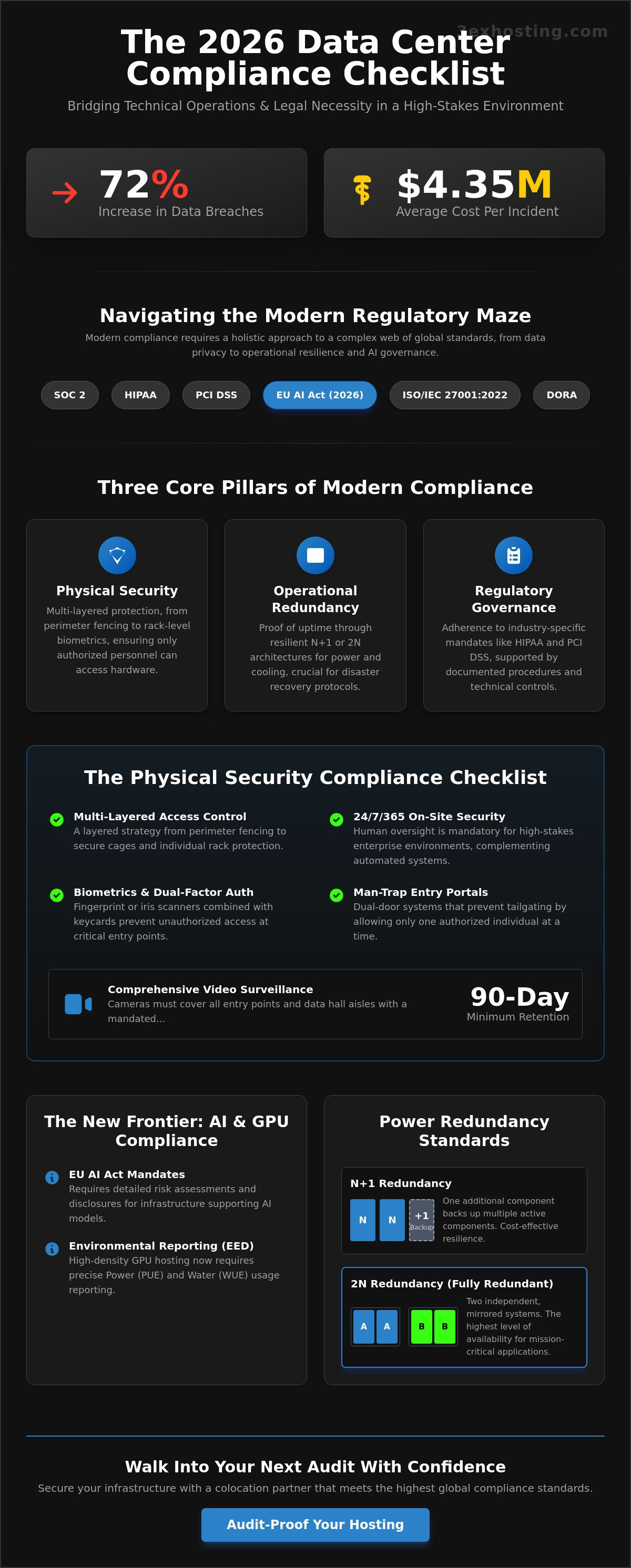
With data breaches increasing by 72% recently, a single security failure now carries an average cost of $4.35 million per incident. You’re likely managing a complex web of SOC2, HIPAA, and PCI requirements while trying to understand how the 2026 EU AI Act impacts your infrastructure footprint. It’s a high-stakes environment where physical security gaps or outdated ISO standards lead to severe regulatory penalties. We’ve developed this comprehensive data center compliance checklist to help you bridge the gap between technical operations and legal necessity.
You’ll gain a clear framework for auditing providers and verifying that your infrastructure meets the latest ISO/IEC 27001:2022 and DORA standards. We’ve simplified the process of documenting physical access, backup power resilience, and AI-specific workload monitoring. By following this guide, you can walk into your next third-party audit with the confidence that your systems are secure, stable, and fully aligned with global mandates. This article covers everything from 90-day video retention to the specific documentation required for modern high-density GPU hosting.
Key Takeaways
- Learn to implement continuous compliance monitoring to replace outdated, point-in-time audit cycles.
- Use our data center compliance checklist to audit layered security protocols from the perimeter to the individual server rack.
- Determine whether N+1 or 2N power redundancy is necessary to satisfy your specific disaster recovery and regulatory standards.
- Streamline your audit preparation by focusing on the core physical requirements of SOC 2 Type II and PCI DSS.
- Identify colocation providers that offer the high-density infrastructure required for compliant AI and GPU hosting.
What is Data Center Compliance in 2026?
Data center compliance represents the framework of physical, technical, and administrative controls used to protect data integrity and ensure service availability. It’s no longer just a legal requirement. In 2026, compliance is the primary differentiator for enterprise colocation providers. Organizations now prioritize physical sovereignty as a core business strategy. They understand that digital data protection is only as strong as the physical walls and biometric locks surrounding the hardware. If the physical layer is compromised, the digital encryption layer becomes vulnerable.
The industry has moved away from traditional “check-the-box” annual audits. Modern compliance requires continuous monitoring and real-time reporting. Using a dynamic data center compliance checklist allows IT leaders to maintain a constant state of audit-readiness. This shift is driven by regulations like the EU’s Digital Operational Resilience Act (DORA), which mandates prompt incident disclosure and rigorous third-party risk testing. You can’t rely on a snapshot from six months ago to prove your security posture today.
Adhering to established Data Center Security Standards involves more than just installing cameras. It requires a holistic approach where every hardware component is accounted for within a secure perimeter. This level of control is why many firms choose private colocation suites to ensure their physical infrastructure remains isolated and audited according to their specific corporate mandates. A secure environment is the foundation of technical stability.
The Core Pillars of Modern Compliance
Three foundational elements define the current compliance environment:
- Physical Security: This involves multi-layered protection, from perimeter fencing to rack-level biometrics. You must verify that only authorized personnel can touch the physical servers.
- Operational Redundancy: Compliance requires proof of uptime. Standards like N+1 or 2N architectures for power and cooling are non-negotiable for disaster recovery protocols.
- Regulatory Governance: This covers industry-specific mandates. Whether it’s HIPAA for healthcare or PCI DSS for payments, your infrastructure must support these technical requirements through documented procedures.
Why Enterprises Can No Longer Ignore AI Governance
The 2026 regulatory environment introduces strict requirements for AI workload transparency and data lineage. The EU AI Act now mandates detailed risk assessments and disclosures for the infrastructure supporting AI models. High-density GPU hosting significantly impacts environmental reporting under the Energy Efficiency Directive (EED). Data centers must now report precise Power Usage Effectiveness (PUE) and Water Usage Effectiveness (WUE) metrics. Meeting these AI-specific safety standards requires specialized cooling and power management systems. A modern data center compliance checklist must include these sustainability and transparency metrics to ensure long-term viability in a regulated market.
The Physical Security Compliance Checklist
Physical security is the first line of defense for any enterprise infrastructure. A robust data center compliance checklist starts at the perimeter. Security isn’t just about a locked door; it’s a layered strategy. You need to verify that your provider uses a multi-tiered approach including perimeter fencing, facility access control, and individual rack protection. This ensures that a breach at one level doesn’t compromise the entire system. Technical stability depends on these physical barriers remaining impenetrable.
On-site security personnel must be present 24/7/365. Automated systems are efficient, but human oversight is required for high-stakes enterprise environments. Audit your provider’s “man-trap” entry systems. These dual-door portals prevent tailgating by ensuring only one person enters at a time. High-security facilities also rely on biometric access and dual-factor authentication. These controls map directly to University of Texas Data Center Security Standards which emphasize NIST-aligned physical barriers and strict access management.
Video surveillance is a standard requirement, but the retention period is what matters for compliance. In 2026, many frameworks require a minimum of 90 days for CCTV footage. Check that cameras cover every entry point and all aisles within the data hall. If you’re planning a deployment, you can request a facility overview to see these security layers in person. Seeing the physical implementation of these protocols often provides the best assurance of reliability.
Cage and Cabinet Sovereignty
For many enterprises, shared space isn’t enough to meet regulatory demands. Cage Solutions provide floor-to-ceiling fencing and independent locking mechanisms to create a private perimeter within the data center. If you opt for Full Cabinet Colocation, verify that each individual rack has unique locks and sensor-based alerts. Managing access logs is critical. You need a transparent, digital record of exactly who touched your hardware and when. This documentation is vital for passing third-party audits and maintaining accountability.
Environmental and Hazard Controls
Physical safety extends to environmental stability. Fire suppression systems should use pre-action dry pipes or gaseous agents like FM-200 to prevent water damage to sensitive electronics. Leak detection sensors must be placed under raised floors to catch moisture before it reaches your racks. For high-density enterprise setups, seismic bracing is a non-negotiable requirement. It protects your hardware from structural vibrations or seismic events, ensuring your systems remain operational during a crisis. These controls are essential for maintaining the high availability that modern workloads demand.
Operational Redundancy and Uptime Standards
Operational redundancy is the technical backbone of regulatory compliance. It’s not just about staying online; it’s about proving your facility can withstand component failures without service interruption. Auditors look for specific Tier-standard benchmarks when evaluating a facility. A comprehensive data center compliance checklist must move beyond vague “uptime” promises and focus on the specific architecture of power and cooling systems. If you can’t demonstrate how your system handles a failure, you won’t pass a modern SOC 2 or DORA audit.
Evaluating power redundancy requires a choice between N+1 and 2N architectures. An N+1 system provides one extra component for every N components in use. While this is sufficient for many, enterprise-grade compliance often demands 2N redundancy. This means two completely independent power systems, each capable of carrying the full load. If one entire grid or generator set fails, the other takes over instantly. This level of resilience is essential for high-density AI infrastructure hosting where power draws are massive and constant.
Cooling resilience is equally critical for 2026 compliance. High-density GPU workloads generate concentrated heat that standard cooling can’t manage. Your audit should verify N+1 cooling at the room level and potentially at the rack level. Backup systems must be tested under full load to ensure they maintain the required thermal environment during a power transition. Additionally, your provider must maintain a minimum 72-hour fuel supply for on-site generators. Regular load bank testing and fuel quality analysis are mandatory documentation points for any regulatory review.
Power Infrastructure Audit
Audit your UPS capacity and failover protocols. Documentation should show exactly how the system behaves during a utility power loss. Every Full Cabinet Colocation unit must receive dual-feed power from independent PDUs. This ensures that a single power strip failure won’t bring down your hardware. Real-time PDU monitoring is also necessary. It provides the granular data needed for energy efficiency reporting and capacity planning.
Disaster Recovery and Business Continuity
Disaster recovery is a core component of regulatory governance. You must align your RTO (Recovery Time Objective) and RPO (Recovery Point Objective) with your industry’s specific legal mandates. Carrier-neutral connectivity is vital here. It allows for diverse network paths and instant failover to secondary providers if a primary link goes dark. For a deeper look at these requirements, see our guide on Strategic Disaster Recovery for Enterprise Continuity. A stable DR plan ensures that even in a total facility crisis, your data remains accessible and compliant.
Navigating Regulatory Frameworks and Audits
Regulatory frameworks provide the legal structure for your security operations. While previous sections focused on physical barriers and redundancy, this stage of your data center compliance checklist involves verifying the administrative proof of those controls. In 2026, simple compliance isn’t enough. You need documented evidence that your provider maintains these standards through rigorous third-party validation. This transparency is what separates high-tier facilities from basic server rooms.
SOC 1 Type II and SOC 2 Type II reports remain the gold standard for enterprise service organizations. A “Type II” designation is critical because it confirms that security controls were tested and functioned effectively over a period of 6 to 12 months. It’s much more reliable than a “Type I” report, which only looks at a single point in time. For businesses handling payment data, PCI DSS mandates specific physical requirements, including restricted access to cardholder data environments and strict visitor logging. Similarly, HIPAA and HITECH standards require physical safeguards to protect sensitive patient information from any unauthorized viewing or physical theft.
The 2026 regulatory shift has added a new layer: Sustainability and Environmental reporting. Under the EU’s Energy Efficiency Directive (EED), data centers must now report precise Power Usage Effectiveness (PUE) and Water Usage Effectiveness (WUE) metrics. Even in the US, initiatives like Oregon’s 2025 POWER Act are incentivizing efficient grid profiles. Your compliance framework must now include these environmental data points to satisfy both government mandates and corporate ESG goals. If you need to verify how your current setup aligns with these standards, you can request a compliance summary for a detailed breakdown of facility certifications.
Gathering Compliance Proof
Requesting a “Bridge Letter” is a standard part of the audit process. This document covers the gap between the end of a provider’s last SOC report and the current date. You should also verify that your colocation contract includes a “Right-to-Audit” clause. This allows your internal or third-party auditors to physically inspect the facility and verify that the provider’s claims match the reality on the data center floor. Relying solely on a PDF report is a risk that modern enterprise IT leaders don’t take.
Operational Support in Audits
Physical audit walkthroughs can be logistically challenging, especially for remote teams. This is where Remote Hands Support becomes an essential compliance tool. On-site technicians can assist auditors by providing visual verification of rack locks, cabling standards, and biometric scanners. They also play a role in hardware lifecycle management. Compliance logs must document every asset from the moment it enters the facility until its secure destruction. Accurate inventory management and real-time asset tracking are no longer just operational tasks; they are core requirements for passing a modern infrastructure audit.
Choosing a Compliant Colocation Partner
Selecting a partner involves more than comparing rack rates. It’s about finding a provider that views compliance as a continuous service rather than a yearly event. This “Compliance-as-a-Service” model ensures that every operational change is documented and every hardware addition is audited in real time. When evaluating partners, use your data center compliance checklist to see if they offer the transparency required for 2026 enterprise standards. You shouldn’t have to chase your provider for SOC reports or access logs.
High-density capabilities are now a fundamental part of compliant AI hosting. The 2026 regulatory environment, including the EU AI Act and various energy directives, means you need a partner capable of managing massive thermal loads while maintaining precise environmental reporting. If a facility can’t support high-density GPU clusters with verified cooling redundancy, your compliance posture for AI workloads will suffer. You need a provider that combines technical stability with the specific power capacity required for modern machine learning infrastructure.
Technical expertise must be available 24/7 to maintain audit-readiness. Compliance failures often happen during off-hours or during rapid hardware deployments when protocols are bypassed for speed. Having expert remote hands on-site ensures that physical security standards are followed every time a technician touches a server. This level of professional oversight provides the peace of mind that your systems are in expert hands at all times.
The 3EX Hosting Approach to Compliance
We provide Private Data Center Suites for organizations that require total physical isolation and customized security controls. This approach allows you to implement biometric and CCTV protocols that exceed standard colocation offerings. We maintain a commitment to carrier-neutral connectivity, ensuring your network remains resilient through diverse high-performance cross-connects. Additionally, our Move-in Assistance team helps you deploy hardware according to your specific compliance logs from Day 1. This prevents the configuration drift that often leads to audit failures during the initial setup phase.
Final Audit Checklist for Decision Makers
Before signing a contract, run through this final data center compliance checklist to verify the provider’s operational maturity:
- Physical Access: Confirm the use of biometric scanners at all entry points and verify a minimum 90-day CCTV retention policy.
- Redundancy Logs: Review historical N+1 or 2N logs for power and cooling to ensure the system handles transitions without interruption.
- Certification Validity: Confirm the presence of a current SOC 2 Type II report and any required industry-specific certifications like HIPAA or PCI DSS.
- AI Infrastructure Support: Verify the facility’s ability to provide high-density power and the reporting required for 2026 environmental mandates.
Get a custom quote for your compliant enterprise infrastructure and ensure your data remains secure, stable, and fully audited.
Future-Proofing Your Infrastructure for 2026 and Beyond
The landscape of enterprise infrastructure has shifted from static annual audits to a model of continuous operational excellence. Maintaining an updated data center compliance checklist is no longer optional; it’s a requirement for navigating the new EU AI Act and global sustainability mandates. You’ve seen how physical sovereignty, combined with N+1 power and cooling redundancy, creates the stability needed for high-density workloads. By prioritizing transparent documentation and rigorous access controls, you protect your business from both technical failures and regulatory penalties.
We provide the technical foundation you need to stay ahead of these complex requirements. Our SOC 2 Type II audited infrastructure ensures your data remains protected within a framework of proven, tested controls. With 24/7/365 on-site remote hands support, you have expert eyes on your hardware at all times, ensuring that every physical interaction meets your strict audit standards. Secure your enterprise future with 3EX Hosting’s compliant colocation solutions.
You don’t have to navigate these regulatory shifts alone. With the right partner and a proactive strategy, you can turn compliance into a competitive advantage that builds trust with your clients and stakeholders.
Frequently Asked Questions
What is the difference between SOC 2 Type I and Type II for data centers?
SOC 2 Type I evaluates the design of security controls at a specific point in time, while Type II assesses the operational effectiveness of those controls over a period, typically six to twelve months. Type II reports provide the historical proof that auditors require for enterprise-grade assurance. It’s the standard for any serious data center compliance checklist because it proves the controls actually work in practice.
Does colocation make my business automatically HIPAA compliant?
Colocation only secures the physical layer of your infrastructure, meaning HIPAA compliance remains a shared responsibility. While the provider handles physical access and facility security, you’re responsible for technical safeguards like encryption and administrative access controls. You must sign a Business Associate Agreement (BAA) with your provider to define these boundaries and ensure all patient data remains protected.
How often should a data center undergo a compliance audit?
Most data centers undergo formal third-party audits annually to maintain certifications like SOC 2 or PCI DSS. However, the 2026 regulatory environment favors continuous monitoring over point-in-time assessments. Leading providers now perform internal reviews quarterly to ensure all systems, from biometric scanners to generator fuel levels, remain within specified tolerances. This proactive approach prevents surprises during the formal annual audit.
What are the physical security requirements for PCI DSS compliance?
PCI DSS requires strict physical access controls to any area where cardholder data is processed or stored. This includes dual-factor authentication, biometric scanners, and a minimum 90-day retention period for CCTV footage. You must also maintain a visitor log that records the name, firm, and authorized personnel escorting any non-employee within the facility. These logs must be kept for at least one year to satisfy audit requirements.
How does AI and high-density hosting affect data center compliance?
AI workloads require high-density power and cooling, which triggers new environmental reporting requirements under the 2026 Energy Efficiency Directive (EED). Compliance now includes documenting precise Power Usage Effectiveness (PUE) and Water Usage Effectiveness (WUE) metrics. The EU AI Act also mandates transparency regarding the physical location and security of the infrastructure supporting high-risk AI models, requiring more granular asset tracking than traditional hosting.
Can I perform my own physical audit of a colocation facility?
You can perform a physical audit if your colocation agreement includes a “Right-to-Audit” clause. This allows your internal security team or a third-party auditor to inspect the facility’s perimeter, man-traps, and rack-level security. It’s an essential step for verifying that the provider’s operational reality matches their written certifications. Most enterprise-grade providers welcome these inspections as a way to demonstrate their commitment to technical excellence.
What is a Bridge Letter in data center compliance?
A Bridge Letter is a formal document issued by a provider to cover the period between the end of their last audit and the current date. It confirms that no significant changes have occurred in their control environment during that gap. This letter ensures your compliance documentation remains current for your own internal or external auditors. It acts as a temporary placeholder until the next formal SOC report is released.
Why is carrier neutrality important for compliance and disaster recovery?
Carrier neutrality allows you to use multiple network providers, which is vital for network path diversity and disaster recovery. If one carrier experiences a regional outage, your systems can fail over to a secondary provider instantly. This redundancy is a core requirement for meeting the high-availability standards found on a modern data center compliance checklist. It prevents a single point of failure from compromising your uptime and regulatory standing.