 SUPPORT



 3EX United States
Blog
A project model can calculate correctly and still mislead when its structure, cash flow timing, or assumptions are poorly controlled. Reliable financial modeling and simulation infrastructure connects project costs, funding, operating cash flows, debt obligations, and scenario testing in a traceable model. The outputs are only as useful as the logic and documentation behind them.
Long timelines and changing project conditions make it essential to separate assumptions from formulas and control revisions. A clear model architecture helps teams see how each input affects cash flow, financing capacity, and returns. Consistent version control also makes it easier to understand what changed and why.
This article explains how to structure an infrastructure model, map development and operating cash flows, document key assumptions, and manage versions for dependable analysis. It also covers how computing, data, and cloud infrastructure can support simulation workloads, and what to consider when evaluating project performance across scenarios.
Key Takeaways
- Match compute, data, and cloud resources to the model’s workload so simulations can run efficiently and produce useful outputs.
- Build a repeatable deployment process with documented assumptions and version control to make model changes easier to trace.
- Plan Monte Carlo and high-performance computing environments around parallel workloads, data movement, and storage needs.
- For AI workloads that need physical server space, compare full cabinets, private suites, and cage configurations against your infrastructure requirements.
What computing, data, and cloud infrastructure do financial simulations require?
Financial simulations need compute resources matched to the model’s calculation pattern, data volumes, and run frequency. A project finance model with a monthly timeline might calculate construction spending, operating revenue, and debt service across many periods. A single scenario can run in a standard compute environment, while large batches of cases can benefit from parallel processing. Start by mapping the model’s inputs, calculations, and expected outputs.
CPU resources handle many spreadsheet-style calculations and linked financial statements. GPU resources can help with workloads designed to run many calculations in parallel, but they are not automatically faster for every model. For example, a Monte Carlo analysis with independent trials can distribute work across compute nodes. A model with sequential dependencies may benefit less from parallel execution. Test representative runs before choosing an environment.
Data infrastructure must keep assumptions, source records, and results organized. Separate raw inputs from cleaned data and model outputs. For a transport project, traffic forecasts, tariff assumptions, and construction schedules should have clear owners and consistent time periods. Use a controlled data pipeline to validate formats, flag missing values, and record when each dataset enters the model. This makes results easier to trace to their inputs.
Storage and network design also affect run efficiency. Large simulation batches can produce substantial intermediate files, so distinguish durable project records from temporary working data. Fast storage can reduce delays when models repeatedly read shared inputs. Network capacity matters when compute nodes retrieve datasets from central storage or send results to analysts. Keep frequently used inputs close to the compute environment to avoid unnecessary data movement.
Cloud infrastructure can provide flexible compute capacity for short, intensive workloads. A practical setup separates development, testing, and production environments. Teams can validate a model in a controlled test environment before running approved scenarios at scale. Access controls should reflect the sensitivity of financial assumptions and project data. Clear permissions reduce unnecessary exposure while giving analysts access to the datasets they need.
For reliable financial modeling and simulation infrastructure, tie resource decisions to specific workloads. Record the model’s data sources, expected run patterns, storage needs, and output requirements. Then test a representative case, measure where processing time accumulates, and adjust compute, storage, or network resources accordingly. This avoids sizing an environment by guesswork and helps keep simulation results useful for project decisions.
Record how the model links development and construction costs, demand and utilization forecasts, revenue mechanisms, operating and lifecycle expenditure, funding requirements, debt and equity structures, cash flows, debt-service capacity, investor returns, valuation, and scenario analysis. The International Energy Agency estimates global infrastructure investment will require $4.5 trillion annually by 2026.
Run scenarios through equity contributions, debt drawdowns, financing costs, operating cash flow, debt-service obligations, reserve requirements, free cash flow, and distribution capacity, while testing a minimum DSCR covenant of 1.15x or 1.20x. Simulations may introduce economic data, regulatory changes, or project-specific risk events for participants to respond to.
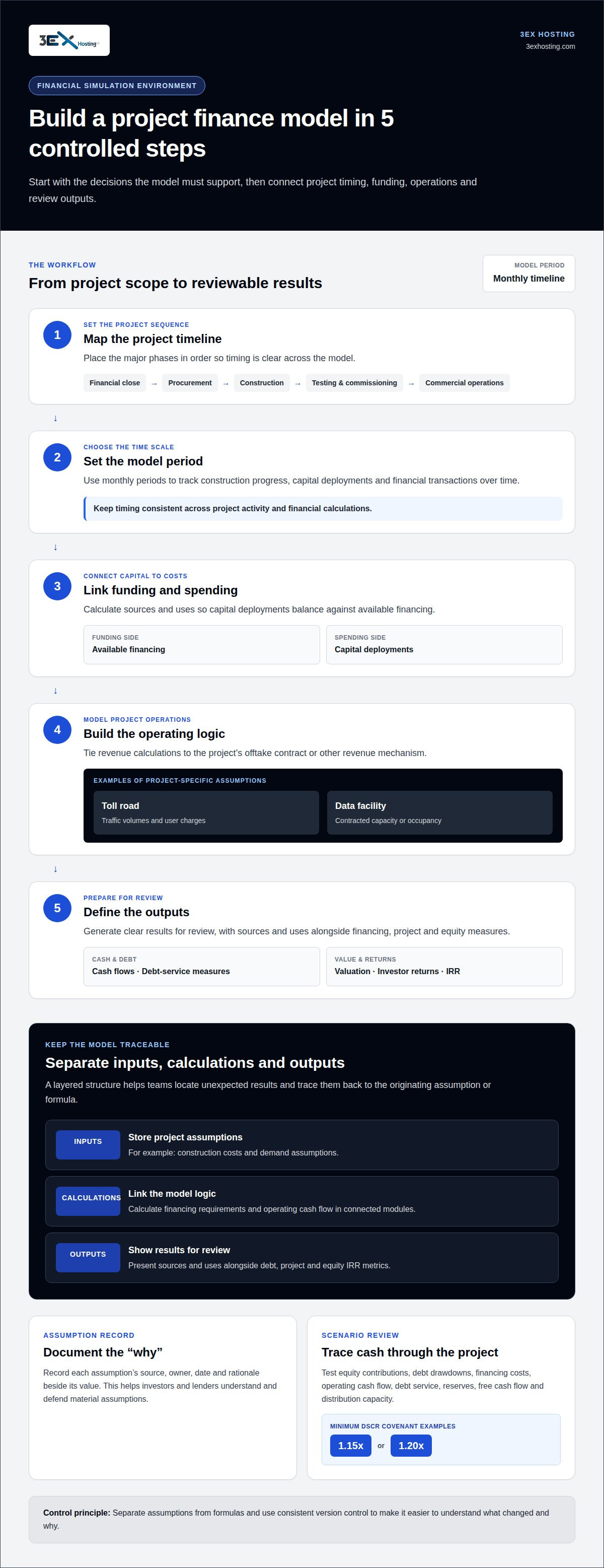
How do firms build and deploy a financial simulation environment?
Build the environment around the project model’s decisions, inputs, and approval process. A model for an infrastructure project should connect development and construction costs with revenue, financing, debt service, and investor returns. Define the required outputs first, then identify the data, calculation logic, and compute resources each one needs. This gives technical teams a clear deployment scope and prevents the simulation platform from growing beyond its purpose.
Use a staged workflow to move from project assumptions to controlled model runs:
- Map the project timeline. Include financial close, procurement, construction, testing, commissioning, and commercial operations.
- Set the model period. Monthly timelines can track construction progress, capital deployments, and financial transactions.
- Connect funding and spending. Calculate sources and uses so capital deployments balance against available financing.
- Build the operating logic. Tie revenue calculations to the project’s offtake contract or other revenue mechanism.
- Define outputs. Generate cash flows, debt-service measures, valuation, and investor-return results for review.
Separate the model’s input, calculation, and output layers. For example, store construction costs and demand assumptions as inputs, then calculate financing requirements and operating cash flow in linked modules. Output sheets should show sources and uses alongside debt, project, and equity IRR metrics. This structure helps locate unexpected results and trace them to the originating assumption or formula.
Use project-specific assumptions instead of copying a template without review. A toll road may rely on traffic volumes and user charges, while a data facility may use contracted capacity or occupancy assumptions. Record each assumption’s source, owner, date, and rationale beside its value. Investors and lenders need to understand and defend material assumptions, particularly when a change affects revenue or debt-service capacity.
Before deployment, test the model in a controlled environment. Check that assets balance with liabilities and equity, cash flows fall in the correct periods, and debt draws align with project funding needs. Run a base case and adverse scenarios, such as construction delays, cost overruns, reduced demand, or higher operating costs. Record the model version and scenario inputs for every run so reviewers can reproduce the results.
Release a model only after its calculation logic, outputs, and scenario behavior have been reviewed. Keep approved versions separate from working copies, and document each material change. This gives analysts a stable reference point while allowing new assumptions to be tested without obscuring earlier results. A disciplined deployment process makes project analysis repeatable rather than a collection of untracked spreadsheets.
What infrastructure is needed for Monte Carlo simulations and high-performance computing?
Monte Carlo simulations repeat a model with varied inputs, then summarize the range of outcomes. For an infrastructure project, runs might vary construction timing, demand, operating costs, or financing assumptions. High-performance computing (HPC) can distribute independent runs across multiple processors. The environment must also collect results consistently so analysts can compare outcomes without mixing inputs or model versions.
Start by dividing the workload into repeatable tasks. Each run needs defined input distributions, a model version, and a recorded random seed. A seed lets the team reproduce a particular run. Store those details with the output, including key measures such as debt-service capacity, equity returns, and cash flow. If a project model has dependencies requiring sequential calculations, preserve those steps rather than forcing them into parallel processing.
Choose compute resources according to how the model calculates. CPU-based nodes can run independent financial model cases in parallel. GPU computing may suit workloads designed for many simultaneous calculations, but it is not required by default for every financial simulation. Benchmark a representative sample first. Compare completion time, memory use, data transfer, and output consistency, then scale the configuration that fits the workload.
Monte Carlo results need reliable storage and an efficient path between data and compute. Keep approved assumptions and reference datasets separate from temporary run files. Use structured output tables for each trial, scenario, and model version. For example, a renewable energy analysis can retain production assumptions alongside debt-sizing results. This lets analysts trace a result to the exact inputs that produced it.
Use scenario design to make compute time decision-relevant. Project finance analysis can test revenue downside of 15% or 20%, and a 10% increase in operating and maintenance costs. Renewable energy debt sizing may also use P90 production estimates. These cases should be defined as explicit inputs, not manually changed between runs. A central run manager can queue cases, track completion, and flag failed jobs for review.
HPC operations also need access controls, workload monitoring, and recovery procedures. Separate development runs from approved production simulations, and restrict sensitive project data to authorized users. Monitor processor and memory utilization to identify bottlenecks. Keep logs of failed tasks and rerun them with the same inputs. For teams planning compute-intensive AI workloads, explore infrastructure hosting options as part of the capacity plan.
Reviewers should carefully evaluate system performance metrics before adjusting resources. Investors and lenders evaluating infrastructure models need to assess whether project cash flows can support debt obligations and how the project performs under adverse conditions. Participant performance may be assessed using financial-model resilience, target equity returns, and debt service coverage ratios under stress.
Infrastructure project finance models should include sensitivities and scenarios to test financial performance under different conditions. Recorded runs make these cases comparable and traceable, helping reviewers see how stressed assumptions affect results while keeping model versions distinct. Compute capacity is most useful when it supports consistent analysis that can be reviewed against the project’s financial objectives.
3EX Hosting: AI infrastructure hosting
3EX Hosting provides AI infrastructure hosting for teams running compute-intensive financial simulations and AI workloads. When an organization needs dedicated physical space for its own server hardware, Full Cabinet Colocation, Private Colocation Suites, and Cage Solutions datacenter offer distinct deployment formats. The right fit depends on how the team plans to house and organize its equipment.
For workloads that need a cloud-based environment, AI infrastructure hosting can support a different operating model from colocating customer-owned hardware. Align the choice with the simulation’s compute requirements, data workflows, and deployment approach. This keeps infrastructure decisions connected to the technical needs established during model planning.
To discuss infrastructure options for your project, contact 3EX Hosting.
Plan the Next Infrastructure Decision
Make your next step a focused design decision: define which workloads must run locally, which can scale in the cloud, and who owns the environment as models evolve. The right financial modeling and simulation infrastructure should stay aligned with changing analytical demand, data sensitivity, and deployment plans. Treat it as an ongoing operational decision, not a one-time setup. Record the conditions that would trigger an architecture review, such as a new model type, larger data inputs, or tighter run schedules. This gives technical and finance teams a shared basis for adapting the environment.
Assign clear ownership for model execution, data stewardship, and infrastructure decisions. That alignment helps teams assess how a change in financial assumptions affects computing needs and delivery timelines. 3EX Hosting can discuss infrastructure options in relation to your deployment goals and technical requirements. Use that conversation to identify a practical next step for your project.
Contact 3EX Hosting to discuss your needs, and move forward with a clear plan.
Frequently Asked Questions
What is financial modeling and simulation infrastructure?
Financial modeling and simulation infrastructure is the technical environment used to build, run, store, and review financial models and their scenarios. It can include computing resources, data storage, modeling software, and controls for managing access and changes. For example, a project team might use it to compare financing outcomes under different demand assumptions. The model provides the calculations; the infrastructure supports running and managing them.