 SUPPORT


 3EX United States
 Blog
What if the cloud “flexibility” you’re paying for is actually the primary bottleneck preventing your infrastructure from scaling? Many IT leaders realize that unpredictable egress fees and shared security models don’t hold up when deploying high-density AI hardware. You’ve likely felt the frustration of monthly bills that fluctuate wildly while your sensitive hardware sits in a shared space you don’t fully control. With North American data center vacancy rates hitting a record low of 1.4% at the start of 2026, securing your footprint is now a matter of survival.
This is where full cabinet colocation for growing businesses becomes a strategic necessity rather than just a storage choice. By mastering the transition to a dedicated 42U environment, you can secure predictable monthly costs and the physical autonomy required for enterprise-grade growth. This guide outlines how to navigate the latest 2026 NEC updates, optimize for high-density power requirements, and build a hardware foundation designed to scale seamlessly through 2030.
Key Takeaways
- Identify the infrastructure tipping point where shared spaces fail and a dedicated 42U environment becomes essential for operational stability.
- Discover how full cabinet colocation for growing businesses provides total cost predictability by eliminating hidden cloud egress fees and fragmented billing.
- Gain technical insights into 42U architecture, including the use of metered PDUs for precise remote monitoring and power management.
- Prepare for 2026 demands by designing rack environments that support high-density AI workloads and specialized GPU server hosting.
- Ensure long-term scalability by leveraging carrier hotel diversity to maintain high-speed connectivity and network resilience.
Transitioning to Full Cabinet Colocation: Identifying the Enterprise Tipping Point
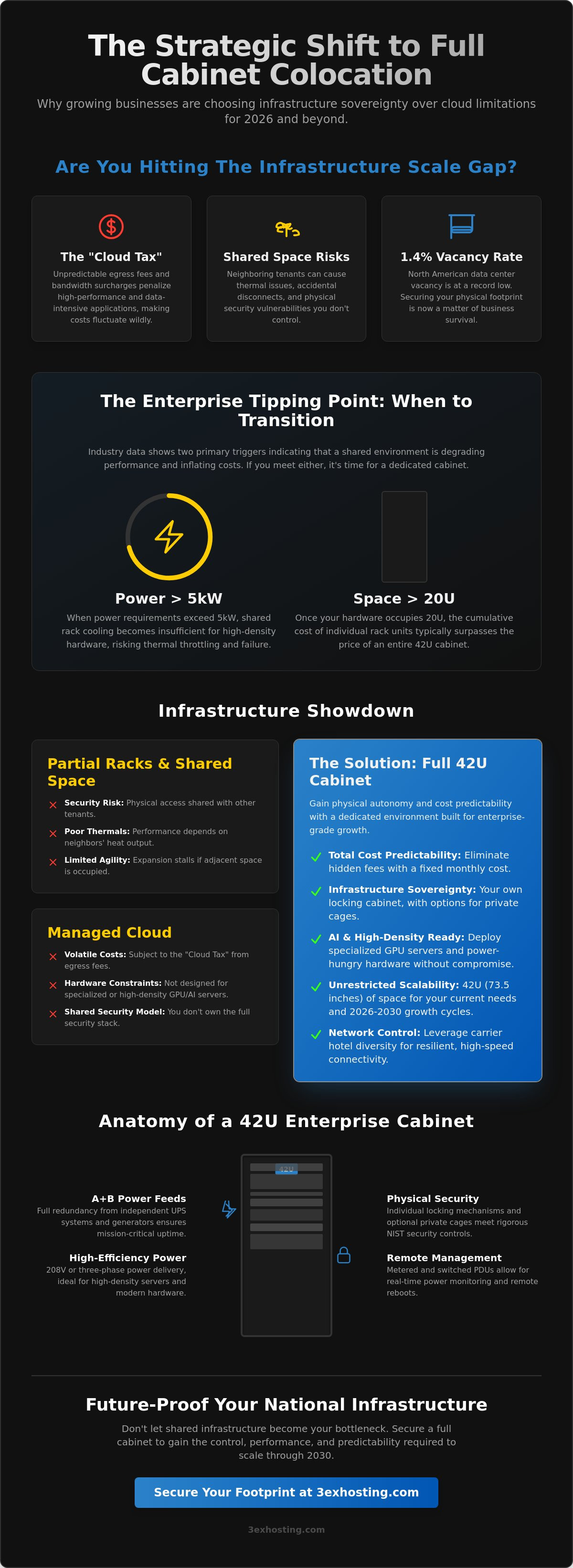
Full cabinet colocation for growing businesses represents the shift from borrowed space to infrastructure sovereignty. A standard 42U locking rack provides the physical security and power density required for modern enterprise operations. While startups often begin in a colocation centre using partial racks, this model eventually hits a “Scale Gap.” This gap occurs when the limitations of shared environments begin to degrade performance or inflate operational costs.
Knowing exactly when to transition is vital for maintaining uptime. Industry data suggests two primary triggers for this move. First, if your power requirements exceed 5kW, partial rack cooling often becomes insufficient for high-density hardware. Second, if your hardware footprint reaches 20U, the cost of individual rack units usually surpasses the price of a full cabinet. Moving to a dedicated environment at this stage ensures you aren’t overpaying for fragmented resources while gaining the room needed for 2026-2030 growth cycles.
The Limitations of Partial Racks and Shared Space
Security is the most immediate concern in shared colocation. In quarter or half cabinets, other technicians may have physical access to the same rack. This increases the risk of accidental cable disconnections or unauthorized access. Thermal management also becomes unpredictable in these setups. Your hardware’s performance shouldn’t depend on whether a neighbor’s server is creating a hotspot. Finally, shared spaces lack agility. If you need to add a new storage array but the adjacent units are occupied, your expansion stalls immediately. A dedicated cabinet eliminates these external variables.
Predicting Your Infrastructure Growth for 2026
Planning for the coming years requires a thorough audit of your current hardware lifecycles. Many firms are shifting from general-purpose servers to high-density clusters designed for data-intensive tasks. This transition often makes managed cloud hosting prohibitively expensive due to the “Cloud Tax.” These are the unpredictable egress fees and bandwidth surcharges that penalize high-performance applications. By investing in full cabinet colocation for growing businesses, you lock in your footprint and gain total control over your network topology. This foundation allows you to deploy specialized GPU servers or AI-ready infrastructure without asking for permission or facing hidden fees. Securing a full cabinet now ensures your physical capacity matches your technical ambitions.
The Technical Architecture of a 42U Enterprise Cabinet
A standard 42U cabinet provides approximately 73.5 inches of vertical rack space. This form factor has become the industry benchmark because it balances vertical density with floor space efficiency. For organizations evaluating full cabinet colocation for growing businesses, this architecture offers the necessary room for patch panels, cable management, and high-density compute nodes. Beyond the frame, the real value lies in the power and security layers. Implementing metered and switched Power Distribution Units (PDUs) allows your team to monitor consumption in real-time. Switched PDUs add an extra layer of control, enabling remote reboots of individual outlets without a physical trip to the data center.
Physical security is a non-negotiable requirement for enterprise deployments. To meet rigorous NIST security and privacy controls, these cabinets feature individual locking mechanisms and can be integrated into private cages for added isolation. This sovereignty ensures that your hardware is protected from both environmental hazards and unauthorized physical access. If you’re ready to secure your footprint, you can explore cabinet specifications that match your security profile.
Advanced Power and Redundancy Configurations
Redundancy is the backbone of mission-critical uptime. Standard enterprise cabinets utilize A+B power feeds, drawing from independent UPS systems and generators. If one circuit fails, the hardware continues to run on the secondary feed without interruption. Most modern facilities offer 208V or three-phase power delivery. These configurations are significantly more efficient than standard 120V circuits for high-density hardware. Strategic use of remote hands support for power cycling and routine maintenance ensures your infrastructure stays operational even when your team is off-site.
Thermal Management and Airflow Optimization
Effective cooling is just as important as reliable power. Cold aisle and hot aisle containment strategies prevent the mixing of air, which can lead to equipment failure. Blanking panels play a vital role here. They fill empty rack units to ensure that cold air passes through your servers rather than around them. This optimization is crucial when deploying high-BTU output hardware like GPU clusters. Proper airflow management prevents thermal throttling, ensuring your processors operate at peak performance during intensive workloads. Planning for these thermal loads now prevents expensive retrofitting as your density increases.
The ROI Analysis: Full Cabinet vs. Managed Cloud and Partial Racks
Analyzing the total cost of ownership (TCO) for a 42U deployment reveals a clear financial turning point for scaling enterprises. While managed cloud services offer low entry costs, they often penalize growth through aggressive scaling fees. Organizations that transition to full cabinet colocation for growing businesses find that owning their hardware allows for long-term asset depreciation. This financial strategy converts a perpetual rental expense into a controlled infrastructure investment. Much like how Cabinet refinishing Denver allows homeowners to maximize the value of their existing kitchen assets rather than opting for a costly full replacement, choosing dedicated colocation ensures you are investing in the longevity of your physical footprint. By shifting to a dedicated cabinet, you eliminate the “noisy neighbor” performance issues that often lead to over-provisioning in cloud or shared environments.
The most significant hidden expense in modern infrastructure is the cost of data movement. Cloud providers typically charge high egress fees for every gigabyte of data that leaves their network. In a dedicated colocation environment, you can leverage cross-connect services to establish direct, private links to carriers and partners. This removes the middleman from your network transit. It also replaces variable, unpredictable monthly bandwidth bills with fixed, manageable costs. For high-traffic applications, these savings alone often justify the move to a full 42U environment.
CapEx vs. OpEx in Infrastructure Planning
Infrastructure planning requires a balance between upfront capital expenditure (CapEx) and ongoing operating expenses (OpEx). Owning your servers requires an initial investment, but it provides a level of cost stability that cloud instances cannot match. A full cabinet allows you to lock in your hosting costs for 3-5 year cycles. This predictability is essential for financial forecasting in 2026. Leveraging cabinet colocation reduces your per-unit hosting costs significantly as you fill the rack. Instead of paying for each virtual machine, you pay for the physical space and power, regardless of how many applications you run within that footprint.
Bandwidth and Connectivity Savings
Carrier-neutral facilities provide a distinct financial advantage for high-traffic businesses. When you aren’t locked into a single provider’s network, you can negotiate better rates and routes. This network diversity prevents latency-related revenue loss by ensuring your data takes the most efficient path. Utilizing cross-connect services allows for direct peering with multiple ISPs and cloud on-ramps. This architecture doesn’t just improve performance; it creates a competitive bidding environment for your bandwidth needs, further driving down your monthly operational costs.
Strategic Deployment: Designing for High-Density and AI Workloads
Deploying 2026-grade hardware requires moving beyond traditional rack density assumptions. Modern AI clusters and high-performance computing (HPC) nodes have pushed power requirements from the old 5kW standard to a range of 15kW to 30kW per rack. Successful full cabinet colocation for growing businesses now depends on selecting a facility that can deliver this high-density power without thermal throttling. This architecture allows you to consolidate more compute power into a smaller physical footprint, which reduces your overall data center costs while maximizing performance.
Integrating GPU servers for AI training within a standard 42U cabinet isn’t just about space; it’s about the electrical and thermal envelope. Many enterprises now adopt a hybrid configuration. They keep their high-intensity, steady-state AI workloads in a dedicated colocation cabinet while using managed cloud hosting for secondary failover or burst capacity. This approach ensures you don’t overpay for cloud instances during 24/7 training cycles while maintaining the flexibility to scale during peak demand.
Preparing for High-Density GPU Hosting
NVIDIA H100 and B200 clusters have specialized power and cooling requirements that exceed the capabilities of older data centers. These nodes generate significant heat, requiring advanced airflow management or liquid cooling readiness. When planning your full cabinet colocation for growing businesses, you must verify that the facility’s PDU infrastructure and cooling loops can sustain these high-wattage nodes. Referencing a High-Density GPU Colocation Pillar can help you design a build that balances power draw with thermal efficiency. If your roadmap includes AI training or high-performance clusters, contact our engineering team for a technical consultation on high-density cabinet design.
Network Architecture and Global Connectivity
Low-latency internal traffic is essential for AI clusters that rely on rapid data exchange between nodes. Designing a top-of-rack (ToR) switching strategy ensures that your internal network isn’t the bottleneck. For multi-cabinet deployments, utilizing Enterprise Private Suites provides the maximum physical and network isolation required for sensitive data processing. These suites allow you to create a custom network topology within a secure, dedicated environment. By integrating these suites into your data center strategy, you gain the network diversity of a carrier hotel while maintaining the sovereignty of a private facility.
Future-Proofing Your National Infrastructure with 3EX Hosting
3EX Hosting provides a turnkey foundation for firms ready to move beyond fragmented hosting models. Choosing full cabinet colocation for growing businesses through our platform means positioning your hardware within a carrier hotel environment. This strategic location offers superior network diversity. It allows your business to connect directly to hundreds of global carriers and cloud on-ramps. This isn’t just about physical space; it’s about building a national infrastructure presence that remains resilient against localized outages and network congestion. By leveraging our established footprint, your enterprise can scale across primary markets without the need to manage multiple vendor relationships.
Relocating enterprise hardware involves complex logistics. We streamline this process through professional move-in assistance. Our team manages the physical transition to ensure your equipment is racked, cabled, and tested according to strict enterprise standards. Once your cabinet is live, our 24/7 remote hands support acts as your on-site engineering team. They handle everything from power cycles to component replacements. This ensures your national footprint stays operational without requiring constant travel for your internal IT staff. Our technicians understand the urgency of uptime and provide the technical stability your business demands.
Scalability Beyond the First Cabinet
Infrastructure needs change quickly. Your strategy should allow for a seamless transition from a single 42U cabinet to cage colocation as your hardware density increases. 3EX Hosting supports this growth by offering private data center suites for large-scale deployments. This path ensures that your physical security and power capacity scale alongside your user base. We also assist in planning multi-site disaster recovery and business continuity. By distributing your primary systems and backup nodes across our national data center footprint, you maintain total operational uptime even during catastrophic regional events. This multi-site approach is the standard for enterprise resilience in 2026.
Next Steps: Securing Your Enterprise Rack
The first step toward a 2026 infrastructure roadmap is a thorough hardware compatibility check. Our engineers can conduct a remote site audit to verify that your current servers, storage arrays, and networking gear are ready for a high-density cabinet environment. Once the audit is complete, we help you develop a deployment timeline that minimizes service disruption. We focus on speed and reliability during every phase of the migration. When you’re ready to lock in your footprint, requesting a tailored colocation quote will provide a clear breakdown of your power and space costs. This transparency allows you to finalize your budget with confidence, knowing your infrastructure is in expert hands.
Building Your 2026 Infrastructure Foundation
Securing a dedicated 42U environment is the most effective way to eliminate the “scale gap” that hampers growing enterprises. By moving away from fragmented cloud instances, you gain total control over your thermal management and hardware sovereignty. This shift doesn’t just reduce your total cost of ownership; it prepares your business for the high-density requirements of 2026 and beyond. Choosing full cabinet colocation for growing businesses ensures your technical roadmap isn’t limited by shared resources or unpredictable egress fees.
At 3EX Hosting, we provide the technical stability your mission-critical applications require. Our facilities feature N+1 power redundancy and carrier-neutral interconnectivity to keep your data moving at peak speeds. With 24/7 remote hands support, your national infrastructure stays in expert hands around the clock. Don’t let infrastructure bottlenecks slow your momentum. Secure your dedicated 42U cabinet and scale your enterprise today. Your growth deserves a foundation built for performance and reliability.
Frequently Asked Questions
What is the standard power density for a full cabinet in 2026?
Standard power density in 2026 typically ranges from 10kW to 15kW for general enterprise workloads, though high-density AI deployments often require 30kW or more per rack. Most facilities have moved away from the legacy 5kW standard to accommodate modern GPU clusters and high-performance compute nodes. You should verify that your provider’s cooling capacity can sustain these higher thermal loads to prevent hardware throttling.
How many servers can I realistically fit in a 42U full cabinet?
You can realistically fit between 30 and 35 1U servers in a 42U cabinet while leaving necessary room for top-of-rack switches and cable management. While the frame has 42 units of vertical space, you must account for the physical footprint of metered PDUs and horizontal patch panels. Overfilling a cabinet can also lead to airflow obstructions, so maintaining a small buffer is a best practice for long-term thermal health.
Is full cabinet colocation more secure than a private cloud environment?
Full cabinet colocation provides physical security that a private cloud cannot match, as you have exclusive access to the locking rack and the underlying hardware. This hardware sovereignty ensures that no other tenant shares your physical server resources, ports, or cabling. For many organizations, full cabinet colocation for growing businesses is the preferred choice for meeting strict regulatory compliance and internal data residency requirements.
What is the difference between a locked cabinet and a custom cage?
A locked cabinet is a single, self-contained 42U rack with its own front and rear locking doors. A custom cage is a fenced-off area within the data center that can house multiple cabinets, providing an additional layer of perimeter security. Cages are ideal for enterprises that need private workspace for technicians or room for significant multi-rack expansion within a dedicated footprint.
Can I use my own network providers in a full cabinet colocation setup?
Yes, you can use your own network providers if you choose a carrier-neutral facility. This is achieved through cross-connect services, which establish a direct physical link between your cabinet and the carrier’s point of presence within the data center. This flexibility allows you to negotiate your own bandwidth contracts and optimize your network path for the lowest possible latency.
What happens if my hardware fails and I am not near the data center?
If your hardware fails while you are off-site, you can utilize 24/7 remote hands support to perform physical troubleshooting. On-site technicians act as your local eyes and ears, handling tasks like power cycling servers, swapping failed hard drives, or verifying cable connections. This service ensures your infrastructure remains operational without requiring your team to travel for every routine maintenance task.
How long does it typically take to deploy a full cabinet?
Deployment timelines for a full cabinet typically range from five to ten business days depending on the complexity of your power and network requirements. If you require custom cage builds or specialized high-density power circuits, the lead time may extend. Professional move-in assistance can often accelerate this process by coordinating the logistics of hardware delivery and initial rack integration.
Does a full cabinet include bandwidth, or is that billed separately?
Bandwidth is almost always billed separately from the physical space and power of a cabinet. Most providers offer a variety of connectivity models, including metered usage or fixed-rate 1Gbps to 100Gbps ports. full cabinet colocation for growing businesses allows you to choose between blended bandwidth from the facility or bringing in your own dedicated carriers to manage costs more effectively.