 SUPPORT


 3EX United States
 Blog
What if your choice of rack space is the single biggest bottleneck preventing your AI infrastructure from scaling in 2026? Many IT leaders find themselves caught between the modular convenience of a single rack and the rigid security requirements of modern enterprise audits. Deciding between a full cabinet vs private suite colocation isn’t just a matter of floor space. It’s a strategic move that affects your power density, physical sovereignty, and long term operational costs.
You’re likely feeling the pressure of a market where high demand for AI ready space is driving up costs and making traditional volume discounts disappear. It’s frustrating to manage high density GPU workloads in shared halls where power limits and physical access protocols feel restrictive. This guide provides a clear ROI framework for upgrading to a private suite and explains how each path impacts your connectivity and managed support. You’ll discover how to future proof your infrastructure for high density hardware while maintaining the strict compliance standards required by 2026 regulations.
Key Takeaways
- Identify the fundamental architectural differences between a standard 42U rack and a fully enclosed environment to determine which fits your current scaling phase.
- Learn why private suites are essential for strict regulatory compliance like SOC2 and HIPAA through dedicated physical sovereignty and localized audit trails.
- Use our decision framework to navigate the full cabinet vs private suite colocation choice based on your specific power density requirements for AI and GPU hardware.
- Discover how managed remote hands support and professional infrastructure maintenance streamline operations across both shared and private environments.
- Audit your 12-month growth projections to identify the exact tipping point where a private suite offers a superior ROI compared to adding multiple individual cabinets.
Defining the Scale: Full Cabinet vs. Private Suite Colocation
Choosing the right infrastructure model is a foundational decision for any growing enterprise. The choice between a full cabinet vs private suite colocation often marks the transition from a standard IT footprint to a bespoke operational environment. A modern colocation centre offers these two distinct paths to accommodate different technical densities and security protocols. While both provide the benefits of outsourced power and cooling, the level of physical control varies significantly between them.
The “carrier hotel” factor plays a major role in this decision. Placement within a facility that acts as a primary interconnection hub ensures that both cabinets and suites have immediate proximity to major fiber backbones. This reduces latency and simplifies cross-connects. It doesn’t matter if you occupy a single rack or a private room; being in a high-connectivity environment is non-negotiable for 2026 performance standards. However, how you manage that space once the fiber is connected is where the two options diverge.
The Anatomy of a Full Cabinet Deployment
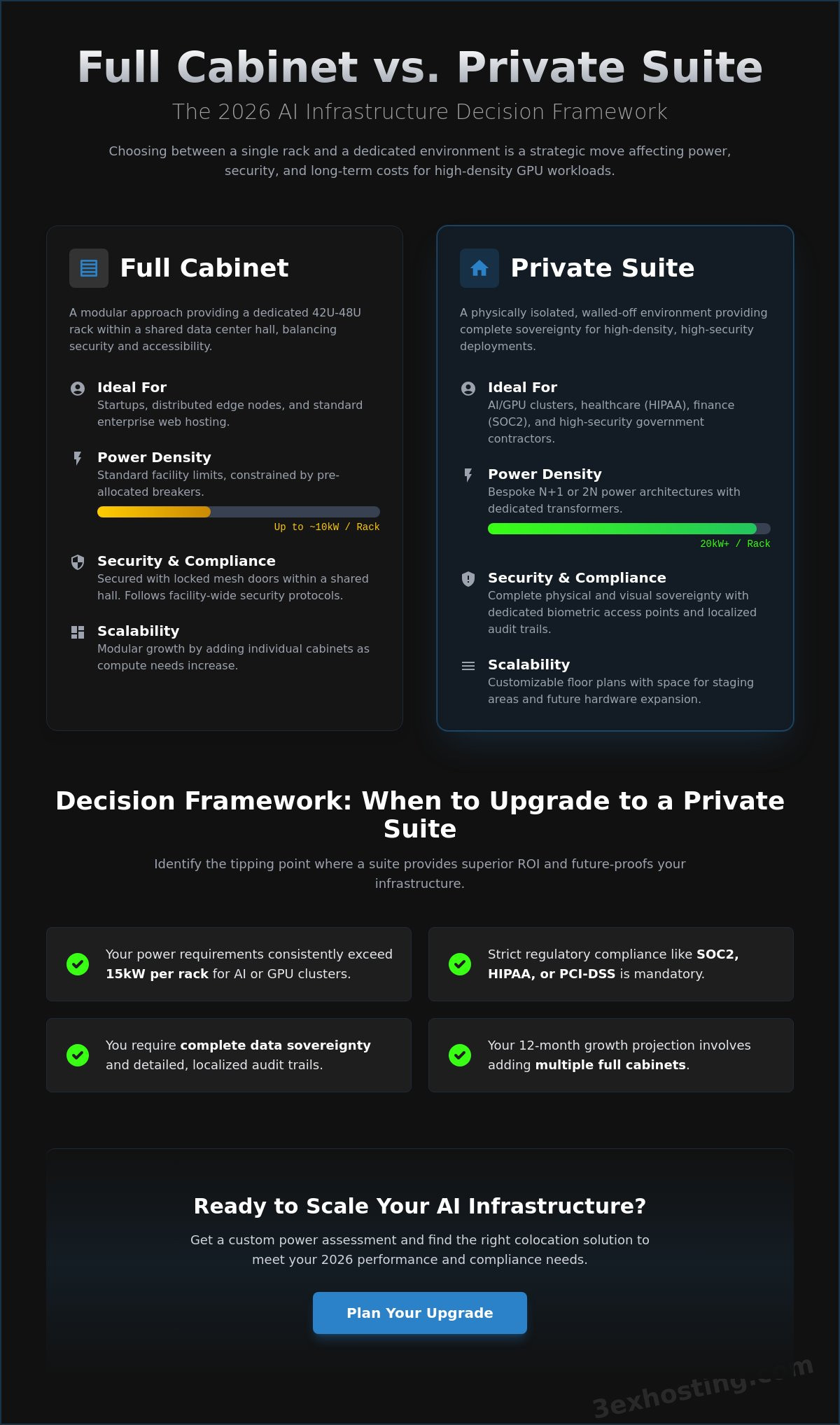
A full cabinet colocation setup typically provides a dedicated 42U to 48U rack. These units reside within a shared data center hall where environmental variables like ambient temperature and humidity are managed at the row level. Equipment stays secured behind locked mesh doors, which provides a balance between physical protection and necessary airflow. It’s a modular approach to scaling. You can start with one rack and add more as your compute needs grow.
- Standard 19-inch rack dimensions for enterprise gear.
- Redundant power drops delivered directly to the cabinet.
- Ideal for startups, distributed edge nodes, and standard web hosting.
The Architecture of a Private Colocation Suite
For organizations requiring true physical isolation, private colocation suites offer a walled-off perimeter. Unlike standard cages, suites feature floor-to-ceiling walls that provide complete visual and physical sovereignty from other tenants. This architecture allows for highly customized airflow management, such as dedicated hot-aisle containment systems built specifically for your hardware layout. You aren’t just renting space; you’re managing a private data center within a larger facility.
- Customizable floor plans with space for staging areas or on-site workstations.
- Dedicated biometric access points at the suite perimeter.
- Ideal for healthcare, financial services, and high-security government contractors.
The distinction ultimately comes down to the scope of your audit requirements and power needs. In a shared hall, you follow the facility’s standard perimeter rules. In a suite, you define the internal layout and access logs. This isolation is critical for meeting strict regulatory audits where data sovereignty requires knowing exactly who can physically stand next to your hardware.
Technical Performance: Power, Cooling, and Connectivity
Performance in a data center environment isn’t just about the hardware you install. It’s about the infrastructure that supports it. When evaluating full cabinet vs private suite colocation, the technical ceiling of each option becomes the primary differentiator. Shared halls are designed for standard enterprise workloads. Private suites are engineered for the extreme densities required by 2026 AI and GPU applications.
Power density limits are often the first bottleneck. In a shared environment, you’re typically limited to the facility’s standard power distribution units. This works well for web servers, but it can struggle with high-density GPU clusters. Private suites provide the flexibility to design custom N+1 or 2N power architectures that can handle 20kW or more per rack without risking the stability of neighboring tenants. For those scaling rapidly, requesting a custom power assessment is a logical next step.
Power Density and Redundancy Protocols
Managing metered power in a full cabinet requires constant monitoring to avoid circuit overloads. If your workload spikes, you’re constrained by the pre-allocated breaker limits. Private suites remove these barriers. They allow for bespoke electrical engineering, including dedicated transformers and localized UPS systems. This level of control is essential for 2026 hardware, where AI training modules demand sustained, high-amperage draws that exceed traditional data center designs.
Interconnection and Cross-Connect Efficiency
Connectivity is the lifeblood of real-time AI inference and high-frequency trading. In a private suite, you can implement structured cabling systems that reduce complexity and signal degradation. These environments support direct fiber handoffs from multiple carriers, ensuring multi-homed resilience. Current colocation trends highlight that enterprises are moving away from messy “spaghetti” cabling in favor of organized, high-bandwidth interconnects.
Efficiency also extends to how you utilize cross-connect services. In a private suite, your internal network latency remains ultra-low because your switches and servers are physically adjacent in a controlled perimeter. This minimizes the distance data travels before hitting the carrier backbone. It’s a critical advantage for applications where every millisecond affects the bottom line.
Cooling efficiency follows a similar logic. Standard cabinets use hot or cold aisle containment provided by the facility. While effective, it’s a one-size-fits-all solution. Private suites allow for suite-level climate control, including precision cooling units that target specific hotspots in your rack rows. This localized management ensures that even the most demanding GPU servers stay within optimal thermal ranges, preventing performance throttling during peak processing periods.
Security, Compliance, and Data Sovereignty
Physical security is often the final hurdle in enterprise compliance audits. While a shared hall provides a high baseline of protection, the choice between full cabinet vs private suite colocation determines how much control you have over your physical audit trail. Data breaches saw a 72% increase between 2021 and 2023, making the physical layer a critical focus for risk management teams. It’s no longer just about keeping the doors locked. It’s about proving exactly who was in the room and why.
For industries governed by SOC2, HIPAA, or PCI-DSS, physical sovereignty is a major asset. A private suite offers a walled environment where you own the perimeter. This eliminates the “noisy neighbor” risk. In a shared hall, you share the aisle with other tenants’ technicians. In a private suite, you control exactly who enters your space. This isolation also prevents thermal interference. You aren’t subject to the heat exhaust of a high-density rack belonging to another company. This level of isolation is now a core requirement for organizations that must comply with ISO/IEC 27001:2022 standards.
The Audit Advantage of Private Suites
Private perimeters simplify physical security audits for enterprise clients by providing a single, verifiable entry point. Within a suite, you can implement custom security protocols like dedicated biometric scanners or floor-to-ceiling cages. These features create a clear, localized log of all physical interactions with your hardware. For a deeper look at these requirements, consult our Enterprise Private Suites Guide to understand how sovereignty affects your 2026 compliance posture.
Shared Hall Security for Full Cabinets
Individual cabinets rely on the data center’s collective security framework. This includes 24/7 on-site staff, multi-factor authentication at the hall entrance, and individual cabinet locking mechanisms. While these systems are robust, they’re part of a shared ecosystem. This model is ideal for non-sensitive workloads where cost-efficiency is the priority. You get professional-grade protection without the overhead of a private room, though you lack the ability to install your own CCTV or secondary biometric layers inside the hall.
A common objection is that a private suite might be overkill for security. However, the definition of “overkill” is shifting. As state-level data center regulations increase in 2026, the ability to demonstrate total control over your physical environment is becoming a standard business requirement. If your reputation depends on the absolute integrity of your data, the physical walls of a suite provide a level of assurance that a mesh door simply cannot match.
Operational Management: Remote Hands and Managed Support
Managing the physical layer shouldn’t require your senior engineers to be on-site for every hardware refresh or port configuration. The operational complexity of full cabinet vs private suite colocation shifts significantly as you move from managing a single rack to a private ecosystem. In a standard cabinet, technical support is often transactional. In a private suite, it becomes a collaborative extension of your local team.
Standard remote hands support in a shared hall typically covers basic tasks like power cycling, visual inspections, and cable swaps. However, private suites allow for more sophisticated managed IT infrastructure services. Technicians can manage on-site inventory, handle complex structured cabling projects, and even assist with the lifecycle management of high-density GPU clusters. If you’re planning a large-scale deployment, request a custom operational audit to see how these services scale with your hardware.
Deployment logistics also differ by scale. Setting up a single cabinet is straightforward, but multi-rack suite environments require coordinated effort. Utilizing professional move-in assistance ensures that your hardware is staged, racked, and cabled according to your specific architectural requirements. This reduces the risk of deployment errors that can lead to costly downtime during the initial go-live phase.
The ROI of Remote Hands for Distributed Teams
Leveraging on-site technicians for rack-and-stack operations significantly reduces travel costs and minimizes the mean time to repair (MTTR). In a private suite, these technicians can maintain a localized inventory of spare parts and components, ensuring that hardware failures don’t result in extended outages. This level of support is essential for maintaining the high availability standards required by modern enterprise service level agreements. For more details on optimizing these workflows, consult our professional Remote Hands Support Guide.
Managed Cloud and Disaster Recovery Integration
Modern infrastructure is rarely siloed. A 2024 study found that 87% of organizations have adopted a hybrid infrastructure strategy, combining physical hardware with cloud resources. Linking your physical cabinets to managed cloud hosting environments creates a resilient, multi-homed architecture. This integration is vital for disaster recovery planning, where mission-critical suite deployments must maintain business continuity through geographic redundancy. By offloading the physical maintenance to an on-site team, your internal staff can focus on high-level architecture rather than swapping failed drives or tracing fiber runs.
Decision Framework: When to Upgrade to a Private Suite
Decision making in infrastructure scaling requires a balance between immediate cost and long term operational agility. When weighing the benefits of full cabinet vs private suite colocation, your internal roadmap should dictate the timeline. A reactive approach often leads to fragmented deployments across multiple data center halls. A proactive framework ensures your hardware resides in an environment designed for its specific thermal and power profile. Following these steps will help you determine the optimal time to transition.
- Audit utilization and growth: Review your current rack unit consumption. If you’re utilizing 80% of your capacity and expect to add two or more racks within the next 12 months, a suite offers better long term scalability.
- Evaluate power density: Shared halls are optimized for standard loads. If your project involves high density GPU colocation, the custom cooling and power distribution of a suite become essential.
- Assess compliance mandates: Determine if upcoming SOC2, HIPAA, or PCI-DSS audits require dedicated physical perimeters.
- Calculate Total Cost of Ownership: Factor in the cumulative cost of separate cross connects and remote hands across multiple cabinets. A consolidated suite often reduces these recurring expenses.
- Select a versatile partner: Choose a provider that offers both cabinet colocation and private suites to ensure a seamless upgrade path.
The Tipping Point: 5+ Cabinets or 50kW?
There is a clear “sweet spot” where suite pricing becomes competitive with multiple individual racks. Managing five or more cabinets in a shared hall often creates operational drag. Connectivity costs increase because every rack requires separate cabling to the carrier room. When analyzing full cabinet vs private suite colocation, the 50kW power threshold is a common trigger point. Once your total draw reaches this level, the custom cooling efficiencies and consolidated power management of a suite provide a superior ROI. High density AI clusters almost always require these suite level adjustments to prevent thermal throttling.
Custom Cage Solutions: The Middle Ground
A cage solution acts as the bridge between a single rack and a full suite. This option provides a mesh perimeter that secures multiple cabinets without the cost of solid walled construction. It’s an ideal choice for teams that need physical separation but don’t require custom suite level climate control. Cages allow for non-standard footprints. This makes them perfect for housing specialized hardware that doesn’t fit standard rack dimensions while maintaining a secure, audited perimeter within the larger facility.
Architecting for the Next Decade of Enterprise Growth
Choosing between full cabinet vs private suite colocation requires a clear understanding of your long term power and security mandates. Individual cabinets offer modular flexibility for standard web applications. However, private suites provide the physical sovereignty and thermal management essential for high density AI and GPU deployments. Selecting the right path ensures your infrastructure remains compliant with 2026 regulatory shifts while maintaining the operational speed your business demands.
Successful scaling depends on a foundation of technical excellence and expert support. By leveraging a carrier neutral facility and specialized high density infrastructure, you can eliminate the bottlenecks that slow down innovation. It’s about more than just floor space; it’s about having a partner who understands the nuances of high performance hardware.
Secure your competitive advantage by selecting an environment that grows with you. Request a custom quote for Full Cabinet or Private Suite Colocation to optimize your 2026 strategy. With 24/7 Remote Hands support and specialized AI ready facilities, your systems are in expert hands. We look forward to powering your next phase of growth.
Frequently Asked Questions
What is the primary difference between a full cabinet and a private suite?
The primary difference lies in the level of physical isolation and space control you maintain over your hardware. A full cabinet is a single lockable rack located within a shared data center hall, whereas a private suite is a fully enclosed room with floor to ceiling walls. This distinction is the core factor when evaluating full cabinet vs private suite colocation for your 2026 infrastructure strategy.
How many racks typically fit into a private colocation suite?
Private suites are highly customizable, but they typically start at a capacity of five to ten racks. The exact number depends on the specific square footage of the room and the power density required for your equipment. Larger deployments can scale to dozens of racks within a single suite to accommodate massive compute clusters or high density storage arrays.
Is a private suite more secure than a standard full cabinet?
Yes, a private suite offers a superior security profile by adding a second layer of physical protection. While a cabinet has its own lockable mesh doors, a suite provides a dedicated perimeter that you control. This prevents other tenants or unauthorized personnel from even standing next to your equipment, which is a critical requirement for high security enterprise environments.
Can I upgrade from a full cabinet to a private suite without downtime?
Upgrading usually involves a phased migration where new hardware is staged in the suite before the final cutover. Most professional providers offer side by side deployment options to ensure service continuity. You should consult with your technical team to develop a migration plan that utilizes redundant network paths to minimize or eliminate potential service interruptions during the transition.
Do private suites include their own cooling and power systems?
Private suites leverage the data center’s central cooling and power plants but allow for localized distribution and control. You can implement custom hot aisle containment or install precision cooling units that target your specific hardware hotspots. This localized management is a major technical advantage in the full cabinet vs private suite colocation debate, especially for high density workloads.
What are the compliance benefits of choosing a private suite over a cabinet?
A private suite provides physical sovereignty, which simplifies the process of passing strict SOC2, HIPAA, or PCI-DSS audits. Because you have exclusive access to the room, you can maintain your own biometric logs and CCTV records. This level of environmental control makes it much easier to prove that your physical data security protocols meet or exceed regulatory requirements.
How does remote hands support work differently in a private suite?
Remote hands technicians can perform more complex and sustained tasks within a private suite compared to a shared hall. Because the suite provides a dedicated staging area, technicians can handle on site inventory management and structured cabling projects without obstructing aisle traffic. This allows for a more collaborative and efficient approach to physical layer maintenance and hardware lifecycle support.
Which option is better for high density AI and GPU hosting?
A private suite is the superior choice for high density AI and GPU hosting due to its advanced thermal management capabilities. AI workloads often require 20kW or more per rack, which can exceed the cooling capacity of a standard shared hall row. Suites allow for bespoke cooling configurations that ensure your GPU clusters stay within optimal temperature ranges to prevent performance throttling.