 SUPPORT


 3EX United States
 Blog
Your legacy cooling strategy isn’t just inefficient; it’s a bottleneck that will eventually stall your AI and GPU scaling. Most data center managers accept high PUE ratios as an unavoidable cost of doing business. You’ve likely felt the frustration of thermal hotspots and hardware throttling as you push your racks toward higher densities. It’s a common struggle when older infrastructure meets modern, power-hungry hardware. Relying on traditional room-cooling alone makes your energy costs unpredictable and limits your growth.
Understanding the specific hot aisle/cold aisle containment benefits allows you to reclaim thermal control and slash operational expenses immediately. This guide explains how precision airflow management enables the high-density GPU hosting required for modern enterprise workloads. You’ll learn how to eliminate bypass air and recirculation to ensure your cooling capacity goes exactly where it’s needed. We’ll examine whether hot or cold aisle containment fits your specific rack density and budget, providing a clear path to lower PUE and extended hardware reliability.
Key Takeaways
- Eliminate cooling inefficiencies by learning how physical airflow separation prevents bypass air and thermal recirculation.
- Compare the mechanical designs of Hot Aisle and Cold Aisle systems to determine which configuration best supports your specific rack density.
- Maximize your ROI by leveraging hot aisle/cold aisle containment benefits to lower PUE and reduce operational energy costs.
- Scale your infrastructure for high-density AI GPU hosting while maintaining strict fire suppression and safety compliance.
- Discover how to reclaim lost cooling capacity to support more enterprise hardware within your existing colocation footprint.
Airflow Management: The Foundation of Data Center Efficiency
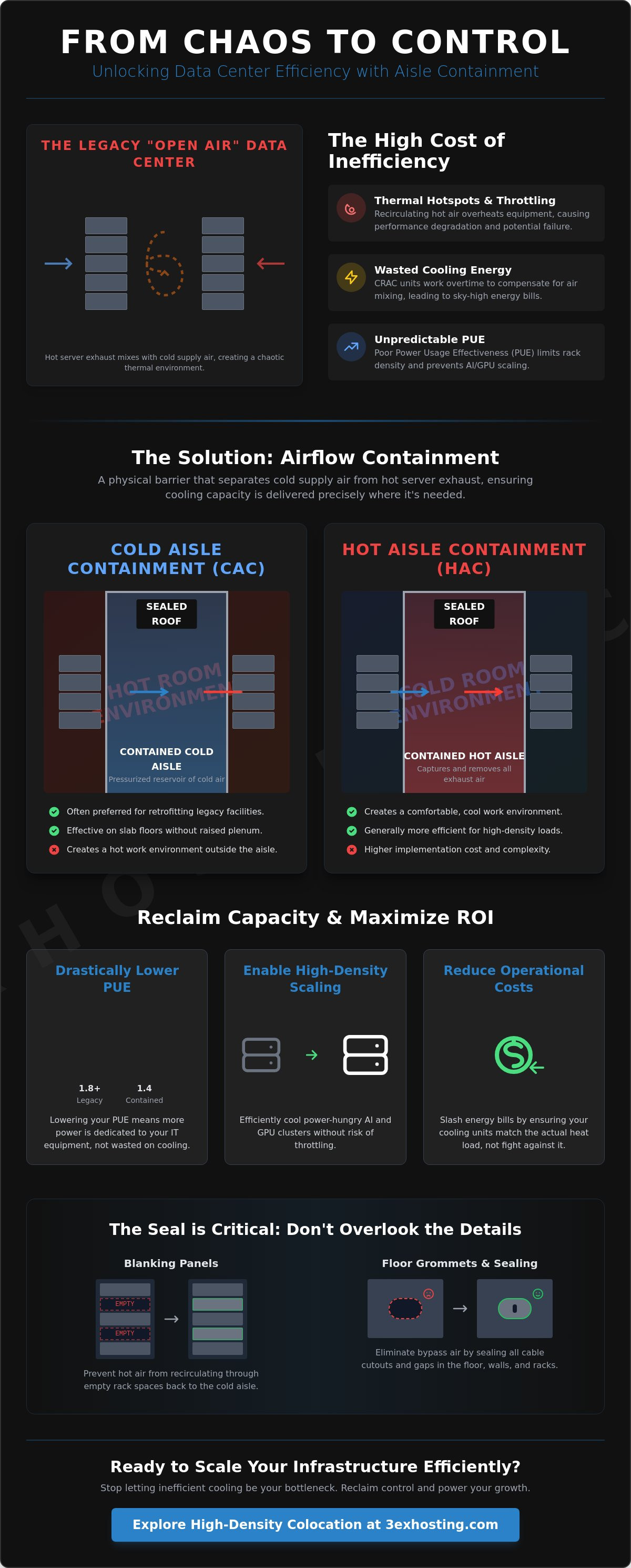
Airflow management is the core of reliable infrastructure. At its simplest, hot and cold aisle containment is the physical separation of cold supply air from hot server exhaust. Without this barrier, air mixes freely, creating a chaotic thermal environment that compromises hardware stability. This “Open Air” design forces cooling units to work significantly harder to maintain stable intake temperatures. The primary goal of any containment strategy is ensuring every server receives air at the exact temperature required for peak performance without the risk of thermal mixing.
Monitoring success in this area relies on Power Usage Effectiveness (PUE). This metric compares total facility power to the power delivered to IT equipment. Lowering your PUE starts with mastering data center cooling efficiency through containment. When you eliminate the mixing of air streams, you create a predictable environment where cooling capacity matches the actual heat load of the room.
The High Cost of Inefficient Cooling
Mixing hot and cold air is an expensive mistake. When exhaust air recirculates into server intakes, it creates thermal hotspots that trigger hardware throttling. This forces Computer Room Air Conditioning (CRAC) units to run at maximum capacity, driving up energy bills without improving cooling outcomes. One of the biggest culprits is bypass air. Bypass air is conditioned air that returns to the cooling unit without ever passing through a server. It’s wasted energy that serves no purpose. Proper containment eliminates these gaps, ensuring your investment in cooling actually reaches your hardware. This efficiency is critical for maintaining uptime and preventing the premature aging of expensive components.
Separating Fact from Fiction: Containment Myths
Many operators believe containment is only a requirement for “mega” data centers or massive hyperscale facilities. This is a misconception. Even a small cabinet colocation deployment benefits from airflow management. Modern hardware, especially high-density GPU clusters, generates heat at levels older 2010-era servers never reached. These systems require much more precise thermal control to prevent failure. You can’t rely on the cooling methods of a decade ago to support the power densities of today.
Another myth is that containment only works for “greenfield” or brand-new builds. In reality, you can retrofit existing legacy environments with doors and roof panels quite effectively. This flexibility is one of the key hot aisle/cold aisle containment benefits, allowing older facilities to support modern, high-density hardware. Whether you’re managing a few racks or private colocation suites, separating air streams is the most effective way to stabilize your operational costs and protect your hardware lifespan.
Hot Aisle vs. Cold Aisle Containment: How They Work
Choosing between these two methods depends on your existing infrastructure and thermal goals. While both strategies deliver significant hot aisle/cold aisle containment benefits, they solve the air mixing problem from opposite directions. Success requires more than just installing doors and roofs. You must also use blanking panels to fill empty rack spaces and floor grommets to seal cable cutouts. These smaller components are essential for maintaining the integrity of the air seal. Without them, your cooling units will still waste energy fighting air leakage.
For a foundational look at how these configurations differ, industry definitions of Hot Aisle vs. Cold Aisle Containment provide a clear baseline for data center design. The mechanical choice you make will dictate your facility’s future scalability and the comfort of your operational staff.
The Mechanics of Cold Aisle Containment (CAC)
Cold Aisle Containment (CAC) focuses on sealing the supply aisle to create a pressurized cold reservoir. Roof panels are installed across the top of the racks, and doors seal the ends of the row. This ensures that every cubic foot of chilled air from your cooling units is forced through the server intakes. It’s often the preferred choice for retrofitting legacy environments, especially those on slab floors. Since the cold air is contained, you don’t need a raised floor to distribute it. However, CAC creates a “hot room” effect. Because the hot exhaust is released into the general room, the area outside the contained aisle becomes much warmer, which can impact non-contained equipment or staff comfort.
The Mechanics of Hot Aisle Containment (HAC)
Hot Aisle Containment (HAC) captures heat at the source. This method uses vertical chimneys or dropped ceiling plenums to duct hot exhaust air directly back to the cooling units. By isolating the heat, the rest of the data center remains a “cold room.” HAC is generally considered more thermally efficient for high-density loads, such as AI or GPU clusters, because it allows the cooling system to operate with a higher return air temperature. This increased temperature delta improves the heat exchange capacity of your CRAC units. If you’re planning a high-density cabinet colocation deployment, HAC offers a more stable environment for both your hardware and your technicians.
Every infrastructure has unique requirements. Before committing to a specific mechanical design, you should evaluate your ceiling clearances and floor types to ensure the chosen system integrates with your existing fire suppression protocols. If you aren’t sure which path fits your density needs, it’s often best to request a professional assessment of your current rack layout.
Key Benefits of Aisle Containment for Enterprise Racks
Implementing a robust containment strategy transforms your infrastructure from a reactive environment to a proactive one. The primary hot aisle/cold aisle containment benefits center on two pillars: hardware protection and operational efficiency. When you isolate air streams, you eliminate the temperature fluctuations that cause component stress. This stability is essential for high-performance computing and AI workloads where hardware runs at peak capacity for extended periods. You aren’t just saving energy; you’re creating a foundation for technical excellence.
Following data center cooling best practices ensures your facility doesn’t just run cooler, but smarter. By reclaiming cooling capacity previously wasted on bypass air, you can support higher power densities in your existing footprint. This allows for seamless scaling without the need for expensive facility expansions. It’s the most direct path to maximizing the value of your current floor space.
Maximizing Power Density and Hardware Lifespan
Containment allows you to push more kilowatts per rack safely. By maintaining a consistent intake temperature, you keep your equipment within ASHRAE A1-A4 environmental specifications. This consistency prevents thermal runaway and significantly reduces server fan power consumption. When servers receive steady, cool air, their internal fans don’t need to spin at maximum RPM. Industry data suggests this can reduce total server power draw by 10% to 20%. Lower fan speeds also mean less vibration and mechanical wear, directly extending the lifespan of your enterprise hardware.
Operational Stability and Disaster Recovery
One often overlooked advantage is the “ride-through” time during a cooling plant failure. In a traditional open-air data center, temperatures spike almost immediately if a chiller fails. A contained cold aisle acts as a thermal sink. It provides a pressurized reservoir of chilled air that buys your team precious minutes to initiate failover protocols or graceful shutdowns. This buffer is a critical component of a robust disaster recovery plan that protects your data and your gear.
Stability also improves the efficiency of your on-site team. Techs providing remote hands support can perform maintenance tasks in a predictable, stable environment. Containment simplifies environmental monitoring as well. With clearly defined air zones, sensor placement becomes more logical and the resulting data is more accurate. You get a clearer picture of your facility’s health, allowing you to identify potential issues before they become outages. This transparency is vital for maintaining the high availability your business demands.
Evaluating ROI: Energy Savings and AI Scalability
Investing in airflow management provides a clear return on investment through immediate OpEx reduction. When you separate air streams, you can safely increase the chilled water set points on your cooling plant. Raising the supply air temperature by even a few degrees significantly reduces the workload on chillers. This adjustment is only possible when you eliminate the risk of hot air mixing with cold supply. By maximizing the delta between supply and return air, you leverage the full hot aisle/cold aisle containment benefits that drive down monthly utility bills. This efficiency allows you to allocate your budget toward growth rather than wasted electricity.
Calculating the Reduction in PUE
Power Usage Effectiveness (PUE) is the gold standard for measuring efficiency. You calculate it by dividing the total facility power by the power delivered to your IT equipment. In a traditional data center, cooling often accounts for a massive portion of that total, leading to PUE ratios of 2.0 or higher. Containment targets the cooling component directly. By using Variable Frequency Drives (VFDs), your fans only spin as fast as necessary to maintain pressure. This precision eliminates the waste of over-cooling empty spaces. Moving toward a sub-1.5 PUE is one of the most quantifiable hot aisle/cold aisle containment benefits for enterprise operators. Some optimized facilities report that containment can reduce cooling energy costs by up to 40%. It’s a strategic move that reclaims power capacity to support more revenue-generating hardware.
Enabling High-Density GPU and AI Clusters
Modern AI workloads have changed the thermal requirements of the data center. A standard CPU rack might pull 5kW to 10kW, but an H100 or A100 GPU cluster can easily exceed 30kW per rack. These high-density nodes require massive volumes of air to stay within safe operating limits. Standard room cooling cannot move enough air fast enough to prevent these chips from throttling. Success in this environment requires high density GPU colocation with isolated airflow. While a standard server might tolerate minor air mixing, a GPU node will hit thermal limits in seconds without a dedicated cold supply. Containment ensures that every CFM of air reaches the intake of your most expensive assets. This isolation also prepares your facility for the next step: liquid-to-air hybrid cooling models. By establishing a contained environment now, you future-proof your infrastructure for the next generation of hardware.
If you’re planning to deploy power-intensive clusters, you need an environment built for density. Contact our team for a custom quote on high-density colocation solutions today.
Choosing the Right Containment for Your Colocation Strategy
Selecting a containment strategy requires balancing physical constraints with performance goals. You must start with a detailed site audit. Check your rack heights for uniformity; mismatched heights create gaps that allow air leakage. Evaluate your ceiling clearance for HAC ducting and verify your floor type. These physical variables dictate whether you can fully realize the hot aisle/cold aisle containment benefits in your specific environment. Safety compliance is the next priority. Your system must integrate with fire suppression protocols, such as FM-200 or pre-action sprinklers. Modern containment solutions often use electromagnetic hold-opens or thermal drop-panels to ensure suppressant reaches your equipment during an emergency.
Flexibility is essential for long-term scalability. As your needs evolve, your infrastructure must adapt without requiring a complete overhaul. Modular containment systems allow you to add capacity to your cabinet colocation deployment as your rack count grows. This step-by-step approach ensures that you only pay for the cooling infrastructure you actually need. Partnering with a provider that manages these technical details allows your team to focus on software and data rather than airflow physics.
HAC vs. CAC: The Final Selection Criteria
Cold Aisle Containment (CAC) is often the faster choice for retrofitting existing rows. It provides immediate results with minimal structural changes. Hot Aisle Containment (HAC) offers superior thermal performance for high-density environments but requires more complex ducting to the return plenum. Technician comfort is a major differentiator. HAC keeps the general data center floor cool, while CAC turns the rest of the room into a hot exhaust zone. If your team spends significant time on the floor, HAC is the better ergonomic choice. It also tends to muffle fan noise more effectively. For organizations with highly specialized requirements, private colocation suites allow for fully customized containment architectures that standard rows cannot accommodate.
Transitioning to a Contained Environment
Transitioning to a contained environment doesn’t have to interrupt your operations. A modular approach allows for “live” installation while maintaining mission-critical uptime. You can deploy panels and doors row by row without taking systems offline. When moving new, high-density hardware into a contained row, professional move-in assistance is invaluable. This ensures that rack positioning and blanking panel installation are handled correctly from day one. Choosing a partner that understands these infrastructure nuances is critical for long-term stability. Your infrastructure deserves a cooling strategy that supports your growth. Request a custom quote for high-density contained colocation to start optimizing your deployment today.
Future-Proofing Your High-Density Infrastructure
Mastering airflow is no longer a luxury for the modern data center. It’s a technical necessity. By implementing the right thermal separation, you eliminate the bottlenecks that prevent your hardware from reaching its full potential. The long-term hot aisle/cold aisle containment benefits extend far beyond immediate energy savings. They provide the cost predictability and mechanical stability required to scale intensive AI and GPU clusters without risking thermal failure. This foundation ensures your systems remain operational as power densities continue to rise.
Success in this high-density era requires an infrastructure partner that understands these thermal physics. We offer carrier-neutral carrier hotel infrastructure and specialized AI and GPU high-density solutions designed for peak performance. Our team provides 24/7 Remote Hands support to ensure your environment remains stable and secure at all times. You don’t have to manage these complexities alone. Take the first step toward a more efficient, scalable deployment by securing a facility built for the future of enterprise compute.
Get a Quote for High-Density Colocation with Advanced Containment
Frequently Asked Questions
What is the primary difference between hot and cold aisle containment?
The primary difference lies in which air stream you isolate from the rest of the data center. Cold aisle containment seals the supply aisle to create a pressurized reservoir of chilled air for server intakes. Hot aisle containment captures the warm exhaust and ducts it directly back to the cooling units. Both methods prevent air mixing, but they require different mechanical configurations for ceiling plenums and floor types.
How much can I expect to save on energy costs with aisle containment?
Optimized facilities often see a reduction in cooling energy costs of up to 40%. These hot aisle/cold aisle containment benefits are achieved by raising chilled water set points and using variable frequency drives to lower fan speeds. Your actual savings will depend on your starting PUE and the total power density of your deployment.
Is aisle containment necessary for low-density server racks?
It’s not strictly mandatory for low-density racks, but it remains a best practice for operational stability. Even at lower power levels, preventing bypass air ensures that your cooling units don’t work harder than necessary. It creates a predictable thermal environment that protects your hardware from the minor hotspots that can occur in open-air rooms.
Can I retrofit containment into an existing colocation cage?
Yes, you can retrofit modular containment systems into most existing cage environments. These solutions use adjustable frames, doors, and roof panels that don’t require structural modifications to the facility. This flexibility allows you to upgrade your airflow management without moving your equipment or interrupting your current uptime.
Does aisle containment interfere with fire suppression systems?
Modern containment is designed to integrate fully with FM-200, Novec 1230, or pre-action sprinkler systems. Many designs use thermal drop panels or electromagnetic hold-opens that release during an alarm. This ensures that fire suppressants can reach the equipment inside the aisle without obstruction. You should always verify compliance with local fire codes during the planning phase.
Which is better for GPU-intensive workloads, hot or cold aisle?
Hot aisle containment is generally the better choice for GPU-intensive workloads and AI clusters. Because GPU racks generate massive amounts of heat, isolating that exhaust immediately prevents it from impacting the rest of the room. It allows the cooling system to handle a higher temperature delta, which is essential for racks exceeding 30kW.
How does aisle containment affect the PUE of a data center?
Containment improves PUE by reducing the “overhead” energy spent on cooling IT equipment. When you eliminate air mixing, the cooling plant operates more efficiently and uses less power to maintain target temperatures. This brings the PUE ratio closer to 1.0, meaning a higher percentage of your total power is going directly to your servers.
What are the risks of not using containment in a high-density environment?
The biggest risks are hardware throttling and premature component failure due to thermal stress. Without the hot aisle/cold aisle containment benefits of air separation, hotspots can form even if the room feels cold. These hotspots trigger internal server fans to spin at maximum RPM, increasing vibration and power draw while potentially leading to emergency shutdowns.