 SUPPORT


 3EX United States
 Blog
With global data center capacity projected to triple by 2030, your current infrastructure might already be reaching its limits. It’s a common struggle for enterprise leaders who face unpredictable latency in standard public clouds and the mounting complexity of managing high-density hardware. You need a solution that balances performance with security, especially when compliance risks in shared environments are higher than ever. Choosing the right managed cloud hosting Miami provider is no longer just a technical decision; it’s a strategic move for national scalability.
We understand that you need systems that just work without the constant overhead of manual management. This guide explores how enterprise-grade managed cloud hosting leverages high-density infrastructure and carrier-neutral connectivity to power mission-critical resilience. You’ll discover how to achieve seamless hybrid cloud integration and zero-downtime disaster recovery. We also break down the requirements for accessing high-density GPU and AI-ready infrastructure to keep your business at the forefront of technological excellence. By the end of this guide, you’ll have a clear roadmap for scaling your digital assets with confidence.
Key Takeaways
- Understand how carrier-neutral connectivity in Miami serves as a strategic nexus for sub-millisecond latency and national scalability.
- Learn to transition from restrictive public clouds to performance-optimized managed cloud hosting Miami solutions that offer dedicated hardware control.
- Identify the critical role of cross-connect services in reducing public internet hops and ensuring mission-critical reliability.
- Explore advanced security architectures that leverage geographic separation and secondary colocation sites for zero-downtime disaster recovery.
- Prepare your infrastructure for 2026 by integrating high-density GPU and AI-ready hardware through custom, KPI-driven migration paths.
Defining Managed Cloud Hosting for the 2026 Enterprise
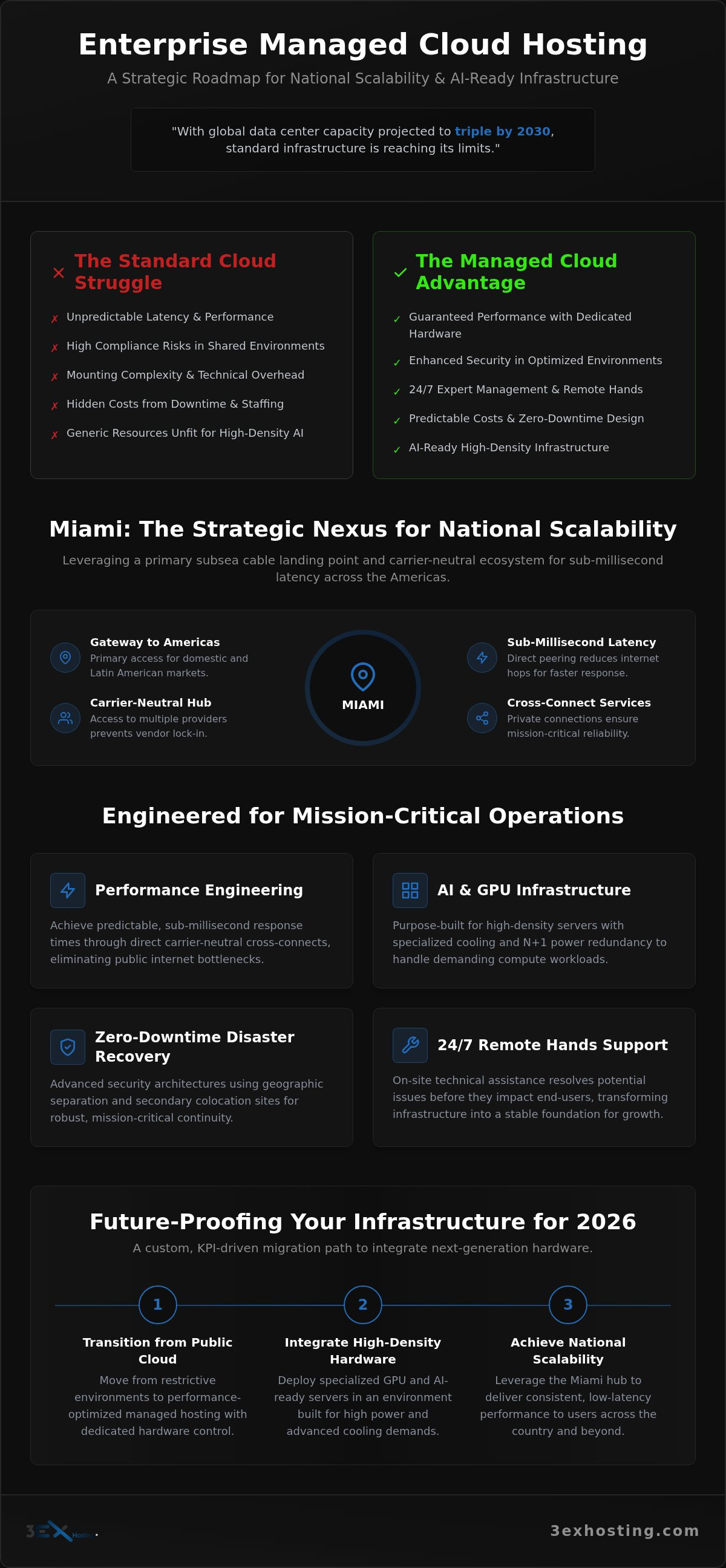
The standard public cloud model often fails to meet the specific performance requirements of modern enterprises. By 2026, the focus has shifted toward managed cloud hosting Miami, a hybrid approach that pairs dedicated, high-density hardware with specialized technical oversight. This model moves beyond generic, shared resources. It places mission-critical applications in optimized environments where performance is guaranteed, not just promised. Effective cloud management ensures that infrastructure scales alongside business demand without sacrificing security or speed.
Enterprises now prioritize localized infrastructure to ensure national service delivery. Placing hardware in a strategic hub like Miami allows for lower latency across the Americas. High-density hardware, specifically designed for AI and GPU-heavy workloads, requires specialized cooling and N+1 power redundancy that standard public clouds often can’t provide at scale. This transition represents a fundamental move toward infrastructure that supports specific business KPIs rather than general computing needs.
Managed vs. Unmanaged Cloud: The Operational Gap
Self-managing infrastructure carries significant technical overhead. Your internal team shouldn’t spend their hours troubleshooting hardware failures or monitoring power cycles. Unmanaged environments often hide costs through unexpected downtime and the need for specialized staffing. Managed solutions eliminate these variables. By utilizing Remote Hands Support, businesses gain 24/7 technical assistance on-site. This proactive monitoring ensures that potential issues are resolved before they impact your end users. It transforms infrastructure from a liability into a stable foundation for growth.
The Strategic Importance of Carrier-Neutral Hubs
A carrier-neutral facility, often called a carrier hotel, acts as a centralized meeting point for multiple network providers. This diversity is vital for cloud performance. It prevents vendor lock-in; you aren’t tied to a single ISP’s pricing or performance limitations. Miami serves as a primary gateway for international traffic, making it the ideal location for companies targeting both domestic and Latin American markets. Accessing carrier-neutral cross-connect services within these hubs allows for direct, private connections to multiple carriers. This architecture reduces public internet hops, which directly improves application speed and user experience. Choosing managed cloud hosting Miami within such a hub ensures your data travels the most efficient path possible.
The Infrastructure Advantage: Why Managed Cloud Hosting in Miami Scales Nationally
Miami’s position as a primary subsea cable landing point makes it a strategic nexus for any enterprise targeting national scalability. By utilizing managed cloud hosting Miami, businesses tap into a carrier-neutral ecosystem where latency isn’t just low; it’s predictable. This is the “Carrier Hotel” advantage. Instead of routing traffic through multiple public internet exchanges, high-performance cross-connect services allow for direct peering with major backbones. This architecture ensures that a user in New York or Chicago experiences the same sub-millisecond response times as one in South Florida. It’s the most efficient way to maintain a national footprint from a single, high-performance location.
3EX Hosting leverages this Florida facility to serve as a high-speed bridge for national enterprise clients. The evolution of the data center has moved beyond simple rack space. It’s now about providing AI-ready infrastructure that can handle the massive throughput required by modern workloads. If you’re looking to optimize your network path, you can request a technical assessment to see how a Miami-based hub fits your national strategy. Our facility is engineered to bridge the gap between local physical hardware and global cloud reach.
High-Density Power and Cooling for AI Workloads
GPU dedicated servers in 2026 demand far more than standard rack power. High-density colocation requires sophisticated cooling strategies to manage the thermal output of AI infrastructure hosting. We utilize N+1 power redundancy to ensure that even during peak processing cycles, your hardware remains stable. This level of engineering is necessary for mission-critical AI applications that can’t afford a single second of thermal throttling or power fluctuation. It provides the technical headroom needed for the next generation of compute-heavy tasks.
Physical Security and Sovereignty
Physical security is the first layer of cloud sovereignty. For managed cloud users, private colocation suites provide an isolated environment that shared public clouds simply can’t match. Custom cage solutions allow for strict compliance with federal security requirements, ensuring that physical access is as tightly controlled as your digital encryption keys. Integrating physical barriers with cloud-layer encryption ensures your data remains under your total control. This “fortress” model is essential for enterprises that manage sensitive data or operate in highly regulated industries.
Performance Engineering: Latency, Connectivity, and Hybrid Synergy
Performance in a digital environment is a direct result of physical distance and network architecture. Strategic network interconnections allow enterprises to achieve sub-millisecond latency, which is essential for real-time data processing. When you utilize managed cloud hosting Miami, your data resides at the edge of major national and international backbones. This proximity eliminates the lag associated with distant public cloud regions. It’s not just about speed; it’s about the consistency of that speed across your entire national network.
Hybrid cloud strategies represent the next step for 2026 infrastructure. Many enterprises find that a mix of dedicated hardware and cloud flexibility offers the best balance. By linking your managed cloud environment with existing Full Cabinet Colocation, you create a seamless data flow. This hybrid synergy allows for high-speed local processing while maintaining the scalability of the cloud. It ensures that mission-critical applications have the dedicated resources they need without the limitations of a single-delivery model.
Maximizing Throughput with Cross-Connect Services
Public internet routes are often congested and unpredictable. Cross-Connect Services solve this by providing direct, private links between your infrastructure and network providers. These connections reduce public internet hops, which directly lowers transit costs and increases reliability. Direct peering allows your applications to communicate with partners and providers at wire speed. For a national enterprise, this means Miami serves as a high-throughput engine that powers services from coast to coast with zero bottlenecking.
AI and GPU Cloud Hosting Integration
The demand for AI infrastructure hosting has fundamentally changed how we engineer cloud performance. Deploying GPU cloud hosting for machine learning training requires massive data throughput and specialized power handling. Managed cloud environments are now built to support these high-density requirements natively. This integration allows you to scale AI cloud computing hosting resources as your models grow more complex. It’s no longer necessary to build out an entire AI lab on-site when you can leverage managed, AI-ready infrastructure that’s designed for 2026 demands. This approach provides the technical headroom needed for rapid machine learning deployment without the massive upfront capital expenditure of unmanaged hardware.
Security Architecture and Disaster Recovery for Mission-Critical Continuity
Resilience in 2026 requires more than just off-site backups. While data preservation is vital, true disaster recovery focuses on the speed of operational restoration. By utilizing managed cloud hosting Miami, enterprises can establish a robust failover environment for their on-premise workloads. This strategy relies on geographic separation. It ensures that if a localized event impacts your primary site, your applications can transition to a secondary, high-availability environment without significant interruption. Mission-critical continuity isn’t a luxury; it’s a fundamental requirement for maintaining user trust and operational stability.
Uptime guarantees are only as strong as the physical infrastructure supporting them. N+1 power redundancy and specialized cooling systems are non-negotiable standards for any enterprise-grade facility. These systems provide the technical headroom needed to survive hardware failures or utility outages. A managed cloud environment offers a layer of stability that shared public clouds often lack. It provides dedicated resources that aren’t subject to the “noisy neighbor” effect, ensuring that your failover site performs exactly as expected when you need it most.
The Role of Remote Hands in Disaster Recovery
Rapid hardware restoration is the primary goal during a technical crisis. If a physical component fails, your team shouldn’t have to wait for a technician to travel to the site. 24/7 technical support provides an immediate response to hardware issues, significantly minimizing the Mean Time to Repair (MTTR). These experts act as an extension of your internal staff, performing physical tasks like drive swaps or cable audits on demand. Learn more about how Remote Hands Support ensures your infrastructure remains operational around the clock.
Data Sovereignty and Compliance in the Cloud
Meeting industry-specific regulations like HIPAA or PCI-DSS is often easier in a managed environment than in a generic public cloud. The security advantages of Private Colocation Suites include complete physical isolation and dedicated hardware. This setup allows you to audit your enterprise data center with total transparency, ensuring that mission-critical loads are handled according to your specific compliance framework. Physical sovereignty combined with cloud-layer encryption creates a multi-layered defense that protects your most sensitive assets. To secure your mission-critical data with a specialized architecture, you can request a custom security assessment today.
Implementing Your Managed Cloud Strategy with 3EX Hosting
Implementing a robust infrastructure strategy requires a clear migration path. We move beyond the theoretical to provide a structured transition from initial assessment to Full Cabinet Colocation integration. Choosing managed cloud hosting Miami means your enterprise isn’t just buying rack space; you’re gaining a technical partnership. We customize managed cloud environments to align with your specific KPIs, whether that’s reducing latency for a national user base or securing sensitive financial data. Our team leverages years of deployment expertise to ensure your hardware is optimized from day one. This proactive approach future-proofs your systems for the next wave of AI technology. It ensures you have the power and cooling headroom necessary for 2026 and beyond, allowing you to scale compute resources without relocating.
Success in this environment depends on a logical flow of information and execution. We don’t just hand over a key; we work through a comprehensive checklist of network optimizations and security protocols. This ensures that every cross-connect and private suite configuration meets our high standards for technical excellence. By focusing on the long-term stability of your systems, we provide a foundation that supports both current operations and future innovation. Our goal is to make the complex infrastructure of a carrier-neutral hub feel simple and reliable for your team.
Seamless Onboarding and Move-In Assistance
Migration friction is a common concern for growing enterprises. Professional Move-In Assistance reduces this risk by handling the physical logistics of hardware deployment. Our experts assist with the initial setup of cross-connects and managed IT infrastructure, ensuring that your network paths are correctly configured from the start. This service allows your internal team to focus on application-layer performance while we handle the foundational rack and stack. It’s a streamlined process designed for speed and reliability. We ensure that your transition to our carrier-neutral hub is as efficient as the connectivity we provide.
Getting a Tailored Infrastructure Quote
Evaluating managed cloud hosting Miami providers in 2026 requires a focus on specific technical requirements. You need to define your exact power, space, and connectivity needs to avoid over-provisioning or performance bottlenecks. We provide transparent assessments that translate your business objectives into a detailed infrastructure plan. Our process ensures you only pay for the high-density resources and carrier-neutral links you actually use. We look at your current workload and project your growth to ensure the quote reflects your real-world needs. When you’re ready to scale your digital footprint, you can get a custom quote for your enterprise cloud needs to see how our Boca Raton facility supports your national growth.
Securing Your Infrastructure for the 2026 Digital Landscape
Building a resilient enterprise requires a foundation that balances raw power with specialized technical oversight. We’ve explored how managed cloud hosting Miami provides the low-latency connectivity and high-density hardware necessary for national scaling. By moving away from generic public clouds toward performance-optimized environments, your business gains the technical headroom to deploy AI workloads and mission-critical applications with confidence. Security and uptime are no longer variables you have to manage alone; they’re integrated features of a mature infrastructure strategy.
Our facility ensures your operations remain stable through N+1 power redundancy and carrier-neutral connectivity to global backbones. With 24/7 remote hands support, technical assistance is always on-site to maintain your hardware integrity. Don’t let infrastructure bottlenecks slow your growth or compromise your data sovereignty. Take the next step in optimizing your network path and resource allocation. Scale your enterprise with managed cloud hosting from 3EX and build a foundation ready for the future of digital service delivery.
Frequently Asked Questions
What is managed cloud hosting and how does it differ from public cloud?
Managed cloud hosting combines dedicated infrastructure with expert technical management. Unlike public clouds, which often use shared resources and leave maintenance to the user, managed environments provide dedicated hardware and proactive support. This model eliminates the operational overhead of server administration. It ensures your environment is optimized for your specific performance and security requirements rather than relying on generic, multi-tenant templates. It’s the ideal choice for mission-critical enterprise workloads. It just works.
Why is Miami considered a strategic hub for national managed cloud hosting?
Miami serves as a primary subsea cable landing point and a carrier-neutral nexus for traffic across the Americas. It offers a unique geographic advantage for national enterprises targeting low-latency delivery. By utilizing managed cloud hosting Miami, businesses can peer directly with major backbones. This architecture reduces the number of hops your data takes, ensuring consistent speeds for users in distant regions across the United States. It provides a stable bridge for national traffic. Speed is the priority.
Can I combine managed cloud hosting with physical cabinet colocation?
Yes, combining these services creates a powerful hybrid infrastructure. You can link your managed cloud resources directly to your existing physical hardware in a full cabinet colocation setup. This synergy allows for high-speed local processing of sensitive data while leveraging the cloud for rapid scalability. It provides a seamless transition for enterprises that need to maintain legacy hardware while modernizing their overall network architecture. It’s a flexible approach for growing digital assets.
What are the benefits of using a carrier-neutral data center for cloud hosting?
A carrier-neutral facility allows you to access multiple network providers from a single location. This diversity prevents vendor lock-in and allows you to choose the most efficient path for your data. You can easily switch carriers or utilize multiple providers for redundancy. It ensures that your cloud environment remains resilient and cost-effective by fostering competition among ISPs within the same physical data center ecosystem. It provides the network agility modern enterprises demand.
How does 24/7 remote hands support improve my cloud uptime?
Remote hands support provides immediate physical assistance for your hardware without requiring your team to travel. Technicians are on-site to perform tasks like drive swaps, cable audits, or power cycles at any hour. This rapid response significantly reduces the Mean Time to Repair (MTTR) during a hardware failure. It ensures that your managed cloud environment remains operational even if a physical component requires manual intervention. It’s like having your own technical team on-site 24/7. Uptime stays high.
Is managed cloud hosting suitable for high-density AI and GPU workloads?
Managed environments are specifically engineered to handle the massive power and cooling demands of AI and GPU workloads. These systems require N+1 redundancy to prevent thermal throttling or power fluctuations during intense processing cycles. By leveraging specialized AI infrastructure hosting, you can scale machine learning training without the upfront cost of building your own high-density lab. It provides the technical headroom needed for the most compute-heavy enterprise applications. It’s ready for future AI demands.
What disaster recovery solutions are available with managed cloud hosting?
Disaster recovery in a managed cloud environment goes beyond simple data backups. It involves setting up a failover site that can take over operations during a primary site failure. This often utilizes geographic separation between data centers to ensure continuity. Managed services include automated failover protocols and rapid restoration processes. It ensures that your mission-critical applications remain accessible even during localized outages or hardware catastrophes. It’s a complete safety net for your digital operations.
How do cross-connect services impact the performance of my managed cloud?
Cross-connect services create direct, private links between your cloud infrastructure and network providers. This bypasses the public internet, which reduces latency and eliminates unpredictable congestion. It provides a more stable and secure path for your data. For enterprises using managed cloud hosting Miami, these direct peering connections are essential for achieving the sub-millisecond response times required by modern, real-time data processing applications. It ensures your network remains fast and reliable. Performance is guaranteed.