 SUPPORT



 3EX United States
Blog
Managed colocation is more than space for servers: it combines a secure data-center environment with operational support. To understand what is included in managed colocation, start with the core services: facility space, power, cooling, physical security and network connectivity, alongside support such as monitoring, maintenance, updates and backups. The exact split between provider and customer responsibilities depends on the service agreement.
Colocation keeps your business’s servers and networking equipment in a third-party data center, while managed support can reduce the day-to-day work your team handles. The right service should match your infrastructure and how much control your team wants to retain.
This guide explains how colocation works, what managed services can cover, and how provider support fits into the arrangement. You’ll also learn what to assess when choosing a provider, so you can understand the service’s practical scope before moving your infrastructure.
Key Takeaways
- Separate the data-center facilities from the management tasks your provider handles, so responsibilities stay clear.
- Assess physical and network security alongside how the provider protects equipment and supports connectivity.
- Understand how monitoring, maintenance, backups, and technical support fit into the service agreement.
- Look at power and cooling resilience as part of the infrastructure supporting your servers and workloads.
How to choose the right managed colocation service provider?
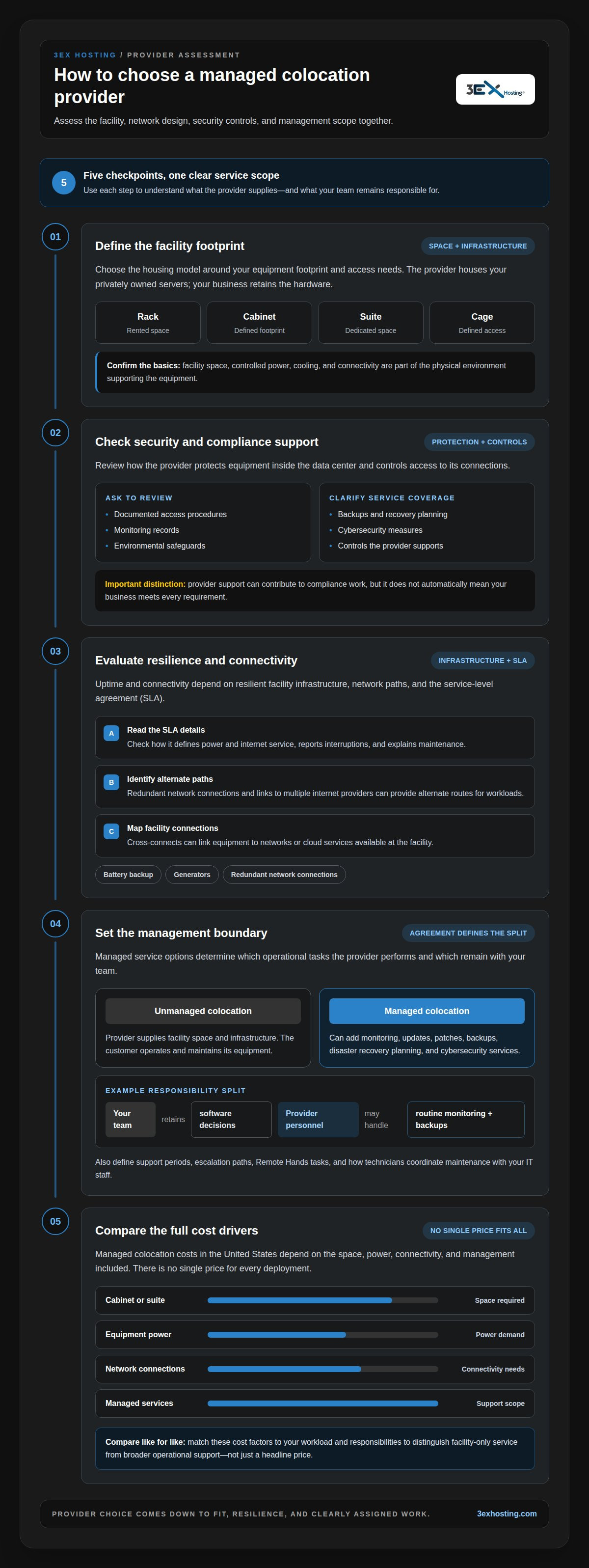
Assess the facility, network design, security controls, and management scope together. A cabinet, private suite, or cage changes how equipment is housed; cabinet colocation options illustrate one way to define that footprint.
Security and Compliance Standards
Physical and network security means protecting equipment inside the data center and controlling access to its connections. Look for documented access procedures, monitoring records, and safeguards against environmental risks. Managed services can also cover backups, recovery planning, and cybersecurity measures. For compliance-focused operations, clarify which controls the provider supports and how responsibilities are divided. Provider support can contribute to compliance work, but it does not automatically mean your business meets every requirement.
Provider Uptime and Connectivity
Uptime and connectivity depend on resilient facility infrastructure, network paths, and the service-level agreement (SLA). Review how the SLA defines power and internet service, reports interruptions, and explains maintenance. Redundant network connections and links to multiple internet providers can provide alternate paths for workloads. Cross-connects can also connect equipment to networks or cloud services available at the facility. These details matter for applications that depend on consistent access, not just a secure room for servers.
Managed Service Options
Managed service options define which operational tasks the provider performs and which remain with your team. In unmanaged colocation, the provider supplies facility space and infrastructure, while the customer operates and maintains its equipment. Managed colocation can add server monitoring, updates, patches, backups, disaster recovery planning, and cybersecurity services. The agreement defines the support available. For example, a business may retain software decisions while assigning routine hardware monitoring and backup operations to provider personnel.
Managed Colocation Costs
Managed colocation costs in the United States depend on the space, power, connectivity, and management included. There is no single price for every deployment. Key cost factors include cabinet or suite requirements, equipment power demand, network connections, and the scope of managed services. Compare these items with your workload and responsibilities to distinguish facility-only service from broader operational support, rather than relying on a headline price.
How colocation data center works?
Colocation places a business’s servers in rented space inside a third-party data center. The business retains its hardware while using the facility’s power, cooling, and connectivity.
Colocation and Rented Data Center Space
Colocation means renting data-center space for privately owned servers and network equipment. A business may use a rack, cabinet, suite, or cage, depending on its equipment footprint and access needs. The facility provides the physical environment around that hardware, including controlled power and cooling. This model can enable businesses to use purpose-built infrastructure without operating a separate server facility themselves.
Hardware Ownership and Facility Models
With colocation, the business typically owns and controls its servers, while the provider houses them. An on-premises data center puts facility operations and equipment at the business’s own site, so the business manages the physical space and supporting infrastructure. Managed colocation changes the division of work, not necessarily hardware ownership: provider personnel perform agreed management tasks, while the business retains its servers and decides how to use them. This distinction helps clarify whether a facility buildout or rented space better suits the workload.
Data Center Redundancy and Security
Redundancy adds alternate infrastructure paths that can help keep servers operating during component disruptions. A data center may use battery backup and generators alongside power supplies, while redundant network connections provide alternate routes for traffic. Physical controls and environmental safeguards help protect equipment from unauthorized access and damage. Managed security options may include firewalls and anti-malware measures. The managed-services agreement defines the division of cybersecurity tasks.
For a closer look at how facility infrastructure supports colocated equipment, explore this data center environment.
Managed colocation support and IT expertise
To understand what is included in managed colocation, separate facility support from system administration. The agreement defines which operational tasks provider technicians handle and which remain with your organization.
Facility Support and Technical Expertise
Facility support addresses the data-center environment, while technical expertise covers equipment and system operations. This distinction matters when your team needs help beyond building infrastructure. Provider personnel can monitor systems, review alerts, and coordinate maintenance with your IT staff. A defined escalation path clarifies who responds to a facility fault, a server alert, or a planned change, helping teams route issues efficiently.
Remote Hands and Technician Assistance
Remote Hands means on-site technicians perform specified physical tasks for customer equipment. Examples include checking indicator lights, tracing a cable connection, or assisting with a planned equipment change. This support lets an organization handle work at the facility without sending its own staff. Remote Hands connects remote IT teams with equipment that needs physical attention, while agreed task boundaries keep responsibilities clear.
Continuous Monitoring and Support
Continuous monitoring means tracking systems and responding to alerts throughout the support period. Colocation providers typically offer monitoring and support 24/7/365, giving distributed teams a way to escalate issues beyond local business hours. Monitoring records can show server activity and provide an audit trail. Useful procedures specify alert ownership, escalation steps, and how the organization receives relevant monitoring information.
Server and Operating System Management
Managed colocation can include server monitoring and maintenance, such as updates and patches. A clear description of what is included in managed colocation should state whether operating-system administration is part of the service. For example, provider staff might perform agreed routine monitoring while the organization approves operating-system changes. Backups and proactive maintenance can also support recovery planning and help reduce disruption from system issues.
What does colocation offer in addition to space, infrastructure, security and support?
Managed colocation can combine facility resources with operational services. The specific scope determines which infrastructure and tasks support each workload.
Power and Cooling Resilience
Power and cooling resilience uses backup systems to support server operations during infrastructure disruptions. Data centers may draw power from multiple grids and use battery backup systems and generators. Cooling maintains a controlled environment around equipment, helping protect hardware from heat-related damage. These systems reduce reliance on a single utility feed or cooling component. The facility’s design and service agreement clarify which infrastructure supports your equipment.
Rack Space and Network Options
Rack space and network options determine how equipment fits into the facility and connects to workloads. Businesses may rent a rack, part of a rack, or a dedicated suite or cage. Requirements depend on equipment footprint, power demand, bandwidth needs, and desired network paths. Connectivity may include links to multiple internet providers and cross-connects to on-site networks or cloud services. These choices shape how systems exchange data with users and other infrastructure.
Managed Colocation Service Inclusions
Managed colocation can combine space, power, cooling, connectivity, physical security, monitoring, maintenance, and backups. In practical terms, the facility houses equipment, while agreed managed services add operational tasks. For example, a business may use provider monitoring and backup support alongside its own application management. Shared infrastructure helps distribute operating costs across facility tenants, while the service agreement defines the exact division of responsibilities.
Match facility capacity and connectivity to your workload, then explore colocation options for suitable rack or cage space.
3EX Hosting: Managed Cloud Hosting
3EX Hosting provides Managed Cloud Hosting for organizations whose infrastructure needs call for a cloud environment rather than space for owned servers. It can suit teams looking to place cloud hosting alongside their colocation strategy, or use it for workloads that do not require dedicated physical equipment.
For businesses keeping their own hardware, Full Cabinet Colocation, Private Colocation Suites, and Cage Solutions provide different ways to house equipment. The right fit depends on your infrastructure footprint and how much dedicated space it requires. Managed Cloud Hosting offers a different model. Consider which workloads belong in hosted cloud infrastructure and which need to remain on colocated hardware.
Contact 3EX Hosting to discuss which infrastructure option fits your requirements.
Plan your next infrastructure move
Turn your understanding of what is included in managed colocation into a clear infrastructure plan. Identify which workloads need owned hardware, which could fit a cloud environment, and how much operational responsibility your team wants to retain. These decisions help shape a service arrangement around your priorities rather than a generic checklist.
For owned equipment, 3EX Hosting offers Full Cabinet Colocation, Private Colocation Suites, and Cage Solutions. These options provide different ways to house infrastructure, depending on your space and separation needs. Consider how your requirements may change as workloads grow, and align the facility model with your operational plans.
Discuss the infrastructure approach that fits your organization. Contact 3EX Hosting to explore the next step and move forward with a plan built around your requirements.
Frequently Asked Questions
What is colocation?
Colocation places computing equipment in a third-party data-center facility. A business rents facility space rather than operating the building and its supporting infrastructure itself. For example, a company with servers in an office can move them into a dedicated data-center cabinet or suite. The facility provides the physical environment, while the service agreement defines responsibilities and access arrangements.
Making the Transition to Managed Colocation?
Start the transition by defining which workloads are moving and what support your organization needs afterward. Map dependencies such as applications, storage, and network connections so the provider can plan the facility and service scope. Then agree on responsibilities, migration timing, and required support. A staged move can help teams coordinate workloads and validate each service before shifting additional systems.
Does managed colocation include servers, storage, and networking equipment?
Managed colocation does not automatically mean the customer receives servers, storage, or networking equipment. The term describes facility and management services, while equipment ownership and package contents require separate definition. At 3EX Hosting, 3EX owns all equipment, and customers have no rights to that equipment. Review the applicable service order to understand the specific infrastructure and services covered before planning workloads around them.
What remote hands and on-site support are included in managed colocation?
Remote hands support lets on-site technicians perform agreed physical tasks for equipment, such as checking status indicators or handling a cable connection. 3EX Hosting provides 24/7 on-site Remote Hands assistance for hardware management, maintenance, and troubleshooting. This can help distributed IT teams address equipment issues without sending staff to the facility. The support scope determines which actions technicians perform and which decisions remain with the organization.
Are power, cooling, bandwidth, and physical security included in managed colocation?
Colocation commonly includes facility power, cooling, network connectivity, and physical security measures as part of the data-center environment. These services support equipment operation and help protect it from environmental risks and unauthorized access. The Service Order defines the relevant capacity and service terms. For example, bandwidth provisions and power allocation should align with the equipment and workload, rather than being assumed from the word “managed.”
What service-level agreements and uptime guarantees do managed colocation providers offer?
A service-level agreement (SLA) records the provider’s commitments and defines how service performance is assessed. Review which infrastructure the SLA covers, how uptime is measured, what exclusions apply, and what remedies follow if commitments are missed. Uptime figures are contractual terms, not a universal feature of managed colocation. A precise SLA helps your organization understand the provider’s obligations and plan for operational risk.