 SUPPORT



 3EX United States
Blog
Faster network performance doesn’t always require more bandwidth. To understand how to improve network performance with peering, start with the route: direct connections between networks can reduce routing hops, bypass congested transit paths, and keep traffic on a more direct path.
If latency or rising traffic is putting pressure on your infrastructure, peering can improve how your network exchanges data. Its value depends on where your traffic flows and which networks you need to reach, so choosing relevant connections matters more than simply adding capacity.
This article explains how peering works, how it can reduce latency and reliance on transit, and what to consider as connectivity scales. It also covers Internet Exchange-as-a-Service and how colocation can support direct network connections.
Key Takeaways
- Direct peering can shorten traffic routes and help avoid congested transit paths, reducing latency for traffic exchanged between networks.
- Internet exchange as a service can provide a way to connect with networks at an exchange without building the same on-site infrastructure.
- Use traffic patterns, target networks, routing needs, and geographic reach to guide peering location decisions as connectivity scales.
- Colocation can support the physical infrastructure behind peering; the right setup depends on how your network needs to connect and grow.
Reduced latency and bandwidth consumption
Peering can improve performance by giving traffic a more direct route between networks. It can also reduce the traffic carried over paid transit connections.
Shorter Traffic Paths
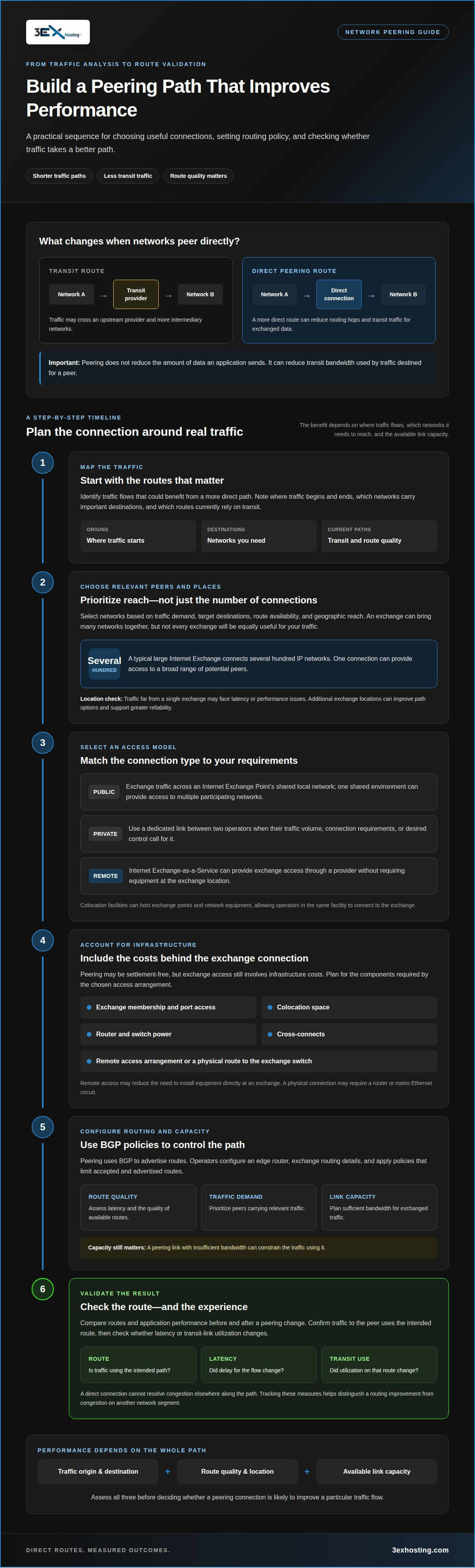
A shorter traffic path uses fewer intermediary networks to carry data between its source and destination. When two networks peer directly, their traffic can bypass an upstream transit provider, reducing routing hops and the time data spends crossing networks.
For example, traffic between users and an application on a peered network may travel through a nearby exchange point rather than taking a longer transit route. Fewer intermediaries can mean lower latency, particularly for interactive applications that depend on quick responses.
Congestion and Latency Reduction
Congestion occurs when network links carry more traffic than they can efficiently handle, increasing delays and sometimes causing packet loss. A direct peering path can bypass a congested transit provider, giving traffic another route between networks.
This can also affect bandwidth planning. Traffic exchanged directly between peers no longer needs to traverse the same transit connection, potentially reducing the spare capacity an operator needs on that route. Peering does not reduce the amount of data an application sends, but it can reduce transit bandwidth used by traffic destined for a peer.
Latency and User Experience
Lower latency means less delay between a user’s action and an application’s response. In a video call, online game, or cloud application, shorter waits can make interactions feel more responsive and reduce interruptions caused by a slow route.
Results depend on where traffic begins and ends, the route it takes, and available link capacity. A direct connection will not resolve congestion elsewhere along the path. Assess which traffic flows could benefit from peering and whether the proposed connection has enough capacity.
Compare routes and application performance before and after a peering change. Track whether traffic to a peer uses the intended route and whether latency or transit-link utilization changes. These measures help distinguish a routing improvement from congestion on another network segment.
What is internet exchange as a service?
Internet Exchange-as-a-Service provides access to an exchange through a provider. Remote peering can offer that access without requiring equipment at the exchange location. Public peering uses a shared exchange network, while private peering connects two operators over a dedicated link. In the United States, costs depend on port access, cross-connects, equipment, colocation, and the remote access arrangement.
Public and Colocation Exchange Access
Public peering lets autonomous systems exchange traffic across an Internet Exchange Point’s shared local network. Colocation facilities often host these points, allowing operators to connect equipment in the same facility and reach participating networks through the exchange.
For example, a network with equipment in a data center can connect to an exchange switch in that facility. The shared environment can make it practical to exchange traffic with multiple networks. Private peering may suit two operators that need a dedicated connection. Choose between them based on traffic volume, connection requirements, and the level of control needed.
Peering Reach and Location Selection
An exchange extends a network’s reach by bringing participating networks together at a common point. A typical large Internet Exchange connects several hundred IP networks, so a single connection can provide access to a broad range of potential peers.
However, not every exchange is equally useful. Choose locations based on where traffic originates, which networks carry important destinations, and whether the required routes are available. Relying on one exchange can create latency or performance issues for traffic far from that point. Additional exchange locations can improve path options and support greater reliability.
Internet Exchange Access Costs
Exchange access involves infrastructure costs even when peering itself is settlement-free. Operators may pay for exchange membership, port access, colocation space, router and switch power, and cross-connects between their equipment and the exchange.
Remote peering can reduce the need to install equipment directly at an exchange, but costs depend on the access arrangement and network requirements. A physical connection may require a router or metro Ethernet circuit to reach the exchange switch. For accurate planning, map target networks and traffic flows, then account for the required access components. Colocation provides a physical setting for network equipment and exchange connections.
What is Network Peering and How Can It Enhance Performance & Efficiency?
Peering connects networks so they can exchange traffic directly, using BGP to advertise routes. The performance benefits depend on route quality, traffic demand, and available infrastructure.
Routing Control and Path Selection
Routing control determines which path traffic takes between networks, influencing latency, efficiency, and technical performance. A network operator uses BGP policies to select routes and control which prefixes are announced to peers.
To establish BGP peering, operators configure an edge router, exchange routing details, and apply policies that limit accepted and advertised routes. Evaluate potential peers by examining traffic volume, latency, and route quality. A direct route to a frequently used application, for example, may be more valuable than a peer carrying little relevant traffic.
Reliability and Bandwidth Capacity
Peering adds a route that can reduce reliance on transit providers and help maintain traffic flow when another route fails. Direct interconnections also let both networks plan sufficient bandwidth for exchanged traffic.
Capacity still matters: a peering link with insufficient bandwidth can become a bottleneck as demand increases. Disaggregated routing can let service providers use lower-end routers to support peering traffic at scale, helping them expand infrastructure without relying on a single large routing platform.
Peering and IP Transit Tradeoffs
IP transit is a paid arrangement that provides access to the rest of the internet through another network. Peering exchanges traffic directly between networks, often without payment for the exchanged data.
Transit provides broad reach, while peering can improve performance for traffic exchanged with specific networks and reduce reliance on transit. Operators often use both: transit reaches destinations outside their peer relationships, while peering carries eligible traffic over selected routes.
Measuring Traffic and Peering Benefits
Before making peering decisions, measure traffic patterns by reviewing destination networks, route paths, link utilization, latency, and packet loss. Compare those baselines with the same measurements after BGP routes change to assess performance and differences in transit use.
Monitor BGP session status, advertised prefixes, route changes, and link capacity. If performance shifts, first inspect route selection and interface utilization, then check for session or policy errors. These checks help identify whether the issue lies in the peering path or elsewhere in the network.
How to identify the best peering locations and networks for traffic exchange?
Choose peering locations by matching network presence to where traffic originates and which destinations matter. A useful location improves real routes, rather than simply having many connected networks.
Start with traffic records. Identify frequently reached autonomous systems, destination regions, and the paths packets currently take. If traffic to a particular network repeatedly crosses a distant transit route, for example, a nearby exchange with that network may offer a more direct option. Compare candidate locations with those traffic flows and existing routes.
Check geographic reach before selecting a virtual peering arrangement. Some virtual networks must be in the same region, which can limit cross-region options. A network serving users across several regions may therefore need peering points in different locations. This can also reduce reliance on a single exchange that is far from users.
Evaluate prospective peers by route relevance, traffic volume, and the paths they announce. A long participant list does not automatically make an exchange a good fit. Confirm that the networks you need are reachable through the location, then consider how adding peers affects routing-table size. As autonomous systems announce newly allocated address blocks, global routing tables grow, so scalable route handling matters.
Plan routing policies alongside physical location. The National Institute of Standards and Technology recommends that an Internet Exchange Point announce its LAN prefix to all member autonomous systems, while members reject more-specific prefixes. This helps establish consistent handling of exchange routes. The US National Institute of Standards and Technology also recommends using access control lists to restrict router connections to authorized neighbor routers.
Map each proposed connection to a measurable purpose: a shorter route to a key network, improved regional reach, or an alternate path. Network automation can simplify device deployment and configuration as peering environments expand. Review traffic and routing behavior after each addition, then refine locations as demand and network architecture evolve.
3EX Hosting
3EX Hosting supports network strategies that need reliable infrastructure alongside peering and exchange connections. Its colocation options provide physical space for network equipment, with Full Cabinet Colocation, Private Colocation Suites, and Cage Solutions available for different deployment needs.
Cross-Connect Services can support the network architecture behind traffic exchange within a facility. Managed Cloud Hosting is another option for workloads suited to a hosted environment rather than customer-managed equipment. These services can support organizations planning a peering footprint or scaling existing infrastructure.
Discuss the infrastructure behind your connectivity plan with Contact 3EX Hosting.
Make Your Next Connectivity Decision Deliberate
Use your traffic priorities to plan the next stage of your network. Decide which destinations matter most, where physical infrastructure should sit, and how peering fits alongside the routes you already rely on. This turns how to improve network performance with peering into a practical infrastructure plan, not an isolated routing change.
When your plan requires a physical deployment, 3EX Hosting offers Full Cabinet Colocation, Private Colocation Suites, and Cage Solutions. The right setup depends on your equipment and network design. Aligning the space with your connectivity requirements helps keep infrastructure decisions coordinated as your network evolves.
Discuss the infrastructure behind your connectivity plan with Contact 3EX Hosting. A clear next step can help move your peering strategy toward a stable, scalable deployment.
Frequently Asked Questions
What is peering?
Peering is a voluntary arrangement in which two networks exchange internet traffic directly under agreed routing policies. In ISP peering, each side typically shares routes for its downstream customers, not its upstream routes. For example, an ISP and a content delivery network can exchange routes so users reach hosted content over a path selected between their networks. Peering arrangements may be settlement-free or paid.
How does network peering improve latency, throughput, and reliability?
Peering can improve latency and reliability when it gives selected traffic a more suitable route, while throughput depends on available capacity along that route. Assess application response and data transfer, not just the connection between networks. A cloud service may respond faster over a direct route, for example, while throughput remains limited by a saturated access link or receiving system.
What are the requirements to join an internet exchange point in the United States?
A network generally needs at least one block of public IP addresses and a public Autonomous System number, each assigned by a Regional Internet Registry. It also needs an edge router capable of running BGP and the technical ability to configure and manage BGP interconnections. The operator must connect to the exchange and follow its participation and routing policies.
What are the security risks of peering and how can route leaks and hijacks be prevented?
Route leaks can spread announcements beyond their intended networks, while route hijacks involve unauthorized announcements of address prefixes. Use access control lists to restrict router connections to authorized neighbors. The National Institute of Standards and Technology recommends that an IXP announce its LAN prefix to all member ASes and that members reject more-specific prefixes. Carefully apply prefix filters and review routing policies to limit incorrect announcements.