 SUPPORT



 3EX United States
Blog
The internet doesn’t run through one network. It connects thousands of independently managed networks, and peering lets two networks exchange traffic for their own networks and customers directly. Transit is different: it’s a paid service that provides reachability to the wider internet. This guide gets peering and interconnection explained in practical terms, so the distinction is clear from the start.
It’s easy to treat these terms as interchangeable because both describe ways networks connect. But the distinction affects which destinations are reachable, how traffic is routed, and how networks plan their connections. Understanding the basics explains why operators may use peering for specific traffic and transit for broader internet access.
You’ll learn how direct connections and internet exchanges link independently operated networks, what BGP does, and how peering compares with transit. This gives you a clearer picture of the choices behind network reachability, performance, and resilience.
Key Takeaways
- Understand how BGP helps networks share routing information and direct traffic to the right destinations.
- See how an internet exchange can connect independently operated networks through a shared switching fabric.
- Distinguish direct traffic exchange from transit service that provides reachability across the wider internet.
- Learn how physical colocation can support network connections when infrastructure needs a secure, scalable home.
What is peering and interconnection?
Peering is a direct exchange of traffic between two networks; interconnection is the link that lets separate networks communicate. BGP carries routing information so each network can direct packets toward destinations it has learned are reachable.
BGP Routing Information Exchange
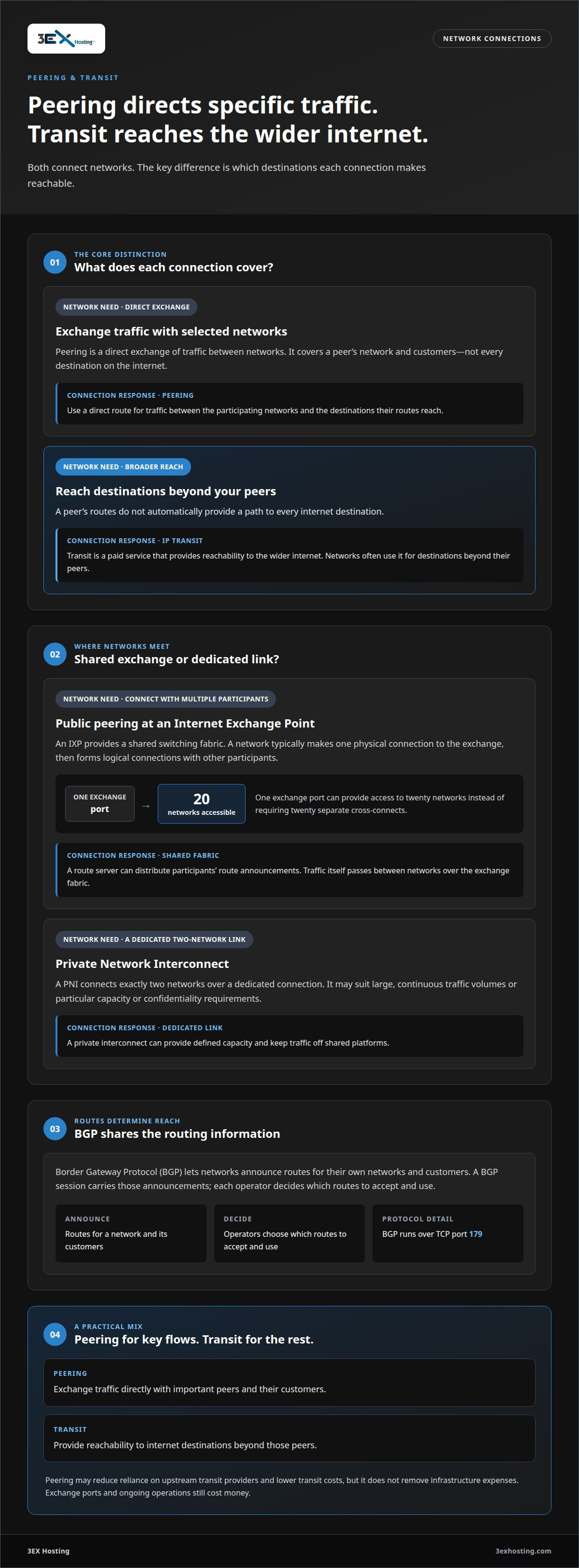
Border Gateway Protocol (BGP) lets networks announce routes for their own networks and customers to other networks. A BGP session carries those announcements, and each operator decides which routes to accept and use. BGP runs over TCP port 179. For an organization, those decisions affect which destinations are reachable and the path traffic follows. Teams often need peering and interconnection explained through the roles of BGP routes, exchange architecture, and the destinations covered.
Internet Exchange Point Architecture
An Internet Exchange Point (IXP) is a shared switching fabric where participating networks connect and exchange traffic. A network typically establishes one physical connection to the IXP, then forms logical connections with other participants. One exchange port can provide access to twenty networks, instead of requiring twenty separate cross-connects. IXPs are commonly housed in data centers, where network infrastructure can connect at a shared site. This setup can simplify access to multiple networks without a separate physical link to each one.
Public Peering and Route Servers
Public peering is the exchange of routes and traffic between networks connected to the same IXP. A route server centrally distributes participants’ route announcements, reducing the need to configure a separate BGP session with every peer. The server shares routing information, while traffic passes between networks over the exchange’s switching fabric. Peering covers a peer’s network and customers, not the entire internet. To understand peering and interconnection, track which routes a session shares and which destinations they cover.
Peering Policies at Exchanges
A peering policy sets the conditions under which a network exchanges routes with other networks. Operators may weigh traffic volume, network presence, and strategic value. A business or ISP can map important traffic destinations to the networks available at an exchange, then choose a data center where those networks connect. A peering agreement depends on mutual benefit, and the parties define its scope and compatible routing arrangements together. Joining an exchange alone does not establish peering with every participant.
Internet as a network of independently operated networks
The internet links thousands of independently managed networks, each making its own routing decisions. Interconnection allows those networks to exchange traffic and extend connectivity beyond their own customers.
Linking Independent Networks
Interconnection links separate networks so data can pass between them rather than stopping at an organization’s boundary. Each network operates as an autonomous system, managing its routes and deciding how to exchange traffic. For example, a regional ISP needs connections to other networks to carry customer traffic beyond its local infrastructure. Those links determine which destinations are reachable and can affect latency along the selected path.
Regional networks often combine local peering with transit from an upstream provider. Picture a donut-shaped regional topology: nearby networks connect around a shared exchange, while transit provides routes beyond that group. This illustrates how local connectivity and broader reachability work together. Network engineers determine which routes use each connection and how traffic shifts if a preferred path changes.
Public and Private Interconnects
Public IXP peering uses a shared switching fabric to connect participating networks. A Private Network Interconnect (PNI), by contrast, links exactly two networks over a dedicated connection. Public peering can provide access to multiple exchange participants through the IXP. A PNI may suit networks exchanging large, continuous volumes of data or with particular capacity or confidentiality requirements.
The choice depends on traffic patterns, the networks involved, and the required connection characteristics. For example, an organization exchanging traffic with several regional networks may use public IXP peering, while two networks with sustained high-volume traffic may use a dedicated PNI. A private interconnect can provide defined capacity and keep traffic off shared platforms. Locating network equipment in a data center can support these physical connections; private colocation suites provide a dedicated environment for infrastructure used in interconnection.
Interconnection, peering, and transit compared
Interconnection is the broader act of linking networks; peering and transit are distinct ways to exchange traffic. The right mix depends on destinations, traffic volume, and the technical capacity a network requires.
Peering Compared with IP Transit
Peering exchanges traffic between networks and their customers, while IP transit provides reachability to the entire internet. For example, a network may peer with a cloud provider to exchange traffic directly, while using transit for destinations beyond its peers. This distinction matters because a peer’s routes do not automatically provide a path to every internet destination.
Network operators commonly use both arrangements, peering for important traffic flows and transit for the rest of the internet. A peering agreement may be settlement-free, meaning neither network charges the other per bit exchanged. However, exchange ports and ongoing operations still cost money. The technical and commercial terms depend on the networks’ agreement.
Peering Costs and Transit Savings
Peering may reduce reliance on upstream transit providers and lower transit costs, but it doesn’t eliminate infrastructure expenses. Operators still need suitable connectivity, exchange access, routing equipment, and engineering work. A network that shifts traffic to a peer may use less transit for those destinations, while continuing to pay for transit to reach others.
Compare the potential reduction in transit usage with the resources needed to establish and operate peering. If a team lacks the required expertise, peering’s operational overhead can exceed transit savings during the first 12-18 months. That makes traffic patterns and internal technical capacity central to the decision, not simply the prospect of lower upstream usage.
Reducing Transit Costs
To estimate potential transit savings, identify destinations that generate substantial traffic and determine whether suitable peers can reach them. If a cloud provider is a major destination, for example, direct peering may carry that traffic outside the transit connection. The benefit depends on available routes and actual traffic volume, not simply on the number of peering sessions.
Keep transit in the network plan for destinations peering doesn’t cover. Use direct exchange for specific traffic flows where it makes sense, and transit for broader reachability. Weigh the technical overhead against any reduction in transit use, then review the mix as traffic patterns change. Peering can give operators more control over selected routes, but it does not replace all transit.
What is the difference between peering and transit?
Peering exchanges traffic between participating networks; transit provides reachability to the entire internet. Peering requirements typically depend on traffic volume, routing policy, and the technical capacity available at each connection point.
BGP Sessions and Prefix Announcements
A BGP peering session lets two networks exchange announcements for the IP prefixes they can reach. These announcements tell each network which destinations the other serves, helping routers direct traffic to those destinations. A peering session alone does not provide routes to the entire internet.
To configure peering, network operators establish an external BGP session with the other participant and apply routing policies to accepted announcements. They can set an eBGP max-prefix limit at roughly 110% of the peer’s expected prefix count. This guardrail helps limit the routing impact of an unexpectedly large announcement. Transit differs because its provider advertises routes that provide broad internet reachability.
Peering Traffic and Technical Requirements
Peering requirements vary with traffic volume, destinations, network presence, and the mutual benefit each side expects. Operators consider whether their traffic patterns justify a direct exchange and whether the connection has enough capacity. There is no universal traffic threshold for every peering arrangement; the parties’ policies and technical needs determine the terms.
Routing policy also determines which paths carry traffic. Operators may prefer a peer’s routes for destinations served by that peer, while retaining transit routes for wider reachability. Monitoring matters: alert within 60 seconds when a peering BGP session goes down, so operators can respond to route loss. Track session status, received prefixes, and traffic levels to identify changes that may affect connectivity. A physical link can remain active even when its BGP session has failed, so monitoring both helps distinguish a routing fault from a connection fault.
3EX Hosting
3EX Hosting supports organizations that need a physical environment for network and server infrastructure. If your peering strategy requires equipment housed in a data center, colocation can provide space for that infrastructure while your network team manages routing and peer agreements.
Choose Full Cabinet Colocation, Private Colocation Suites, or Cage Solutions according to the space and separation your deployment needs. For workloads better suited to hosted infrastructure, Managed Cloud Hosting is another option. These services meet different infrastructure needs; they do not replace routing decisions or agreements between networks.
To discuss how your infrastructure requirements fit these options, contact 3EX Hosting.
Put Your Interconnection Strategy Into Practice
With peering and interconnection explained, the next step is to connect network strategy with infrastructure planning. Map the destinations your organization needs to reach, identify where direct connectivity supports those goals, and plan how your physical environment will accommodate the required equipment. Clear priorities help your engineering team assess connectivity choices without treating every route or connection as equally important.
Infrastructure needs can also change as workloads and traffic patterns evolve. Choose an environment that fits your operational requirements and leaves room for deliberate network planning. 3EX Hosting provides colocation options for organizations placing their own infrastructure in a data center, alongside managed cloud hosting for suitable workloads.
Contact 3EX Hosting to discuss connectivity and the infrastructure that supports your plans. A considered next step can help your team move forward with clarity and confidence.
Frequently Asked Questions
Is peering free?
Peering is often settlement-free, meaning neither network charges the other per bit exchanged. That doesn’t make the connection costless: networks may still pay for exchange access, ports, cross-connects, equipment, and engineering. Some arrangements involve payment, depending on traffic balance and commercial negotiations. A network may avoid per-bit settlement while still incurring costs to establish and operate its exchange connection.
What is an internet exchange?
An Internet Exchange Point (IXP) is a shared switching fabric where networks connect and exchange traffic. It lets participants establish logical connections without a separate physical connection to every network they want to reach. For example, one IXP port can provide access to twenty other networks, rather than requiring twenty separate cross-connects. Participants still choose which networks to peer with.
What is network peering?
Network peering is an arrangement in which independently operated networks exchange traffic directly for destinations covered by their agreement. For example, an online service network and an ISP might peer so their customers can communicate over a direct route. Peering doesn’t automatically give either network access to every internet destination. Operators assess whether the exchange offers enough mutual benefit for the traffic involved.
How Does the Peering Process Start?
Start by identifying the destinations that generate significant traffic, then determine which networks serve them and where they interconnect. Operators assess traffic volume, network presence, and strategic value before proposing a peering relationship. The parties agree on its scope and routing arrangements, select a public exchange or dedicated connection, and coordinate the technical setup. A clear case for mutual benefit is the starting point.
How does peering work?
After networks establish a peering connection, their routers exchange routes through BGP. Each operator applies routing policy to decide which announcements to accept and how to direct traffic. For instance, an operator could assign local preference 200 to IXP routes and 100 to transit routes, making the IXP route preferable when both are available. The selected route depends on policy, not simply geographic distance.
What are the Benefits of Peering?
Peering can provide a more direct path to covered destinations, potentially reducing latency and packet loss. It may also reduce reliance on transit providers for those traffic flows and give operators more control over routing performance. The practical benefit depends on which networks participate and how much traffic the connection carries. Peering complements transit, which remains important for destinations outside peer networks.