 SUPPORT


 3EX United States
 Blog
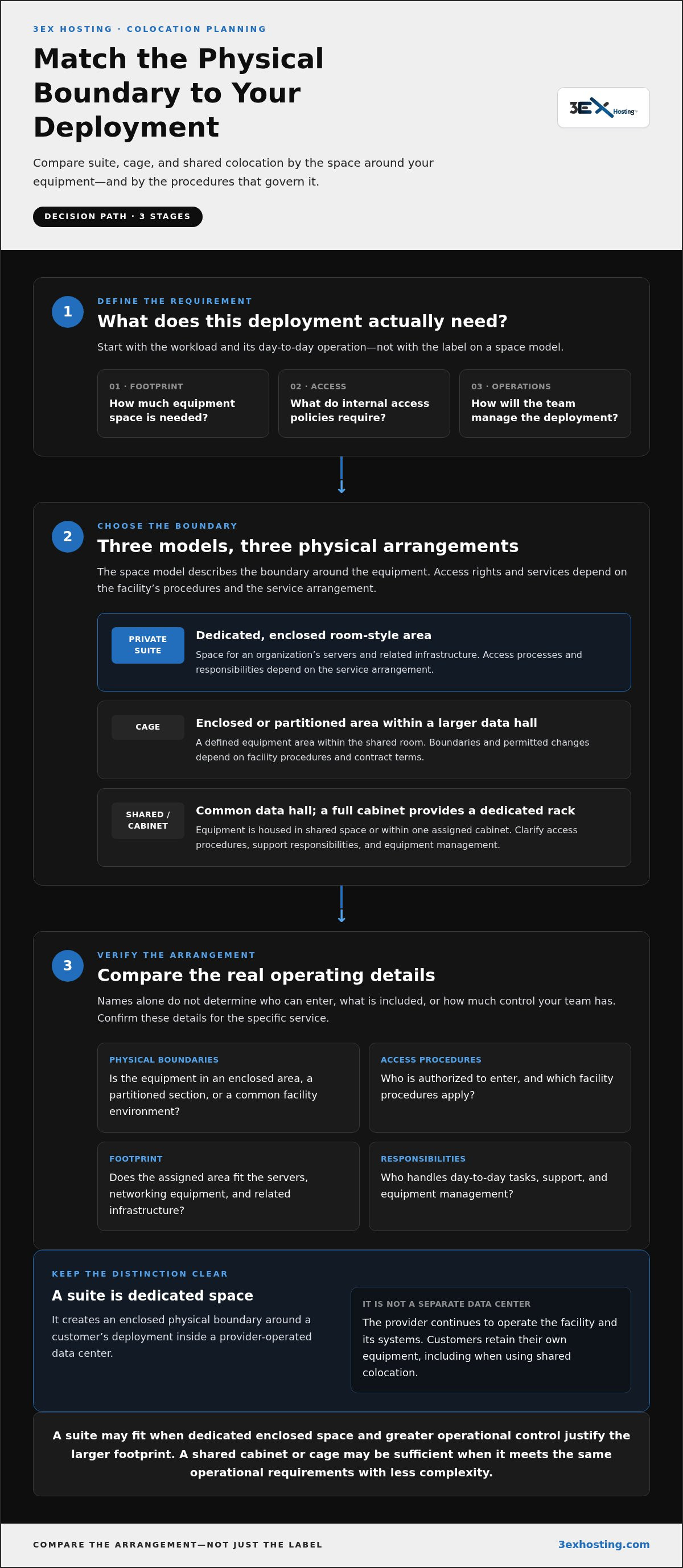
More physical separation isn’t always the right choice, and a private room doesn’t automatically make infrastructure more secure. Private colocation suites can fit workloads that need dedicated space and greater operational control, but they also require a larger footprint and a plan for managing that space. A shared cabinet or cage may be sufficient when it meets the same operational requirements with less complexity. Start by defining what your environment actually needs.
To compare the options, look at physical boundaries, access procedures, equipment footprint, and day-to-day responsibilities. Suites, cages, and shared colocation can be described in different ways, so compare the actual arrangement rather than relying on labels.
This guide compares the three models across physical separation, access control, operational responsibility, connectivity, support, and growth. You’ll learn when dedicated space may be justified and when a smaller footprint can meet your needs. It also covers how remote hands support and cross-connects fit into deployment planning, so you can make a decision with clearer expectations.
Key Takeaways
- Choose private colocation suites when dedicated, enclosed space and greater operational control justify a larger footprint.
- Compare suites, cages, and shared space by physical boundaries, access procedures, equipment footprint, and who handles day-to-day tasks.
- Assess power and cooling needs alongside connectivity before selecting a space model, especially when planning for future equipment growth.
- Use a structured checklist to define isolation, access, environmental, and capacity requirements before deployment.
- Plan how remote hands support and cross-connect services will fit into ongoing operations and network requirements.
When Do Private Colocation Suites Make More Sense Than Shared Space?
Start with a practical question: does your infrastructure need its own enclosed area, or can it operate effectively in a shared room? The answer depends on your equipment footprint, internal access policies, and how your team manages the deployment. A dedicated suite provides a clearer physical boundary, but that boundary may not be necessary for every workload.
Colocation places customer-owned IT equipment in a data center operated by a service provider. For background on how facilities support different colocation data centers models, consider the distinction between customer equipment and provider-operated infrastructure.
What does a private colocation suite provide?
A private suite is a dedicated, enclosed area within a provider-operated data center. An organization uses it for servers, networking equipment, and related infrastructure, with a layout planned around the project’s footprint and operating requirements. The provider continues to operate the facility and its systems; the customer does not own or run the entire data center.
A private suite is customer-dedicated space inside a shared, provider-operated facility, not a separate data center. The suite creates a physical boundary around the customer’s deployment, while facility infrastructure and services remain part of the wider site. Explore private data center suites when dedicated colocation space fits your requirements.
When can shared colocation space be enough?
Shared colocation space may suit a smaller deployment, such as a limited number of servers or a focused network environment. It can also work for teams that want to house equipment in a provider-operated facility without dedicating an enclosed area to it. Shared space is not inherently unsafe or unsuitable for enterprise workloads. Its fit depends on the organization’s policies, processes, and operational needs.
Assess the requirement, not just the label. If your procedures allow equipment to operate in a shared environment, a suite may add space and coordination without addressing a specific need. If your team requires dedicated enclosed space to meet physical separation or access requirements, a suite may be more appropriate. Either way, security and operations still need clear procedures.
Before choosing, define what “isolation” means for your deployment. Do you need a dedicated physical area, a defined equipment footprint, or access procedures that align with internal policy? Clear answers help distinguish a genuine need for a suite from a preference for additional separation. They also keep the decision grounded in how the infrastructure will be used and supported.
Private Suites, Cages, and Shared Colocation: What Actually Differs?
These models differ mainly in the physical boundary around your equipment. A suite is an enclosed, dedicated area; a cage is a separated section within a larger data hall; and shared colocation places customer equipment in a common facility environment. The labels alone do not determine who can enter, which services are included, or how much day-to-day control your team has. The service arrangement and operating procedures define those details.
| Model | Physical boundary | Typical footprint | Operational considerations |
|---|---|---|---|
| Private suite | Dedicated, enclosed room-style area | Space for an organization’s servers and related infrastructure | Access processes and responsibilities depend on the service arrangement |
| Cage | Enclosed or partitioned area within a larger data hall | Defined equipment area within the shared room | Access boundaries and permitted changes depend on facility procedures and contract terms |
| Shared space or cabinet | Common data hall; a full cabinet provides a dedicated rack | Equipment housed in shared space or within one assigned cabinet | Clarify access procedures, support responsibilities, and how equipment is managed |
How does a private suite differ from a colocation cage?
A suite has room-style boundaries around the deployment, while a cage creates a defined, separated area inside a larger hall. The difference can affect equipment organization and access planning, but it does not automatically determine who is authorized to enter or which facility systems are shared. Those details depend on operating procedures and service terms. For dedicated space, review private data center suites. A cage is another option when a bounded area within a shared hall fits the footprint.
How does shared colocation compare with a full cabinet?
“Shared” describes the facility environment, not shared ownership of servers. Customers retain their own equipment, while a full cabinet provides one customer with dedicated rack space inside the colocation facility. It can suit a contained deployment that needs a rack but not a separate room or cage. Consider cage colocation solutions when you need a defined area beyond a cabinet.
Physical separation is only one part of the decision. For example, data center security standards illustrate how physical, administrative, and technical controls can all factor into facility requirements. Use your own access policies and workflows to determine which boundaries matter. 3EX Hosting offers colocation options ranging from full cabinets and cages to private suites, so you can match the deployment model to your needs.
Compare Private Colocation Options Across Five Decision Factors
Compare the models against your deployment’s actual demands, not a general ranking. A suite provides dedicated enclosed space, while a cage or shared area may be a better fit for a smaller footprint. No model automatically determines security, power capacity, connectivity, or support. Evaluate those requirements against the facility design and service terms.
| Decision factor | Private suite | Cage | Shared space or cabinet |
|---|---|---|---|
| Physical separation | Dedicated enclosed area | Defined, secured area within a larger data hall | Shared data hall; a cabinet dedicates rack space, not a room |
| Power and cooling | Plan around the equipment load and the arrangement’s available power and cooling | Match equipment needs to the allocation and facility environment | Confirm the provision for the cabinet or shared deployment |
| Connectivity | Plan required network paths and cross-connects for the deployment | Plan connections around equipment location and network needs | Identify how the cabinet or equipment connects to required networks |
| Operational access | Set authorized users, entry procedures, and hardware-work responsibilities | Coordinate access within the facility’s processes | Define who can access equipment and how work is handled |
| Growth | Consider whether the dedicated footprint can accommodate planned expansion | Assess whether the defined area can support added equipment | Determine how additional rack space or equipment would fit the deployment plan |
How should security and operational control affect the choice?
Consider physical access separately from cybersecurity and internal governance. A suite changes the physical boundary; it does not by itself establish network security, satisfy compliance obligations, or prevent incidents. List who needs facility access, what approval process they follow, and who coordinates installation, maintenance, and other hardware work. The IEEE discussion of data center deployment standards provides broader context on infrastructure requirements, but your organization’s own controls should guide the decision.
How do power, connectivity, and growth change the comparison?
Begin with a realistic equipment plan. Document expected power demand and cooling needs, then compare them with the proposed arrangement’s available capacity. Map network dependencies as well. If systems rely on cross-connects to reach other networks, include those connections in the design rather than treating them as a later detail. Finally, plan for credible growth: added equipment may require more rack space, a larger cage, or a suite layout tailored to the project.
Colocation models differ in control, footprint, and operational responsibility, not in a universal measure of suitability. Private colocation suites can fit when dedicated space supports defined operational needs. If that model is under consideration, explore private suite colocation as part of deployment planning.
Use This Checklist to Decide Whether Your Business Needs a Suite
Base the decision on documented operating requirements, not on the assumption that a larger dedicated space is automatically better. Work through the assessment with the teams responsible for infrastructure, security, networking, and ongoing support. The result should show whether shared space, a cage, or a suite fits the workload with the right balance of control and complexity.
- 1. Define the required isolation. Identify the physical boundary your internal policies and daily procedures require. Distinguish a need for an enclosed dedicated area from a preference for greater separation. A preference alone may not justify a suite if it does not change access processes or operations.
- 2. Record the equipment footprint. List the servers, network equipment, and supporting infrastructure in scope. Estimate the space they occupy now and identify planned additions. A contained deployment may fit a cabinet or cage; a broader layout may call for dedicated suite space.
- 3. Document power and environmental needs. Describe the equipment’s power requirements and any project-specific environmental considerations. Use the hardware plan to guide space and capacity planning rather than assuming every model supports the same configuration.
- 4. Map access roles and procedures. Note who needs facility access, how authorization is managed, and who performs or coordinates hardware work. Include internal maintenance workflows and dependencies on remote hands support. The physical boundary matters, but so does having a clear process for getting work done.
- 5. Identify connectivity requirements. Document network connections, cross-connect needs, and the systems that depend on those links. Include how the deployment connects to other infrastructure. This surfaces operational dependencies before the space decision is fixed.
- 6. Use realistic growth assumptions. Separate committed plans from possible future expansion. Estimate how additional equipment could affect footprint, power, cooling, access, and connectivity. Avoid choosing a suite solely for hypothetical growth, but account for a well-defined expansion plan.
- 7. Compare each model against essential requirements. Check shared space, a cage, and a suite against the same list. Mark each requirement as essential, preferred, or optional. If a smaller model meets every essential operational need, a suite may add complexity without a clear benefit. If dedicated boundaries or a tailored layout are necessary, private colocation suites may be proportionate.
Revisit the assessment when workloads, staffing, access procedures, or infrastructure plans change. A sound fit reflects current requirements and credible near-term needs, while leaving room to adjust as operations evolve. For broader planning context, explore 3EX Hosting’s private colocation options and consider how dedicated space, cage solutions, and operational support fit your deployment.
Plan a Private Suite Deployment with the Right Colocation Support
A clear deployment plan turns infrastructure requirements into decisions about space, connectivity, access, and ongoing work. 3EX Hosting provides private colocation suites for organizations that need dedicated colocation space. Bring an equipment and operations plan to deployment planning so the proposed layout reflects the workload rather than assumptions about what a suite should include.
What belongs in a private suite deployment plan?
Document the deployment before finalizing its footprint. Include the equipment inventory, rack or floor-space needs, expected power demand, cooling considerations, and required network connections. Note dependencies on other infrastructure, such as network links systems need to communicate. These details help align the physical layout with how the environment will operate.
Set out responsibilities, too. Identify who is authorized to access the space, who coordinates installation and maintenance, and which tasks your internal team will handle. Include anticipated equipment additions and the operational dependencies they bring. A realistic growth plan can inform the initial layout without reserving space for expansion that remains hypothetical.
How can colocation support simplify ongoing operations?
Distributed IT teams may not have staff on site for every hardware task. 3EX Hosting’s remote hands support helps teams coordinate on-site work without requiring their own staff to travel for every physical intervention. Define the tasks, instructions, and escalation process your operations depend on as part of the support plan.
Give connectivity the same attention. A cross-connect is a physical network connection between relevant parties or networks within a data center environment. Identify which systems need to connect, what each connection supports, and how it fits into the deployment’s network design. 3EX Hosting’s cross-connect services support colocation customers with these interconnection requirements.
Keep the plan focused on operational essentials: the equipment to be installed, physical and environmental requirements, access responsibilities, network dependencies, and credible growth needs. This gives infrastructure and operations teams a shared basis for deployment decisions. It also helps distinguish the dedicated space you require from the services that support the environment after installation.
Ready to turn your requirements into a deployment plan? Discuss private colocation requirements with 3EX Hosting.
Choose the Colocation Model That Fits Your Next Stage
The right deployment matches your actual requirements. Compare shared space, cages, and private colocation suites by physical separation, equipment footprint, access procedures, power and cooling needs, connectivity, and credible growth plans. A dedicated suite can make sense when its added control and space support defined operational needs. A cabinet or cage may fit when a smaller footprint meets those needs.
Plan beyond the physical boundary. Decide how hardware work will be handled and which network connections your systems depend on. 3EX Hosting provides private suites, cage solutions, and full cabinet colocation, with remote hands support and cross-connect services for colocation operations.
Bring your requirements together into a deployment plan, then take the next step with a clear understanding of the space and support your infrastructure needs. Discuss your private colocation requirements with 3EX Hosting and choose a model built around your operations.
Frequently Asked Questions
What is a private colocation suite?
A private colocation suite is a dedicated, enclosed area within a data center operated by a colocation provider. An organization uses the space for its servers and related infrastructure, while the provider operates the wider facility. Private colocation suites provide a distinct physical boundary, but they do not mean the customer owns or operates the data center. Facility systems and services may remain shared, depending on the arrangement.
How is a private colocation suite different from a cage?
A suite is typically a dedicated, enclosed room-style area, while a cage is a secured, defined space within a larger data hall. The physical boundary can affect equipment layout and access planning, but it does not by itself determine every access right or operational responsibility. Those details depend on facility procedures and service terms. A cabinet, by comparison, dedicates rack space rather than a separate room or cage.
Is a private colocation suite more secure than shared space?
A private suite provides a dedicated physical boundary, but that alone does not make an environment secure or prevent incidents. Security also depends on access procedures, cybersecurity controls, staff responsibilities, and how hardware work is managed. Shared colocation can be suitable when its physical arrangements and operating processes meet an organization’s requirements. Assess the full control environment, and do not treat a suite as a guarantee of security or regulatory compliance.
When should a business choose a private suite instead of shared colocation?
Choose a private suite when your organization has a defined need for dedicated enclosed space, a particular equipment layout, or physical access procedures that a shared deployment cannot meet. A smaller footprint may fit in shared space, a cabinet, or a cage. Compare the options against internal policies, equipment needs, and operational workflows. Private colocation suites are most appropriate when their added separation and footprint support concrete requirements.
Can a private colocation suite scale as infrastructure grows?
A suite can be planned around anticipated infrastructure growth, but expansion depends on the deployment design and the space, power, cooling, and connectivity available under the service arrangement. Start by documenting current equipment and realistic additions. Consider how growth could affect layout and operations, too. Treat scalability as a planning requirement, not an automatic outcome of choosing a suite, and revisit the plan as workloads change.
What should a business compare when choosing colocation space?
Compare physical separation, equipment footprint, power and cooling requirements, connectivity, operational access, support responsibilities, and growth plans. Use the same criteria for shared space, a cabinet, a cage, and a suite. For example, list the network connections the workload depends on and who will coordinate hardware tasks. Then distinguish essential requirements from preferences. This makes the trade-offs clearer without assuming one model is right for every organization.
Does a private suite include dedicated power and cooling?
Not automatically. A private suite describes dedicated enclosed space; it does not, by itself, specify whether power or cooling systems are dedicated to that customer. Those requirements depend on the deployment and its service arrangement. Document the equipment’s expected power demand and environmental needs, then align them with the planned space and capacity. Include the details in the deployment plan so infrastructure and operations teams share the same expectations.