 SUPPORT


 3EX United States
 Blog
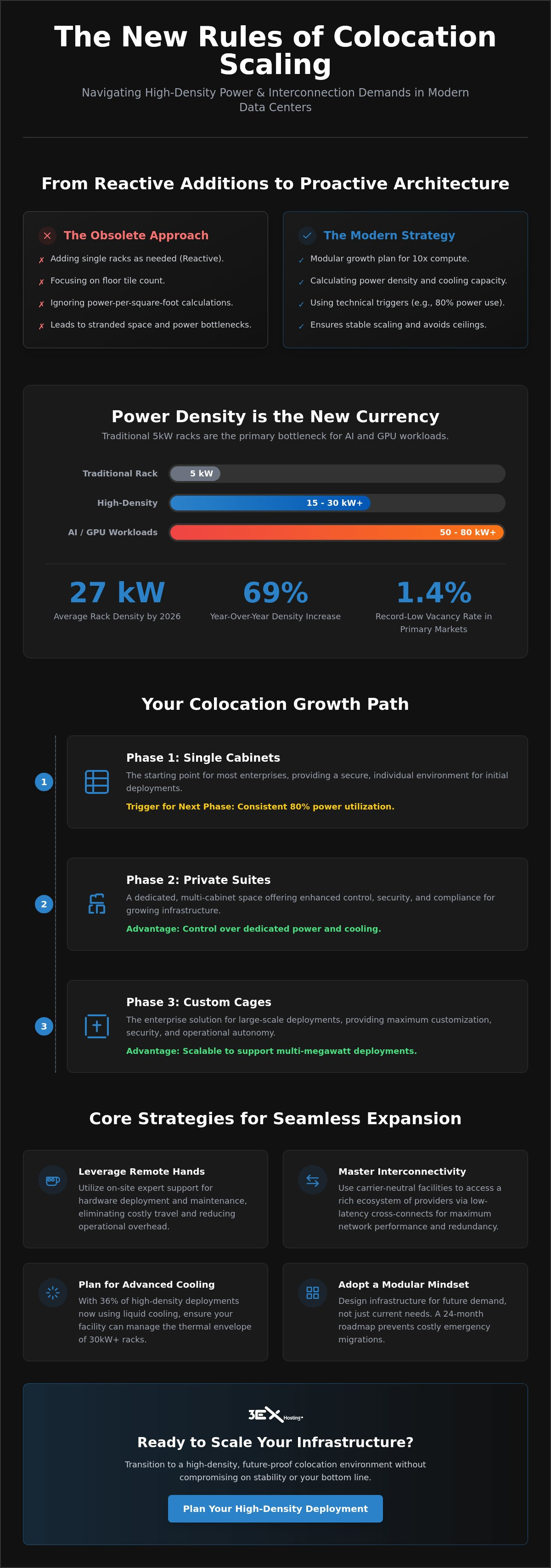
With average rack densities hitting 27 kW in 2026 and vacancy rates in primary markets plummeting to a record low of 1.4%, the old rules of data center expansion are officially obsolete. You’ve likely felt the pressure of unexpected power density limitations or the mounting costs of sending engineers across the country just to rack new hardware. Successfully scaling infrastructure in a colocation environment now requires a shift from counting floor tiles to calculating power-per-square-foot and interconnection agility. It’s no longer just about where your servers sit, but how efficiently they can draw power and exchange data.
We understand that rapid growth shouldn’t come at the cost of stability or your bottom line. This guide provides the technical roadmap you need to expand your footprint while maintaining 100% uptime and managing high-density GPU workloads that often exceed 50kW per rack. You’ll learn how to transition seamlessly from single cabinets to private suites and leverage remote support to slash operational overhead. We’ll also break down the strategies for navigating the 2026 NEC updates and new interconnection standards, ensuring your infrastructure remains fast, secure, and ready for the next phase of enterprise demand.
Key Takeaways
- Transition from reactive rack additions to a modular growth strategy by identifying technical triggers before they impact performance.
- Overcome AI and GPU power bottlenecks by deploying high-density configurations that support 15kW to 30kW+ per rack.
- Master scaling infrastructure in a colocation environment by utilizing cross-connect services to ensure secure, high-throughput network connectivity.
- Reduce operational overhead through a travel-free scaling model that leverages remote hands for seamless hardware deployment.
- Recognize the security and compliance advantages of moving from individual cabinets to private suites and custom cage solutions.
The Architecture of Scalability: Assessing Your Colocation Growth Path
Most enterprises start their journey by adding single racks as needed. This reactive approach is risky in a modern colocation environment where power density is the new currency. Scaling infrastructure in a colocation environment requires a modular mindset. Instead of asking how many servers you need today, you must design for the day you’ll need ten times the compute. This means planning for power distribution and cooling capacity long before the hardware arrives. Proactive planning ensures you don’t hit a ceiling just as your business gains momentum.
Identifying the right technical triggers is vital. Don’t wait for a rack to hit 100% capacity. Look for signs like consistent 80% power utilization or rising thermal exhaust temperatures that signal your cooling is at its limit. Transitioning from cloud to colocation often shifts your financial model from high OPEX to a predictable CAPEX and OPEX blend. It gives you control over hardware life cycles while stabilizing monthly costs. Using carrier-neutral facilities further protects your investment. It prevents vendor lock-in by allowing you to choose the most cost-effective and highest-performing network providers as your needs evolve.
Evaluating Current Capacity vs. Future Demand
Effective scaling starts with a rigorous audit. You need to measure your current rack utilization and thermal headroom. Many facilities have “dead space” in existing cabinets. This is often caused by poor cable management or inefficient airflow. Optimizing these areas can delay the need for new floor space. However, you should still project your 24-month growth. Consider application scaling and data ingestion rates. If your AI workloads are expanding, your power needs will likely outpace your physical space requirements. A 24-month roadmap allows you to reserve adjacent space or plan for a transition to cage solutions without emergency migration costs.
The Carrier Hotel Advantage
Choosing a carrier-neutral facility, often called a carrier hotel, is a strategic move for long-term growth. This flexibility is essential when scaling infrastructure in a colocation environment. You can leverage multiple fiber providers to build a redundant network that survives provider outages. Low-latency cross-connects are also critical for distributed applications. Whether you start with full cabinet colocation or move directly to a private suite, having direct access to a dense ecosystem of carriers ensures your network throughput scales as fast as your compute. This connectivity ensures your data moves at the speed your business demands.
Power Density: The Critical Factor in High-Performance Scaling
High-density colocation is no longer a niche requirement. By mid-2026, average rack densities have surged to 27 kW, representing a 69% increase year-over-year according to recent market data. In this context, high-density refers to infrastructure capable of supporting 15kW to 30kW+ per rack. Traditional 5kW racks, once the industry standard, are now the primary bottleneck for enterprise growth. When scaling infrastructure in a colocation environment, relying on low-density cabinets often leads to “stranded space.” You run out of power long before you fill the physical U-space of the rack.
Modern AI hardware has changed the math entirely. A single high-performance AI server can consume upwards of 8 kW. Attempting to deploy these in a standard environment is impossible. You need to look at the facility’s ability to provide N+1 redundancy at these higher tiers. This ensures that even during a component failure, your high-density clusters remain operational without thermal runaway. When evaluating colocation power density, ensure the provider can deliver consistent, high-amperage feeds without compromising your uptime SLA.
Scaling for AI and GPU Workloads
AI infrastructure hosting requires specialized power distribution. A rack of 10 GPUs can consume 80 kW alone, which is why cooling is now as critical as power. High-density scaling fails if the thermal envelope isn’t managed. Liquid cooling adoption reached 36% in early 2026 to handle these intense loads. For AI infrastructure, high-density colocation is defined as the specialized integration of high-kilowatt power delivery and advanced thermal management required to support GPU-intensive training clusters. If you’re planning a deployment of this scale, you can request a custom power assessment to ensure your footprint is optimized for these extreme loads.
Optimizing Metered Power and PDU Selection
Predictable costs are essential during rapid expansion. Metered power provides transparency, allowing you to pay only for the electricity you actually use rather than a flat, estimated circuit fee. This is especially beneficial when scaling infrastructure in a colocation environment because it prevents over-provisioning costs during the early stages of a rollout. Enterprise-grade cabinets should utilize three-phase power. It provides more balanced loads and higher efficiency than single-phase alternatives. Pair this with smart PDUs. These devices offer remote monitoring at the rack level, giving your team real-time visibility into consumption and helping you identify potential power issues before they cause an outage.
Network Interconnectivity: Scaling Beyond the Physical Cabinet
Expanding your physical hardware without a parallel network strategy creates a digital bottleneck. Scaling infrastructure in a colocation environment isn’t just about power and cooling; it’s about the data throughput leaving your racks. By mid-2026, enterprise applications increasingly require 100G and 400G interconnection capabilities to manage massive data ingestion. If your network remains static while your server count doubles, your latency will inevitably spike. You need a topology that scales horizontally. This involves planning for high-density peering points and diversified fiber paths early in your expansion cycle.
Peering points are essential for reducing latency as your footprint grows. They allow you to exchange traffic directly with other networks, bypassing the congestion of general internet transit. This is especially important for distributed enterprise applications that rely on real-time synchronization. Future-proofing your network also means looking toward the IEEE 802.3dj standard. It’s expected to support 800G and 1.6T speeds using a 200 Gb/s lane rate. Preparing your rack-level switching for these speeds now prevents a costly hardware overhaul in eighteen months.
Strategic Use of Cross-Connects
Cross-connects provide the physical foundation for high-performance scaling. These direct links to cloud providers or partners bypass the public internet. It’s a more secure and reliable way to move data. While a VPN might work for a small setup, it’s inefficient for enterprise-scale traffic. Cross-connects reduce latency to sub-millisecond levels. As you move from one cabinet to several, the complexity of your interconnections will grow. Implementing structured cabling from the start prevents “cable spaghetti” and simplifies maintenance as you scale infrastructure in a colocation environment.
Hybrid Cloud Integration
Modern enterprises rarely rely on a single environment. They scale their on-premise hardware alongside managed cloud hosting. This hybrid model offers significant advantages. You maintain control over sensitive data for sovereignty and compliance on your own servers. You leverage the public cloud for burst capacity when demand spikes. It’s an agile way to manage growth. This approach also streamlines disaster recovery. Using managed cloud services as a failover target ensures your business stays online without the massive overhead of a redundant physical data center.
Operational Logistics: Scaling Without On-Site Presence
Scaling infrastructure in a colocation environment shouldn’t require your senior engineers to spend half their time in airports. The “Travel-Free” scaling model relies on on-site expertise to handle the physical heavy lifting. This shift allows your team to focus on architecture and high-level configuration while data center staff manage the tactical deployment. By using local professionals, you eliminate the high costs of travel and the risks associated with hardware being handled by untrained personnel. It’s a more efficient way to manage a growing footprint across multiple geographic regions.
Security remains paramount during these expansions. Every hardware installation must follow strict protocols. This includes verified access lists and documented chain of custody for new equipment. 24/7 technical support acts as a safety net. It ensures that if a component fails during a rapid expansion phase, there is an immediate response to maintain 100% uptime. This level of support is non-negotiable for enterprises running mission-critical workloads that can’t afford a single minute of downtime. You need a partner who treats your hardware with the same care as your own team would.
Leveraging Remote Hands Support
The scope of remote hands support covers everything from basic power cycles to complex cabling and hardware swaps. You can use these technicians for the initial racking, stacking, and physical configuration of your new expansion modules. This allows your remote team to log in and begin software-level setup as soon as the hardware is powered on. Remote hands acts as a force multiplier for lean IT teams by providing on-site physical presence without the overhead of additional headcount.
Move-In and Deployment Logistics
Coordinating hardware delivery is often the most stressful part of an expansion. You need to manage shipping schedules and inventory with the data center staff before the crates even arrive. Utilizing move-in assistance ensures that your hardware is received, unboxed, and securely stored until deployment begins. This service is vital for complex migrations where timing is critical. It prevents the chaos of unmanaged deliveries and ensures your new cabinets are ready for production on day one.
Creating a standardized deployment checklist for new full cabinet installs is a best practice. This list should include:
- Verification of power circuit labels and PDU placement.
- Documentation of all serial numbers and asset tags.
- Pre-deployment cable testing for all cross-connects.
- Verification of airflow management panels to prevent hot spots.
If you’re planning a significant expansion and want to avoid the logistical headaches of physical deployment, you can get a quote for managed deployment services to streamline your next phase of growth.
Transitioning to Enterprise Infrastructure: Cabinets to Private Suites
There comes a point where adding another rack to a shared row is no longer the most efficient path forward. As your footprint expands into double-digit rack counts, the complexity of managing airflow and power distribution in a shared environment becomes a performance bottleneck. Recognizing when a full cabinet colocation strategy has reached its limit is vital for long-term operational excellence. Scaling infrastructure in a colocation environment at an enterprise level requires a shift toward dedicated environments that offer higher levels of control and physical security.
The transition to more robust infrastructure is often driven by the need for better density management. Shared rows are designed for standardized loads. If you’re deploying high-performance computing (HPC) clusters or AI training nodes, your thermal requirements will likely exceed what a standard row can handle without specialized containment. Moving to a dedicated footprint allows you to implement custom hot or cold aisle containment. This ensures your hardware runs at optimal temperatures, extending its lifespan and maintaining peak performance during heavy processing cycles.
When to Choose Cage Solutions
Security triggers are often the primary reason for moving into a dedicated cage. Compliance frameworks like PCI-DSS, HIPAA, or SOC 2 often mandate physical isolation for certain types of data. A cage provides a physical barrier that prevents unauthorized personnel from even standing in front of your hardware. Beyond security, cages offer operational flexibility. You can customize the layout of your PDUs and network racks to match your specific workflow. This dedicated space makes it easier to manage high-density cooling and power without worrying about the environmental impact on neighboring tenants.
The Sovereignty of Private Suites
For organizations reaching the highest stage of infrastructure maturity, private colocation suites offer total sovereignty. A private suite provides you with your own four walls within the data center, including dedicated cooling, power distribution, and multi-factor biometric security. This is the ultimate environment for scaling infrastructure in a colocation environment. You aren’t just renting space; you’re operating a data center within a data center.
Private suites allow for complete customization of the physical layout. You can design the room specifically for high-performance computing needs, such as implementing liquid-to-chip cooling or specialized fire suppression systems. This level of isolation also simplifies audits and compliance reporting. You have total visibility and control over who enters the space and every change made to the physical environment. If your 24-month roadmap includes hundreds of kilowatts of demand, a private suite provides the stable, secure, and scalable foundation your enterprise requires. You can request a consultation to determine if your current growth trajectory justifies a move to a private suite or cage solution.
Future-Proofing Your Data Center Footprint for 2026 and Beyond
Successfully scaling infrastructure in a colocation environment requires moving beyond simple rack counts to focus on power density and network agility. High-performance AI workloads now demand up to 30kW+ per rack. This shift makes thermal management and Enterprise N+1 Power Redundancy essential for long-term stability. By leveraging Carrier-Neutral Interconnectivity and 24/7/365 Remote Hands Support, you can expand your footprint without the logistical friction of constant on-site travel.
Whether you’re optimizing a single cabinet or migrating to a private suite, the right infrastructure partner ensures your growth is seamless and secure. Our facility provides the technical foundation you need to maintain 100% uptime through rapid expansion phases. Your infrastructure should be an asset that accelerates your growth, not a bottleneck that slows it down. We’re ready to support your next deployment with the speed and reliability your business demands.
Request a custom quote for your scaling infrastructure needs and start building your scalable enterprise roadmap today.
Frequently Asked Questions
How do I determine if I need high-density colocation?
You need high-density colocation if your hardware requirements exceed 10kW to 15kW per rack. This is standard for AI training clusters and modern GPU servers. If you find yourself leaving half of a standard 42U rack empty because you’ve hit the power or thermal limit, it’s time to shift. High-density environments ensure you maximize your floor space while maintaining proper cooling for power-intensive hardware.
What is the difference between a cross-connect and a standard network link?
A cross-connect is a direct physical cable between two different environments within the same data center. This is different from a standard network link that routes through the public internet. Cross-connects provide much lower latency and higher security. They’re essential for scaling infrastructure in a colocation environment when you need reliable, high-speed access to cloud on-ramps, multiple carriers, or partner networks located within the same facility.
Can I scale my infrastructure without physically visiting the data center?
Yes, you can manage the entire deployment process remotely by using remote hands support and move-in assistance. On-site technicians receive your hardware, rack the units, and perform initial cabling according to your specifications. This travel-free model allows your internal IT team to focus on logical configuration and software deployment from any location, significantly reducing the operational overhead and costs associated with expansion.
What are the main advantages of a carrier-neutral data center for scaling?
Carrier neutrality allows you to choose from multiple telecommunications providers rather than being locked into a single vendor. This is critical for scaling because it gives you the flexibility to negotiate better rates and ensure network redundancy as your bandwidth needs grow. You can easily add new fiber paths or switch providers to optimize for latency without moving your physical hardware, ensuring your network always keeps pace.
How does N+1 power redundancy impact my ability to scale infrastructure?
N+1 redundancy ensures that your infrastructure has at least one independent backup component for every active power system. This architecture is vital when scaling because it allows for maintenance or component failure without causing downtime. As you increase your rack density, the risk of thermal issues during a power failure rises, making robust N+1 configurations a non-negotiable requirement for enterprise-grade availability and peace of mind.
When should my business transition from a full cabinet to a private suite?
Transition to a private suite when your footprint exceeds 10 to 15 racks or when compliance requirements demand total physical isolation. Private suites offer dedicated cooling and power distribution that you can customize for specific high-performance needs. If your long-term roadmap involves significant growth, moving to a suite provides the sovereignty and operational control needed for a mature enterprise environment that shared rows cannot offer.
What kind of remote hands support is needed for large-scale hardware deployments?
Large-scale deployments require comprehensive remote hands support that includes inventory management, structured cabling, and hardware verification. Technicians should be capable of performing complex tasks like installing high-density GPU servers and setting up smart PDUs for remote monitoring. Having an expert team on-site 24/7 ensures that any physical issues during the expansion phase are resolved immediately without requiring your senior engineering staff to travel.
How do I manage cooling for high-density GPU racks in a colocation environment?
Managing cooling for GPU racks requires advanced thermal containment strategies like hot or cold aisle isolation. In 2026, many high-density environments are also adopting liquid cooling to handle the extreme heat generated by AI workloads. When scaling infrastructure in a colocation environment, you must ensure the facility can support these cooling technologies to prevent hardware throttling and maintain consistent performance across your entire hardware cluster.