 SUPPORT


 3EX United States
 Blog
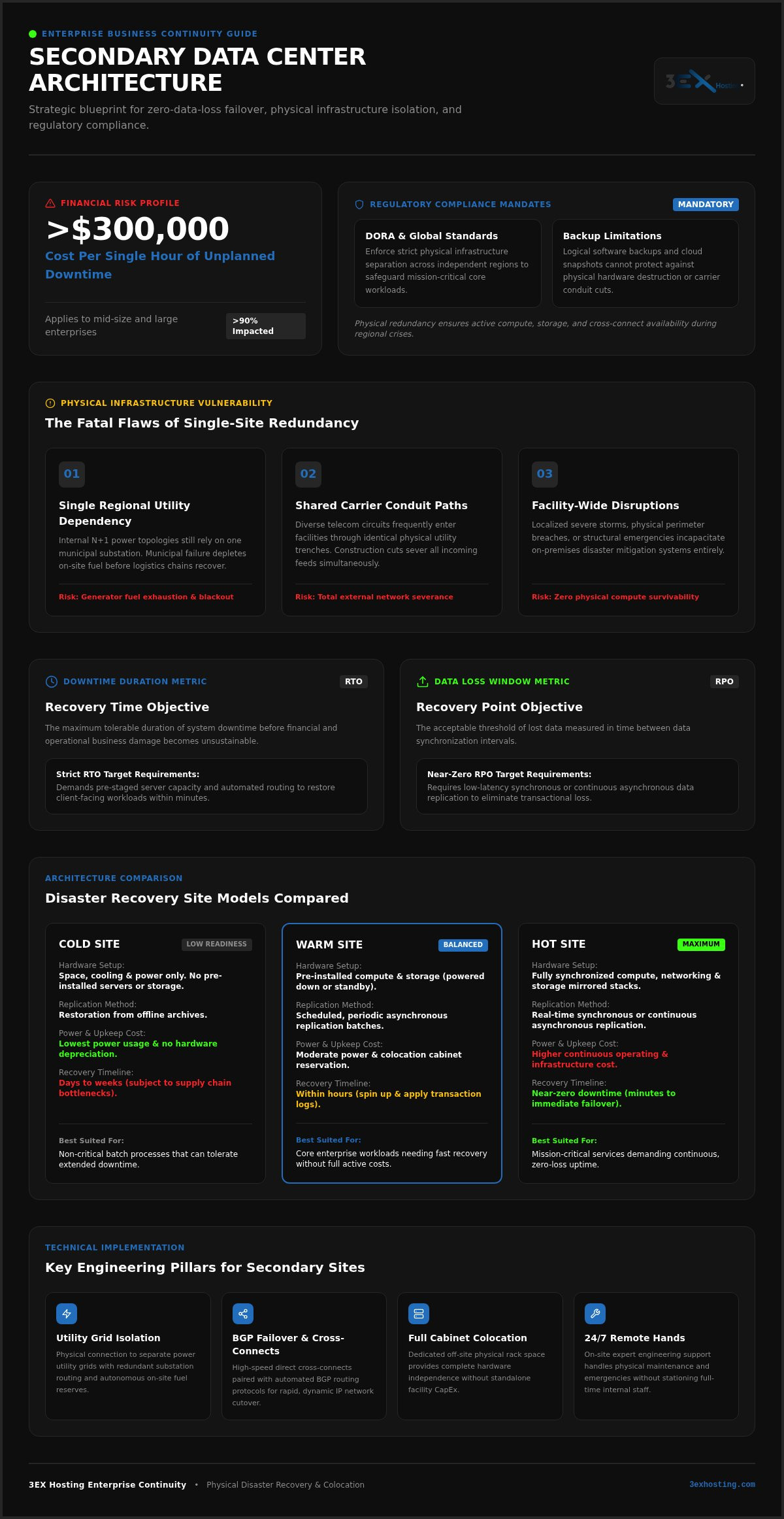
For more than 90% of mid-size and large enterprises, a single hour of unplanned downtime burns over $300,000. You already know that relying on software backups alone leaves your business vulnerable when primary facility outages strike. Securing a dedicated secondary data center for disaster recovery is essential, but it introduces demanding technical trade-offs. You must balance low-latency data replication with enough geographic distance to survive regional disruptions, all while maintaining offsite hardware without full-time staff stationed on location.
Building an offsite failover environment doesn’t have to strain your internal team. You’ll learn how to architect, select, and deploy an enterprise secondary data center for disaster recovery that achieves zero-data-loss recovery objectives and seamless network cutover. We’ll examine redundant power topologies, high-speed cross-connects, and 24/7 remote hands engineering support so your mission-critical workloads remain online through any crisis.
Key Takeaways
- Discover why logical backups fail during major facility outages and how physical separation across independent utility grids safeguards core workloads.
- Compare cold, warm, and hot site architectures to match hardware readiness with your Recovery Time and Recovery Point Objectives.
- Learn the essential selection criteria for an enterprise secondary data center for disaster recovery, including redundant substation routing and on-site fuel autonomy.
- Master low-latency cross-connect configurations and automated BGP routing protocols to execute rapid IP failover during unplanned interruptions.
- Explore how colocation deployments paired with 24/7 remote hands engineering solve remote hardware management without stationing full-time internal staff offsite.
Why Enterprise Continuity Demands a Secondary Data Center for Disaster Recovery
A secondary data center for disaster recovery functions as an autonomous, geographically separated failover site engineered to maintain business operations during severe primary site failures. Many organizations mistakenly rely entirely on localized software snapshots or cloud-tier replication, believing their services are safe. Software-level replication cannot protect against physical hardware destruction, underground carrier conduit severances, or widespread electrical blackout conditions. Modern regulatory mandates like DORA and updated global resilience standards require physical separation of infrastructure for mission-critical operations. Deploying an off-site enterprise data center environment guarantees that compute, storage, and interconnects remain intact regardless of local disruptions.
Defining Recovery Time Objective and Recovery Point Objective
Structuring an effective continuity posture requires precise thresholds. In enterprise IT disaster recovery, Recovery Time Objective (RTO) defines the maximum tolerable duration of system downtime before financial and operational damage becomes unsustainable. Recovery Point Objective (RPO) dictates the acceptable threshold of lost data, measured in time between sync intervals:
- Strict RTO Targets: Require pre-staged server capacity and automated routing to restore client-facing workloads within minutes.
- Near-Zero RPO: Demands low-latency synchronous or continuous asynchronous data replication to eliminate transactional losses.
Setting these performance benchmarks dictates whether your secondary site operates in an active or passive state.
The Limits of Single-Site Redundancy
Local hardware redundancy provides a dangerous illusion of complete safety. Even an on-premise room built with internal N+1 power distribution ultimately depends on a single regional utility provider. When municipal substations collapse, on-site generator fuel reserves only buy a temporary buffer before fuel logistics chain disruptions introduce critical failure points.
Physical network paths present an equal vulnerability. Diverse telecom circuits often share identical physical utility trenches entering the building. A single construction incident or severe storm can sever all feeds at once. Establishing a dedicated secondary data center for disaster recovery provides true infrastructure diversity, isolating core assets from localized grid failures, physical perimeter breaches, and facility-wide emergencies.
Evaluating Disaster Recovery Architectures: Cold, Warm, and Hot Sites
Selecting the right operational model determines how fast your infrastructure recovers when production systems halt. Many enterprise guides reduce disaster planning to basic cloud backups, yet cloud storage alone can’t replicate dedicated network architectures or custom hardware arrays. Architecting a secondary data center for disaster recovery requires balancing hardware readiness, power utilization, and replication frequency against realistic recovery targets outlined in your information technology disaster recovery plan (IT DRP).
Cold Sites vs. Warm Sites: Cost vs. Readiness
Cold sites provide space, cooling, and basic electrical infrastructure without pre-installed servers or storage networks. During a total facility disruption, you must procure, ship, rack, and configure replacement hardware before restoring data from offline archives. This approach minimizes power usage and hardware depreciation costs, but modern supply chain bottlenecks can stretch recovery timelines from several days into weeks. Cold sites are practical only for non-critical batch processes that can tolerate extended downtime.
Warm sites bridge this gap by housing pre-installed compute and storage environments powered down or running in a standby state. Data synchronizes periodically through scheduled, asynchronous replication batches. When an outage occurs, systems spin up, apply transaction logs, and resume operations within hours. If you need dedicated rack space ready for rapid hardware provisioning, reserving Full Cabinet Colocation provides the physical footprint without the capital burden of constructing a standalone facility.
Hot Sites: Achieving Near-Zero Downtime
Hot sites maintain fully synchronized compute, networking, and storage stacks mirrored with your production environment. Infrastructure runs continuously in either an active-passive or active-active topology across dual facilities:
- Active-Passive Topology: The secondary environment continuously mirrors primary systems using synchronous data replication. When monitoring systems detect primary failure, automated orchestration triggers rapid DNS or IP redirection.
- Active-Active Clustering: Workloads distribute across both facilities concurrently, ensuring zero idle hardware and seamless traffic absorption if either location drops offline.
Deploying an active-active secondary data center for disaster recovery demands dedicated low-latency fiber links to prevent database locking and replication lag. While continuous power draw and hardware licensing increase ongoing expenses, this architecture represents the gold standard for organizations demanding zero data loss and instantaneous business continuity.
Critical Site Selection Criteria for Secondary Infrastructure
Choosing an offsite facility involves far more than simply finding available rack space in another town. You’re creating an operational fortress capable of running your business when your main systems go dark. True survivability depends on physical site mechanics, independent electrical utility routing, and strict perimeter controls. Evaluating these physical variables early prevents your failover site from falling victim to the very disaster that took down your primary facility.
Geographic Separation and Grid Independence
Distance creates true resilience, but it must be calculated carefully. Your facility should sit on a completely separate regional electrical grid and outside your primary site’s local weather pattern, seismic fault zone, and hundred-year floodplain. That separation protects against regional catastrophes that incapacitate municipal infrastructure.
At the same time, you have to balance physical distance against optical latency limits:
- Synchronous Boundaries: Keeping facilities within roughly 50 to 60 miles maintains round-trip network latency below 5 milliseconds, enabling real-time synchronous writes without degrading transaction performance.
- Asynchronous Protection: Moving beyond 100 miles provides superior geographical isolation against major grid disruptions, but requires asynchronous replication configurations to absorb network propagation delay.
Partnering with a proven enterprise data center guarantees your backup operations rest on N+1 or 2N redundant power topologies supported by on-site generator fuel reserves capable of sustained, multi-day autonomous generation.
Carrier Neutrality and Fiber Diversity
A failover facility is useless if external traffic can’t reach it during an emergency. The location must offer true carrier-neutral connectivity, providing access to diverse national Tier 1 transit operators rather than locking you into a single proprietary telecom circuit. This setup ensures that if one upstream provider experiences routing degradation, automated Border Gateway Protocol (BGP) routing immediately shifts external traffic to clean alternatives.
Physical cable pathways demand identical scrutiny. Insist on inspecting the facility’s physical Meet-Me Rooms (MMRs) and verify redundant fiber entry points through completely independent building manholes. Dual fiber strands bundled into a single street trench leave your operations open to accidental backhoe strikes. True telecommunication diversity requires diverse physical conduits, distinct lateral lines, and direct access to high-density cross-connect fabrics.
Physical security controls round out site qualification. Ensure the prospective facility enforces multi-factor biometric authentication, mantraps, mantrap tailgating prevention, and continuous perimeter monitoring. Your secondary data center for disaster recovery must mirror the compliance, security, and uptime rigor of your primary enterprise footprint.
Operational Execution: Interconnection, Replication, and Remote Management
Executing an emergency failover demands seamless coordination between your network routing protocols and physical facility access. When production services fail, automated BGP routing must instantly broadcast updated autonomous system (AS) path attributes to redirect inbound customer traffic to your backup site. Without low-latency connectivity and tested execution runbooks, an expensive secondary facility becomes a stranded asset during live production outages.
Deploying Dedicated Cross-Connects for Replication
Continuous database synchronization requires guaranteed bandwidth without public Internet instability. Routing replication traffic over public connections introduces packet jitter, throughput caps, and unpredictable routing shifts that destroy strict recovery point targets. Direct dark fiber or carrier-neutral cross-connects establish secure, private physical paths directly between enterprise cabinets, Meet-Me Rooms, and upstream transport providers.
These private interconnects yield tangible infrastructure advantages:
- Sub-Millisecond Layer 2 Syncing: Sustains raw block-level storage arrays and active database replication streams with zero public hop contention.
- Direct Cloud Interconnects: Creates dedicated, private backbones into hyperscale environments for hybrid workload balancing.
- Isolated Out-of-Band (OOB) Access: Maintains dedicated serial console and IPMI pathways to reach core firewalls and hypervisors during wide-area network drops.
Direct Layer 2 interconnects eliminate transit bottlenecks, ensuring transactional datasets arrive intact at your secondary site before an alert fires.
Leveraging 24/7 Remote Hands Support
Maintaining an offsite failover facility hundreds of miles from your central engineering hub introduces a real operational dilemma. Flying internal systems engineers out to power-cycle unresponsive host nodes, patch optical transceivers, or swap degraded drives in an enterprise secondary data center for disaster recovery drains operational budgets and creates dangerous recovery delays. Routine maintenance and disaster response require rapid on-site action.
Experienced on-site engineers bridge this physical divide. Deploying expert remote hands support places experienced data center technicians at your equipment racks instantly. These specialists execute urgent hardware replacements, conduct structured cable testing, and assist with real-world failover simulation drills without your staff ever leaving the corporate office.
Operational stability requires reliable physical execution alongside strong network architecture. Partner with an infrastructure team that provides verified technical oversight and fast ticket turnarounds. Explore how our round-the-clock Remote Hands Support protects your secondary infrastructure day and night.
Deploying Resilient Secondary Infrastructure with Colocation
Building an owned, standalone facility requires massive capital expenditures, lengthy environmental permitting, and years of construction time. Leasing enterprise colocation capacity bypasses these barriers entirely. It delivers immediate access to hardened physical infrastructure, industrial-grade cooling, and dual utility distribution without speculative real estate exposure. Organizations can quickly deploy a secondary data center for disaster recovery, keeping critical assets compliant and operationally ready from day one.
Full Cabinet Colocation vs. Private Suites
Enterprise workloads demand physical footprints that match distinct security and scalability requirements. Physical boundaries must support strict data governance while enabling rapid capacity expansion:
- Cabinet Environments: Deploying full cabinet colocation provides secure, lockable enclosures equipped with redundant power drops, ideal for mirrored production stacks and high-density compute tiers.
- Cage Partitions: Implementing cage solutions datacenter builds creates partitioned private zones for organizations managing expansive server footprints alongside dedicated parts storage.
- Autonomous Suites: Transitioning into private data center suites offers fully segregated environments, dedicated cooling containment, and customized security perimeters to satisfy rigid regulatory audits.
Integrating these physical hardware deployments with managed cloud hosting creates an adaptable hybrid framework, letting you scale temporary resources on demand during recovery testing.
Executing Your Enterprise DR Deployment
A structured migration process prevents configuration oversights and unexpected downtime. Start with a comprehensive infrastructure audit to document actual workload consumption, including peak electrical loads, heat generation, and projected storage expansion. Knowing your exact kilowatt requirements per cabinet ensures the facility provisions appropriate cooling distribution before your equipment arrives on site.
Coordinate secure transport logistics and initial rack installations according to pre-planned elevation diagrams. Structured cabling and meticulous port labeling performed during move-in prevent troubleshooting delays later during live failover scenarios. If you’re ready to engineer a fail-safe secondary data center for disaster recovery that protects your bottom line, contact our team to get a quote on tailored enterprise colocation solutions.
Build Your Resilient Failover Foundation Today
True operational continuity requires looking past localized software snapshots. When regional disruptions compromise your primary facility, survivability hinges on independent electrical feeds, low-latency replication paths, and automated network failover. Architecting your infrastructure around hardened physical boundaries ensures your mission-critical applications stay online when disruption strikes.
Deploying an enterprise secondary data center for disaster recovery eliminates operational vulnerabilities while keeping capital overhead manageable. By pairing high-density power topologies and carrier-neutral cross-connects with full cabinet or private suite physical security, you gain an uncompromising failover environment. Reliable 24/7 on-site remote hands engineering ensures your hardware is constantly monitored, patched, and maintained by experienced technicians. Take control of your business continuity strategy today. Request a customized disaster recovery colocation quote and safeguard your enterprise infrastructure with complete confidence.
Frequently Asked Questions
What is the difference between a secondary data center and a cloud backup?
A secondary data center provides a live or standby physical computing environment capable of running full enterprise workloads immediately during a primary site failure, whereas cloud backup is simply offsite data storage. Cloud backups require you to provision infrastructure, download massive storage volumes over network lines, and reconfigure operating systems before applications run. A secondary facility maintains pre-configured servers, networking fabric, and firewalls ready to absorb operational traffic without prolonged provisioning delays.
How far away should a secondary disaster recovery data center be located?
An ideal secondary facility should sit between 50 and 100 miles away from your primary site to balance low latency with risk mitigation. Facilities located within 50 to 60 miles support synchronous data replication with round-trip latencies below 5 milliseconds, enabling real-time zero-loss failover. Distances beyond 100 miles provide superior physical isolation from regional disasters and grid failures, but require asynchronous replication architectures to handle transmission delays across greater fiber distances.
What is the primary difference between hot, warm, and cold disaster recovery sites?
The primary difference lies in hardware readiness and recovery speed. A hot site runs continuously with mirrored compute and real-time data replication, enabling instantaneous automated failover. A warm site houses pre-racked servers with scheduled data syncs that take several hours to activate. A cold site provides basic power, cooling, and space without pre-installed hardware, requiring days or weeks to procure, configure, and restore operational systems after an emergency.
Can an enterprise utilize colocation as a secondary data center?
Yes, enterprises routinely deploy colocation facilities as an isolated secondary data center for disaster recovery to bypass building and operating a dedicated private facility. Colocation provides immediate access to hardened physical infrastructure, dual utility feeds, industrial cooling, and carrier-neutral telecommunication density. Organizations deploy full cabinets, private cages, or dedicated private suites to house secondary workloads, maintaining strict physical compliance and hardware ownership while avoiding heavy real-estate capital expenditures.
How do high-speed cross-connects improve disaster recovery replication?
High-speed cross-connects deliver dedicated point-to-point physical fiber cabling that links enterprise racks directly to network carriers and exchange fabrics without routing across the public Internet. Direct physical cross-connects eliminate variable transit latency, packet loss, and public routing jitter. This predictable, high-bandwidth pathway ensures continuous data replication between storage volumes and production databases, keeping your recovery point objectives as close to zero as technically possible without exposure to outside bandwidth bottlenecks.
What role does 24/7 remote hands support play in a disaster recovery site?
On-site 24/7 remote hands support gives enterprise IT teams access to experienced facility technicians who handle physical maintenance and urgent hardware tasks around the clock. When secondary infrastructure sits hundreds of miles away, dispatching internal engineers for basic cable patching, hard drive replacements, or server power cycles wastes critical time. Remote hands engineers serve as your on-site physical team, performing scheduled failover testing, hardware diagnostics, and optical transceiver verification instantly upon request.
How often should an enterprise test its secondary disaster recovery data center?
Enterprises should perform end-to-end failover testing on their secondary data center for disaster recovery at least twice a year, alongside quarterly component validation. Frequent simulation drills test network routing cutovers, database synchronization integrity, and application dependencies under realistic outage conditions. Regular testing reveals configuration drift, DNS propagation issues, and outdated runbooks before a true physical disaster strikes, ensuring your disaster recovery solutions execute reliably when operational uptime is on the line.