 SUPPORT


 3EX United States
 Blog
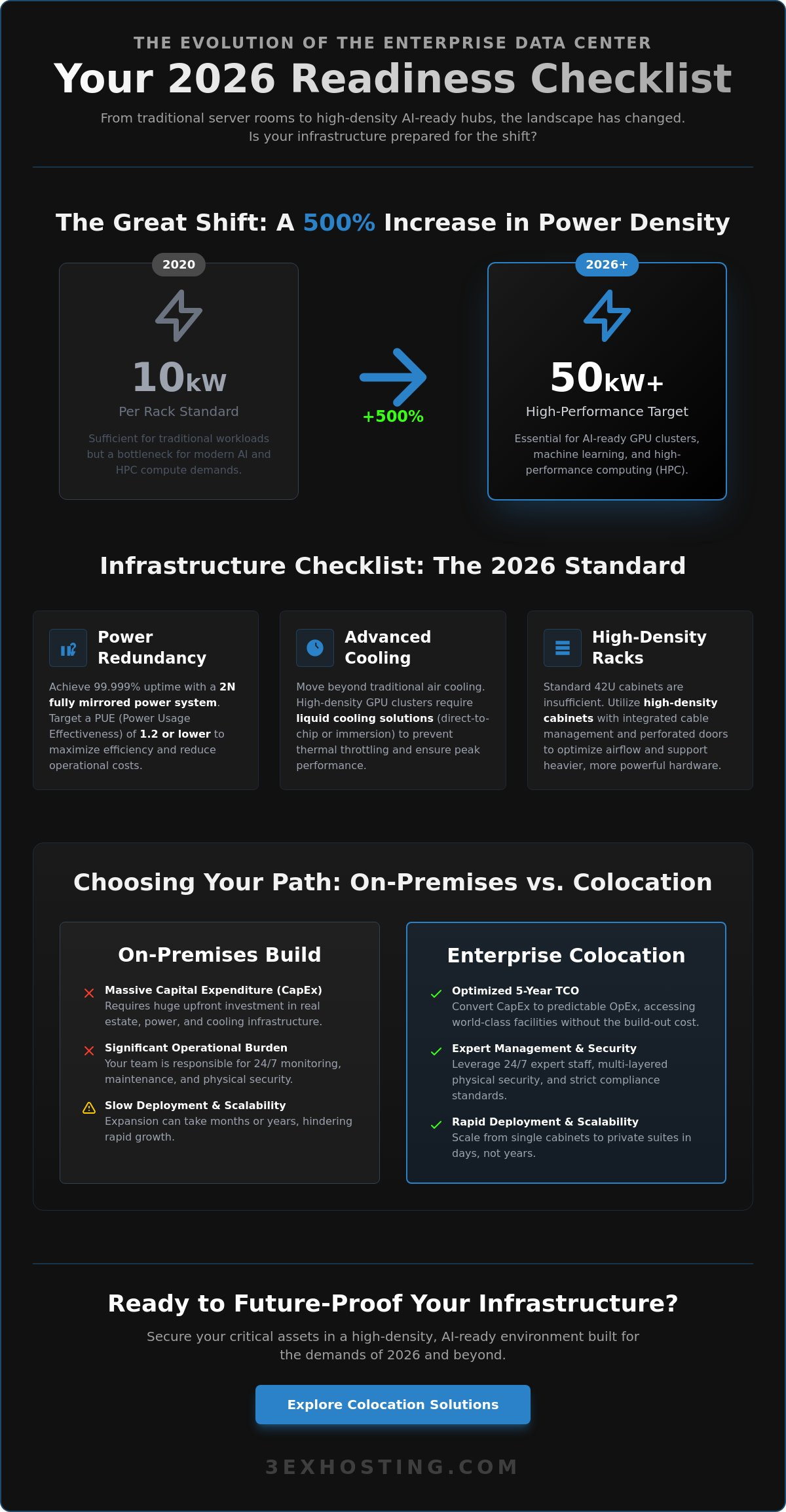
By 2026, the average power density in a high-performance enterprise data center is projected to exceed 50kW per rack, marking a 500% increase from the 10kW standard seen in 2020 according to recent industry forecasts. You’re likely facing the intense pressure of these shifting requirements, particularly when trying to balance rising CapEx costs with the need for AI-ready GPU clusters. Maintaining 100% uptime and strict compliance while your infrastructure demands more power than ever creates a significant operational burden. It’s a challenge that requires a precise, technical strategy rather than just more hardware.
This guide provides the clarity you need by offering a comprehensive checklist to evaluate your infrastructure and operational excellence. We’ll help you decide whether an on-premises facility or a colocation model offers the best stability for your specific workloads. You’ll learn exactly how to future-proof your hardware deployments to ensure they remain superfast, secure, and ready for the next decade of digital growth.
Key Takeaways
- Define the 2026 standard for high-density IT hubs and move beyond traditional server room limitations.
- Assess your infrastructure’s readiness for high-performance computing with targeted power and liquid cooling checklists.
- Analyze the 5-year total cost of ownership to decide between the control of on-premises builds and the efficiency of colocation.
- Establish a robust operational framework using 24/7 monitoring and disaster recovery plans to guarantee business continuity.
- Future-proof your enterprise data center strategy by integrating modular growth plans for next-generation AI and GPU workloads.
What is an Enterprise Data Center? Defining the 2026 Standard
An enterprise data center is a private facility or dedicated environment engineered to house an organization’s most critical IT infrastructure. Unlike generic web hosting where resources are shared among thousands of users, these environments offer total control over hardware, networking, and security. By 2026, the definition has moved beyond simple “server rooms.” These facilities now function as high-density strategic hubs that power real-time business intelligence and global operations.
Modern enterprise data centers provide a level of physical and digital isolation that standard commercial environments can’t match. They’re built for organizations that view downtime not just as an inconvenience, but as a systemic risk. The 2026 standard demands a move away from legacy on-premises setups toward specialized private data center suites that offer the flexibility of the cloud with the security of dedicated iron.
The distinction between enterprise-grade and standard hosting lies in the architecture. Enterprise facilities prioritize custom power configurations, dedicated cooling loops, and multi-layered physical security protocols. They don’t just host data; they protect corporate assets through rigorous compliance standards and superfast, redundant connectivity paths.
The Evolution of Enterprise Infrastructure
The shift from cramped on-premises closets to modern high-density environments has been driven by the massive compute requirements of AI and machine learning. In 2024, average rack density hovered around 10kW. By 2026, enterprise racks frequently exceed 50kW to support specialized GPU clusters. This evolution makes the data center the central anchor of a hybrid cloud strategy. It provides a stable, high-performance foundation where sensitive data stays local while non-critical tasks scale to the public cloud. This balance ensures maximum performance without sacrificing data sovereignty.
Core Objectives of an Enterprise Facility
The primary goal of any enterprise-grade facility is maintaining 99.999% uptime. This level of reliability requires 2N redundancy in power and cooling systems, ensuring that no single point of failure can take the system offline. Security is the second pillar. Enterprise facilities use biometric access, 24/7 armed monitoring, and isolated cages to protect physical assets. Finally, low-latency connectivity is vital. These hubs provide direct on-ramps to global carrier networks, ensuring that data moves across the world at superfast speeds. For businesses scaling rapidly, our cabinet colocation services provide the necessary bridge to this high-availability world.
- Availability: Guaranteed 99.999% uptime through redundant infrastructure.
- Security: Multi-factor physical authentication and dedicated surveillance.
- Scalability: Rapid expansion from single racks to multi-megawatt private suites.
- Connectivity: Carrier-neutral environments with diverse fiber entries.
The Physical Infrastructure Checklist: Racks, Power, and Cooling
Building a resilient enterprise data center requires a shift from traditional models to high-density environments. By 2026, rack power requirements are expected to exceed 20kW as standard for AI-driven workloads. You must evaluate your circuits for high-performance computing (HPC) loads to avoid thermal bottlenecks. Following infrastructure best practices ensures your facility maintains 99.999% availability while scaling effectively.
Power Redundancy and Distribution
Reliability depends on your redundancy model. N+1 provides a single backup component for every set of active units, while 2N offers a fully mirrored secondary system for maximum uptime. Use Uninterruptible Power Supplies (UPS) for immediate battery backup and diesel generators for long-term outages. PUE (Power Usage Effectiveness) serves as the key efficiency metric by measuring the ratio of total energy used by the facility compared to the power delivered to the IT equipment. Modern facilities target a PUE of 1.2 or lower to minimize operational costs.
Rack and Cabinet Specifications
Standard 42U cabinets often fail to meet the cooling needs of 2026 hardware. High-density cabinets with perforated doors and integrated cable management are essential. Proper cable routing prevents air dams, ensuring that cold air reaches the intake fans without obstruction. If your current footprint is too small for these demands, Full Cabinet Colocation provides the necessary space and power for rapid scaling. High-density cabinets also support the weight of modern blade servers, which can exceed 1,000 lbs per rack.
Cooling architecture is no longer a one-size-fits-all solution. Traditional hot/cold aisle containment works for loads up to 10kW per rack. However, GPU-heavy AI workloads require liquid cooling solutions, such as rear-door heat exchangers or direct-to-chip systems. These methods handle heat 10 times more effectively than air-based systems alone. Transitioning to liquid cooling reduces the energy load on fans and lowers the overall carbon footprint of your enterprise data center.
Physical security must be multi-layered to protect sensitive hardware. Use biometric access control for all entry points and 24/7 surveillance to monitor every aisle. Man-traps prevent unauthorized tailgating by requiring two-stage authentication. For fire protection, pre-action dry pipe systems ensure water only enters the pipes when a fire is confirmed, while clean agent extinguishers like FM-200 suppress flames without damaging electronics. If you need to optimize your current setup, you can get a custom quote for high-density infrastructure.
On-Premises vs. Enterprise Colocation: A Comparison
Deciding between building an on-premises facility or leveraging an enterprise data center is a choice that defines your technical agility for the next decade. A five-year Total Cost of Ownership (TCO) analysis often reveals that on-premises builds cost 25% to 35% more than colocation. This gap exists because companies often underestimate the “hidden” costs of facility management. While on-premises offers total control over every floor tile, it also places the entire burden of power redundancy, cooling maintenance, and physical security on your internal team. In a colocation model, you outsource the facility’s operational overhead while retaining control over your hardware and data.
Scalability highlights the biggest difference between these two paths. If your business needs to deploy 10 additional racks to support a new AI initiative, an on-premises facility might require a physical expansion or a power upgrade. These projects typically take 12 to 18 months to complete. A professional colocation provider can often provision that same 10-rack footprint in less than 30 days. This speed allows you to respond to market demands without waiting for construction permits or electrical contractors.
Many executives suffer from an “in-house” bias, fearing they’ll lose visibility if they move off-site. However, modern colocation eliminates this concern through dedicated environments. You don’t have to share space with others in a way that compromises your standards. You can achieve the same level of isolation as an on-site server room without the headache of managing the underlying infrastructure.
The CapEx vs. OpEx Financial Model
Building a Tier III facility from scratch is a massive financial undertaking. Industry data shows that construction costs for a reliable enterprise data center range from $10 million to $20 million per megawatt of IT load. This CapEx investment ties up capital that could be used for core business growth. Colocation shifts this to an OpEx model with predictable monthly billing. This makes budget forecasting simpler. From a tax perspective, service fees are often fully deductible in the year they occur, whereas owned infrastructure must be depreciated over many years.
Security and Compliance Considerations
Maintaining compliance is a full-time job. Colocation providers undergo rigorous annual audits to maintain SOC 2 Type II, HIPAA, and PCI-DSS certifications. Achieving these standards in-house requires significant documentation and specialized staff. For example, hiring a 24/7/365 physical security team for an on-premises site can cost upwards of $250,000 per year. For organizations with the strictest requirements, Private Data Center Suites provide a middle ground. You get a physically walled-off area that only your staff can access, combined with the shared security costs and certified infrastructure of a world-class facility.
The Operational Excellence Checklist: Management and Support
Operational stability in a modern enterprise data center requires more than just high-end hardware; it demands a rigorous management framework that anticipates failure before it happens. By 2026, manual oversight is a liability. Systems must utilize predictive analytics to monitor environmental health, power consumption, and hardware status every second of the day. Data from the Uptime Institute shows that 94% of data centers have experienced a significant outage in the last three years, often due to preventable human error or delayed response times. Reliable management eliminates these gaps.
A robust disaster recovery and business continuity plan isn’t a static document. It’s a functional protocol. Organizations should conduct full-scale failover simulations at least twice a year to ensure systems migrate seamlessly during a crisis. Inventory management also requires a modern approach. Tracking assets across 50 or 100 cabinets demands automated DCIM (Data Center Infrastructure Management) tools. These tools provide real-time visibility into every server and switch, preventing the “ghost server” problem where idle hardware consumes power without providing value.
Leveraging Remote Hands Support
National enterprises can’t always fly senior engineers across the country for a simple hard drive swap or a cable adjustment. It’s inefficient and costly. On-site technical support acts as an extension of your internal team, providing immediate physical intervention when every minute of downtime costs an estimated $9,000. Professional Remote Hands Support ensures that a qualified technician is always standing by to handle the heavy lifting.
Your remote hands checklist should include:
- Scheduled power cycling and physical reboots of unresponsive gear.
- Structured cabling, labeling, and patch panel management for 100Gbps environments.
- Hot-swappable component replacements, including NVMe drives and power supplies.
- Visual verification of status lights and physical rack audits.
Network Interconnectivity and Latency
Connectivity is the lifeblood of any enterprise data center strategy. Relying on a single carrier creates a dangerous single point of failure. True operational excellence requires carrier-neutrality, providing access to a diverse ecosystem of providers. Carrier hotels are vital here because they reduce network hops, which is critical for latency-sensitive applications.
Direct cross-connects allow you to bypass the public internet entirely. This creates a secure, private tunnel for data transfer that typically offers 40% lower latency than standard routing. For businesses running high-density workloads, these direct paths aren’t just a luxury; they’re a requirement for maintaining 99.999% uptime. Audit your connectivity monthly to ensure cross-connect availability matches your scaling needs.
Future-Proofing Your Enterprise Data Center Strategy
Building a resilient enterprise data center strategy for 2026 requires more than just adding floor space. It demands a shift toward high-density power architectures and modular scalability. You can’t afford to outgrow your facility in twenty-four months. The focus must be on infrastructure that adapts as your hardware evolves from standard compute to specialized AI clusters.
Preparing for High-Density AI Workloads
Standard power densities of 5kW to 7kW per rack are insufficient for 2026 requirements. Modern GPU clusters, such as those utilizing NVIDIA H100 or Blackwell architectures, often draw between 700W and 1,200W per individual chip. This pushes rack requirements well beyond 20kW. If your facility lacks the cooling capacity to handle these thermal loads, your hardware will throttle, destroying your ROI.
Use this checklist to evaluate a facility’s readiness for high-density AI:
- Power Distribution: Can the facility deliver 20kW+ to a single rack without specialized electrical overhauls?
- Cooling Infrastructure: Does the data center support hot/cold aisle containment or liquid-to-chip cooling readiness?
- Floor Load Capacity: Can the raised floor support the 2,500+ lbs weight of fully populated GPU racks?
Scaling should be seamless. Many enterprises begin with a few cabinets and transition into a Custom Cage Solution as their data footprint expands. This modular approach ensures you only pay for the security and space you currently need while maintaining a clear path for growth.
Next Steps: Moving Toward a Resilient Infrastructure
A successful strategy starts with a thorough gap analysis. Compare your current server environment against your projected 2026 processing needs. Look for bottlenecks in carrier diversity and physical expansion space. A carrier-neutral enterprise data center provider gives you the flexibility to switch providers or blend connections to optimize latency and cost.
3EX Hosting provides the technical stability required for these intensive workloads. We focus on customized infrastructure that eliminates the friction of scaling. Don’t wait for a capacity crisis to rethink your hardware placement. You can consult with our experts for a customized quote to see how your current stack fits into a future-proofed environment.
Take the lead in 2026. Explore 3EX Hosting’s Enterprise Data Center Solutions and secure the power, cooling, and connectivity your business demands.
Secure Your Competitive Edge for 2026
Building a resilient enterprise data center strategy requires more than just modern hardware. By 2026, the industry standard demands a transition to high-density cooling and automated operational management to handle evolving AI workloads. Success hinges on balancing physical infrastructure with Tier III reliability. You can’t afford downtime when 98% of organizations report that a single hour of outage costs over $100,000 according to ITIC’s 2024 reliability report. Transitioning to a professional colocation model ensures your hardware stays cool, powered, and protected by N+1 redundancy. It’s about creating a foundation that scales as fast as your data demands.
3ex Hosting provides the technical stability your mission-critical applications require. Our carrier-neutral facility offers high-speed cross-connects to keep your data moving at peak velocity without bottlenecks. You’ll have total peace of mind with 24/7/365 on-site Remote Hands support, ensuring expert technicians are always available to manage your equipment. We focus on the background stability so you can focus on your business growth. Don’t leave your 2026 infrastructure strategy to chance. Take the next step toward a stable, high-performance environment today.
Request a Custom Enterprise Infrastructure Quote
Frequently Asked Questions
What is the difference between a colocation data center and an enterprise data center?
An enterprise data center is a private facility owned and operated by a single company for its own internal needs. In contrast, a colocation facility rents space, power, and cooling to multiple external tenants who manage their own hardware. Colocation provides professional infrastructure management without the high capital costs of building a private facility from scratch.
How much power does a typical enterprise data center rack require in 2026?
A typical enterprise data center rack in 2026 requires between 15kW and 30kW of power to support high-density AI and machine learning workloads. This represents a 50% increase from the 10kW average seen in 2022. Modern facilities now use liquid cooling and rear-door heat exchangers to manage the thermal output of these high-performance server configurations.
Is it more secure to keep my enterprise data center on-premises?
On-premises facilities aren’t inherently more secure than professional providers. Tier III and Tier IV data centers employ 24/7 armed guards, biometric access controls, and man-traps that most private companies can’t justify financially. Data from the 2024 Uptime Institute report shows that professional providers often maintain higher physical security standards than average corporate offices.
What are the most important certifications to look for in a data center provider?
Look for ISO 27001 for information security management and SOC 2 Type II for operational effectiveness. You should also verify Uptime Institute Tier III or IV certifications to ensure 99.982% or higher availability. These benchmarks prove that the enterprise data center follows strict global protocols for uptime and data protection.
How does an enterprise data center support disaster recovery?
Enterprise data centers support disaster recovery through geographic redundancy and automated failover systems. By maintaining a secondary site at least 100 miles away, businesses ensure continuity if the primary site fails. Modern facilities use super-fast NVMe storage replication to keep Recovery Point Objectives (RPO) under 5 minutes during a critical event.
What is carrier-neutrality and why does it matter for my business?
Carrier-neutrality means the facility allows dozens of different telecommunications providers to offer their services within the building. This prevents vendor lock-in and lets you switch providers to get the best latency or pricing. It’s vital for business because it ensures your enterprise data center remains connected even if one specific ISP experiences a major outage.
Can I scale from a single cabinet to a private suite in an enterprise facility?
You can easily scale from a single 42U cabinet to a caged private suite or a dedicated hall in most modern facilities. This modular approach allows you to start small and expand your footprint as your server requirements grow. Providers use hot-aisle containment and flexible power distribution to accommodate this growth without disrupting your existing hardware.
What is the role of remote hands in enterprise data center management?
Remote hands are on-site technicians who perform physical tasks like cable management, server reboots, or hardware replacements on your behalf. They act as your eyes and ears in the facility 24/7. This service eliminates the need for your IT staff to travel to the data center for routine maintenance or emergency repairs, ensuring your systems stay stable.