 SUPPORT


 3EX United States
 Blog
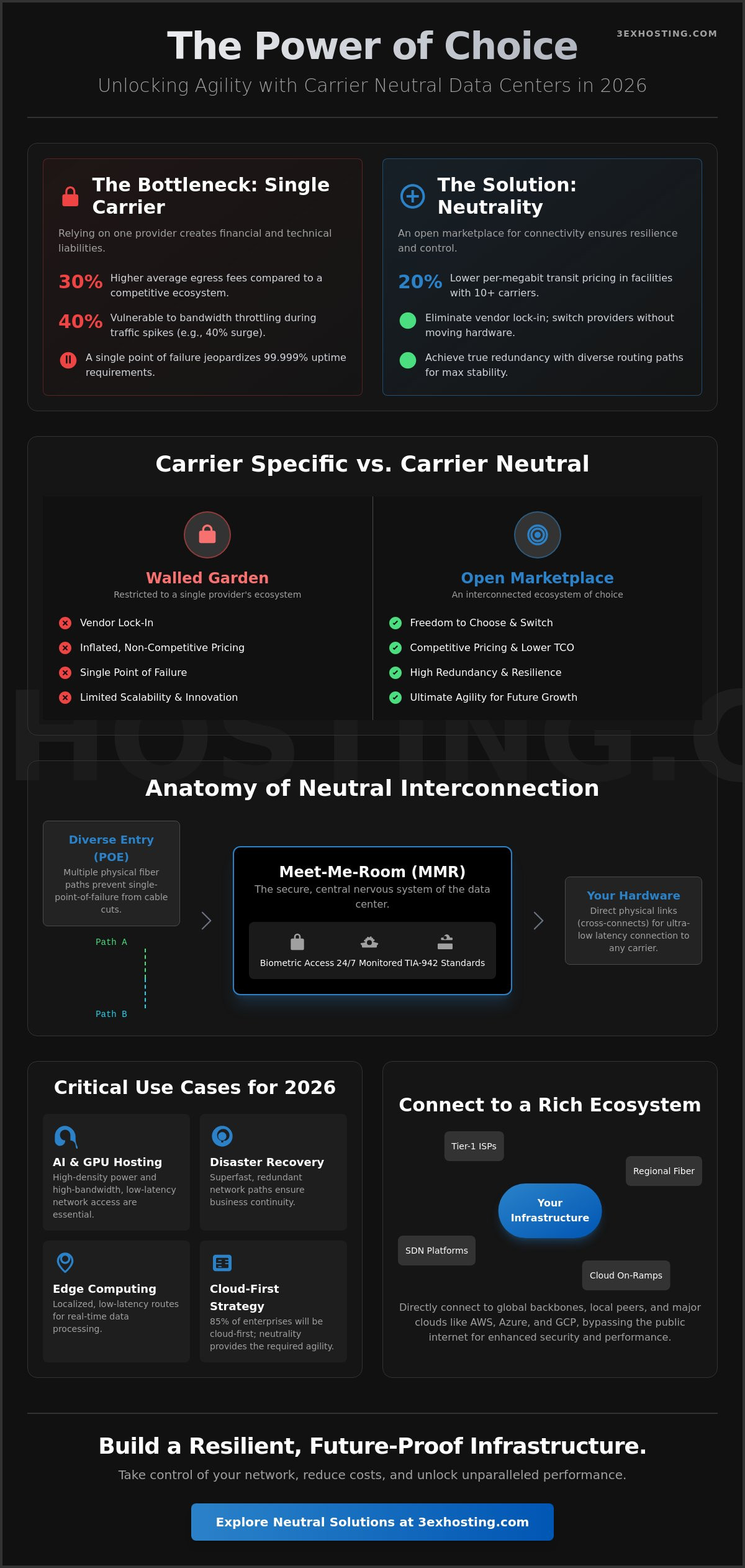
Relying on a single network provider in 2026 isn’t just a technical bottleneck; it’s a financial liability that often inflates egress fees by 30% compared to carrier neutral ecosystems. You already know that infrastructure agility is the foundation of your digital operations. It’s exhausting to manage rigid contracts or find your bandwidth throttled during a 40% traffic spike. A single point of failure in your network architecture simply isn’t an option when 99.999% uptime is your baseline requirement.
This guide explains how a neutral facility eliminates these constraints by providing an open marketplace of connectivity options. You’ll discover how to bypass vendor lock-in, slash latency through direct access to multiple Tier-1 providers, and regain total control over your routing paths. We’ll examine the technical shift toward superfast, redundant environments that significantly lower your total cost of ownership for high-bandwidth applications. This reference guide provides the roadmap you need to build a resilient, competitive infrastructure for the coming year.
Key Takeaways
- Understand how a carrier neutral facility eliminates vendor lock-in, allowing you to switch providers without moving your physical hardware.
- Learn how the Meet-Me-Room and cross-connects work together to provide the ultra-low latency required for modern enterprise applications.
- Discover how to optimize ROI by leveraging a competitive landscape of multiple carriers to find the best bandwidth pricing and routing.
- Identify why neutral connectivity is a critical prerequisite for the high-density demands of AI, GPU hosting, and superfast disaster recovery.
- Gain a practical framework to audit facilities for physical security, redundant power, and diverse entry paths to ensure maximum stability.
Defining Carrier Neutrality in Modern Data Center Architecture
A carrier neutral data center is a colocation facility that functions independently of any single network provider. It allows enterprises to connect with multiple telecommunication carriers, internet service providers (ISPs), and cloud platforms within a single environment. These hubs, often referred to as “Carrier Hotels,” serve as the primary exchange points of the internet’s backbone. The industry shifted away from carrier-owned facilities after the early 2000s infrastructure boom. Enterprises realized that being locked into one provider’s ecosystem created a single point of failure and limited bandwidth scalability. By 2026, industry projections suggest that 85% of enterprises will adopt a cloud-first principle. Neutrality provides the agility required to manage these complex, high-speed architectures.
Carrier Neutral vs. Carrier Specific: The Key Differences
Carrier-owned data centers operate as “walled gardens.” You’re restricted to their “on-net” services, which creates a bottleneck when you need to scale or switch providers. If that specific carrier’s network experiences an outage, your entire operation stops. In contrast, a neutral facility offers an open marketplace. You aren’t tied to a specific vendor’s hardware lifecycle. If a provider fails to upgrade their fiber to modern 400G standards, you simply cross-connect to a competitor who has. This flexibility extends the utility of your own hardware by ensuring your network path is never the limiting factor for performance.
The Anatomy of a Neutral Connectivity Ecosystem
A robust ecosystem includes Tier-1 ISPs, regional fiber providers, and Software-Defined Networking (SDN) platforms. This diversity creates a competitive environment that benefits the end-user. Industry reports indicate that facilities with more than 10 carriers often see per-megabit transit pricing up to 20% lower than single-carrier sites. Key participants include:
- Tier-1 ISPs: Global backbones that ensure your data reaches international markets.
- Regional Fiber: Localized, low-latency paths essential for edge computing and real-time processing.
- Direct Cloud On-ramps: Physical, private connections to AWS, Azure, and Google Cloud.
These direct connections bypass the public internet to provide the superfast, secure pathways necessary for modern data center operations. This architecture ensures that enterprise infrastructure remains stable, redundant, and ready for the data demands of 2026. By removing the “on-net” limitation, businesses can optimize their network topology based on latency, cost, and route diversity rather than being forced into a single provider’s roadmap.
Technical Mechanics: How Interconnection Works Inside the Facility
The physical reality of a carrier neutral environment is what separates high-performance facilities from standard server rooms. It isn’t just about having choices; it’s about how those choices are engineered to interact. Inside the data center, the architecture focuses on minimizing the distance between your hardware and the global internet backbone.
Meet-Me-Room (MMR) Standards and Best Practices
The MMR acts as the central nervous system of a carrier-neutral data center. This secure, restricted space is where dozens of different telecommunications carriers terminate their fiber optic lines. To maintain the integrity of these connections, 2026 standards require multi-factor biometric access and 24/7 AI-monitored CCTV. This prevents unauthorized tampering with the physical layer of the network.
Reliability depends on how fiber enters the building. Leading facilities utilize diverse Points of Entry (POEs). By using two or more geographically separate entry paths, the data center protects against “backhoe incidents” where a single cable cut could isolate the entire facility. In a carrier neutral setup, these POEs are managed with strict adherence to TIA-942 standards to ensure maximum uptime for every tenant.
Cross-Connect Services: Performance and Provisioning
A cross-connect is the direct physical link between your server cabinet and a provider’s equipment. While legacy setups relied on manual patches, 2026 sees a heavy shift toward automated, software-defined interconnection. This allows enterprises to scale bandwidth or switch providers in minutes. Common connection types include:
- Single-mode Fiber (OS2): The gold standard for high-bandwidth, long-distance throughput.
- Cat6a/7 Copper: Used for shorter distances and specific local network equipment.
- Coaxial: Still utilized for certain specialized handoffs and legacy broadcast requirements.
- Virtual Cross-Connects: Logical links over a shared fabric for cloud-to-cloud connectivity.
The latency advantage of “in-building” connections is undeniable. A cross-connect within the facility typically delivers latency under 0.5 milliseconds. If you were to use an external local loop to reach a provider’s nearest point of presence, you’d likely face 10 to 15 milliseconds of delay. For superfast applications like high-frequency trading or real-time AI inference, those extra milliseconds are unacceptable.
Maintaining this performance requires meticulous cable management. High-density patch panels prevent signal degradation and airflow blockages. If your team isn’t on-site to handle these physical layers, you can leverage Remote Hands Support to manage your connections and hardware updates. For businesses looking to optimize their network topology, choosing a carrier neutral data center provides the technical foundation needed for a truly resilient infrastructure.
Strategic Business Advantages: Why Neutrality Wins on ROI
Choosing a carrier neutral data center is a calculated financial decision that directly impacts your bottom line. It moves your infrastructure away from the restrictive “walled garden” model where one provider dictates terms. In a neutral environment, you maintain the power to switch carriers without moving a single piece of physical hardware. If a provider’s performance dips or their pricing increases, you simply request a new cross-connect. This flexibility eliminates the massive labor costs and downtime risks associated with physical migrations.
Cost optimization becomes a continuous process rather than a one-time setup. You can “price shop” for specific routes, selecting one carrier for low-latency domestic traffic and another for cost-effective international bulk transit. This granular control allows enterprises to mix and match bandwidth tiers to suit specific application needs. Reliability also sees a massive boost. By utilizing disparate fiber paths from multiple providers, you achieve true redundancy. If one carrier experiences a fiber cut, your traffic reroutes through a secondary provider instantly. This architecture is the only way to realistically target 100% uptime in a 2026 digital economy.
Scalability happens at the speed of software. As your national or global traffic grows, you don’t need to wait for a single provider to upgrade their local capacity. You simply tap into the existing ecosystem of the hub. This agility ensures your network capacity always stays ahead of your user demand.
The Economic Impact of Carrier Competition
Market data shows that when 10 or more carriers compete within a single facility, transit costs typically drop by up to 50%. This competitive pressure works in your favor. Unlike non-neutral cloud environments that trap users with high egress fees, a neutral hub lets you negotiate directly with providers. Investing in Full Cabinet Colocation within such a hub provides the physical foundation to leverage this competition. It turns your data center footprint into a strategic asset that lowers operational expenses every year.
Future-Proofing Through Network Agility
By 2026, traffic patterns will shift heavily toward edge computing and localized peering. A carrier neutral facility allows you to adapt to these changes by integrating emerging 6G backhaul and satellite providers as they mature. This setup also supports corporate ESG goals. By optimizing data routing to the shortest physical paths, you reduce the energy consumption associated with long-haul transit. You aren’t just buying space; you’re buying the ability to evolve your network without a forklift upgrade.
Critical Use Cases: AI, GPU Hosting, and Disaster Recovery
Modern AI workloads demand more than just raw power; they require a carrier neutral environment to ensure data flows as fast as the processors can think. By 2026, enterprise AI models will routinely require data ingestion rates exceeding 100 Gbps for real-time training and synchronization. A facility that limits you to a single bandwidth provider creates a bottleneck that no amount of hardware can overcome. High-density environments thrive on choice, allowing engineers to optimize every hop between the data source and the GPU cluster.
Networking for High-Density GPU Colocation
AI inference at the edge requires ultra-low latency to deliver results in milliseconds. If your infrastructure is locked into one provider, you’re at the mercy of their specific peering agreements and congestion levels. In a neutral facility, you can utilize direct cross-connects to specialized AI clouds and diverse fiber paths. This strategy bypasses the public internet entirely, often slashing latency by up to 40%.
- Massive Bandwidth: Supports the multi-terabit bursts required for Large Language Model (LLM) checkpointing.
- Direct Interconnects: Enables superfast links to hyperscale environments for hybrid AI workflows.
- Optimized Routing: Allows for precision tuning of traffic paths to reduce jitter in distributed training.
For enterprises scaling their machine learning capabilities, choosing High-Density GPU Colocation within a neutral facility ensures the network never becomes the weak link in the chain.
Resilience and Disaster Recovery Strategies
True business continuity isn’t just about having a backup; it’s about path diversity. A carrier neutral data center allows you to build a “mesh” network that survives even catastrophic regional fiber cuts. A 2024 industry report found that multi-carrier diversity reduces the risk of total connectivity loss by 85% compared to single-homed setups. This level of redundancy is a prerequisite for any enterprise handling mission-critical data.
By utilizing BGP (Border Gateway Protocol), your systems can automatically reroute traffic to a secondary or tertiary carrier if the primary link fails. This failover happens in seconds, preventing the kind of large-scale outages that cost companies an average of $9,000 per minute in lost productivity and reputation. Deploying Private Data Center Suites in these environments provides the physical and digital isolation necessary for a gold-standard disaster recovery site.
3ex Hosting provides the technical stability and carrier-agnostic access required to keep your most intensive applications online, no matter the external conditions.
Ready to build a resilient, high-performance foundation for your AI infrastructure? Get a custom colocation quote tailored to your enterprise needs.
Evaluation Framework: How to Audit a Carrier Neutral Facility
Selecting a carrier neutral facility requires more than checking a box. It’s a technical deep dive into the infrastructure that powers your enterprise connectivity. Use this five step framework to ensure the facility meets 2026 standards for performance and redundancy.
- Step 1: Audit the carrier list. A robust ecosystem includes Tier-1 giants like Lumen or NTT, Tier-2 regional players, and specialized SD-WAN or cloud on-ramp providers. A diverse mix prevents vendor lock-in and ensures competitive pricing.
- Step 2: Inspect the Meet-Me-Room (MMR). This room is the heart of connectivity. It must feature biometric security and 2N power redundancy. Verify that fiber enters the building through physically diverse paths, at least 50 feet apart, to prevent a single conduit failure from causing a total outage.
- Step 3: Review the Service Level Agreements (SLAs). Standard cross-connect provisioning in 2026 should take 24 to 48 hours. If a provider quotes 10 business days, they aren’t optimized for modern enterprise agility.
- Step 4: Assess on-site support. Network troubleshooting requires expert eyes. Ensure the facility offers 24/7 remote hands with certified technicians who understand BGP and physical layer issues.
- Step 5: Verify peering exchange participation. Check if the facility hosts nodes for major Internet Exchanges like DE-CIX or local peering points. This reduces latency by keeping traffic local rather than routing it through distant hubs.
Key Questions for Data Center Operators
Ask about monthly recurring costs (MRC) for every cross-connect. Some sites charge $300 or more per month per cable, which scales poorly as your network grows. Inquire about fiber path diversity. You need to know if carriers enter through the same conduit, as this creates a single point of failure. Finally, request a “Lit Building” report. This document confirms which carriers have active, powered equipment in the facility right now, rather than just fiber nearby.
The Final Decision: Beyond the Neutral Label
The “neutral” label is a baseline, not a finish line. A carrier neutral facility with 50 carriers is often superior to one with 5. High-density environments drive down costs by forcing providers to compete for your business. You’ll often see transit costs drop by 15% to 30% in highly competitive ecosystems. Balance this connectivity depth with physical security. A facility with 100 carriers is useless if its physical access controls are weak. Look for K-rated fencing, 24/7 surveillance, and multi-factor authentication at every entry point.
Ready to secure your infrastructure in a high-performance environment? Get a Quote for a carrier-neutral solution tailored to your enterprise.
Securing Your Enterprise Connectivity Strategy for 2026
Selecting a carrier neutral facility is a decisive move toward operational independence. By 2026, data from industry analysts suggest that 80% of global enterprises will utilize multi-cloud strategies to maintain 99.999% availability. This approach works by utilizing diverse fiber paths and removing the limitations of single-provider lock-in. It’s the most effective way to host high-density AI applications that demand massive throughput and low-latency performance. Technical stability isn’t an option; it’s a requirement for modern competition.
3ex Hosting provides the professional foundation your business needs to thrive. Our facility features high-density AI-ready infrastructure and offers strategic access to global carrier hubs. We back our hardware with 24/7 Remote Hands Support to keep your systems running at peak performance. We don’t rely on flashy promises, just reliable, superfast hardware and expert support. You’ll find the stability you’ve been looking for in a partner that understands the technical demands of the 2026 landscape.
Explore Enterprise Colocation in our Carrier-Neutral Facility
We’re ready to help you build a more resilient and scalable digital presence today.
Frequently Asked Questions
What is the primary benefit of a carrier-neutral data center?
The primary benefit of a carrier-neutral data center is the freedom to choose from multiple network providers. This competition drives down connectivity costs by up to 30 percent compared to single-provider facilities. You avoid vendor lock-in and can switch carriers without moving your hardware. It ensures your infrastructure stays online even if one provider suffers a backbone failure.
Does carrier neutral mean I have to manage my own bandwidth?
You don’t have to manage your own bandwidth in these facilities. Most providers offer managed network services where the data center or a third-party ISP handles the routing for you. However, 65 percent of enterprise clients choose to manage their own BGP sessions to gain full control over their traffic paths. It’s about flexibility rather than a mandatory technical burden.
How much do cross-connects typically cost in a neutral facility?
Cross-connects typically cost between 250 and 500 dollars per month per connection in Tier III facilities. These fees cover the physical fiber or copper cabling between your rack and the carrier’s Point of Presence. While these are recurring costs, they’re often offset by the 15 to 20 percent lower transit rates available in a competitive marketplace.
Is a carrier-neutral data center more expensive than a carrier-owned one?
A carrier neutral facility often has higher monthly rack space fees, but the total cost of ownership is usually lower. Carrier-owned sites might offer cheap space to lock you into their expensive bandwidth. Data from 2024 industry reports shows that enterprises save an average of 12 percent on total infrastructure spend by leveraging competitive bidding between on-site carriers.
What happens if a carrier in a neutral facility goes bankrupt?
You simply migrate your traffic to another provider already present in the building. Since these facilities house dozens of carriers, a bankruptcy doesn’t threaten your uptime. You can establish a new cross-connect within 24 to 48 hours. This structural redundancy is why 90 percent of mission-critical enterprise workloads reside in neutral environments.
Can I use my own IP addresses in a carrier-neutral environment?
You can use your own provider-independent IP addresses by announcing them via Border Gateway Protocol. This allows you to maintain your network identity regardless of which carrier provides the physical transit. It’s a standard practice for 85 percent of enterprises that require high availability. Your IP space remains portable, which simplifies disaster recovery and multi-homing strategies.
What is the difference between a carrier-neutral facility and an IXP?
A carrier neutral data center is the physical building that houses the hardware. An Internet Exchange Point is a specific platform inside that building where networks trade traffic directly. Think of the data center as the airport and the IXP as the terminal where different airlines exchange passengers. Over 500 global IXPs currently operate within neutral facilities to reduce latency.
How does carrier neutrality affect data center security?
Neutrality improves security by allowing you to implement diverse, private connections that bypass the public internet. These facilities maintain strict ISO 27001 and SOC 2 Type II compliance standards. Because they cater to multiple competing entities, they invest more in 24/7 biometric access and physical isolation. Security isn’t just a feature; it’s the foundation of the business model.