 SUPPORT


 3EX United States
 Blog
North American data center vacancy rates have reached record lows of 0.3% in major hubs, making efficient power allocation the most critical asset in your 2026 infrastructure strategy. Many enterprise teams currently struggle with power circuit overloads and hardware throttling in aging, low-density facilities. Adopting 5kw cabinet colocation solves these bottlenecks by providing the necessary density for modern blade servers while remaining compatible with standard air-cooling systems. It’s a precise balance of performance and reliability that ensures your hardware operates at its full potential without the risks of legacy power constraints.
You’ve probably dealt with the frustration of hidden costs in metered billing and the constant worry of cooling failures. It’s a common pain point for growing firms that need stability above all else. This guide will show you how to leverage 5kW power density to secure predictable monthly costs and zero-latency connectivity for your national deployments. We’ll explore the technical configurations and cooling strategies that allow you to scale your enterprise hardware with maximum uptime and efficiency. You’ll gain the clarity needed to transition from fragile legacy setups to a robust, high-density environment designed for the demands of modern AI and cloud workloads.
Key Takeaways
- Understand why 5kW has replaced the 2kW legacy standard as the baseline for modern enterprise hardware and AI workloads.
- Master the technical requirements of 5kw cabinet colocation, including 208V/30A circuit configurations and advanced thermal management strategies.
- Learn how to calculate the total cost of ownership (TCO) and reduce recurring cross-connect fees through strategic rack consolidation.
- Follow a step-by-step deployment strategy to audit actual power draw and optimize rack layouts for better heat distribution.
- Discover how N+1 redundancy and carrier-neutral connectivity provide a stable foundation for scaling mission-critical infrastructure.
What is 5kW Cabinet Colocation and Why Does Density Matter?
5kw cabinet colocation represents a specific power allocation where a single 42U or 48U rack is provisioned with 5,000 watts of usable power. In the previous decade, a 2kW “legacy” rack was the enterprise standard. However, the hardware landscape has changed. Modern blade servers and high-performance computing clusters require significantly more energy to operate. Transitioning to a 5kW baseline allows you to consolidate more hardware into a smaller physical footprint. This reduces your overall data center infrastructure costs by minimizing the number of cabinets you need to lease and manage.
Density dictates efficiency. When you spread low-power hardware across multiple 2kW racks, you pay for unused vertical space and extra cross-connects. A 5kW configuration maximizes the vertical capacity of the cabinet. It provides enough headroom for virtualization clusters and storage arrays that would otherwise trigger circuit breakers in older facilities. For most enterprises in 2026, this 5kW threshold is the “sweet spot” where performance meets cost-effectiveness.
The Evolution of Power Density in 2026
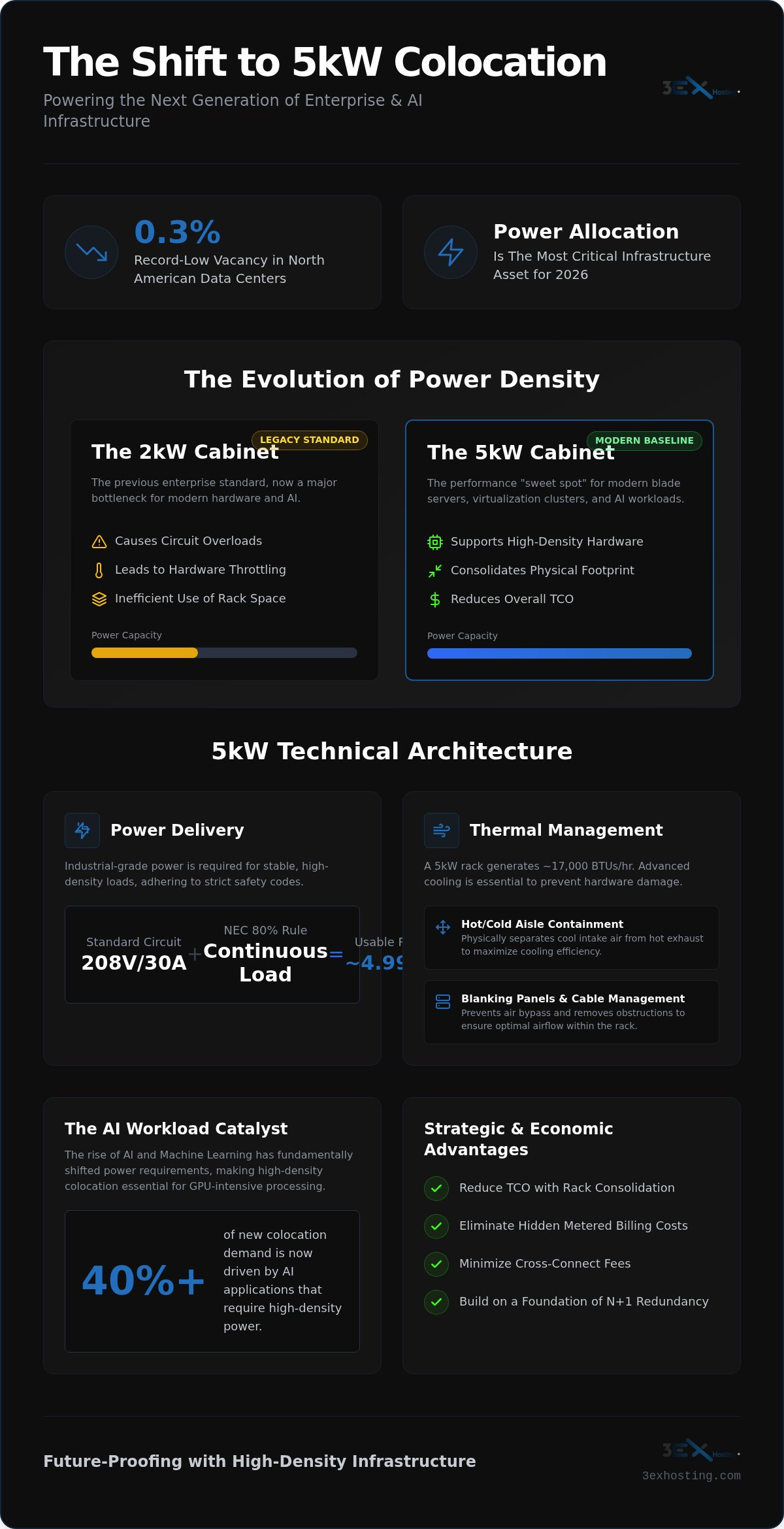
The rise of AI and machine learning has fundamentally shifted power requirements. Research shows that AI workloads now account for over 40% of new colocation lease demand. These applications rely on full cabinet colocation environments that can support intensive GPU processing. Legacy 2kW racks have become a major bottleneck. They simply cannot provide the sustained amperage required for modern GPU server hosting. 3EX Hosting addresses this by providing stable, high-density environments that prevent hardware throttling and ensure consistent performance for national enterprise workloads.
Key Terminology: kW vs. kVA in Colocation
Understanding the difference between real power (kW) and apparent power (kVA) is vital for capacity planning. Real power is the energy your hardware actually consumes to perform work. Apparent power includes the “extra” energy that flows through the system but isn’t used for computing; this is often caused by the power factor of your equipment. Most modern servers have a power factor close to 1.0, meaning kW and kVA are nearly identical.
When you select a 5kw cabinet colocation plan, you must ensure your Power Distribution Units (PDUs) can handle the load without exceeding the 80% rule for continuous use. We focus on providing usable power rather than just theoretical maximums. This technical precision ensures that your mission-critical hardware remains stable even during peak processing cycles. By aligning your power factor with our infrastructure, you achieve a more predictable monthly cost structure.
Technical Architecture: Cooling and Powering a 5kW Rack
Deploying 5kw cabinet colocation requires a shift from standard residential voltages to industrial grade power delivery. A 120V circuit cannot efficiently handle a 5kW load without excessive amperage and heat. Standard 208V/30A configurations are the benchmark for 2026 enterprise environments. Under the National Electric Code (NEC) 2026 updates, continuous loads must not exceed 80% of the circuit’s rated capacity. This means a 30A circuit provides roughly 4.99kW of usable power, perfectly aligning with the 5kW cabinet standard. We ensure every circuit is provisioned to meet these rigorous safety and performance thresholds.
Thermal management is equally critical. A rack pulling 5kW of power generates roughly 17,000 BTUs of heat every hour. Without containment, this heat recirculates and causes hardware throttling. Modern facilities use Hot Aisle or Cold Aisle containment to physically separate intake and exhaust air. This ensures that cold air from the cooling units reaches your servers without mixing with hot exhaust. If you need assistance designing your rack for optimal airflow, our remote hands support can help with precise hardware placement and cable routing.
Advanced Cooling Strategies for High-Performance Racks
Precision Air Conditioning (CRAC) units are the heart of a high-density facility. They maintain consistent humidity and temperature levels to protect sensitive electronics. However, the facility’s cooling is only as good as your rack’s internal airflow. Blanking panels must be installed in every empty rack unit (U) to prevent cold air from bypassing your servers. Proper cable management is not just about aesthetics; it’s about removing physical obstructions from the exhaust path. We monitor rack-level temperatures 24/7 to identify hotspots before they impact performance. This proactive approach prevents the hardware degradation often seen in lower density environments.
Power Distribution Units (PDUs) for 5kW Circuits
The choice between metered and switched PDUs depends on your specific management needs. Metered PDUs provide local and remote power consumption data, while switched PDUs allow you to reboot individual servers remotely. For maximum reliability, use redundant A+B power feeds. This configuration ensures that if one power source fails, the secondary feed takes over instantly without downtime. PDUs distribute the 5kW capacity across the 42U rack space by providing multiple outlets that balance the electrical load across all installed hardware. Using high-quality PDUs is the final step in creating a stable, high-density environment that supports modern enterprise workloads.
Performance vs. Cost: The Economics of 5kW Colocation
The primary driver for shifting to 5kw cabinet colocation is the significant reduction in Total Cost of Ownership (TCO). While the base price for a high-density cabinet is higher than a legacy 2kW rack, the math favors consolidation. Leasing two 2.5kW racks forces you to pay for two physical footprints, two sets of security fees, and double the cable management overhead. By moving to a single 5kW environment, you eliminate the redundancy of physical space and focus your budget on the actual computing power. This efficiency becomes even more apparent during hardware refreshes. You won’t need to migrate to a new facility just because your next generation of servers has a higher power draw.
Consolidation also directly impacts your connectivity budget. Research shows that physical cross-connect fees in 2026 typically range between $150 and $400 per month for fiber. If your infrastructure is spread across multiple low-density racks, you’re paying those recurring fees for every cabinet that requires a direct link to a carrier or a cloud provider. A 5kW configuration allows you to aggregate your hardware, often reducing the number of required cross-connects by 50% or more. These monthly recurring savings add up quickly, especially for enterprises with complex hybrid cloud or multi-carrier requirements.
Consolidation: Doing More with Less Space
Many enterprises find that legacy 2kW racks leave over 70% of the vertical space empty because the power circuit trips before the rack is full. A 5kW circuit changes this dynamic. It allows you to populate more of the 42U or 48U space with modern, energy-intensive hardware like virtualization clusters or storage arrays. You can fit more computing power into a smaller footprint, which simplifies management and reduces the time your team spends on physical maintenance. This high-density approach is the foundation of our cabinet colocation solutions, designed to help you scale without the complexity of managing a sprawling, multi-rack footprint.
Predictable vs. Metered Power Billing
In 2026, regulatory shifts in states like California and Washington have made power costs more volatile for data center operators. This volatility often trickles down to users in the form of metered billing overages. Choosing a fixed-fee 5kW plan provides a circuit-based pricing model that’s much easier to forecast. You pay for the circuit capacity rather than the fluctuating usage. This is especially beneficial for 24/7 enterprise workloads where power draw remains high and consistent. It removes the risk of bill shock and ensures your monthly infrastructure spend remains predictable regardless of grid impact fees or peak demand surcharges.
Deployment Strategy: Optimizing Your 5kW Cabinet
Deployment success for 5kw cabinet colocation relies on moving from theoretical capacity to operational reality. Your first step is a rigorous audit of hardware power draw. Nameplate ratings on servers often reflect maximum theoretical loads that your hardware will never reach. Relying on these numbers leads to over-provisioning and wasted budget. Instead, measure actual draw during peak processing cycles to ensure your 5kW circuit remains within safety thresholds for continuous loads. This data allows you to maximize the density of your rack without risking unplanned outages.
Once power requirements are verified, design your rack layout for both stability and thermal efficiency. Heavy equipment, such as storage arrays or UPS units, must be placed at the bottom of the cabinet to lower the center of gravity. This prevents tipping risks and aligns with standard safety protocols. You should also implement a redundant network topology at this stage. Use dual top-of-rack (ToR) switches connected via diverse fiber paths to eliminate single points of failure. This ensures that even if one switch or carrier path fails, your mission-critical applications remain online.
Rack Layout Best Practices
Efficient airflow is the difference between stable performance and hardware failure. Use vertical and horizontal cable managers to keep the back of the rack clear. Messy cabling blocks exhaust air and creates hotspots that cooling units can’t reach. If your team isn’t on-site, utilizing remote hands is the most reliable way to ensure professional rack population. Expert technicians handle the physical installation and labeling, which simplifies future troubleshooting and maintenance cycles.
Connectivity and Low Latency
Your high-density environment must exist within a carrier-neutral ecosystem. This provides the flexibility to choose between multiple Tier 1 providers and direct cloud on-ramps. Diverse fiber entry points are essential for enterprise business continuity, protecting your data from physical line cuts. For those scaling advanced workloads, our guide on High-Density GPU Colocation explores how connectivity impacts AI performance. To see how these strategies fit your specific needs, request a customized colocation quote today.
Proactive monitoring is the final pillar of your strategy. Install environmental sensors at the top, middle, and bottom of the rack to track humidity and temperature in real-time. Combine this with PDU-level monitoring to track power consumption trends. This approach allows you to identify hardware that might be failing or drawing excessive power, ensuring your 5kw cabinet colocation environment remains optimized for long-term reliability.
Future-Proofing with 3EX Hosting’s 5kW Infrastructure
3EX Hosting provides the technical stability necessary for national enterprise deployments in 2026. Choosing 5kw cabinet colocation through our facilities means prioritizing a zero-latency environment backed by N+1 power redundancy. This standard ensures that even during routine maintenance or grid instability, your mission-critical hardware remains online. We offer a 100% power uptime SLA, reflecting our confidence in the infrastructure we build and maintain. Our on-site technical team is available 24/7/365 to handle everything from emergency reboots to complex cabling adjustments.
Scaling your footprint shouldn’t require a total overhaul of your operations. Our facilities support seamless growth, allowing you to transition from a single 5kW cabinet to private colocation suites as your data needs expand. This flexibility is vital for enterprises managing AI workloads or large-scale virtualization projects that require rapid capacity increases. You get a stable foundation that evolves with your hardware refreshes, rather than a static space that limits your potential. We focus on providing the physical and electrical headroom your business needs to stay competitive.
Beyond the Rack: Managed Services and Support
Our move-in assistance simplifies the migration process by providing expert logistics and physical setup support. This service ensures your 5kw cabinet colocation environment is optimized for airflow and connectivity from day one. You can also integrate your high-density hardware with our managed cloud and disaster recovery solutions for a truly resilient hybrid architecture. For organizations with strict compliance or privacy needs, we provide custom cage solutions that offer enhanced physical security and dedicated space within the data center.
Get Started with Your High-Density Deployment
Receiving a custom 5kW colocation quote is a straightforward process designed to respect your timeline. We analyze your specific power draw, connectivity requirements, and support needs to provide a transparent, fixed-fee proposal. This eliminates the risk of bill shock and allows for accurate long-term budgeting. Consult with an infrastructure expert to ensure your cabinet configuration meets the specific thermal and electrical requirements of your hardware.
Get a custom 5kW colocation quote today
Secure Your High-Density Strategy for the Years Ahead
Implementing 5kw cabinet colocation is no longer just an option for growing enterprises; it’s a technical necessity for maintaining a competitive edge in 2026. You’ve seen how consolidating hardware into high-density environments slashes TCO by reducing physical footprints and recurring cross-connect fees. Proper thermal management combined with N+1 power redundancy ensures your most demanding AI and virtualization clusters operate without the risk of throttling or unplanned downtime. This transition isn’t just about saving space; it’s about building a resilient foundation for future hardware refreshes.
3EX Hosting stands ready to support your national deployment with carrier neutral connectivity and 24/7/365 on-site remote hands. We focus on technical excellence so your team doesn’t have to worry about the complexities of power distribution or thermal containment. It’s time to move past the bottlenecks of legacy racks and embrace an infrastructure that scales at the speed of your innovation. Our experts are here to help you navigate every technical requirement with precision and care.
Request a 5kW Cabinet Colocation Quote and secure your stable, high-performance environment today.
Frequently Asked Questions
What kind of hardware requires a 5kW cabinet colocation?
Hardware like high-performance virtualization clusters, modern blade servers, and dense storage arrays typically requires 5kW. These systems pull significantly more power than legacy 1U servers. High-density 5kw cabinet colocation is also the entry-point for smaller AI inference nodes and GPU-accelerated workloads. If your rack contains multiple 2U servers with dual 1200W power supplies, you’ll likely exceed standard 2kW limits and need this higher power allocation for stability.
How many servers can I typically fit in a 5kW 42U rack?
The number of servers depends on the actual power draw of each unit rather than physical space. In a 5kW rack, you can usually fit 10 to 15 modern 1U servers if they average 300 to 400 watts each. While the 42U rack has space for 42 units, the 5kW power limit is the primary constraint. It’s better to populate the rack partially with high-performance units than to fill every slot with underpowered hardware.
Is 5kW considered high-density colocation in 2026?
In 2026, 5kW is considered the baseline for modern enterprise density. While specialized AI GPU hosting can reach 50kW or more per rack, 5kW is the standard for general-purpose virtualization and cloud infrastructure. It’s high-density compared to legacy 2kW racks but represents a stable middle ground for most corporate workloads. This level of density allows for significant consolidation without requiring the exotic liquid cooling systems used in extreme AI deployments.
What happens if my hardware exceeds the 5kW power limit?
Exceeding the 5kW limit will likely trip the circuit breaker at the PDU or the facility level, causing an immediate outage for all hardware in that rack. To prevent this, we recommend monitoring your actual draw using metered PDUs. If your requirements grow, you can upgrade your circuit or distribute the load across multiple 5kw cabinet colocation environments. Proactive monitoring helps identify spikes before they reach the 80% threshold of your circuit.
Do I need special PDUs for a 5kW power circuit?
Yes, a 5kW circuit typically requires an industrial-grade PDU capable of handling a 30A/208V input. Standard 120V power strips aren’t compatible with these high-density configurations. You should choose between metered PDUs for local data or switched PDUs if you need remote reboot capabilities. Using high-quality PDUs ensures that power is distributed safely across your 42U or 48U rack space while adhering to current National Electric Code standards for data centers.
How does 5kW colocation improve my disaster recovery strategy?
High-density cabinets allow you to replicate your entire production environment in a smaller physical footprint at a secondary site. This consolidation makes disaster recovery more cost-effective by reducing the number of racks and cross-connects you need to maintain. With 3EX Hosting’s N+1 power redundancy and carrier-neutral connectivity, your off-site backups remain accessible and secure. It’s a faster way to restore mission-critical services without the complexity of managing a sprawling, low-density recovery site.
What is the difference between a 5kW cabinet and a private suite?
A 5kW cabinet is a single locking rack within a shared data center floor, while a private suite is a dedicated, walled-off room. Suites are designed for larger deployments involving multiple racks and offer higher levels of physical security and customizable cooling. A single cabinet is ideal for enterprises that need high-density power for a specific cluster. Suites are better suited for organizations that require a fully isolated environment for compliance or large-scale scaling.
Can I upgrade from 5kW to higher densities later?
Yes, our infrastructure is designed for seamless scaling as your technical needs evolve. You can upgrade from a standard 5kW circuit to higher densities or add additional cabinets to your footprint without moving your existing hardware. This future-proofing is essential for businesses planning to integrate more GPU-intensive workloads or AI processing. Our team provides the move-in assistance and remote hands support needed to manage these transitions smoothly and quickly as your requirements grow.