 SUPPORT


 3EX United States
 Blog
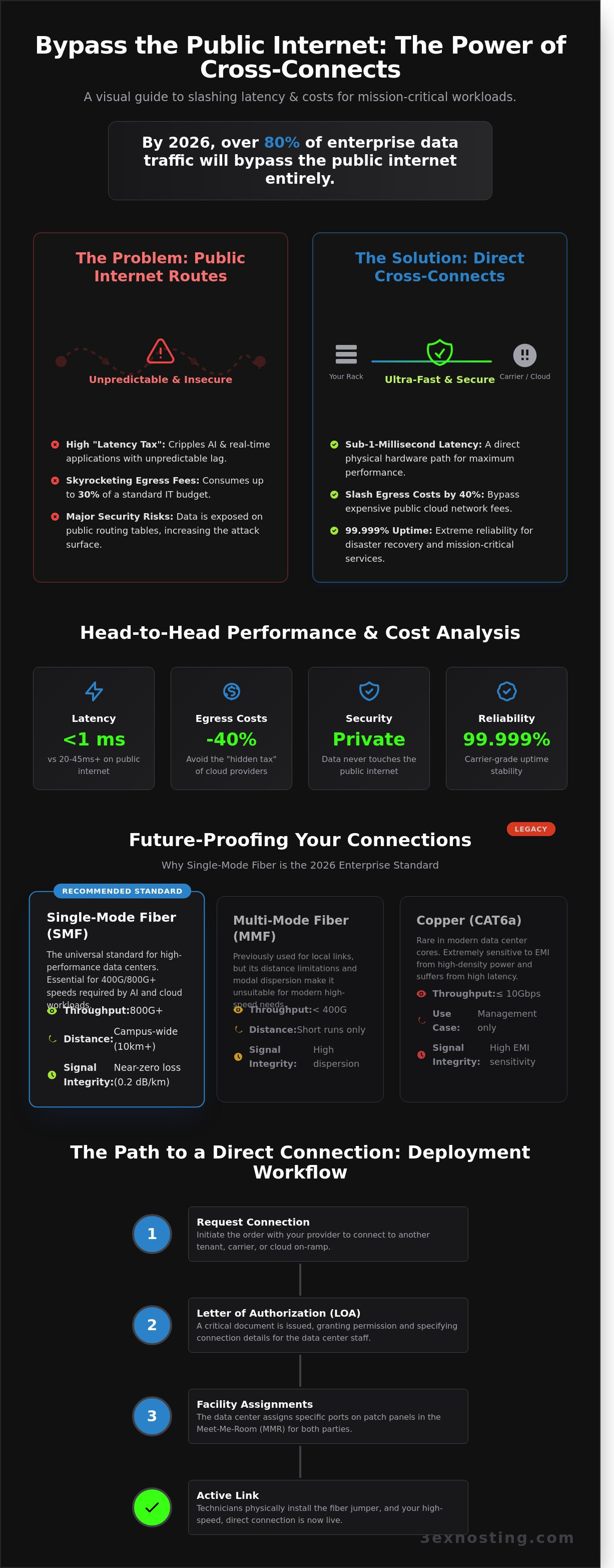
By 2026, over 80% of enterprise data traffic will bypass the public internet entirely to avoid the “latency tax” that cripples modern AI applications. You’ve likely noticed that relying on the open web for critical workloads is a constant gamble. Unpredictable lag and skyrocketing cloud egress fees, which often consume 30% of a standard IT budget, make scaling your digital infrastructure feel like an expensive, uphill battle. Security vulnerabilities in software-defined perimeters only add to the stress of managing a modern network.
This guide demonstrates how cross-connect services provide the superfast, physical foundation needed to eliminate these bottlenecks for good. You’ll discover how to slash egress costs by 40% while achieving sub-1-millisecond latency through direct, hardware-level links. We’ll break down the technical steps to building a secure hybrid cloud architecture that gives you direct access to a global carrier ecosystem and total control over your monthly connectivity spend. It’s time to move beyond the instability of public routes and embrace a more stable, professional interconnection strategy that puts your data in safe hands.
Key Takeaways
- Understand the physical foundation of modern data centers and how the Meet-Me-Room acts as the central hub for your infrastructure.
- Identify why Single-Mode Fiber has become the essential 2026 standard for maintaining high-performance, future-proof media links.
- Learn how to bypass the “hidden tax” of the public internet and slash egress costs using dedicated cross-connect services.
- Navigate the deployment workflow with confidence by mastering the critical roles of the Letter of Authorization (LOA) and Facility Assignments.
- Discover how to future-proof your hybrid cloud by leveraging carrier-neutral ecosystems designed for high-density power and cooling requirements.
Understanding Cross-Connect Services in Modern Data Centers
A cross-connect is a dedicated, physical point-to-point cable that links two separate termination points within a data center environment. Unlike standard internet connections that route data through multiple public hops, cross-connect services establish a direct hardware path between a customer and a service provider, carrier, or another enterprise. This physical link ensures that data never touches the public internet, providing a level of reliability and speed that virtual connections cannot replicate.
The Meet-Me-Room (MMR) acts as the central nervous system for these connections. It’s a fortified, highly regulated space where different network providers and tenants terminate their equipment to facilitate Interconnection. Without the MMR, the seamless exchange of data between global networks would be impossible. While software-defined networking (SDN) has simplified how we manage traffic, it still relies on these physical foundations. You can’t virtualize the physical transmission of light through a fiber optic cable; the hardware remains the ultimate bottleneck or the ultimate enabler of performance.
It’s vital to distinguish between standard internal cabinet connections and intra-campus links. Internal connections stay within your own hardware footprint. Intra-campus cross-connects extend your reach to other entities within the same facility or across a multi-building campus, often utilizing high-density fiber to maintain sub-millisecond latency across distances of up to 10 kilometers.
The Physicality of Interconnection
Physical security is a primary advantage of this architecture. By bypassing the public internet, you effectively remove your data from the public routing table. This setup utilizes structured cabling standards to organize patch panels, fiber trays, and cable management systems. This organization isn’t just for aesthetics; it prevents signal degradation and simplifies troubleshooting. When selecting a provider, carrier-neutrality is a key factor. A carrier-neutral data center allows you to choose from dozens of different providers, ensuring you aren’t locked into a single vendor’s pricing or performance limits.
Business Value: Why Enterprises Invest
Enterprises invest in cross-connects to eliminate jitter and packet loss, which are common in congested public networks. For mission-critical applications, a 20ms delay can be the difference between a successful transaction and a system timeout. By removing data from the public eye, you reduce your attack surface by nearly 100% for that specific link. This is essential for disaster recovery solutions that require real-time data replication. Companies often see a 30% to 45% reduction in latency compared to VPN-based solutions. This stability allows for 99.999% uptime, providing the technical foundation necessary for high-frequency trading, large-scale AI processing, and secure financial communications.
Technical Specifications: Fiber, Copper, and 2026 Media Standards
Single-Mode Fiber (SMF) has become the universal standard for high-performance data centers in 2026. While Multi-Mode Fiber (MMF) served local links for decades, its distance limitations and modal dispersion make it unsuitable for the 400G and 800G speeds now required by enterprise AI and cloud workloads. SMF utilizes the OS2 standard, offering a nearly unlimited bandwidth ceiling and signal attenuation as low as 0.2 dB/km. This ensures that cross-connect services maintain signal integrity across large-scale campus environments without the need for active regeneration.
Legacy copper links like CAT6a are increasingly rare in the core of the data center. These cables suffer from high latency and are extremely sensitive to electromagnetic interference (EMI) generated by high-density power distribution units. In a modern colocation environment, copper is typically reserved for out-of-band management or low-speed legacy hardware. For production traffic, fiber is the only viable path for technical stability and speed.
- SMF (OS2): Best for high-speed, long-distance links; supports 800G+ throughput.
- MMF (OM4/OM5): Limited to short distances; increasingly phased out in 400G architectures.
- Copper (CAT6a): High EMI sensitivity; limited to 10Gbps over short runs.
- LC Connectors: The standard for 10G to 100G duplex connections.
- MPO/MTP Connectors: Essential for high-density 400G/800G breakout configurations.
If you are planning a high-density deployment, our super-fast cabinet colocation options provide the necessary infrastructure to support these advanced media standards.
Choosing the Right Media Type
Selecting the correct media type is the foundation of network reliability. SMF is the mandatory choice for campus-wide connectivity where distances exceed 100 meters. You must ensure your optical transceivers match the data center’s link type exactly. An SR (Short Reach) transceiver will not function on a Single-Mode link; you must use LR (Long Reach) or DR4 optics to ensure compatibility with modern cross-connect services. This precision prevents packet loss and hardware sync issues.
Latency Benchmarking
In 2026, we measure performance in microseconds rather than milliseconds. Physical distance remains the primary driver of latency; light travels through fiber at roughly 200,000 kilometers per second, creating a delay of approximately 5 microseconds per kilometer. Within a single data center, a direct cross-connect typically introduces less than 1.5 microseconds of latency. Direct physical cross-connects provide a 100x latency advantage over 2026-era 5G or Fiber-to-the-premise connections which still operate in the 5 to 20 millisecond range due to routing overhead.
Cross-Connects vs. Public Internet: A Performance and Cost Analysis
Public internet routing is fundamentally unpredictable. It relies on Border Gateway Protocol (BGP) to find the cheapest path, not the fastest or most stable one. This creates a “best-effort” environment where latency spikes and packet loss are common. For enterprises, cross-connect services provide a necessary alternative by establishing a dedicated physical layer connection. This link bypasses the congested public infrastructure entirely. It offers a 99.999% uptime SLA, providing a level of reliability that standard ISPs cannot match. It’s the difference between a crowded public highway and a private high-speed rail line.
The Financial Impact of Egress Fees
Cloud providers impose what many architects call a “hidden tax” through egress fees. These are the charges for moving data out of a cloud environment to the public internet. These costs are often volatile. In a 2025 financial review of mid-sized enterprises, those using public internet for data transfers saw monthly billing fluctuations of up to 25%. By using Direct Cloud On-ramps like AWS Direct Connect or Azure ExpressRoute via a physical cross-connect, you replace variable bandwidth costs with predictable, lower-rate peering fees. A typical case study shows that companies moving more than 15TB of data monthly can reduce their total connectivity costs by 40% within the first year of implementation.
Performance Stability for Enterprise Apps
High-frequency trading and VoIP systems require absolute stability. They cannot tolerate jitter or the “noisy neighbor” effect. This occurs when other users on a shared ISP link consume bandwidth, causing your performance to drop. A physical cross-connect eliminates this interference. It provides a dedicated, private lane for your traffic. This deterministic performance is a core requirement when integrating your infrastructure into disaster recovery solutions. It ensures that real-time data replication between primary and backup sites remains constant.
Security is the final pillar of this analysis. Private links simplify complex audits for PCI-DSS and HIPAA compliance. Since the data never touches the public web, the attack surface is significantly smaller. 82% of IT directors surveyed in 2025 cited private interconnection as their primary method for securing sensitive data transfers between colocation environments and cloud providers. Cross-connect services don’t just move data faster; they move it more securely. It’s a controlled environment where you own the path from end to end.
The Deployment Workflow: From LOA to Active Link
Establishing cross-connect services requires a precise sequence of administrative and technical steps. It starts with the Letter of Authorization (LOA). This document functions as your formal permission to the data center operator. It allows them to connect your equipment to a third party, such as a carrier or cloud provider. Without a valid LOA, security protocols prevent any physical changes to the Meet-Me Room (MMR). It’s the primary safeguard that ensures only authorized parties can manipulate high-speed data pathways.
Managing the LOA/CFA Process
The LOA must include the Customer Facility Assignment (CFA). This identifies the exact rack, panel, and port for the connection. In 2026, roughly 85% of tier-III data centers use digital LOA workflows via automated portals to reduce manual entry errors. A common mistake involves using an expired CFA or a port that’s already occupied; this typically results in a 24-hour rejection cycle. To generate a valid LOA, ensure your provider confirms the port availability in writing before you submit the request to the facility manager. This simple check prevents the “port-in-use” errors that account for 40% of deployment delays.
Leveraging Remote Hands for Connectivity
Most enterprises don’t send technicians to the facility for every patch. This is where remote hands support becomes essential for physical patching and link verification. On-site technicians use OTDR (Optical Time-Domain Reflectometer) testing to identify signal loss in “dark fiber” segments. If light levels fall below -22 dBm on a 10G link, the connection will likely flap or fail entirely. Professional support teams can clean fiber tips or swap patch cables immediately, saving you from a costly site visit.
Standard lead times for cross-connect installation usually range from 48 to 72 hours, though premium expedited services can reduce this to 4 hours in emergencies. Once the physical link is active, the data center provides a completion notice including light level readings. You should always verify these metrics against your hardware specifications. For example, a 100G QSFP28 module has much tighter tolerances than a standard 1G SFP. Maintaining organized cable runs within cabinet colocation setups isn’t just about aesthetics; it ensures that future troubleshooting doesn’t cause accidental outages for neighboring links.
Ready to optimize your infrastructure? Explore our high-performance colocation options today.
Scaling Your Infrastructure with 3EX Hosting Connectivity
3EX Hosting operates a carrier-neutral facility that empowers your business to choose from a diverse ecosystem of 200+ global network providers. This flexibility prevents vendor lock-in and allows you to optimize your latency based on specific geographic needs. By 2026, enterprise workloads will require unprecedented power levels to support AI and high-performance computing. Our infrastructure already supports high-density configurations, delivering up to 30kW per rack to meet the rigorous cooling and energy demands of next-generation hardware.
You can customize your physical footprint to match your security and growth requirements. Whether you choose cage colocation for physical isolation or a dedicated private suite for maximum control, we provide the space and power you need. Our cross-connect services provide the physical link between your equipment and our global fiber backbone. This isn’t just about cabling; it’s about building a resilient, high-speed network that scales on demand. Our expert team monitors these connections 24/7/365, ensuring mission-critical stability for every packet of data. We maintain a 99.999% uptime guarantee for connectivity, backed by onsite engineers who respond to requests in under 15 minutes.
Seamless Integration with Managed Services
Your connectivity shouldn’t exist in a vacuum. We bridge the gap between physical hardware and managed cloud hosting through our integrated cross-connect services. This creates a unified environment where your private clouds and colocated servers communicate over a secure, low-latency fabric. You get a single point of contact for both your hardware and your network, which simplifies management and slashes troubleshooting delays. Our scalable fiber backbone ensures that as your data needs grow from 10Gbps to 100Gbps and beyond, your network won’t become a bottleneck.
Getting Started with 3EX Hosting
We take a consultative approach to your network design. Our engineers analyze your traffic patterns and carrier requirements to recommend the most efficient setup for your budget. Standard deployments often go live within 48 to 72 hours, ensuring your business stays agile. If you’re looking for high-density cabinet solutions, we provide detailed power and cooling blueprints to ensure your hardware runs at peak performance. Contact us to receive a custom quote and see how our infrastructure can support your 2026 growth strategy.
Future-Proof Your Network Architecture
As we approach 2026, relying on the public internet for critical data transfers creates unnecessary latency and security risks. Transitioning to professional cross-connect services provides the sub-millisecond response times required for modern AI and high-frequency trading workloads. By utilizing N+1 redundant infrastructure, enterprises eliminate single points of failure while maintaining carrier-neutral flexibility. The shift from standard copper to 2026-standard fiber optics isn’t just an upgrade; it’s a necessity for handling petabyte-scale data movements. 3EX Hosting simplifies this transition through a streamlined deployment process that takes links from Letter of Authorization to active status in under 4 hours. You gain access to a platform built for technical stability and 24/7/365 remote hands support. Don’t let legacy bottlenecks hinder your infrastructure’s potential. Our team ensures your systems remain online with guaranteed availability and 100% carrier neutrality. Your data deserves a high-performance home that scales as fast as your business does.
Optimize your connectivity with 3EX Hosting Cross-Connect Services
Building a resilient, high-speed foundation is the smartest move you’ll make for your enterprise this year.
Frequently Asked Questions
What is the difference between a cross-connect and an interconnect?
A cross-connect is a physical point-to-point cable link between two hardware units in the same data center, while an interconnect refers to the broader concept of linking different networks. Cross-connects provide dedicated, private bandwidth with latency typically under 0.5 milliseconds. Interconnects can span multiple facilities or cities via carrier networks. You’ll use a cross-connect to reach a service provider’s rack located just 50 meters away.
How much do cross-connect services typically cost per month in 2026?
Expect to pay between $250 and $500 per month for each link in 2026. Standard fiber cross-connect services at major hubs like Equinix or Digital Realty now average $375 monthly. Installation fees usually range from $500 to $1,000 per port. These prices reflect the high demand for 400Gbps ready infrastructure and specialized cooling requirements in modern facilities.
Can I use copper cables for a cross-connect if my equipment is older?
You can use copper cables for your connection if your legacy equipment requires RJ45 interfaces. Cat6a copper supports speeds up to 10Gbps over distances shorter than 100 meters. However, 85% of modern enterprise deployments have shifted to single-mode fiber to future-proof their bandwidth. If your hardware is over 5 years old, a media converter might be necessary to bridge to newer fiber backbones.
What is a Letter of Authorization (LOA) in a data center context?
A Letter of Authorization (LOA) is a formal document that gives the data center operator permission to run a cable into another customer’s space. It acts as a security gatekeeper to prevent unauthorized physical connections. The document specifies the exact cabinet and port, known as the CFA, to ensure accuracy. Without a valid LOA, the facility staff won’t touch the distribution frame or your patch panel.
How long does it take to provision a new cross-connect link?
Most providers complete the physical installation within 48 to 72 hours after you submit the LOA. Many Tier IV facilities now offer automated provisioning that cuts this time to under 12 hours for existing fiber runs. If you’re in a rush, a 4 hour expedited service is often available for a one-time fee of $300. Speed depends on technician availability and the complexity of the cable path.
Do cross-connects include the cost of the circuit from the carrier?
No, the cost of the cross-connect only covers the physical patch cord and the port on the data center’s distribution frame. You’ll maintain a separate contract with your telecommunications carrier for the actual data circuit. Cross-connect services facilitate the last mile inside the building. For a 10Gbps link, you might pay $400 to the data center and $1,200 to the ISP monthly.
What happens if a cross-connect cable fails or the signal is weak?
If a signal drops or weakens, the data center’s Remote Hands team will perform an Optical Time-Domain Reflectometer (OTDR) test to locate the fault. Most physical cable failures occur at the connector face due to dust or improper seating. Technicians usually resolve these issues in under 60 minutes. If the cable is damaged, the provider replaces the entire run as part of your 99.9% uptime guarantee.
Are cross-connects required for hybrid cloud architectures?
High-performance hybrid cloud architectures require cross-connects to establish private, low-latency on-ramps to providers like AWS or Azure. These direct links bypass the public internet, which reduces jitter by 40% and improves security. Enterprises using direct fiber connections often see a 50% reduction in cloud egress fees. It’s the standard method for syncing large databases between on-premises servers and cloud environments.